Why did Zheng He's treasure fleets sail seven times, then stop?

TL;DR — The fleets were the Yongle emperor’s project, run by his eunuch admiral Zheng He. When both were gone, cost, the Mongol frontier and court politics ended them.
Zheng He’s fleets sailed seven times between 1405 and 1433 because the Yongle emperor paid for them, and stopped because his successors would not. The admiral was a Muslim eunuch from Yunnan whom the emperor had known since boyhood. His ships called at ports from Champa, in what is now Vietnam, to Malindi, in what is now Kenya, and carried back envoys, tribute and a giraffe. After the seventh fleet came home in 1433, no Ming fleet of that scale went out again. Historians point to three causes: the cost, the Mongol frontier, and a court where the eunuchs who backed the voyages lost to officials who preached thrift.
Quick facts
- When
- Seven voyages 1405–1433 · Galle stele dated February 15, 1409 · giraffe presented 1414 · Changle stele 1431 · last fleet home 1433
- Where
- From Nanjing and Changle (Fujian) through Champa, Java, Malacca, Ceylon and Calicut to Hormuz, Aden, Mogadishu and Malindi
- Who
- Zheng He, Muslim eunuch admiral; the Yongle emperor (r. 1403–1424) and his grandson the Xuande emperor; chroniclers Ma Huan and Fei Xin
- Outcome
- No Ming fleet of that scale sailed again after 1433; the ship sizes in the Ming History are disputed by Sally Church and Xin Yuan'ou
An emperor who needed to be seen, and the man he trusted
Zhu Di, the Yongle emperor, took the Ming throne in 1403 after a three-year civil war against his nephew. Sue Gronewald’s teaching unit for Columbia University’s Asia for Educators describes what he wanted next: foreign rulers recognizing the Ming through the tribute system, in which neighbors sent gifts and received trade and protection in return. For the “Western Oceans” he chose Zheng He.
Zheng He was born Ma He, to a Muslim family in Yunnan, about 1371. Ming soldiers captured him at the age of ten, castrated him and sent him to serve the prince who became Yongle. He took the prince’s side in the civil war and was renamed Zheng after the victory.
Where the seven fleets went, 1405 to 1433
The first fleet left in 1405 with 62 large ships, 255 smaller ones and 27,000 men, by the count that Columbia’s Asia for Educators repeats from the 1992 exhibition catalog Circa 1492. It stopped at Champa, Siam and Java, passed the Straits of Malacca and reached Cochin and Calicut on India’s southwest coast. On the way home it seized the pirate Chen Zuyi at Palembang, in Sumatra.
The second voyage, from 1407 to 1409, returned to Calicut. The third, from 1409 to 1411, went on to Ceylon, where Zheng He captured the king, Alagakkonara, and delivered him to Nanjing; the emperor let him go home. The fourth, from 1413 to 1415, pushed to Hormuz on the Persian Gulf. The fifth, from 1417 to 1419, carried 17 foreign rulers home and went on to Aden, Mogadishu, Brawa and Malindi on the East African coast. The sixth, from 1421 to 1422, mainly returned ambassadors. The seventh, from 1431 to 1433, was sent by Yongle’s grandson, the Xuande emperor, with more than 100 large ships and over 27,000 men.
How big were the ships?
The Ming History gives the treasure ships as 44 zhang long and 18 zhang wide, which Sally K. Church of the University of Cambridge converts to 447 by 183 feet (138 by 56 meters). Her 2005 paper in Monumenta Serica traced the numbers back through the sources. The Ming History was finished in 1739. The earliest text with the dimensions is a novel, Luo Maodeng’s Sanbao taijian Xiyang ji of 1597; the earliest edition of Ma Huan’s eyewitness account, from about 1617, has no ship sizes at all. The Changle stele of 1431 calls them giant ships but gives no measurement.
Church, following the shipbuilding engineer Xin Yuan’ou of Shanghai Jiaotong University, argued that a wooden hull of 447 feet would defy what is known of wooden ships. A rudderpost 36 feet (11 meters) long, dug up at the Nanjing treasure-ship yard in 1957, was read by Zhou Shide as proof of a ship 480 to 536 feet long; André Sleeswyk read the same post as fitting a ship of about 203 feet. Gong Zhen, who sailed on the seventh voyage, wrote that the large ships carried 200 to 300 men. Church concluded that ships of 200 to 250 feet made more sense, and that the true size of the largest was unknown.
What the fleets left behind: a stele, an inscription, a giraffe
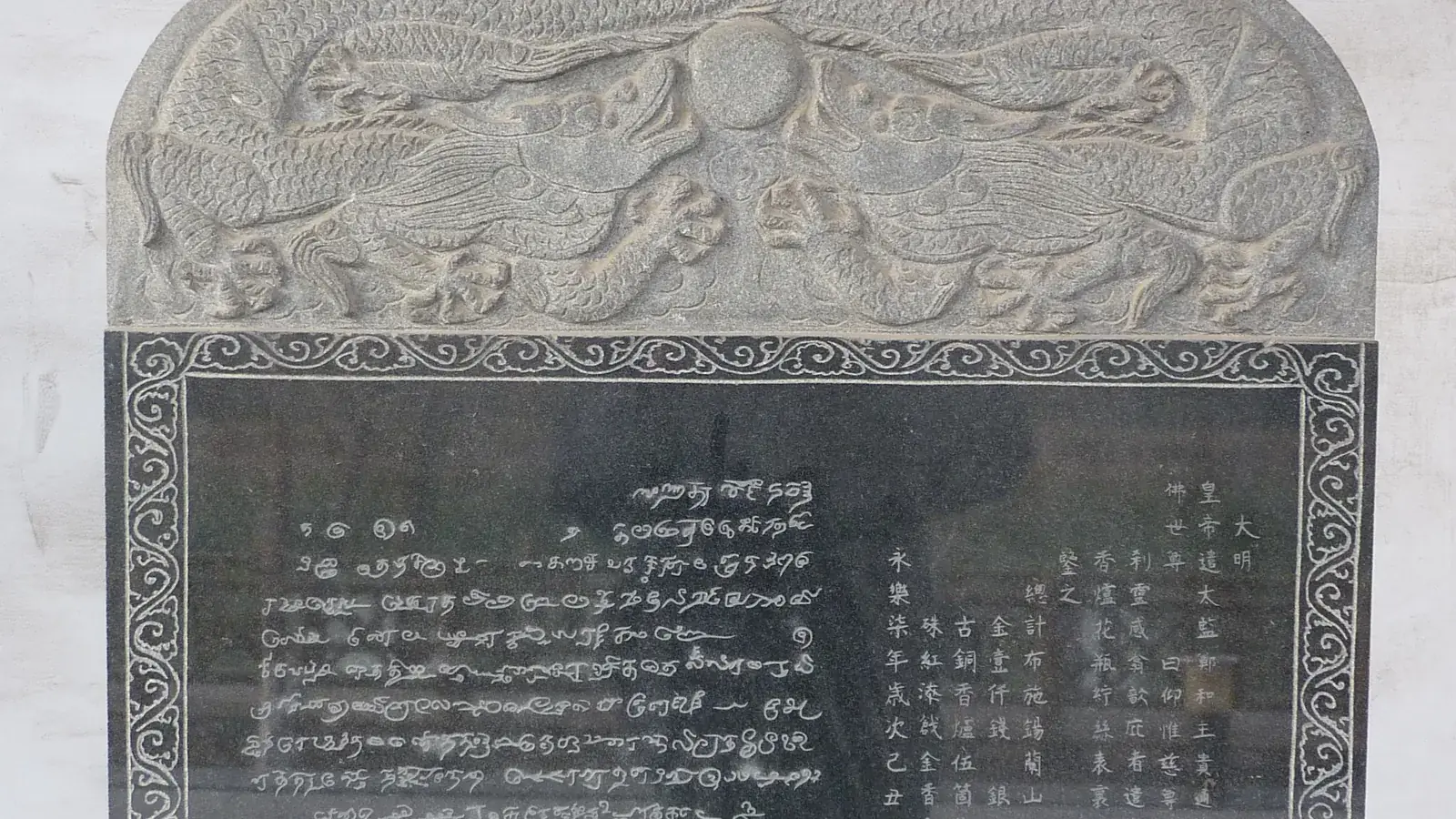
The oldest object is a stone tablet dated February 15, 1409, carved in Nanjing and carried to Ceylon on the third voyage. It records offerings in Chinese, Persian and Tamil to the Buddha, to Vishnu and to Allah. A British engineer found it in 1911 near Galle; it is in the Colombo National Museum, and UNESCO entered it in the Memory of the World International Register in 2025.
In 1431, waiting at Changle in Fujian for the wind, Zheng He and his officers set up a stele at the temple of the sea goddess Tianfei. Its text lists all seven voyages by year and port, counts “more than a hundred ocean-going vessels” on each, and says the officers wrote it “in order to make these known forever.”
The giraffe arrived in 1414. Envoys from Malindi had brought giraffes to Bengal, and the Bengal court sent one on to Yongle, where it was presented as a qilin, the auspicious beast of Chinese legend. Church found in a 2004 study that the emperor played the omen down. A painting of the giraffe with its keeper, attributed to the court painter Shen Du, hangs in the Philadelphia Museum of Art, which dates the painting to the 16th century.
Why the voyages stopped
Yongle died in 1424. Gronewald lists what he had spent besides the fleets: a new capital at Beijing, the Forbidden City, the Grand Canal, a war in Annam and Mongol campaigns. Famine and flood cut the tax base, and by 1449 reunited Mongol tribes were raiding the northern border. World History Encyclopedia adds that the tribute the fleets brought back never covered what they cost. Xuande allowed one more voyage, then none.
The third cause was the court itself. Gronewald describes a split between the eunuch faction that had run the voyages and Confucian officials who argued for frugality. A story told in Yan Congjian’s Shuyu zhouzi lu of 1574 has a vice minister of war, Liu Daxia, confiscating Zheng He’s records in 1477 when a new voyage was proposed, calling them “deceitful exaggerations of bizarre things.” Church wrote that this 1574 account is the only evidence for it. Zheng He himself died in 1433 by Columbia’s and World History Encyclopedia’s account, or 1435 by the Metropolitan Museum’s chronology.
How the voyages were remembered
What survives comes from men who sailed. Ma Huan, the fleet’s translator, sailed three times; his Yingyai shenglan, first printed in 1451, and Fei Xin’s Xingcha shenglan describe the ports and customs of more than 30 countries. Gavin Menzies’s 1421: The Year China Discovered America (2002) claimed the fleets reached the Americas; the historian Robert Finlay reviewed it and found its reasoning circular, its evidence spurious and its voyages impossible.
The fleets were an emperor’s instrument, and they lasted as long as an emperor wanted them. Once Yongle and his admiral were gone, the officials who counted the cost won at court, and the argument over their reasons is the one that remains.
Key facts
- Zheng He, born Ma He in Yunnan about 1371, was captured and castrated as a boy and served the prince who became the Yongle emperor in 1403.
- Seven voyages sailed between 1405 and 1433; the first is counted at 62 large ships, 255 smaller ones and 27,000 men.
- The fleets reached Calicut on the first voyage, Hormuz on the fourth and the East African ports of Mogadishu and Malindi on the fifth.
- The Ming History gives the treasure ships as 44 by 18 zhang (447 by 183 feet); Sally Church’s 2005 study argued for 200 to 250 feet and called the true size unknown.
- The Galle stele, dated February 15, 1409, honors the Buddha, Vishnu and Allah in three languages and entered UNESCO’s Memory of the World register in 2025.
- The Changle stele of 1431 lists all seven voyages and counts “more than a hundred ocean-going vessels.”
- A giraffe from Malindi reached Yongle by way of Bengal in 1414; the story of Liu Daxia burning the voyage records rests on a single account of 1574.
FAQ
How many ships did Zheng He have?
The standard count for the first fleet of 1405 is 62 large ships, 255 smaller ones and about 27,000 men. The Changle stele of 1431, written by the fleet's own officers, says "more than a hundred ocean-going vessels" on each voyage.
How big were Zheng He's treasure ships?
The Ming History gives 44 by 18 zhang, about 447 by 183 feet. Sally Church's 2005 study found no source for those figures older than a 1597 novel, and argued on engineering grounds for ships of 200 to 250 feet. No wreck of a treasure ship has been found.
Why did China stop the voyages after 1433?
The three reasons historians give are cost, the Mongol threat on the northern frontier and a court split between the eunuchs who ran the voyages and officials who wanted thrift. The Yongle emperor died in 1424, Zheng He in 1433 or 1435, and no fleet of that scale sailed again.
Sources
- Columbia University, Asia for Educators — Sue Gronewald, "The Ming Voyages" (teaching unit).
- Columbia University, Asia for Educators — "Key Points: 1000–1450 CE," quoting Circa 1492: Art in the Age of Exploration (National Gallery of Art, 1992).
- Sally K. Church — "Zheng He: An Investigation into the Plausibility of 450-ft Treasure Ships," Monumenta Serica 53 (2005), pp. 1–43, copy on the Internet Archive.
- UNESCO Memory of the World — "Trilingual Inscription (Tribhasha Sellipiya)," International Register entry.
- Oregon State University Open Textbook, Middle and Early Modern Ages — "Inscriptions of Zheng He, 1431," translation from Ming-Yang Su, Seven Epic Voyages of Zheng He in Ming China (2005).
- World History Encyclopedia — Mark Cartwright, "The Seven Voyages of Zheng He" (February 7, 2019).
- Science News — Sarah Zielinski, "The giraffes that sailed to medieval China" (October 1, 2013).
- Philadelphia Museum of Art — "Tribute Giraffe with Attendant," 16th century, collection record.
- The Metropolitan Museum of Art, Heilbrunn Timeline of Art History — "China, 1400–1600 A.D.," chronology.
- History Cooperative — Robert Finlay, "How Not to (Re)Write World History: Gavin Menzies and the Chinese Discovery of America."
Cite this article
- APA
- Our Earth's History. (2026, September 20). Why did Zheng He's treasure fleets sail seven times, then stop? Our Earth's History. https://ourearthshistory.com/east-asia/medieval/zheng-he-treasure-fleets-why-they-stopped/
- Chicago
- Our Earth's History. “Why did Zheng He's treasure fleets sail seven times, then stop?” Our Earth's History, September 20, 2026. https://ourearthshistory.com/east-asia/medieval/zheng-he-treasure-fleets-why-they-stopped/.
- MLA
- “Why did Zheng He's treasure fleets sail seven times, then stop?” Our Earth's History, 20 Sep. 2026, https://ourearthshistory.com/east-asia/medieval/zheng-he-treasure-fleets-why-they-stopped/.
Text licensed CC BY-NC-ND 4.0. Found an error? Tell us.