'Never seen a place like it': Abdur Razzaq at Vijayanagara, 1443

TL;DR — Abdur Razzaq of Herat reached Vijayanagara in April 1443 and wrote that no eye had seen its like; the city fell to sack after the battle of January 23, 1565.
“The city of Bidjanagar is such that the pupil of the eye has never seen a place like it, and the ear of intelligence has never been informed that there existed anything to equal it in the world.” So wrote Abdur Razzaq, envoy of the Timurid ruler Shahrukh of Herat, of a mission to India that the Encyclopaedia Iranica dates from January 1442 to December 1444. R. H. Major’s 1857 translation for the Hakluyt Society has him at the gates of the city at the end of April 1443 and lodged there on May 1. Bidjanagar was Vijayanagara, capital of a Hindu kingdom on the Tungabhadra river in the southern Deccan; the ruins at Hampi in Karnataka are what is left of it. Razzaq stayed six months and described the walls, the bazaars, the king’s elephants, a royal festival, and a plot against the king’s life that had failed just before he came.
Quick facts
- When
- Mission to India January 1442 to December 1444 · at the gates of Vijayanagara end of April 1443, lodged there May 1 · left the city November 5, 1443 · Paes at the city about 1520 · battle of Talikota Tuesday, January 23, 1565 · Federici's visit 1567 · Hampi inscribed 1986
- Where
- Vijayanagara on the Tungabhadra river in the Deccan, the ruins at Hampi in Karnataka; Calicut and Mangalore on the Malabar coast; Herat, the court of Shahrukh
- Who
- Abdur Razzaq, envoy of Shahrukh; the raja Deva Raya II, "Diou-rai" in his text; the Venetian Nicolò Conti; the Portuguese Domingo Paes; Robert Sewell, who edited the Portuguese chronicles in 1900
- Outcome
- Three visitors across a century described a walled city of unmatched size; after the defeat of January 23, 1565 it was sacked and abandoned, and its ruins at Hampi were inscribed as a World Heritage site in 1986
Seven walls, measured against Herat
Razzaq’s measure of the city was his own hometown. “It is built in such a manner that seven citadels and the same number of walls enclose each other,” he wrote. Around the outermost wall stood stones the height of a man, half sunk in the ground and set so close that no horse or foot soldier could approach. He then matched each ring to a stretch of Herat, bridge by bridge and gate by gate. The seventh, in the center, held the king’s palace and covered ten times the area of Herat’s marketplace. From the north gate to the south he reckoned two parasangs, and as much from east to west. Between the first wall and the third lay fields and gardens; from the third to the seventh, “a numberless crowd of people, many shops, and a bazaar.”
Roses, jewels and the house of the elephants
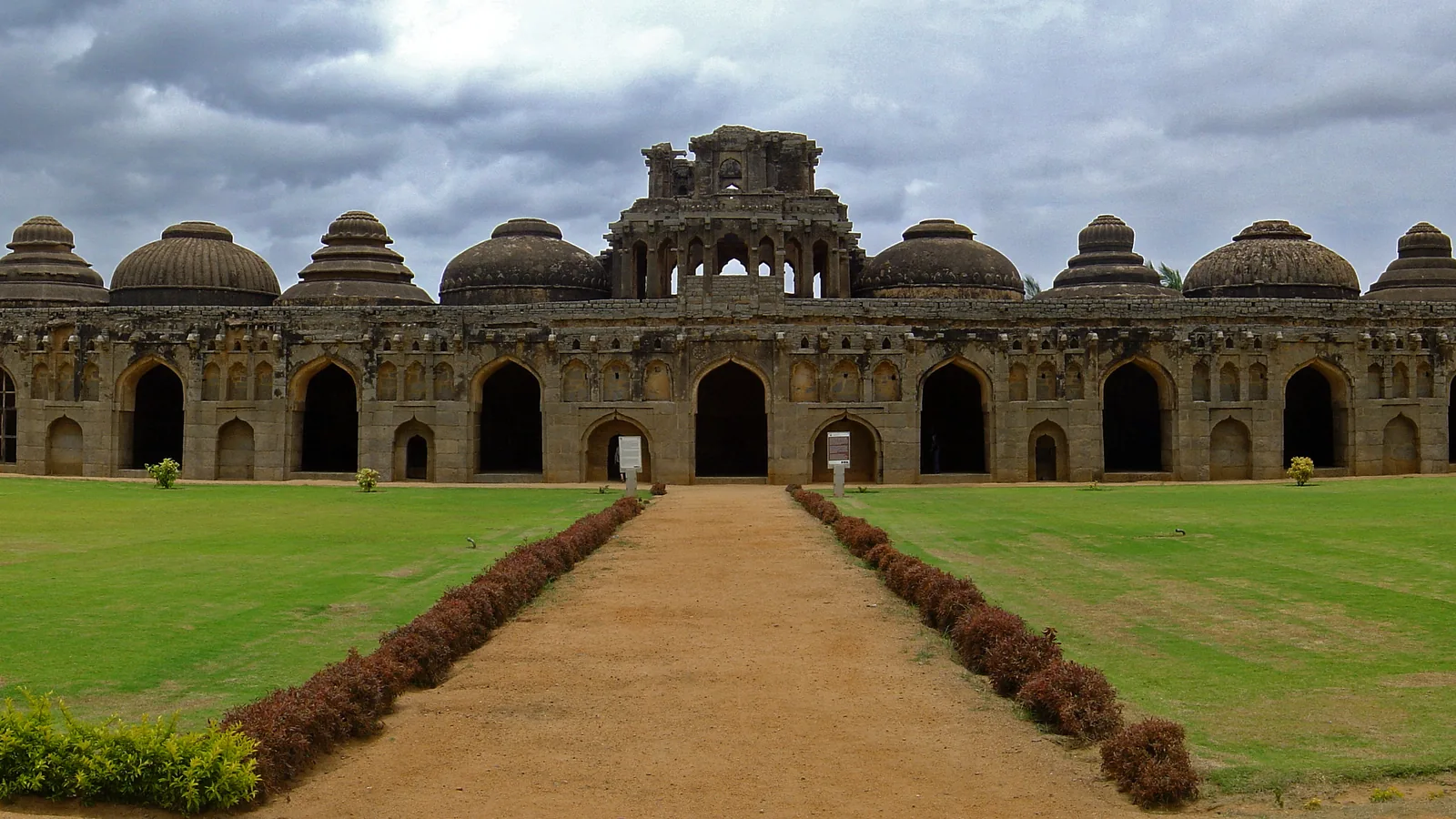
At the palace gate four bazaars faced one another, each under a lofty arcade, with the king’s audience hall rising above them all. Rose merchants set high stands before their shops; “these people could not live without roses,” Razzaq wrote, “and they look upon them as quite as necessary as food.” Jewelers sold pearls and rubies, emeralds and diamonds in the open bazaar. Opposite the council house stood the Fil-Khaneh, the house of the elephants, though the largest animals were kept within the first and second walls near the palace. A white elephant with grey spots was led before the king every morning as a good omen. A domed building called the Elephant Stables still stands at Hampi, and Robert Sewell in 1900 placed a bazaar named in one of Deva Raya’s inscriptions “close to the rear of the elephant stables still standing.”
A king in green satin, and the brother who tried to kill him
The king Razzaq met is “Diou-rai” in Major’s text, the raja Sewell identified as Deva Raya II. Summoned to court, Razzaq offered five horses and lengths of damask and satin. The king sat in a robe of green satin with a collar of pearls, olive-skinned, thin and rather tall, with down on his cheeks and no beard; when the envoy, in too many robes, began to sweat, the king sent him a fan.
The festival Razzaq called Mahanadi filled three days in the month of Rajab. Generals and Brahmins from across the realm brought a thousand elephants painted with cinnabar on trunk and ears, and a nine-story structure held the king’s throne on the ninth level; Razzaq had a place on the seventh. He watched a trained elephant climb a stair of beams to stand on one no wider than its foot and keep time to the music with its trunk.
The plot he had heard of at Calicut, between November 1442 and April 1443 by Sewell’s reckoning, he told plainly. The king’s brother invited the court to a new house and, under cover of drums, had the guests killed one by one as they were called in to eat, then stabbed the king with a dagger hidden under a dish of betel and announced from the palace steps that he was king. The wounded raja felled the man left to behead him and shouted, “I am alive. I am well and safe. Seize that wretch”; the crowd killed the brother. Fernão Nuniz, a Portuguese chronicler of the 1530s whom Sewell also printed, made the assailant a nephew; Sewell took Razzaq’s version as “without doubt the more reliable.” Deva Raya II died in 1444, or in 1446 by an inscription Sewell cites.
Conti before him, Paes after: "as large as Rome"
Nicolò Conti, a Venetian merchant who returned home in 1444 after 25 years in the East, had reached “the great city of Bizenegalia” about 300 miles inland from the Malabar coast. “The circumference of the city is sixty miles: its walls are carried up to the mountains and enclose the valleys at their foot,” he said, and he put its men fit to bear arms at 90,000; of its three great annual festivals, the third lasted nine days. In about 1520, in the reign of Krishna Deva Raya, the Portuguese Domingo Paes climbed a hill: “What I saw from thence seemed to me as large as Rome, and very beautiful to the sight.” Paes dated the feast Conti had counted in days: “These feasts begin on the 12th of September, and they last nine days, and take place at the king’s palace.” Three witnesses, writing in Persian, Latin and Portuguese across a century, agree on walls running into the hills, on crowds too large to count, and on a nine-day feast at the palace.

Tuesday, January 23, 1565
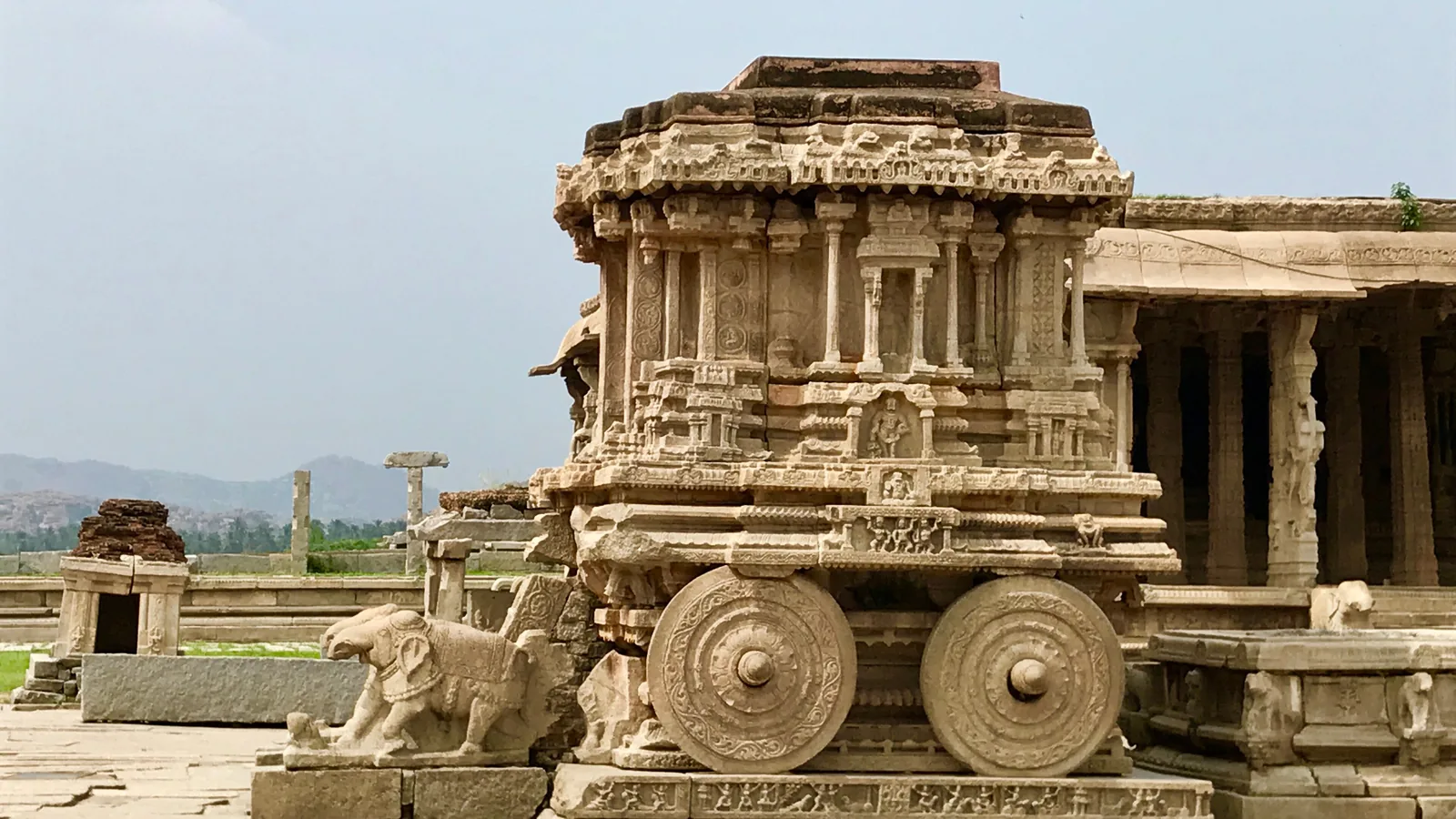
On “Tuesday, January 23, 1565,” as Sewell converts the date, the armies of the Deccan sultanates met the host of Rama Raya, the regent of Vijayanagara, south of the Krishna river; the battle carries the name of Talikota, though Sewell wrote in a footnote that the fighting was many miles south of that town. Rama Raya was killed. The royal family loaded the treasury and the jeweled throne onto 550 elephants and fled to Penukonda, and for five months, in Sewell’s account, the victors pulled down the temples and palaces of the capital. Cesare Federici, an Italian merchant, came two years later, and Sewell prints his report as the Elizabethan translators gave it: “The Citie of Bezeneger is not altogether destroyed, yet the houses stand still, but emptie, and there is dwelling in them nothing, as is reported, but Tygres and other wild beasts.” The Karnataka tourism department’s page on Hampi records that the monuments were inscribed as a World Heritage site in 1986.
Key facts
- The Encyclopaedia Iranica dates Abdur Razzaq’s mission to India from Ramadan 845 (January 1442) to Ramadan 848 (December 1444); he was sent by Shahrukh from Herat.
- Major’s translation has him at Vijayanagara at the end of April 1443, lodged there on May 1, and, by Major’s introduction, leaving the city on November 5, 1443.
- Razzaq counted seven citadels and seven walls, put the palace enclosure at ten times the area of Herat’s marketplace, and reckoned two parasangs from the north gate to the south.
- The king, “Diou-rai” in the Persian, is Deva Raya II; he died in 1444, or in 1446 by a Sravana Belgola inscription Sewell cites.
- The plot against the king, dated by Sewell between November 1442 and April 1443, was the work of the king’s brother in Razzaq’s telling and of a nephew in Nuniz’s.
- Nicolò Conti gave the city a circumference of “sixty miles” and 90,000 men fit to bear arms; he returned to Venice in 1444 after 25 years abroad.
- Domingo Paes, in about 1520, wrote that the city seemed to him “as large as Rome” and that the palace feasts began on September 12 and lasted nine days.
- The battle of Talikota was fought on Tuesday, January 23, 1565, in Sewell’s dating; Federici found the houses empty in 1567, and Hampi was inscribed as a World Heritage site in 1986.
FAQ
Who was Abdur Razzaq and why did he go to Vijayanagara?
He was a judge, a qadi, at the court of Shahrukh in Herat, sent on a mission to India in 1442. While he was at Calicut, the king of Vijayanagara sent to the ruler of Calicut asking that the envoy be forwarded to him, and Razzaq traveled by the port of Mangalore and then overland to the capital, arriving at the end of April 1443.
What did Abdur Razzaq say about Vijayanagara?
That "the pupil of the eye has never seen a place like it": seven walls enclosing one another, four bazaars at the palace gate with rose sellers and jewelers, a house of elephants, and a royal festival with a thousand elephants and a nine-story pavilion. He also recorded a failed attempt on the king's life by his brother.
When was Vijayanagara destroyed?
After the battle of Talikota on Tuesday, January 23, 1565, by Sewell's conversion of the Persian date. The royal family fled to Penukonda with 550 elephants, the city was sacked over five months, and Cesare Federici in 1567 found the houses standing but empty. The ruins at Hampi were inscribed as a World Heritage site in 1986.
Sources
- R. H. Major (ed.) — India in the Fifteenth Century (Hakluyt Society, 1857): Journey of Abd-er-Razzak, translated from the Persian, pp. 1–49 with Major's introduction; full text at the Internet Archive.
- R. H. Major (ed.) — India in the Fifteenth Century (Hakluyt Society, 1857): The Travels of Nicolò Conti, translated from Poggio Bracciolini's Latin; same volume, separate pagination, full text at the Internet Archive.
- Robert Sewell — A Forgotten Empire (Vijayanagar): A Contribution to the History of India (Swan Sonnenschein, 1900), chapter 6 on Deva Raya II and chapter 15 on the destruction of 1565; scanned edition at the Internet Archive.
- Robert Sewell — A Forgotten Empire (Vijayanagar), Project Gutenberg eBook 3310: the Chronicle of Domingo Paes (about 1520) and the Chronicle of Fernão Nuniz in Sewell's translation, with his footnote on the site of the battle.
- Encyclopaedia Iranica — Claus-Peter Haase, "ʿAbd-al-Razzāq Samarqandī," vol. I, fasc. 2, pp. 158–160 (1982; updated 2018).
- Government of Karnataka, Department of Tourism — "Hampi," tour page: World Heritage inscription 1986, the Elephant Stables.
- Ministry of Tourism, Government of India, Incredible India — "Hampi," Karnataka: the standing monuments, the Elephant Stables and Queen's Bath.
Cite this article
- APA
- Our Earth's History. (2026, September 22). 'Never seen a place like it': Abdur Razzaq at Vijayanagara, 1443. Our Earth's History. https://ourearthshistory.com/south-asia/medieval/vijayanagara-1443-abdur-razzaq-embassy-hampi/
- Chicago
- Our Earth's History. “'Never seen a place like it': Abdur Razzaq at Vijayanagara, 1443.” Our Earth's History, September 22, 2026. https://ourearthshistory.com/south-asia/medieval/vijayanagara-1443-abdur-razzaq-embassy-hampi/.
- MLA
- “'Never seen a place like it': Abdur Razzaq at Vijayanagara, 1443.” Our Earth's History, 22 Sep. 2026, https://ourearthshistory.com/south-asia/medieval/vijayanagara-1443-abdur-razzaq-embassy-hampi/.
Text licensed CC BY-NC-ND 4.0. Found an error? Tell us.