Tipu's Tiger: the growling organ taken at Seringapatam in 1799

TL;DR — Tipu Sultan’s wooden tiger, an organ worked by a crank, left Seringapatam after the storming of May 4, 1799 and has been on show in London since 1803.
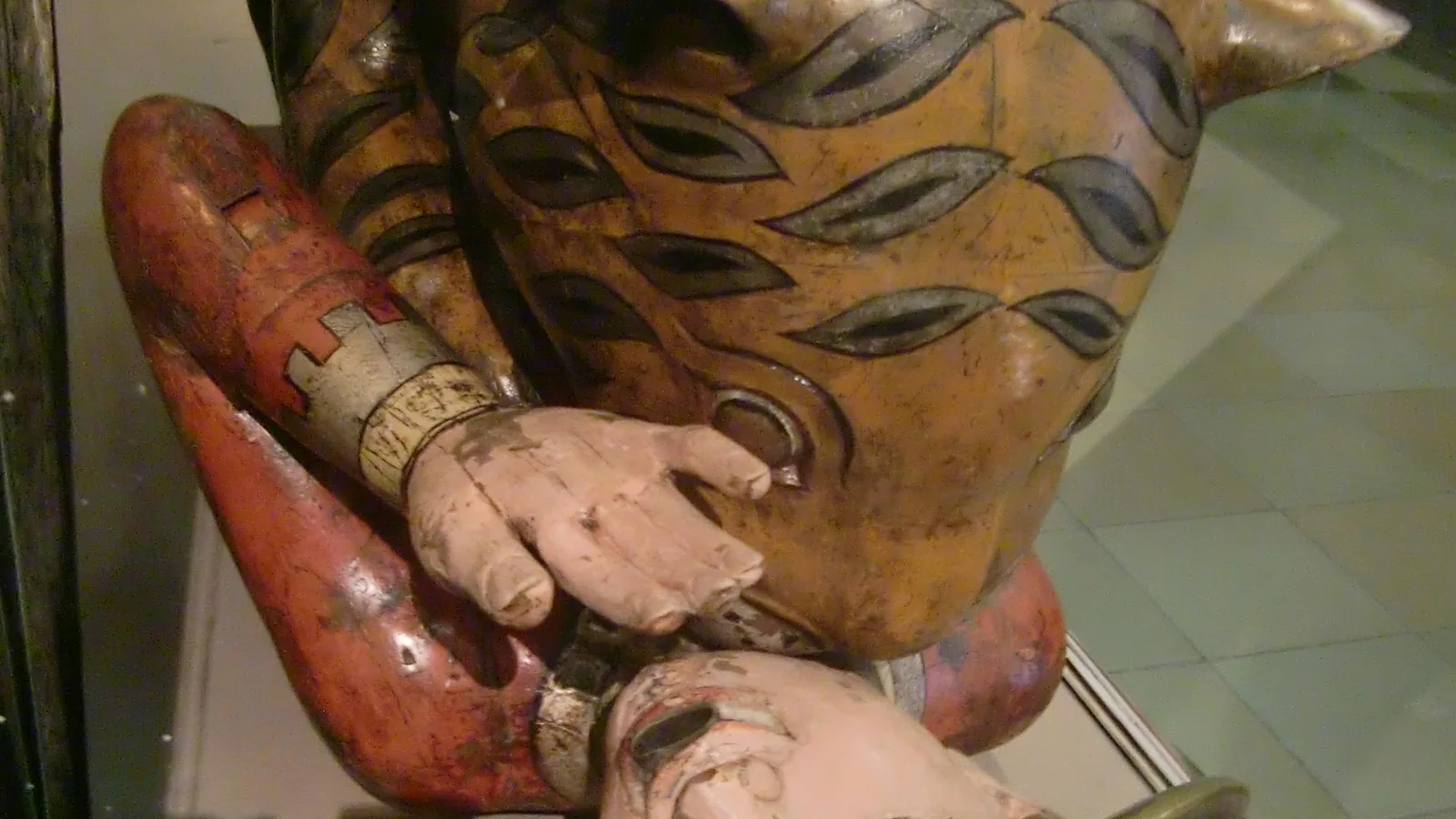
Tipu’s Tiger is a painted wooden tiger, almost life-size and 178 centimeters long, sinking its teeth into the neck of a European man who lies on his back. Turn the handle on its flank and, as the Victoria and Albert Museum in London describes it, the man’s left forearm moves between his mouth and the tiger’s ear while bellows inside make the animal growl and the man give “a plaintive whooping sound”; a flap opens on organ pipes and a keyboard with ivory buttons. It was made for Tipu Sultan, ruler of Mysore in South India from 1782 to 1799, and kept in the music room of his palace at Seringapatam, the island fortress on the Kaveri River that the East India Company’s army stormed on May 4, 1799. The tiger reached London in 1800 and has stood in the V&A since 1956.
Quick facts
- When
- 1792 (the tiger drawn by James Hunter) · May 4, 1799, about 1:30 p.m. (the assault) · dusk, May 4 (the body found) · June 18 to 19, 1799 (Tipu's sons sent to Vellore) · June 22, 1799 (partition treaty) · June 30, 1799 (the raja installed) · January 22, 1800 (part of the throne in England) · 1800 (the tiger reaches London) · 1803 (on public display) · 1879 (transferred to South Kensington) · 1956 (moved into the V&A)
- Where
- Seringapatam (Srirangapatna), the island fortress of Mysore on the Kaveri River in South India; the old town of Mysore; Vellore; East India House in Leadenhall Street, London; the Victoria and Albert Museum, South Kensington
- Who
- Tipu Sultan, ruler of Mysore 1782 to 1799; Major-General Baird, who led the assault and searched for the body; Colonel Arthur Wellesley, who restored order; Lieutenant-General George Harris, commander in chief; Alexander Beatson, a major at the siege who published the official account in 1800; Krishnaraja Wodeyar III, aged five; Conrad Heinrich Küchler, who designed the medal
- Outcome
- Tipu was killed at the water gate; his treasury was divided among the army by prize agents, his throne left India in pieces, Mysore was partitioned with the Nizam on June 22, 1799 and a five-year-old raja was installed on June 30; the wooden tiger went to the East India Company's museum in 1800 and to the V&A, where it stands
Six minutes on the breach
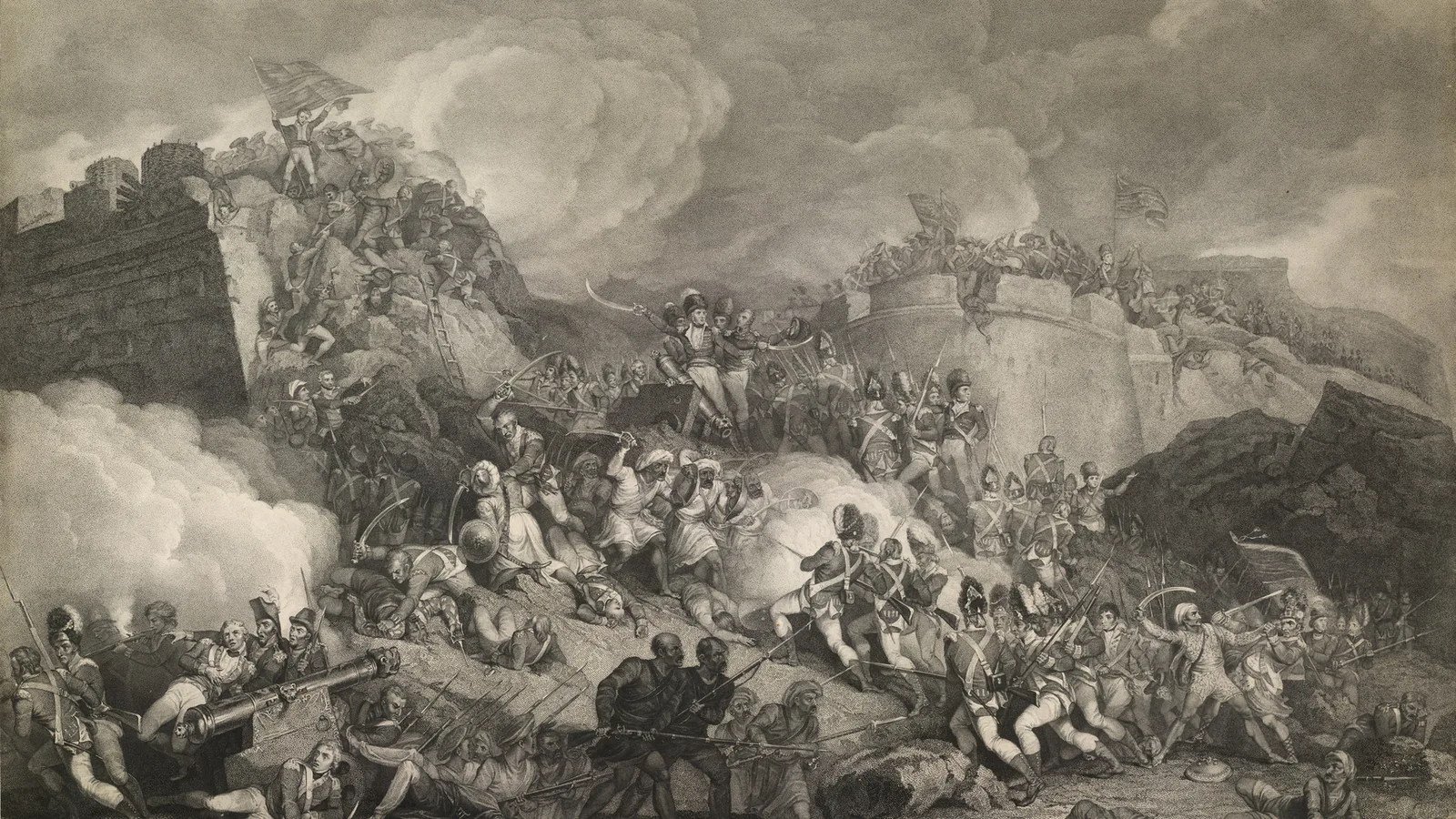
The Company had fought three wars against Mysore before 1799; the fourth ended in one afternoon. Alexander Beatson, a major at the siege who published A View of the Origin and Conduct of the War with Tippoo Sultaun in London in 1800, put the moment at about half past one. Major-General Baird stepped out of the trench, drew his sword and told his men, “come, my brave fellows, follow me, and prove yourselves worthy the name of British soldiers!” Two columns crossed the riverbed under fire, each headed by a forlorn hope of a sergeant and 12 men. “In six minutes the forlorn hope, closely followed by the rest of the troops, had reached the summit of the breach, where the British colours were instantly displayed,” Beatson wrote.
One of those sergeants has a name. A letter from Cannanore dated May 27, 1799, printed in the Asiatic Annual Register, said that Graham of the Bombay European regiment climbed the breach, pulled off his hat and cheered “Success to Lieut. Graham,” the commission he expected if he lived; he planted the colors on the rampart and was shot through the head.
The body under the water gate
Tipu was at dinner in a pavilion at a gate in the north wall, which Beatson calls a water gate, when the assault began. Beatson’s narrative, from the servant Rajah Cawn, has Tipu fire seven or eight shots from the rampart, then ride to a gate of the inner wall, where the crowd blocked him and fire into the gate wounded him. A grenadier reached for the gold buckle of Tipu’s sword-belt. Tipu snatched a sword, struck once, the blow landing on the musket, struck a second soldier with more effect, and was killed “by a musket ball which penetrated his right temple.” Beatson prints a second account, taken from the fort’s killadar and other servants, that agrees on the belt, the sword-cut and the shot through the temple but differs on the other wounds and their order.
“About dusk,” Beatson wrote, Baird came to the gate with lights to search for the sultan, “and after much labour it was found and brought from under a heap of others to the inside of the gate.” Not less than 300 men had died under the arch. The turban, jacket and sword were gone, but Tipu’s own people knew the face. Major Allan, who was there with Colonel Arthur Wellesley, recorded that the body was so warm the two doubted for a moment whether Tipu was dead.

Plunder, prize agents and a throne in pieces
The army swept into the city and looted the houses of its inhabitants, the V&A’s account says, until Colonel Wellesley restored order by hanging and flogging some of the men responsible. The treasury was divided on the spot between the soldiers according to rank; the museum’s record of the tiger adds that prize agents valued and shared it out over the following weeks.
Tipu’s throne went the same way. Beatson described an octagonal frame eight feet by five, sheeted in gold and covered in tiger stripes, with ten small gold tiger heads set with precious stones along its railing. It did not stay whole. A note kept with a gold tiger-head finial now on loan to the V&A quotes a letter of January 22, 1800, from T. Grenville to his brother the Marquis of Buckingham: Henry Wellesley “is come from India and has brought Lt. Grenville a lion’s head of gold & part of Tippoo’s throne.”
The victory got a medal, designed by Conrad Heinrich Küchler about 1801 and struck at the Soho Mint in Birmingham for every Company soldier at the siege. Its face shows the British lion forcing a tiger to the ground under the date IV. May MDCCXCIX, with an Arabic banner reading Assadullah al Ghaleb, “The conquering lion of God,” a phrase from the weapons of Tipu and other Muslim warriors, now turned against him.
Mysore divided and a five-year-old on the musnud
The Company and the Nizam of Hyderabad partitioned Mysore by a treaty executed at Seringapatam on June 22, 1799. What was left went to a child. Beatson recorded the boy’s name as Kistna Rajah Oodiaver, the Krishnaraja Wodeyar III of later histories, “said to be five years old.” On June 30, the day the Brahmins had fixed as auspicious, in the old town of Mysore, Lieutenant-General George Harris and the Nizam’s representative Meer Allum took the boy by the hands and led him to the musnud, the old rajas’ seat found in the palace at Seringapatam. Tipu’s four eldest sons had crossed the river with their families on June 18 and set out the next day for the fortress of Vellore.
From Leadenhall Street to South Kensington
The tiger was found in the music room. In 1800 Lord Wellesley, the governor-general and the colonel’s elder brother, sent it to the Company’s Court of Directors in London and suggested the Tower of London as its home. The directors kept it at East India House in Leadenhall Street, where it was on public display by at least 1803. Visitors turned the handle and played patriotic tunes on the keyboard, the museum’s gallery label says.
When the Company’s property passed to the Crown in 1858 the tiger was stored at Fife House in Whitehall. It moved to the India Office in 1868, to the Eastern Galleries in South Kensington in 1874, and in 1879 into the South Kensington Museum. During the Second World War workmen moving a plinth failed to notice the tiger on top of it and broke it. In 1956 it was carried across the road to the Victoria and Albert Museum, where the record says it has remained ever since.
Key facts
- Tipu’s Tiger (V&A 2545(IS)) is painted wood, 178 by 71 by 61 centimeters; a crank works bellows and an organ and moves the man’s left forearm.
- The assault on Seringapatam began about 1:30 p.m. on May 4, 1799; Beatson wrote that the forlorn hope reached the top of the breach in six minutes.
- Both servant accounts printed by Beatson have Tipu cut at a soldier who reached for his sword-belt and die of a shot through the temple; they differ on the other wounds.
- Baird found the body at dusk under a heap of the dead at the gate; Major Allan recorded that it was still warm.
- The V&A says Colonel Arthur Wellesley restored order after the looting by hanging and flogging; prize agents divided the treasury over the following weeks.
- A letter of January 22, 1800 records “part of Tippoo’s throne” already in England; the Seringapatam medal bears the date IV. May MDCCXCIX.
- Mysore was partitioned by treaty on June 22, 1799 and Krishnaraja Wodeyar III, aged five, was placed on the musnud on June 30; the tiger reached London in 1800 and the V&A in 1956.
FAQ
How does Tipu's Tiger work?
A handle on the tiger's side drives bellows and a small organ hidden in the body. Turning it makes the tiger growl, the man wail and his left forearm rise and fall; a flap opens on the pipes and an ivory-buttoned keyboard, according to the V&A's description.
How did Tipu Sultan die?
Beatson's account, from the servant Rajah Cawn, says a grenadier reached for the gold buckle of Tipu's sword-belt at a gate of the inner wall on May 4, 1799; Tipu cut at him with a sword and was shot through the right temple. A second account in the same book agrees on the belt and the shot but gives the other wounds differently.
Where is Tipu's Tiger now?
In the Victoria and Albert Museum, South Kensington, London. It went from East India House in Leadenhall Street to Fife House in 1858, the India Office in 1868, South Kensington in 1874 and the V&A building in 1956.
Sources
- Victoria and Albert Museum — 'Tipu's Tiger' (article, updated October 8, 2025): what the object is and does, the tiger motif, the looting and Wellesley's order, the medal.
- Victoria and Albert Museum, Explore the Collections — 'Tippoo's Tiger,' mechanical organ, museum number 2545(IS): physical description, dimensions, object history from 1800 to 1956, gallery labels.
- Victoria and Albert Museum, Explore the Collections — throne finial, gold tiger head, LOAN:SSEA.1-2021: physical description and the handwritten note quoting the letter of January 22, 1800.
- Victoria and Albert Museum, Explore the Collections — 'The Seringapatam Medal,' 1531-1877: designer, mint, inscriptions and their translations.
- Alexander Beatson, A View of the Origin and Conduct of the War with Tippoo Sultaun (London, 1800): the assault of May 4, 1799, Tipu's last hours and the throne, the partition and the raja's installation, and the appendix accounts of the servants and of Major Allan. Internet Archive OCR text.
- The Asiatic Annual Register for the Year 1799 (London, 1800), Chronicle: letter from Cannanore, May 27, 1799, on Sergeant Graham at the breach. Internet Archive OCR text.
Cite this article
- APA
- Our Earth's History. (2026, September 22). Tipu's Tiger: the growling organ taken at Seringapatam in 1799. Our Earth's History. https://ourearthshistory.com/south-asia/modern/tipus-tiger-seringapatam-1799/
- Chicago
- Our Earth's History. “Tipu's Tiger: the growling organ taken at Seringapatam in 1799.” Our Earth's History, September 22, 2026. https://ourearthshistory.com/south-asia/modern/tipus-tiger-seringapatam-1799/.
- MLA
- “Tipu's Tiger: the growling organ taken at Seringapatam in 1799.” Our Earth's History, 22 Sep. 2026, https://ourearthshistory.com/south-asia/modern/tipus-tiger-seringapatam-1799/.
Text licensed CC BY-NC-ND 4.0. Found an error? Tell us.