Fourteen carriages, 400 guests, 21 guns: Bombay to Thane, April 16, 1853

TL;DR — On April 16, 1853, 14 carriages carried about 400 guests from Bori Bunder to Thane under 21 guns; a 5 per cent guarantee signed in 1849 paid for the line.
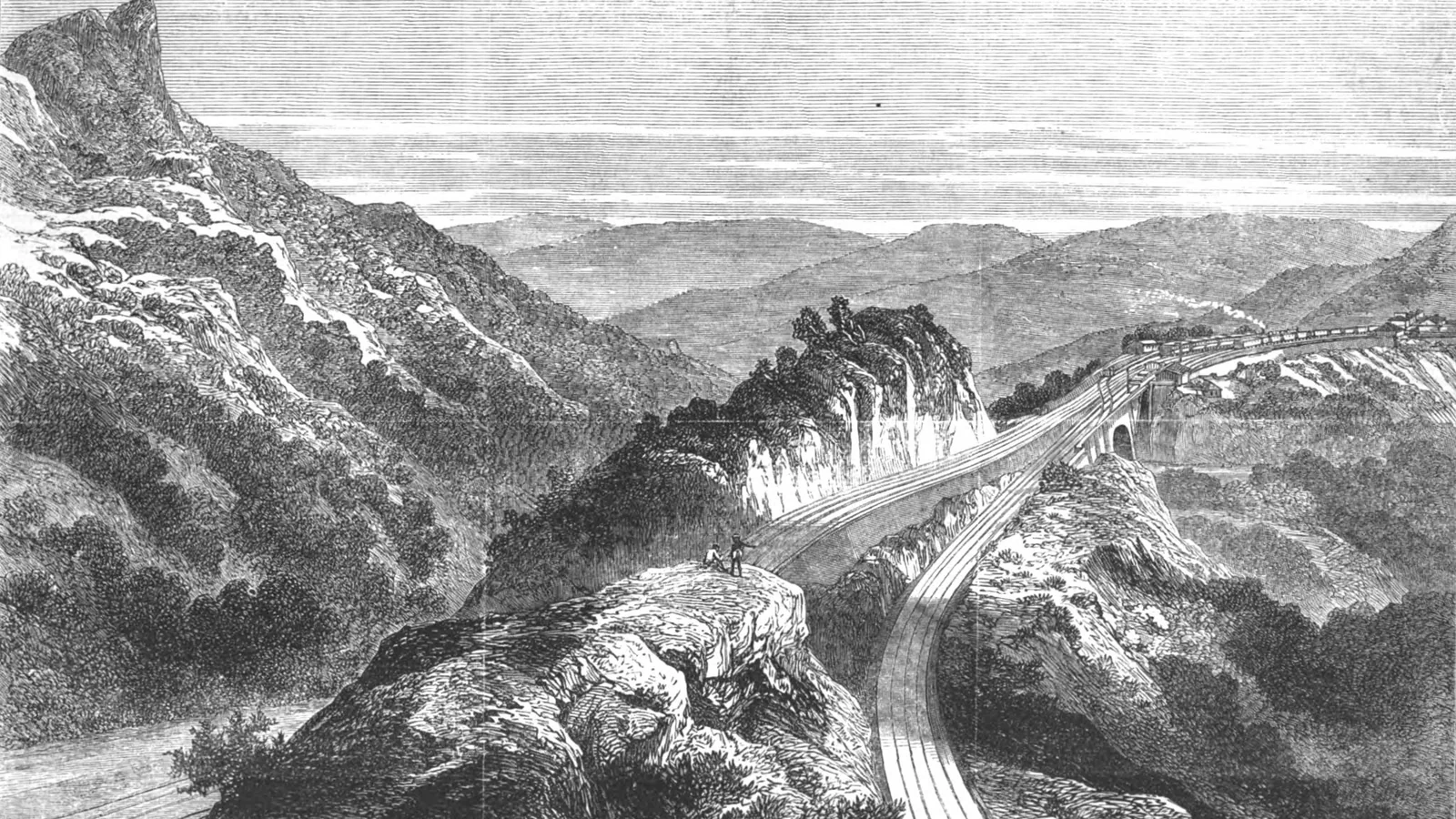
“The formal inauguration ceremony was performed on 16th April 1853, when 14 railway carriages carrying about 400 guests left Bori Bunder at 3.30 pm ‘amidst the loud applause of a vast multitude and to the salute of 21 guns.’” That sentence stood on the official website of the Government of India’s Railway Board, in a page the Wayback Machine archived in 2003, which called the 21 miles from Bombay to Thane “the first railway on Indian sub-continent.” The Gazetteer of the Bombay Presidency, printed in 1882, gives a second date and a second wording: “The line was opened for traffic to Thāna on the 18th April 1853.” Neither text explains the other. The company that ran the train, the Great Indian Peninsula Railway, held a contract signed on August 17, 1849, that guaranteed its shareholders 5 per cent with no time limit. That April the governor-general wrote a minute that turned one short line into a scheme of trunk lines. The pass above the line, the Bhor Ghat, took 15 more years and more than 30,000 men.
Quick facts
- When
- August 17, 1849 (Great Indian Peninsula Railway contract signed) · October 31, 1850 (first sod turned) · April 16, 1853 (inauguration train, Bori Bunder to Thane) · April 18, 1853 (line "opened for traffic," Bombay Gazetteer) · August 17, 1853 (Court of Directors replies to Dalhousie's minute) · May 1, 1854 (Thane to Kalyan) · August 15, 1854 (Howrah to Hooghly) · May 14, 1868 (Bhor Ghat incline opened)
- Where
- Bori Bunder in Bombay (now Mumbai) to Thane, 21 miles; Kalyan; the Bhor Ghat and Thal Ghat passes of the Western Ghats; East India House and the Board of Control in London; Howrah near Calcutta
- Who
- The Great Indian Peninsula Railway Company; George Clark, chief engineer of the Bombay government; John Chapman, "the founder of the Bombay system"; James Wilson, secretary to the Board of Control; the Marquis of Dalhousie, governor-general; James J. Berkley, the company's chief engineer; the contractors S. Tredwell and Jackson
- Outcome
- The 21-mile line was the first railway on the Indian subcontinent to carry passengers. Its 1849 contract gave the company "an absolute 5 per cent guarantee, without limit of period," and Dalhousie's minute of April 1853 turned one line into a scheme of trunk lines. The company itself lasted until 1951
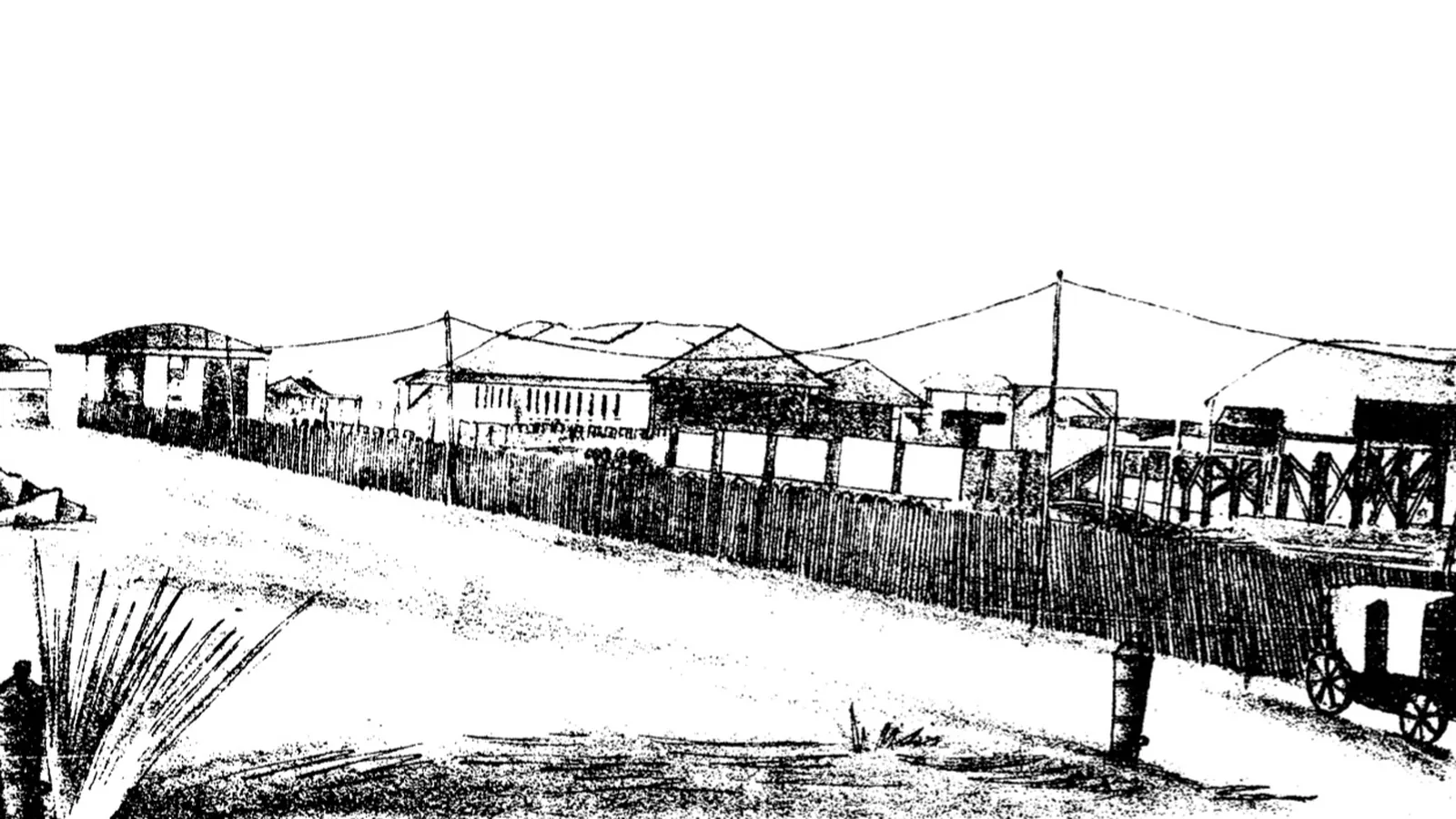
Bori Bunder, 3.30 pm
The Railway Board’s page traces the route to a visit by George Clark, chief engineer of the Bombay government, to Bhandup in 1843, when “the idea of a railway to connect Bombay with Thane, Kalyan and with the Thal and Bhore Ghats inclines first occurred” to him. Hyde Clarke, in a book published in London in 1857, named a different man: railways for India, he wrote, “were proposed by Sir Macdonald Stephenson, the founder of the Bengal system, by the late John Chapman, the founder of the Bombay system, and the late J. M. Heath, the founder of the Madras system.” The Railway Board credits the idea to Clark; Clarke’s book credits the system to Chapman. No source cited below names the locomotives that pulled the 14 carriages, and the Bombay Times report of the day is not among them.
"An absolute 5 per cent guarantee, without limit of period"
The money came from a contract that Horace Bell, writing a history of Indian railway policy in 1894, traced letter by letter. The East India Company’s Court of Directors had recommended 4 per cent for a Bengal line; the Board of Control, on December 19, 1846, objected to any guarantee, or allowed one for 15 years at most. In June 1847, after the chambers of commerce of Manchester and Glasgow pressed for better terms, the Court and the Board of Control “reluctantly consented” to raise the rate on the East Indian Railway “from 4 to 5 per cent and for a period of twenty-five years.” The Bombay promoters had Robert Stephenson review the terms offered to them, and he advised that they were inadmissible. The dispute ended when James Wilson, secretary to the Board of Control, sent a despatch to the Court on March 19, 1849, “which ultimately resulted in a grant of an absolute 5 per cent guarantee, without limit of period, and legal agreements were shortly drawn up and finally signed on the 17th August 1849.” In 1852 the Madras government asked to try direct construction by the state; the Board of Control refused, Bell wrote, calling the system of contract “the more eligible and conducive” to attracting British capital.
October 31, 1850: the first sod
“The first sod of the Peninsula railway was turned on the 31st October 1850, but the work was not begun till February 1851,” the Gazetteer records. On May 1, 1854, the line was open from Thane to Kalyan, where it split toward the two passes. Before that, on July 25, 1853, Charles Newdegate, the member for North Warwickshire, told the House of Commons during the debate on the Government of India Bill that “the railway projects which the Indian Government had already sanctioned were three, namely, the East Indian Railway Company, the Indian Peninsular Railway Company, and the Madras Railway Company. The aggregate paid-up stock of these companies was 1,690,020 l.” His figure is the size of Indian railway capital in the summer the first train ran.
Dalhousie's minute and the Court's reply
Bell mentions two railway minutes by the Marquis of Dalhousie, the governor-general. One, “dating from Chini in the Himalayas” in July 1850, dealt with the Bengal experimental line and its gauge. The other he describes as “another minute by the same hand, written in 1853,” which “sketched the direction to be taken by the trunk lines”; his footnote to the paragraphs he quotes reads “Lord Dalhousie’s Minute of 20th April 1853.” James J. Berkley, the Bombay company’s chief engineer, called it in 1861 “his celebrated Minute of April 1853.” The quoted paragraph asked that railways be treated “as national works, over which the Government may justly exercise, and is called upon to exercise, a stringent and salutary control.” On August 17, 1853, “the Court of Directors replied to this minute, and a large scheme of railways was forthwith approved, and surveys ordered.”
On August 15, 1854, the Railway Board’s page states, “the first passenger train steamed out of Howrah station destined for Hooghly, a distance of 24 miles,” the first section of the East Indian Railway. Madras followed with 63 miles on July 1, 1856. “By 1880 the Indian Railway system had a route mileage of about 9000 miles.” In between, Bell wrote, “the outbreak of the Mutiny in 1857 threw everything into confusion,” and the guaranteed company remained “until 1869 the recognised system for railway construction throughout India.” The Great Indian Peninsula Railway itself, by the Science Museum Group’s collection record, lasted from 1845 to 1951 as a predecessor of the Central Railway.
Thirty thousand men on the Bhor Ghat
Berkley’s paper on the Thal Ghat, read to the Bombay Mechanics’ Institution and printed in 1861, gives the scale of the passes in Clark’s plan of 1843. The company, he said, employed more than 30,000 men on the Bhor Ghat incline, “extending over only 14 miles of Railway,” among them “10,822 drillers.” The gradient on both inclines was 1 in 37; the Bhor incline climbed 1,831 feet against 972 on the Thal. There had been “frequent visitations of Cholera at the Bhore Ghaut,” two “of an alarming character” in the season before he spoke. The two resident contractors of the inclines, S. Tredwell and Jackson, had died, “a sacrifice to their arduous labours and exposure to the climate.”
The Gazetteer’s dates close the account. Because the works on the Bhor pass “would take some years to complete,” a temporary line of seven and a half miles from Palasdhari to Khopoli at the foot of the hills was sanctioned in October 1854 and opened on May 12, 1856. The incline itself, from Palasdhari to Khandala, opened on May 14, 1868.

Key facts
- On April 16, 1853, 14 carriages with about 400 guests left Bori Bunder at 3.30 pm “to the salute of 21 guns,” by the Government of India Railway Board’s page archived in 2003.
- The Gazetteer of the Bombay Presidency (1882) gives April 18, 1853, as the date the line “was opened for traffic to Thāna.”
- The route was 21 miles, Bombay to Thane; George Clark had the idea at Bhandup in 1843, and Hyde Clarke in 1857 called John Chapman “the founder of the Bombay system.”
- The Great Indian Peninsula Railway’s contract, “an absolute 5 per cent guarantee, without limit of period,” was signed on August 17, 1849, after James Wilson’s despatch of March 19, 1849 (Bell, 1894).
- The East Indian Railway had received 5 per cent for 25 years in June 1847; the Madras government’s 1852 request to build by the state was refused.
- The first sod was turned on October 31, 1850, work began in February 1851, and Thane to Kalyan opened on May 1, 1854 (Gazetteer).
- Bell’s footnote dates Dalhousie’s minute April 20, 1853; the Court of Directors replied on August 17, 1853; Howrah to Hooghly, 24 miles, opened on August 15, 1854.
- Berkley counted more than 30,000 men on the Bhor Ghat incline in 1861, including 10,822 drillers; the incline opened on May 14, 1868.
FAQ
When did the first passenger train run in India?
The inauguration train left Bori Bunder in Bombay for Thane at 3.30 pm on April 16, 1853, by the Government of India Railway Board's account. The Gazetteer of the Bombay Presidency (1882) states that the line was opened for traffic on April 18, 1853.
What was the 5 per cent guarantee of 1849?
A contract signed on August 17, 1849, between the East India Company and the Great Indian Peninsula Railway that guaranteed shareholders 5 per cent interest with no time limit. The East Indian Railway's guarantee of June 1847 ran for 25 years; the guaranteed-company system lasted until 1869.
When was the Bhor Ghat incline finished?
The line from Palasdhari to Khandala over the Bhor pass opened on May 14, 1868. A temporary line to Khopoli at the foot of the hills had opened on May 12, 1856, and Kalyan had been reached on May 1, 1854.
Sources
- Government of India, Railway Board, official Indian Railways website, page "Indian Railways.... the golden Era, 16th April, 1853, The Beginning," as archived by the Wayback Machine on December 26, 2003.
- Government of India, Railway Board, the same page as archived by the Wayback Machine on December 7, 2006 (identical text).
- Gazetteer of the Bombay Presidency, vol. XIII, part I, Thána (Bombay: Government Central Press, 1882), railway section compiled from Davidson's Railways of India (1868), Berkley's papers and information supplied in 1882 by the agent of the G. I. P. Railway; full text on the Internet Archive.
- James J. Berkley, Paper on the Thul Ghaut Railway Incline of the Great Indian Peninsula Railway, read before the Bombay Mechanics' Institution (printed 1861); full text on the Internet Archive.
- Horace Bell, Railway Policy in India (London: Rivington, Percival and Co., 1894), chapter I, "Historical Sketch"; Digital Library of India scan, full text on the Internet Archive.
- Hyde Clarke, Colonization, Defence, and Railways in our Indian Empire (London: John Weale, 1857); full text on the Internet Archive.
- UK Parliament, Historic Hansard, House of Commons, July 25, 1853, "Government of India Bill," vol. 129, cc. 761–792 (Mr. Newdegate's speech).
- Science Museum Group Collection (London), search results for "Great Indian Peninsula Railway," object metadata giving the company's dates as 1845 to 1951 and describing it as a predecessor of the Central Railway.
Cite this article
- APA
- Our Earth's History. (2026, September 22). Fourteen carriages, 400 guests, 21 guns: Bombay to Thane, April 16, 1853. Our Earth's History. https://ourearthshistory.com/south-asia/modern/bombay-thane-railway-april-16-1853-fourteen-carriages-guarantee/
- Chicago
- Our Earth's History. “Fourteen carriages, 400 guests, 21 guns: Bombay to Thane, April 16, 1853.” Our Earth's History, September 22, 2026. https://ourearthshistory.com/south-asia/modern/bombay-thane-railway-april-16-1853-fourteen-carriages-guarantee/.
- MLA
- “Fourteen carriages, 400 guests, 21 guns: Bombay to Thane, April 16, 1853.” Our Earth's History, 22 Sep. 2026, https://ourearthshistory.com/south-asia/modern/bombay-thane-railway-april-16-1853-fourteen-carriages-guarantee/.
Text licensed CC BY-NC-ND 4.0. Found an error? Tell us.