Why was India split in 1947, and why was the line drawn in six weeks?
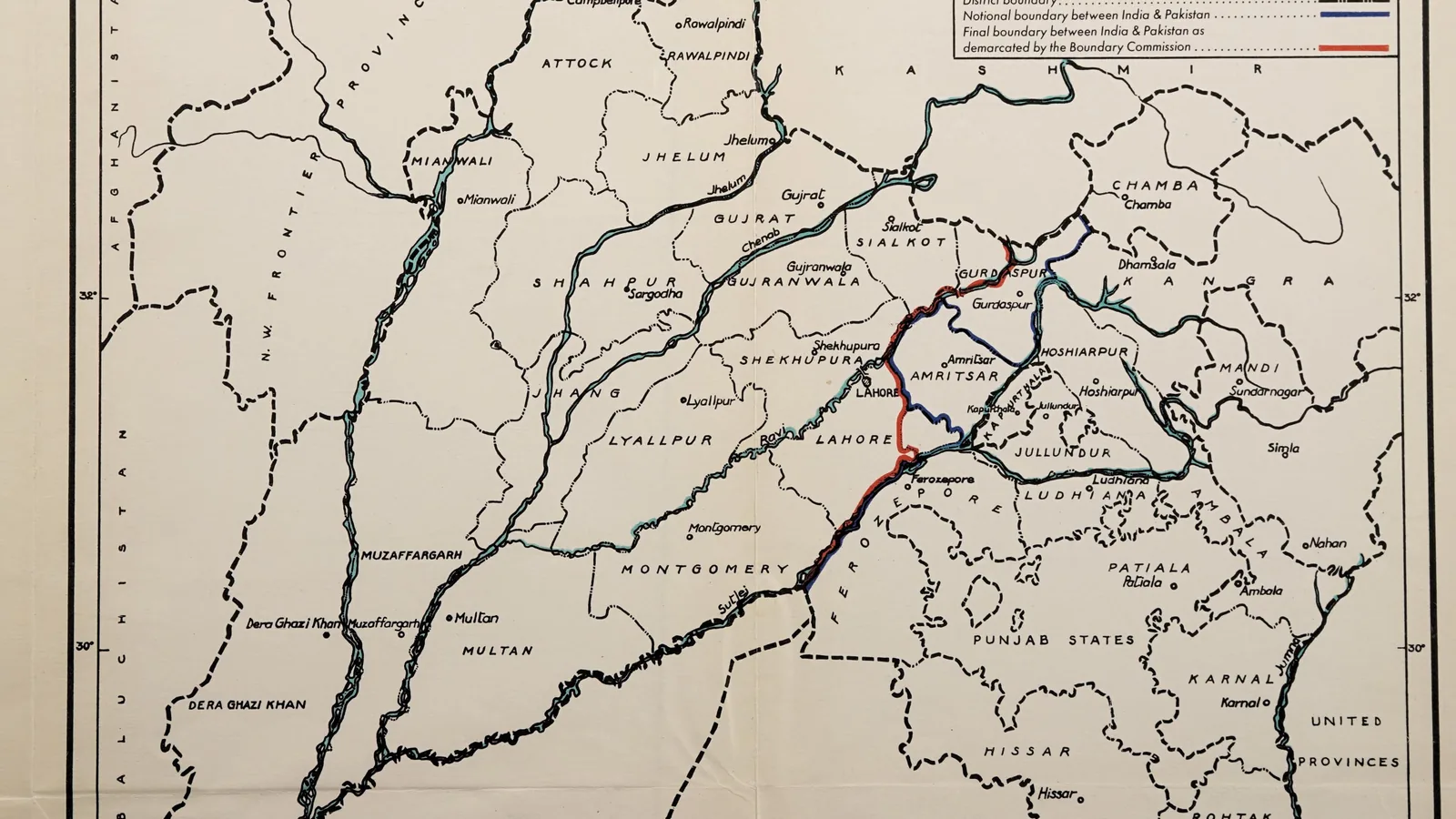

TL;DR — No agreement on one union, so Britain set a date, June 1948, then August 15, 1947, and boundary commissions formed on June 30 signed the line on August 12.
British India was divided in 1947 because the Muslim League and the Congress could not agree on one union, and Britain then moved its deadline forward to August 15. On February 20, 1947, the government in London announced a transfer of power “by a date not later than June, 1948.” On June 3 Clement Attlee told the Commons that power would pass that year to “one or two successor authorities.” Boundary commissions constituted on June 30, under a chairman named on July 10, signed their awards on August 12 and 13; the line was announced on August 17, two days after independence.
Quick facts
- When
- February 20, 1947 (deadline of June 1948 announced) · June 3, 1947 (plan for one or two Dominions) · June 30, 1947 (boundary commissions constituted) · July 10, 1947 (Attlee tells the Commons Radcliffe will chair both) · July 18, 1947 (royal assent) · July 16 to 31, 1947 (public sittings at Calcutta and Lahore) · August 11, 1947 (Jinnah's speech) · August 12 and 13, 1947 (awards signed) · August 14 and 15, 1947 (independence) · August 17, 1947 (boundaries announced)
- Where
- The House of Lords and House of Commons in London; New Delhi, where the viceroy announced the plan and Radcliffe signed the awards; Calcutta and Lahore, where the commissions sat; Simla, where the Punjab commission deliberated; the districts between the Ravi, Beas and Sutlej rivers, and the cities of Lahore and Amritsar
- Who
- Clement Attlee, prime minister; Lord Pethick-Lawrence, secretary of state for India; Viscount Mountbatten of Burma, viceroy from March 1947; Muhammad Ali Jinnah of the Muslim League; Jawaharlal Nehru of the Congress; Sir Cyril Radcliffe, chairman of both commissions; Justices Din Muhammad, Muhammad Munir, Mehr Chand Mahajan and Teja Singh of the Punjab commission
- Outcome
- Two Dominions, India and Pakistan, from August 15, 1947; Bengal and the Punjab divided; the awards signed on August 12 and 13 and announced on August 17; migration and deaths that the UK National Archives states in two different sets of figures
The deadline: February 20, 1947
Lord Pethick-Lawrence, the secretary of state for India, read the statement to the House of Lords on February 20, 1947. It recorded “differences among Indian Parties” that were “preventing the Constituent Assembly from functioning.” Paragraph seven held the sentence that mattered: “His Majesty’s Government wish to make it clear that it is their definite intention to take the necessary steps to effect the transference of power into responsible Indian hands by a date not later than June, 1948.” It also named Viscount Mountbatten of Burma to replace Lord Wavell as viceroy in March.
Viscount Cranborne answered that the statement “provides no safeguards for minorities.” Pethick-Lawrence declined to take questions that day. The date had been fixed before the shape of the settlement was known.
Why two states, 1946 to 1947
Muslims were about a quarter of British India’s population, concentrated in a few regions, and the UK National Archives’ classroom summary records that some Muslim leaders called for those regions to have greater independence. Its introduction by the historians Arun Kumar and Heena quotes Muhammad Ali Jinnah in 1945: “a united India means slavery for Mussulmans.” The Congress under M. K. Gandhi and Jawaharlal Nehru demanded a free, united India. When the Cabinet Mission failed, the same page records, the League called an agitation for its Pakistan demand, and killings of Hindus by Muslims in Calcutta in 1946 were answered by violence by Hindus there and elsewhere.
Attlee gave the parliamentary version on June 3, 1947. The Muslim League, “including in it a majority of the representatives of Bengal, the Punjab and Sind,” had “decided not to participate in the Constituent Assembly.” Winston Churchill drew the conclusion from the opposition bench: “the agreement of the various parties in India has only been achieved on the basis of partition.”
June 3: the plan and the vote
The plan asked the legislative assemblies of Bengal and the Punjab, minus their European members, to meet “in two parts, one representing the Muslim majority districts and the other the rest of the Province.” Either half could force it: “If a simple majority of either part decides in favour of partition, division will take place.” “As soon as a decision involving partition has been taken for either Province, a Boundary Commission will be set up by the Governor-General,” Attlee read. “It will be instructed to demarcate the boundaries of the two parts of the Punjab on the basis of ascertaining the contiguous majority areas of Muslims and non-Muslims. It will also be instructed to take into account other factors. Similar instructions will be given to the Bengal Boundary Commission.” Then came the new date: legislation “for the transfer of power this year on a Dominion status basis to one or two successor authorities.”
The Act of July 18 and the commissions, June 30 to August 13
On July 10 Attlee reported that “a decision has already been come to that Bengal and the Punjab should be divided.” He conceded that “the time given is not commensurate with its great importance” but said the government was “constrained by the urgency of the matter.” Sir Cyril Radcliffe, a King’s Counsel, had accepted the request of all parties to chair both commissions. Royal assent came on July 18, 1947. Section 1 provided that “as from the fifteenth day of August, nineteen hundred and forty-seven, two independent Dominions shall be set up in India, to be known respectively as India and Pakistan,” and called August 15 “the appointed day.” Parliament had changed India’s government by statute once before, in 1858, from a company to the Crown.
The commissions’ reports, printed by the Government of India in 1958, give the calendar. Both were “constituted by the announcement of the Governor-General, dated the 30th of June, 1947.” The Punjab commission’s members were Justices Din Muhammad, Muhammad Munir, Mehr Chand Mahajan and Teja Singh; Radcliffe “was subsequently appointed Chairman.” Its report added: “We were desired to arrive at a decision as soon as possible before the 15th of August.” Public sittings ran at Calcutta from July 16 to 24 and at Lahore from July 21 to 31; Radcliffe attended neither in person and read the daily record instead.
The judges could not agree. In the Punjab, Radcliffe wrote, “the divergence of opinion between my colleagues was so wide that an agreed solution of the boundary problem was not to be obtained,” and they “assented to the conclusion that I must proceed to give my own decision.” The report named the sticking point: “There was also the stubborn geographical fact of the respective situations of Lahore and Amritsar, and the claims to each or both of those cities which each side vigorously maintained.” He signed the Bengal and Punjab awards at New Delhi on August 12 and the award for the Sylhet district of Assam on August 13.
August 14 to 17: independence before the line
On August 11 the Constituent Assembly of Pakistan elected Jinnah its president. “A division had to take place,” he told it; “in my judgment there was no other solution.” Then he addressed the minorities on both sides of a line not yet published: “You are free; you are free to go to your temples, you are free to go to your mosques or to any other places of worship in this State of Pakistan.” In New Delhi on the night of August 14, Nehru moved the pledge in India’s Constituent Assembly: “At the stroke of the midnight hour, when the world sleeps, India will awake to life and freedom.” The National Archives’ summary records that independence was declared on August 14 and 15 and the borders were announced on August 17.
What the count leaves open
The same institution gives two sets of numbers. Its partition page says that “in the months around August 1947 over 15 million people are thought to have migrated across the new borders,” and that officials “were given just 9 weeks” to divide British India. Its independence page, by Kumar and Heena, says Radcliffe was asked to draw the lines “within six weeks,” and that “about one million people died, more than seventy-five thousand women were raped, and 10 million people were displaced.” No page read for this article reconciles the two.
The date came first, in February; the decision to divide came in June; the commissions had from June 30 to August 15. The people who lived on the line learned where it ran two days after the flags changed.
Key facts
- On February 20, 1947, the British government announced a transfer of power “by a date not later than June, 1948” and named Mountbatten viceroy.
- On June 3, 1947, Attlee announced that Bengal and the Punjab would vote on partition and that power would pass “this year” to “one or two successor authorities.”
- Both boundary commissions were constituted on June 30, 1947; Attlee told the Commons on July 10 that Radcliffe would chair both.
- The Indian Independence Act received royal assent on July 18, 1947; section 1 set up India and Pakistan from August 15, “the appointed day.”
- Public sittings ran at Calcutta from July 16 to 24 and at Lahore from July 21 to 31, 1947; Radcliffe attended neither.
- Radcliffe signed the Bengal and Punjab awards on August 12 and the Sylhet award on August 13, 1947; the boundaries were announced on August 17.
- The UK National Archives gives “over 15 million” migrants on one page and “10 million people were displaced” with “about one million” dead on another.
FAQ
Who drew the Radcliffe Line?
Two commissions of four Indian judges each, with Radcliffe as chairman of both; Attlee told the Commons on July 10 that Hindus, Muslims and, in the Punjab, Sikhs would be members. The Punjab report names Justices Din Muhammad, Muhammad Munir, Mehr Chand Mahajan and Teja Singh. When the judges could not agree, the reports record, the award became the chairman's own decision under sections 3 and 4 of the Act.
Why was the deadline moved from June 1948 to August 1947?
Attlee told the Commons on June 3 that the major parties had "repeatedly emphasised their desire" for the earliest possible transfer, and on July 10 that a central government "containing the leaders of two parties that wished to separate" could not continue for long. The Act fixed August 15.
How many people died or moved in 1947?
The sources read for this article give no single figure. The UK National Archives' partition page says over 15 million are thought to have migrated; its independence page says about one million died and 10 million were displaced. Both are that institution's statements, not a census count.
Sources
- UK Parliament, Historic Hansard — House of Lords, "Indian Policy," February 20, 1947, vol. 145, cc. 835–841 (Lord Pethick-Lawrence reads the government statement).
- UK Parliament, Historic Hansard — House of Commons, "India (Transfer of Power)," June 3, 1947, vol. 438, cc. 35–46 (Attlee's statement and Churchill's reply).
- UK Parliament, Historic Hansard — House of Commons, "Indian Independence Bill," second reading, July 10, 1947, vol. 439, cc. 2441–2550 (Attlee on Clause 1 and the commissions).
- legislation.gov.uk (The National Archives) — Indian Independence Act 1947, 10 & 11 Geo. 6 c. 30, introduction, as enacted, July 18, 1947.
- legislation.gov.uk (The National Archives) — Indian Independence Act 1947, section 1, "The new Dominions," as enacted.
- Government of India, Reports of the Bengal Boundary Commission and Punjab Boundary Commission (Radcliffe Awards) (New Delhi, 1958); OCR text of the Internet Archive scan.
- National Assembly of Pakistan — "Address of the Founder of Pakistan Quaid-e-Azam Muhammad Ali Jinnah on 11th August, 1947 to 1st Constituent Assembly."
- Jawaharlal Nehru, Independence and After: a collection of the more important speeches from September 1946 to May 1949 (Delhi: Publications Division, 1949), "A Tryst with Destiny," August 14, 1947; Internet Archive scan.
- The National Archives (UK), classroom resource "Partition of British India," Background.
- The National Archives (UK), classroom resource "Indian Independence," introduction by Dr Arun Kumar (University of Nottingham) and Dr Heena (University of Edinburgh).
Cite this article
- APA
- Our Earth's History. (2026, September 21). Why was India split in 1947, and why was the line drawn in six weeks? Our Earth's History. https://ourearthshistory.com/south-asia/contemporary/partition-of-india-1947-why-six-weeks/
- Chicago
- Our Earth's History. “Why was India split in 1947, and why was the line drawn in six weeks?” Our Earth's History, September 21, 2026. https://ourearthshistory.com/south-asia/contemporary/partition-of-india-1947-why-six-weeks/.
- MLA
- “Why was India split in 1947, and why was the line drawn in six weeks?” Our Earth's History, 21 Sep. 2026, https://ourearthshistory.com/south-asia/contemporary/partition-of-india-1947-why-six-weeks/.
Text licensed CC BY-NC-ND 4.0. Found an error? Tell us.