Dear Friend: Gandhi's letter of March 2, 1930, and the salt at Dandi

TL;DR — Gandhi’s letter of March 2, 1930 announced the breach of the salt laws; marchers left March 12, and the settlement was read to the Commons on March 5, 1931.
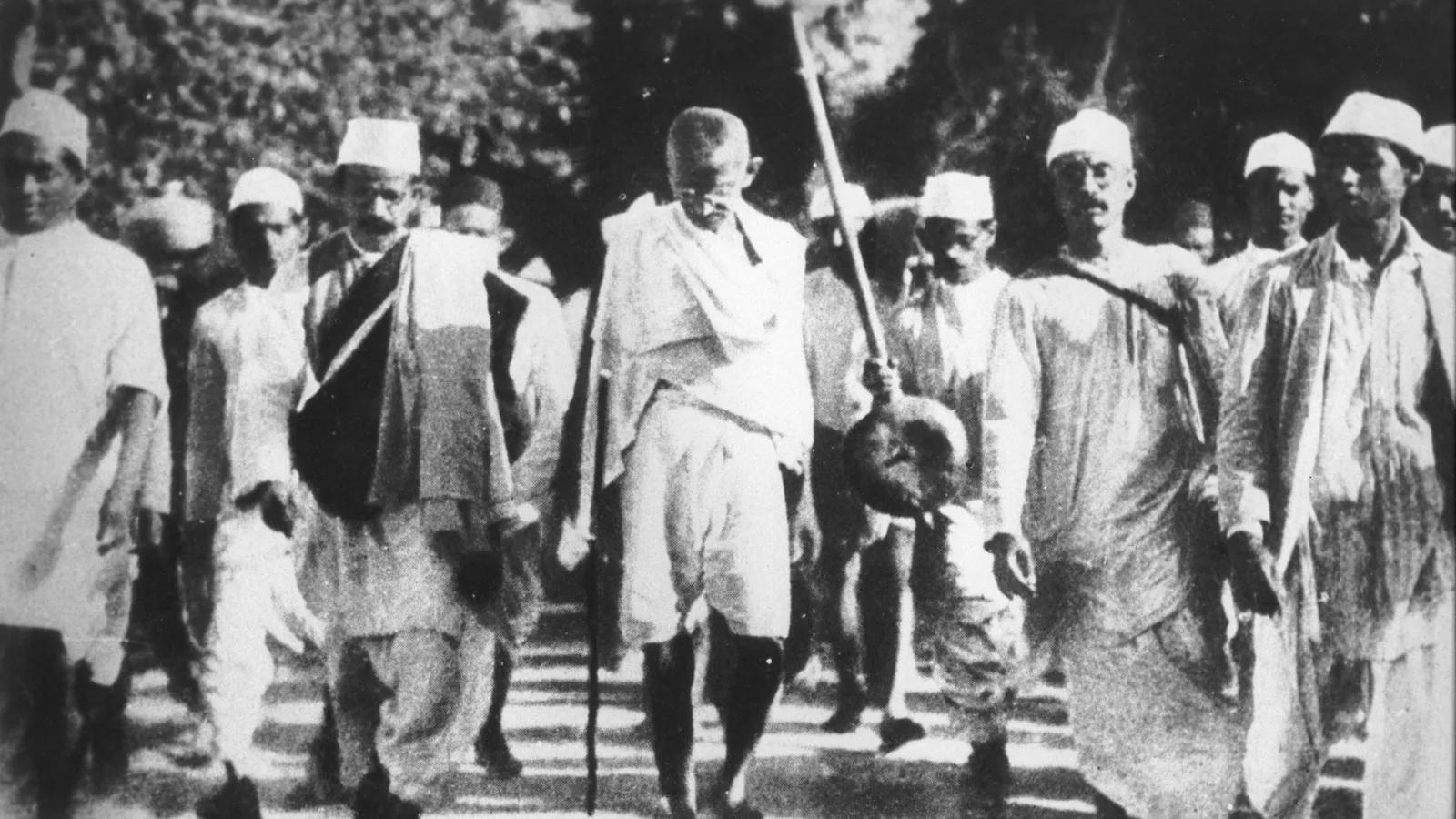
“I shall proceed with such co-workers of the Ashram as I can take, to disregard the provisions of the salt laws,” M. K. Gandhi wrote to Lord Irwin, the viceroy, on March 2, 1930. The letter gave the day as “the 11th day of this month”; the editors of the Collected Works of Mahatma Gandhi add in a footnote that the march started on March 12. Seventy-eight volunteers walked with him for 25 days to Dandi, where he picked up salt on April 6. He was arrested at 12:45 a.m. on May 5, and on May 21 volunteers marched on the Dharasana salt works, where the injured were counted as 170 by one report and 320 by another. On March 5, 1931, the settlement was read in full to the House of Commons.
Quick facts
- When
- March 2, 1930 (letter to Lord Irwin) · March 12, 6:30 a.m. (march leaves Sabarmati) · April 5 (arrival at Dandi) · April 6, 8:30 a.m. (salt picked up) · May 4 (letter announcing Dharasana) · May 5, 12:45 a.m. (arrest at Karadi) · May 21 (Dharasana salt works) · May 26 (British summary circulated in the Commons) · March 5, 1931 (settlement read to the Commons)
- Where
- Satyagraha Ashram at Sabarmati; 40 villages and towns of Gujarat on the way to Dandi, on the coast; the camp at Karadi; the Dharasana salt works; Yeravda Central Jail; the House of Commons in London
- Who
- M. K. Gandhi; Lord Irwin, the viceroy; Reginald Reynolds, who carried the letter; 78 volunteers named in Young India; Sarojini Naidu; Manilal Gandhi; Vallabhbhai Patel; Webb Miller of the United Press; Wedgwood Benn, secretary of state for India; Stanley Baldwin and David Lloyd George
- Outcome
- The salt laws were broken at Dandi on April 6, 1930; Gandhi was held at Yeravda from May 5; the Dharasana injured were counted as 170 by the Bombay government's report and 320 by Webb Miller; the settlement read to the Commons on March 5, 1931, released nonviolent prisoners but kept the Salt Acts, with a domestic exemption for villages beside the salt areas
March 2, 1930: a letter delivered by hand
The letter opened “DEAR FRIEND,” and went, in Gandhi’s words, by “a young English friend who believes in the Indian cause”; the Collected Works name him as Reginald Reynolds. It said: “Whilst, therefore, I hold the British rule to be a curse, I do not intend harm to a single Englishman or to any legitimate interest he may have in India.”
The salt tax came at the end of a list of burdens on the peasant. “Even the salt he must use to live is so taxed as to make the burden fall heaviest on him, if only because of the heartless impartiality of its incidence,” Gandhi wrote, and he called the tax “the most iniquitous of all from the poor man’s standpoint.” The closing lines said the letter “is not in any way intended as a threat but is a simple and sacred duty peremptory on a civil resister.”
The viceroy’s reply, as the Collected Works summarize it, was “simply an expression of regret” that Gandhi should be “contemplating a course of action . . . bound to involve violation of the law and danger to the public peace.” Young India printed the letter on March 12, the morning the march left.
Seventy-eight volunteers, 40 villages
At 6:30 a.m. on March 12, 1930, Gandhi walked out of the Sabarmati ashram with 78 volunteers. Young India printed their names by province: 31 from Gujarat, 13 from Maharashtra, eight from the United Provinces, and the rest from 13 other places, from Cutch to Nepal. Vallabhbhai Patel had been arrested at Ras five days before the march and convicted.
The journey took 25 days, of which the party walked 22. It passed through 40 villages and towns, and at each he spoke. Village headmen resigned as it went: by April 5 the compilation Sabarmati to Dandi, citing the Home Political files of 1930, counts 140 resignations in Surat district, and 227 ten days later.
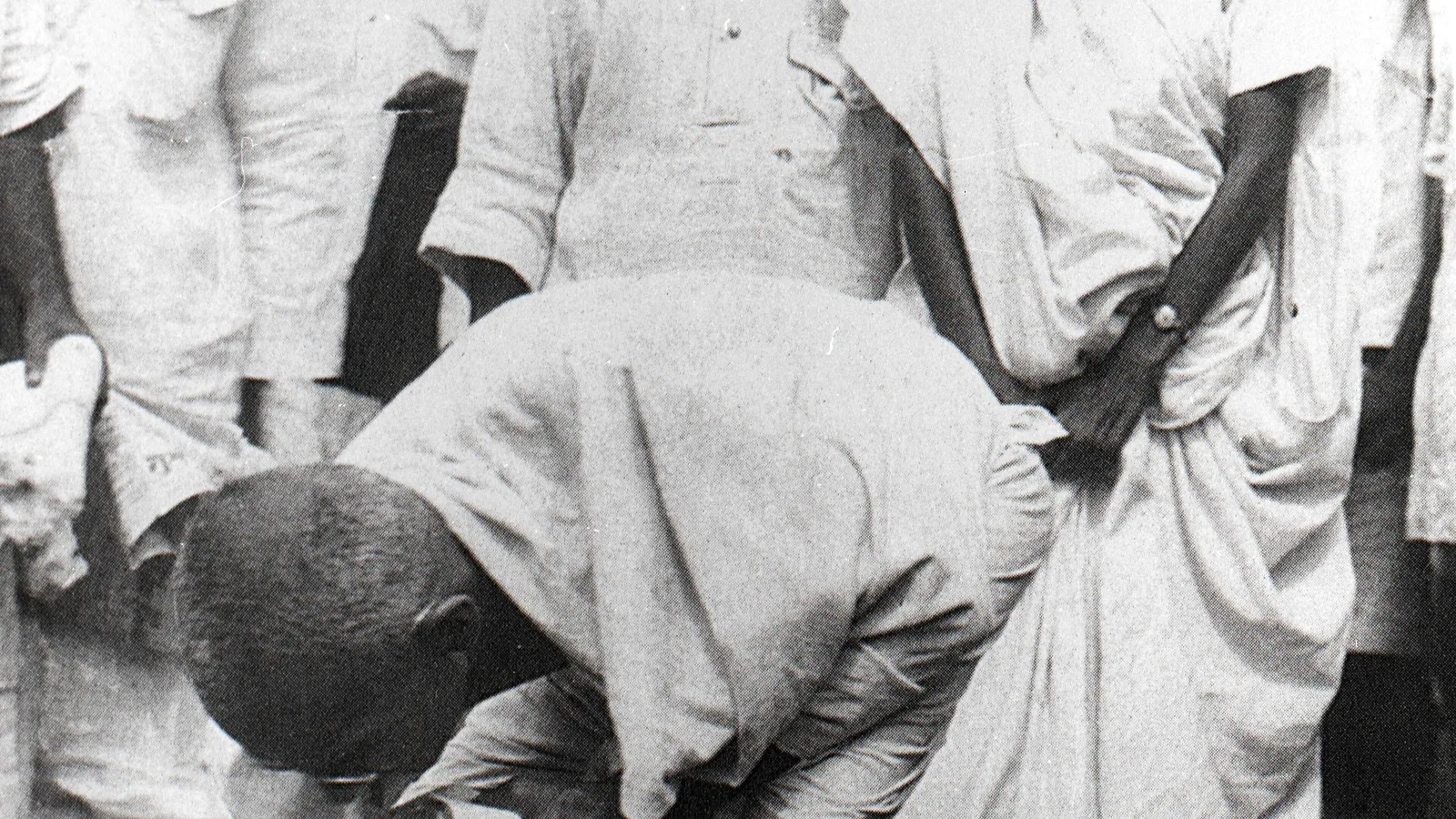
The marchers reached Dandi on April 5, where Sarojini Naidu, the poet, was waiting. At 8:30 a.m. on April 6 Gandhi took up a lump of natural salt from a small pit. Naidu cried “Hail Deliverer,” and Gandhi said, “With this, I am shaking the foundations of the British Empire.” That day about two tolas of the salt were auctioned for Rs. 525 to Seth Ranchhod Shodhan, a mill-owner of Ahmedabad.

"This is mere camouflage": the arrest at Karadi
On May 4 Gandhi drafted a second letter to the viceroy. It announced a march on Dharasana to “demand possession of the Salt Works,” and answered the government in advance: “The public have been told that Dharasana is private property. This is mere camouflage. It is as effectively under Government control as the Viceroy’s House.”
The dates in the draft were still blank. At 12:45 a.m. on May 5 the district magistrate reached the camp at Karadi with the superintendent of police and 20 armed constables. The warrant placed him under restraint under Regulation XXV of 1827 and ordered his removal to Yeravda Central Jail. On May 26 Wedgwood Benn, the secretary of state for India, told the Commons that he had nothing later than “a report of 5th May that he had arrived at Yeravda, in excellent health.” Four days earlier Benn had told the same House that he knew “of no case” of flogging “save that of four juveniles at Sholapur.”
Dharasana, counted twice
The summary Benn circulated on May 26 states that on May 21 “massed attacks on the salt works were delivered by thousands of volunteers.” The Bombay Government’s report, quoted in the summary, put the attackers at 2,600. It recorded that “Not a single round fired; no weapon except lathis used,” and gave the casualties this way: “From Congress sources it is estimated that 170 were wounded, more or less, only three or four seriously.” Naidu and Manilal Gandhi were among those arrested. The report gives no figure for the dead.
Webb Miller of the United Press had reached Dharasana after a tip “on the evening of May 20, 1930.” He wrote: “Suddenly, at a word of command, scores of native police rushed upon the advancing marchers and rained blows on their heads with their steel-shod lathis. Not one of the marchers even raised an arm to fend off the blows. They went down like ten-pins.” In the temporary hospital, “I counted 320 injured, many still insensible with fractured skulls,” and “two had died.” An unsigned note at Bulsar told him his dispatches “have not been telegraphed.”
Clause 20, read to the Commons on March 5, 1931
On March 5, 1931, Benn read the whole settlement to the House. Hansard heads it “Conversations Between the Governor-General of India and Mr. Gandhi”; it is commonly called the Gandhi-Irwin Pact. Clause 13 dealt with the prisons: “Those prisoners will be released who are undergoing imprisonment . . . for offences which did not involve violence (other than technical violence) or incitement to violence.” Stanley Baldwin said he “would prefer to abstain from any comment” until he had mastered the text, and David Lloyd George joined “the congratulations tendered.”
The salt tax survived the settlement. Clause 20, as read that afternoon, ran: “Government are unable to condone breaches of the existing law relating to salt administration, nor are they able, in the present financial conditions of the country, to make substantial modifications in the Salt Acts. For the sake, however, of giving relief to certain of the poorer classes, they are prepared to extend their administrative provisions on the lines already prevailing in certain places in order to permit local residents, in villages immediately adjoining the areas where salt can be collected or made, to collect or make salt for domestic consumption or sale within such villages, but not for sale to or trading with individuals living outside them.”
Key facts
- Gandhi’s letter to Lord Irwin was dated Satyagraha Ashram, Sabarmati, March 2, 1930, and printed in Young India on March 12; it announced the breach of the salt laws for “the 11th day of this month” (Collected Works, vol. XLIII).
- The letter was carried by “a young English friend,” identified in the Collected Works as Reginald Reynolds; the viceroy replied with “an expression of regret.”
- The march left Sabarmati at 6:30 a.m. on March 12, 1930 with 78 volunteers, whose names Young India printed by province: 31 from Gujarat, 13 from Maharashtra (mkgandhi.org).
- The journey took 25 days, 22 of them walking, through 40 villages and towns; by April 5, 140 headmen had resigned in Surat district, and 227 ten days later (Sabarmati to Dandi, citing Home Political File 21 of 1930).
- Salt was picked up at Dandi at 8:30 a.m. on April 6, 1930; about two tolas of it were auctioned that day for Rs. 525.
- Gandhi was arrested at 12:45 a.m. on May 5, 1930 at Karadi under Regulation XXV of 1827 and taken to Yeravda Central Jail; his letter of May 4 announcing Dharasana (“This is mere camouflage”) was drafted the evening before, with the dates left blank.
- For Dharasana on May 21, 1930, the Bombay Government’s report gave 2,600 attackers and “170 were wounded, more or less” (Hansard, May 26, 1930); Webb Miller counted 320 injured and recorded that two had died (I Found No Peace, 1936).
- The settlement read to the Commons on March 5, 1931 released nonviolent civil disobedience prisoners (clause 13) and kept the Salt Acts, allowing villages next to salt areas to make salt for domestic use (clause 20).
FAQ
What did Gandhi's letter of March 2, 1930 to Lord Irwin say?
It listed the burdens of British rule on the Indian peasant, singled out the salt tax as "the most iniquitous of all from the poor man's standpoint," and announced that on the 11th of the month he would go with co-workers of the ashram "to disregard the provisions of the salt laws." The march in fact left on March 12.
How many people were injured at Dharasana on May 21, 1930?
Two figures survive. The Bombay Government's report, circulated in the House of Commons on May 26, 1930, gave "170 were wounded, more or less, only three or four seriously," a figure it took from Congress sources. Webb Miller of the United Press, who was there, counted 320 injured in the temporary hospital and wrote that two had died.
Did the Gandhi-Irwin Pact abolish the salt tax?
No. Clause 20 of the settlement read to the Commons on March 5, 1931 said the government could not "make substantial modifications in the Salt Acts." It allowed residents of villages next to the salt areas to collect or make salt for their own use or for sale within the village, but not for trade outside it.
Sources
- The Collected Works of Mahatma Gandhi, vol. XLIII (March–June 1930), Publications Division / Navajivan Trust: item 3, "Letter to Lord Irwin," March 2, 1930 (with editorial footnotes on the March 12 start, the Viceroy's reply and Reginald Reynolds), and item 393, "Letter to Viceroy," May 4, 1930 (footnote on the arrest at 12.45 a.m. on May 5). OCR text of the Internet Archive scan, identifier dli.ernet.162028.
- mkgandhi.org (Bombay Sarvodaya Mandal and Gandhi Research Foundation), "Dandi March," reproducing Jyotsna Tiwari's compilation Sabarmati to Dandi: the departure of March 12, the 25 days, the headmen's resignations (citing Home Political File 21 of 1930), the arrival of April 5 and the salt of April 6.
- mkgandhi.org, "Persons Who Accompanied Gandhi On The Dandi March": the list of 78 names by province, reproduced from Young India, March 12, 1930.
- mkgandhi.org, "Viceroy's Attitude": Regulation XXV of 1827 and the arrest at Karadi at 12.45 a.m. on May 5, 1930, citing the Halifax Papers.
- mkgandhi.org, "Defiance of Salt Tax": the arrest of Vallabhbhai Patel at Ras five days before the march.
- UK Parliament, Historic Hansard, House of Commons, May 26, 1930, vol. 239, cc. 789–791, "Dharasana Salt Depot": the summary circulated by Wedgwood Benn, with the Bombay Government's report.
- UK Parliament, Historic Hansard, House of Commons, May 26, 1930, vol. 239, cc. 781–782, "Mr. Gandhi": Benn's answer on Gandhi's health.
- UK Parliament, Historic Hansard, House of Commons, May 22, 1930, vol. 239, cc. 563–564, "Flogging": Benn's answer on Sholapur.
- UK Parliament, Historic Hansard, House of Commons, March 5, 1931, vol. 249, cc. 595–601, "Conversations Between the Governor-General of India and Mr. Gandhi": the full statement read by Benn, with the replies of Baldwin, Lloyd George and Brockway.
- Webb Miller, I Found No Peace: The Journal of a Foreign Correspondent (1936), chapter "They That Turn the Cheek." OCR text of the Internet Archive scan, identifier dli.csl.6944.
Cite this article
- APA
- Our Earth's History. (2026, September 22). Dear Friend: Gandhi's letter of March 2, 1930, and the salt at Dandi. Our Earth's History. https://ourearthshistory.com/south-asia/contemporary/salt-march-1930-gandhi-letter-irwin-dandi-dharasana/
- Chicago
- Our Earth's History. “Dear Friend: Gandhi's letter of March 2, 1930, and the salt at Dandi.” Our Earth's History, September 22, 2026. https://ourearthshistory.com/south-asia/contemporary/salt-march-1930-gandhi-letter-irwin-dandi-dharasana/.
- MLA
- “Dear Friend: Gandhi's letter of March 2, 1930, and the salt at Dandi.” Our Earth's History, 22 Sep. 2026, https://ourearthshistory.com/south-asia/contemporary/salt-march-1930-gandhi-letter-irwin-dandi-dharasana/.
Text licensed CC BY-NC-ND 4.0. Found an error? Tell us.