A coach, virginals and two farmans: Roe before Jahangir, 1616–1618

TL;DR — Roe reached Jahangir’s court in January 1616 with a coach and virginals, asked for a sealed treaty for three years, and left in 1618 with farmans.
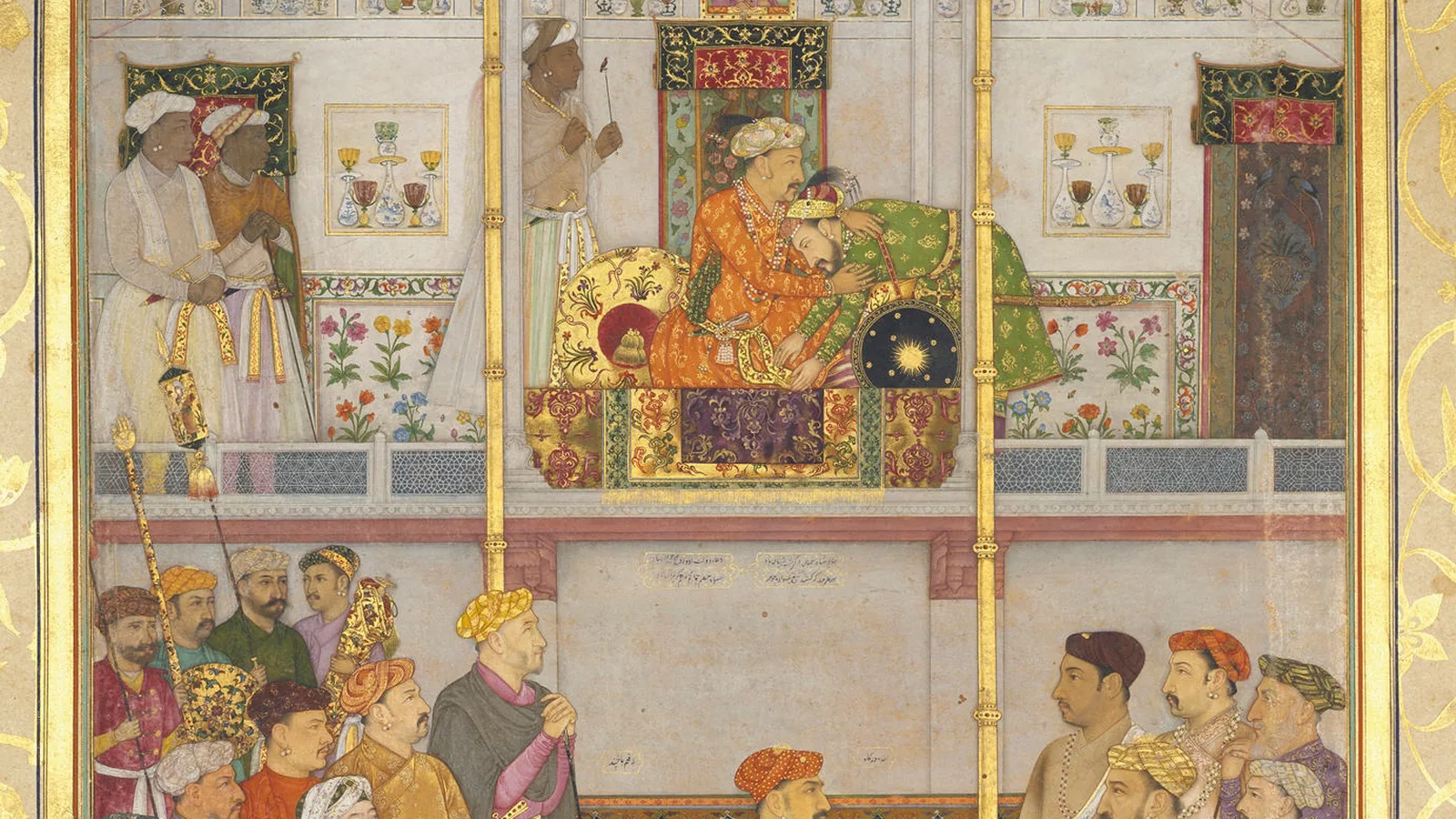
“I went to court at four in the evening to the durbar,” Sir Thomas Roe wrote in his journal on January 10, 1616, the day he first stood before the Mughal emperor Jahangir at Ajmer. His letter to the East India Company of January 25 lists what went in with him: “the coach, the virginalls, the knives, a scarfe all richly imbrodred, and a rich swoord of myne owne.” Roe, the first ambassador an English king had accredited to the Mughal court, spent three years asking for a sealed treaty on the model of the privileges European nations held in Ottoman Turkey and sailed home in 1619 without one. What he took away were farmans, imperial orders issued case by case: two signed by the prince Khurram for the English at Surat, and a general one at parting whose exact terms his editor Sir William Foster could not recover. Jahangir’s own memoirs never name Roe; they do mention an English carriage.
Quick facts
- When
- September 7, 1614 (East India Company approves Roe) · February 2, 1615 (Roe boards the Lion) · September 18, 1615 (anchor off Swally) · December 23, 1615 (Ajmer) · January 10, 1616 (first audience) · June 1–25, 1616 (barred from court) · late September 1618 (leave-taking, general farman) · February 17, 1619 (sails on the Anne) · September 24, 1619 (James I at Whitehall)
- Where
- Tilbury Hope and the Downs; Swally roadstead and Surat, on the coast of Gujarat; Ajmer, where Jahangir held court; Whitehall, London
- Who
- Sir Thomas Roe; the emperor Jahangir; Prince Khurram (later Shah Jahan); Asaf Khan; Zulfiqar Khan, governor of Surat; Sir Thomas Smythe; the chaplains John Hall and Edward Terry; the editor Sir William Foster
- Outcome
- Roe's draft treaty, meant to match the Ottoman capitulations, was never sealed. Khurram signed two farmans for the English at Surat, and at parting in September 1618 Jahangir gave a general farman whose exact terms Foster could not recover. Jahangir's memoirs never name Roe
Smythe's recommendation, September 7, 1614
On September 7, 1614, the East India Company’s Court of Committees heard its governor, Sir Thomas Smythe, propose “Sir Thomas Rowe, a gentleman well knowne unto them all to bee of a pregnant understandinge, well spoken, learned, industrious, and of a comelie personage.” The candidate was to win “articles and priviledges as may bee most beneficiall” from “the Grand Magore” and to counter the plots the Jesuits might lay against the trade.
In September 1612 Thomas Best’s ships had beaten a Portuguese fleet off Surat, and the agreement for an English factory that followed had a clause for “the residence at court of an English ambassador.” William Edwards, one of the company’s merchants, wrote home in December 1614 that “the title of a merchant is of them despised.”
The Lion, from Tilbury Hope to Ajmer
Roe boarded the Lion at Tilbury Hope on February 2, 1615; contrary winds held the fleet off the English coast until March 6. The journal for September 18 begins “In the morning at flood we weighed” and ends with the ships at anchor off Swally, the roadstead of Surat. Roe reached Ajmer, where Jahangir held court, on December 23, “comming in privatly in the evening, beeing not able to sitt upp.” He kept his bed until January 9. On December 31 the emperor sent him boar meat from a hunt.
At the audience of January 10, Roe’s letter of January 25 says, Jahangir, seated in state, “could not well descerne the coach, but sent many to see yt, and caused the musitian to play on the virginalls.” That night the emperor climbed into the coach to see every corner of it and afterwards wore Roe’s sword and scarf “the English fashion.”
Ten thousand rupees on a miniature
A smaller gift did more work. Roe had brought a miniature by the English painter Isaac Oliver, and the courtier Asaf Khan carried it to the emperor. “Hee tooke extreame content, showeing it to everie man neare him,” Roe wrote in 1616. When Jahangir’s chief painter said “he could make as good,” Roe offered to wager 10,000 rupees; Foster’s summary is that it was “only with difficulty that he was able to discerne which was which.” A Jaipur painting published in Douglas’s Bombay and Western India as Jahangir receiving Roe, Foster rejected in a footnote: the figure wore Indian dress, and the chaplain Edward Terry recorded that Roe’s party wore English clothes.
Roe complained of the exactions of Zulfiqar Khan, governor of Surat, and Khurram, the prince who later reigned as Shah Jahan, “within a few days” signed two farmans “authorizing the residence of the English at Surat and their free passage inland.” On June 1, 1616, Asaf Khan passed word that on the prince’s complaint the emperor had barred Roe from court, a ban that lasted until June 25; Jahangir “promptly denied having issued any order for his exclusion,” and Roe “was received by the King after the ould manner.” In August his chaplain John Hall died: “This day soddenly dyed, to my great greife and discomfort, my minister, Mr. Hall.” On September 26, 1616, the Surat factors proposed Terry, “about 25 yeares of age,” in his place.
"Of little use": farmans in place of a treaty
Roe’s draft asked for trade at every Mughal port including Bengal and Sind, no charges beyond customs and no seizure of a dead factor’s goods; Foster writes that it was “intended, in fact, to be on a par with the capitulations obtained by the European nations in Turkey.” It went to Asaf Khan and was never sealed. Farmans, in Roe’s own verdict as Foster’s edition gives it, “however favourable, were of little use; they were partial in their application, and were liable to be contradicted at any moment by fresh commands.” In late September 1618 he took leave of Jahangir and received a general farman for the English to stay in the empire, Foster adds, “the exact terms of which are unknown.”
After four months at Surat, on February 17, 1619, the fleet put to sea with Roe aboard the Anne, which reached Plymouth in late August. On Friday, September 24, 1619, Roe saw James I at Whitehall and, in John Chamberlain’s report, “presented him with two antelopes, a straunge and bewtifull kind of red deare . . . from the Great Mogul.”
November 10, 1616: a carriage in Jahangir's memoirs
The Tuzuk-i-Jahangiri, the emperor’s memoirs, in the Rogers–Beveridge translation of 1909–1914, names no Englishman called Roe. Beveridge asked in a footnote to one Ajmer passage whether it was “an allusion to some complimentary remark of Sir Thomas Roe”; the guess is the translator’s. They do record a sea fight: “In the roadstead of the port of Surat a fight took place between the English, who had taken shelter there, and the Viceroy.”
The National Archives at Kew catalogues Roe’s letters in the India Office series IOR/E/3, among them “Sir Thomas Roe at Ajmer to Thomas Kerridge and factors at Surat” (IOR/E/3/4, ff. 81–82) and his complaints to Zulfiqar Khan (IOR/E/3/3, ff. 61–62). Foster edited the journal and letters for the Hakluyt Society in 1899 and, revised, for Oxford University Press in 1926; Rupali Mishra, in the Journal of British Studies in 2014, called him an envoy “triangulating between the different interests he represented.”
The coach reappears under November 10, 1616, when Khurram set out on campaign and Jahangir listed among the prince’s gifts “a carriage, according to the English fashion, for him to sit and travel about in,” then wrote of himself: “I mounted the Frank carriage, which had four horses attached to it, and left the city of Ajmir.” Beveridge’s note reads: “According to Roe, it was not the English carriage, but a copy. Perhaps Jahangir had the original carriage and Shah Jahan the copy.”
Key facts
- On September 7, 1614, the East India Company’s Court of Committees approved Sir Thomas Smythe’s proposal to send Sir Thomas Roe to the Mughal court (Foster, introduction).
- Roe boarded the Lion at Tilbury Hope on February 2, 1615, cleared the Lizard on March 6 and anchored off Swally on September 18, 1615 (Foster, journal).
- He reached Ajmer on December 23, 1615, “beeing not able to sitt upp,” and first saw Jahangir on January 10, 1616 (Foster, journal).
- His letter of January 25, 1616, lists the presents: “the coach, the virginalls, the knives, a scarfe all richly imbrodred, and a rich swoord of myne owne” (Foster, correspondence).
- Khurram signed two farmans “authorizing the residence of the English at Surat and their free passage inland”; Roe was barred from court on June 1, 1616, and received again on June 25 (Foster, introduction).
- Roe’s draft treaty, meant to match the Ottoman capitulations, went to Asaf Khan and was never sealed; the general farman of September 1618 has terms Foster calls “unknown” (Foster, introduction).
- The fleet sailed from Surat on February 17, 1619, with Roe on the Anne; he met James I at Whitehall on September 24, 1619, with two antelopes (Foster, introduction, citing Chamberlain).
- The Tuzuk-i-Jahangiri names no Roe; under November 10, 1616, Jahangir wrote “I mounted the Frank carriage,” and Beveridge’s note reads “According to Roe, it was not the English carriage, but a copy” (Rogers–Beveridge, vol. 2).
FAQ
When did Thomas Roe first meet Jahangir?
On January 10, 1616, at Ajmer, at the afternoon durbar. He had arrived in Ajmer on December 23, 1615, and had been ill until January 9.
Did Thomas Roe sign a treaty with the Mughal emperor?
No. His draft, meant to match the capitulations European nations held in Ottoman Turkey, went to Asaf Khan and was never sealed. He received farmans: two from Prince Khurram for the English at Surat, and a general one from Jahangir in September 1618 whose exact terms Foster could not recover.
Does Jahangir's autobiography mention Thomas Roe?
Not by name. The Rogers–Beveridge translation of the Tuzuk-i-Jahangiri has a footnote by Beveridge asking whether one Ajmer passage alludes to Roe; the text itself records "a carriage, according to the English fashion" given to Khurram and "the Frank carriage" the emperor rode from Ajmer on November 10, 1616.
Sources
- Sir Thomas Roe, The Embassy of Sir Thomas Roe to India, 1615–19, as narrated in his Journal and Correspondence, ed. Sir William Foster, new and revised edition (Oxford University Press, 1926): editor's introduction, journal entries for September 18 and December 23, 1615, January 10 and August 1616, and the letter to the East India Company of January 25, 1616 (Internet Archive, India Office Records copy).
- Nur-al-Din Muhammad Jahangir, The Tūzuk-i-Jahāngīrī, or Memoirs of Jahangir, tr. Alexander Rogers, ed. Henry Beveridge, vol. 1 (Royal Asiatic Society, 1909): the Ajmer passages and Beveridge's footnotes (Project Gutenberg e-text).
- The Tūzuk-i-Jahāngīrī, tr. Rogers, ed. Beveridge, vol. 2 (Royal Asiatic Society, 1914): the Surat sea fight, the gifts to Khurram and the "Frank carriage" entry, with Beveridge's note (Project Gutenberg e-text).
- The National Archives (UK), Discovery catalogue: search results for "Sir Thomas Roe" and Surat in the India Office series IOR/E/3, including IOR/E/3/4 ff. 81–82 and IOR/E/3/3 ff. 61–62 (catalogue entries only).
- Rupali Mishra, "Diplomacy at the Edge: Split Interests in the Roe Embassy to the Mughal Court," Journal of British Studies 53, no. 1 (2014): 5–28, abstract and reference list (Cambridge Core).
- Jarl Charpentier, review of The Embassy of Sir Thomas Roe to India, 1615–19, ed. Sir William Foster (1926), Bulletin of the School of Oriental and African Studies 4, no. 4 (1928): 862–864, title and bibliographic entry (Cambridge Core).
- Jarl Charpentier, "A Note from the Memoirs of Jahangir," Journal of the Royal Asiatic Society 56, no. 3 (1924): 440–442, footnote preview citing the Rogers–Beveridge translation (Cambridge Core).
- Encyclopaedia Iranica, "JAHANGIR," bibliography: entries for Foster's 1899 Hakluyt Society edition of Roe and for the Rogers–Beveridge translation of the Tuzuk.
Cite this article
- APA
- Our Earth's History. (2026, September 22). A coach, virginals and two farmans: Roe before Jahangir, 1616–1618. Our Earth's History. https://ourearthshistory.com/south-asia/early-modern/roe-embassy-ajmer-january-10-1616-jahangir-coach-virginals-two-farmans/
- Chicago
- Our Earth's History. “A coach, virginals and two farmans: Roe before Jahangir, 1616–1618.” Our Earth's History, September 22, 2026. https://ourearthshistory.com/south-asia/early-modern/roe-embassy-ajmer-january-10-1616-jahangir-coach-virginals-two-farmans/.
- MLA
- “A coach, virginals and two farmans: Roe before Jahangir, 1616–1618.” Our Earth's History, 22 Sep. 2026, https://ourearthshistory.com/south-asia/early-modern/roe-embassy-ajmer-january-10-1616-jahangir-coach-virginals-two-farmans/.
Text licensed CC BY-NC-ND 4.0. Found an error? Tell us.