March 12, 1610: a Venice pamphlet with four new moons around Jupiter

TL;DR — Galileo’s Sidereus Nuncius, dated Padua, March 12, 1610, and printed in Venice, reported a rough Moon and four bodies circling Jupiter; Kepler answered from Prague within the year.
The title page calls the book Sidereus Nuncius, the Starry Messenger, by Galileo Galilei, professor of mathematics at Padua, and at its foot it reads “Venetiis, Apud Thomam Baglionum. M D C X. Superiorum Permissu, et Privilegio”: Venice, at the press of Tommaso Baglioni, 1610, with the permission of the authorities and with privilege. The Museo Galileo in Florence dates publication to March 12, 1610, and puts the run at 550 copies, sold out at once. Inside were five plates of the Moon and a night-by-night record, from January 7 to March 2, 1610, of three and then four small lights moving around Jupiter. The dedication to Cosimo II de’ Medici, Grand Duke of Tuscany, named them the Medicean Stars. Kepler printed a reply from Prague the same year, and on April 25, 1611, Galileo was enrolled in the Accademia dei Lincei in Rome, where the instrument got its name.
Quick facts
- When
- Late 1609 (first tubes made at Padua) · January 7 to March 2, 1610 (nights recorded in the book) · March 12, 1610 (dedication signed at Padua; publication in Venice) · 1610 (Kepler's reply printed at Prague; pirated edition at Frankfurt) · April 25, 1611 (Galileo enrolled in the Accademia dei Lincei)
- Where
- Padua, in the Republic of Venice, where Galileo taught; Venice, at the press of Tommaso Baglioni; Florence, seat of Cosimo II; Prague, seat of the emperor Rudolf II; Frankfurt; Rome
- Who
- Galileo Galilei; Cosimo II de' Medici, Grand Duke of Tuscany; the printer Tommaso Baglioni; Johannes Kepler; Giuliano de' Medici, Tuscan ambassador at Prague; Federico Cesi, founder of the Accademia dei Lincei
- Outcome
- 550 copies sold out at once, per the Museo Galileo; a Frankfurt printer pirated the book the same year; Kepler accepted the observations in print from Prague; in April 1611 Galileo joined the Lincei, and Cesi proposed the word telescope for the instrument
A lead tube and two lenses, Padua, 1609
Galileo’s own account, in Edward Stafford Carlos’s 1880 English translation, opens with a rumor. “About ten months ago,” he wrote, a report had reached him that a Dutchman had built a tube through which distant objects “were seen distinctly as if near.” He then made his own, a tube “at first of lead” with a convex lens at the far end and a concave one at the eye. Objects through it “appeared one-third of the distance off and nine times larger.” A second instrument, made “with more nicety,” magnified “more than sixty times.” The last showed objects “magnified nearly a thousand times, and more than thirty times nearer.” The figures are Galileo’s own, given as apparent size and distance; to repeat the observations, he wrote, a glass of “at least 400 times” was needed.
One objective lens from these months survives, 38 millimeters across; the Museo Galileo’s catalog dates it to late 1609 or early 1610 and records that Galileo gave it to Cosimo II.
Seven nights in January
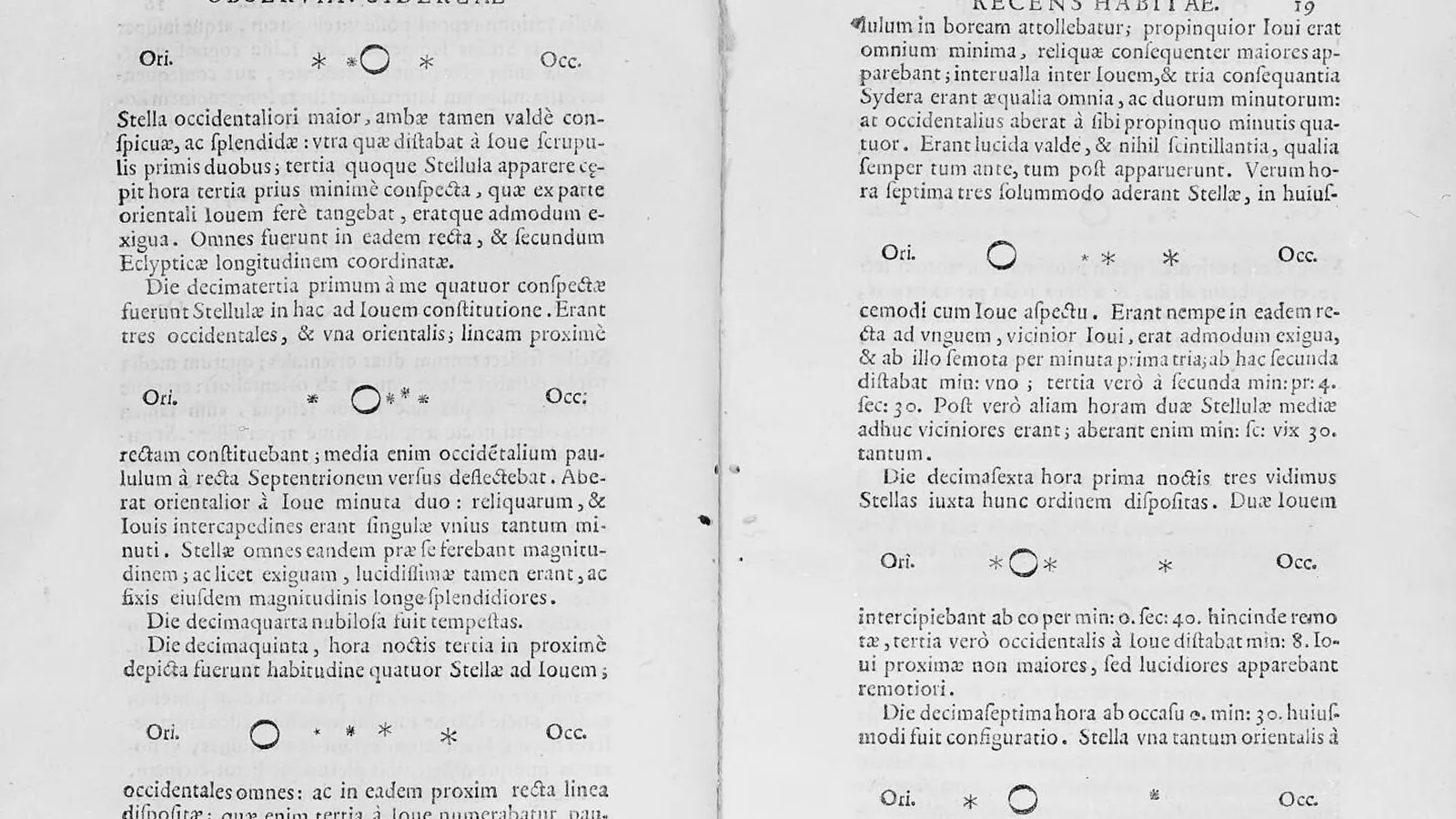
“On the 7th day of January in the present year, 1610, in the first hour of the following night,” the record begins in Carlos’s translation, and Jupiter came into view with “three little stars, small but very bright, . . . near the planet; and although I believed them to belong to the number of the fixed stars, yet they made me somewhat wonder, because they seemed to be arranged exactly in a straight line, parallel to the ecliptic.” Two lay east of Jupiter and one west. On January 8 all three were west of the planet. Clouds hid the sky on the 9th; on the 10th only two showed, and on the 11th the spacing and brightness had changed again. Fixed stars do not do that. “I therefore concluded, and decided unhesitatingly, that there are three stars in the heavens moving about Jupiter, as Venus and Mercury round the Sun,” he wrote. The entry for January 13 records, “For the first time four satellites were in view.” The nightly diagrams run on to March 2.
_;_Galilei_Galileo,_aut._de_texte_-_btv1b2600224d_(10_of_10).jpg)
The Moon's face and a grand duke's name
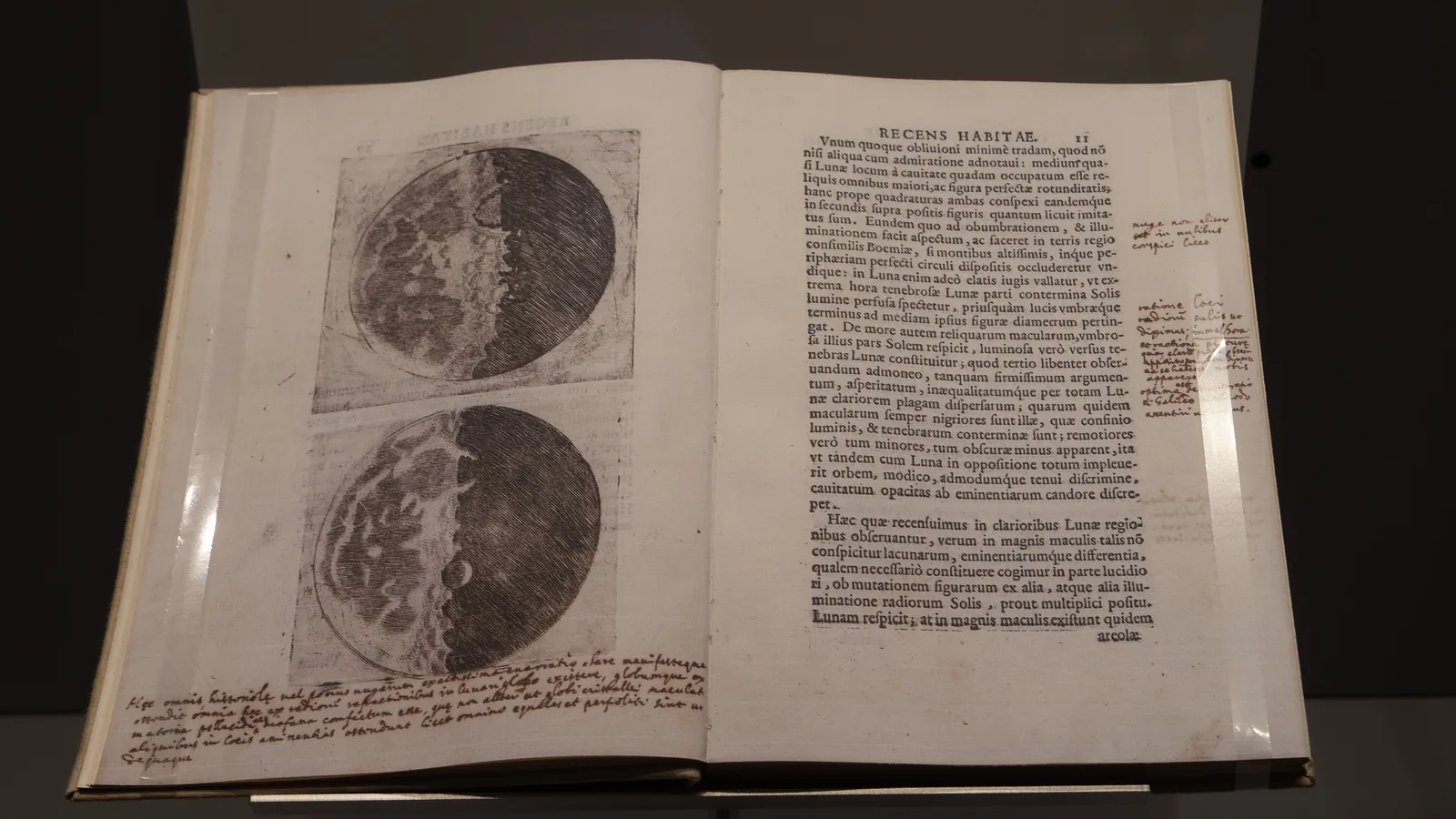
The Moon comes first in the book. Galileo wrote that he felt “sure that the surface of the Moon is not perfectly smooth, free from inequalities and exactly spherical, as a large school of philosophers considers . . . but that, on the contrary, it is full of inequalities, uneven, full of hollows and protuberances, just like the surface of the Earth itself.” His evidence was the ragged line between light and shadow, and bright points in the dark part that grew and joined the lit part, as mountain tops catch dawn before valleys. The Smithsonian Libraries’ catalog record for its copy lists five copper engravings of the Moon on leaves 8, 9 and 10; the Linda Hall Library’s exhibition The Face of the Moon, first mounted in 1989, calls them the first printed telescopic images of the Moon.
The dedication is signed “Padua, March 12, 1610.” Galileo reminded Cosimo II that he had taught him mathematics “during the four years just passed” and wrote that “under your patronage, most serene Cosmo, I have discovered these stars.” He called them the Medicean Stars. The heading over the text calls them the Cosmian Stars, after Cosimo alone, and the Smithsonian copy carries a printed slip pasted over that heading correcting “Cosmica” to “Medicea.”
Eleven copies on thick paper, and a pirate in Frankfurt
The Linda Hall Library in Kansas City bought its copy at auction in 1988. William B. Ashworth, Jr., its consultant for the history of science, wrote in 2017 that it is one of eleven printed on extra-thick paper for presentation “to selected luminaries,” corrected by Galileo himself, with the word “semi” written in his hand at the foot of the first page.
A second copy in the same library is the pirate. “Not many books were pirated in the 17th century,” Ashworth wrote, “it just wasn’t worth the expense,” but the Venice printing sold out so fast that a Frankfurt printer obtained a copy and issued his own later in 1610. The Venice edition had “carefully etched plates of the Moon” and accurate star maps; in the Frankfurt piracy the Moon images were copied as crude woodcuts and the star maps “are barely maps at all.”
Prague in 1610, Rome in 1611
According to Carlos’s introduction, Galileo, through Giuliano de’ Medici, the Tuscan ambassador to the emperor Rudolf II at Prague, invited Kepler to correspond, and the emperor asked for Kepler’s opinion. The answer was a pamphlet. Its title page reads Dissertatio cum Nuncio Sidereo, a discussion with the Starry Messenger, “Pragae, typis Danielis Sedesani, Anno Domini M.DC.X.,” and it is dedicated to Giuliano de’ Medici. Kepler had no telescope and could not check the observations, Carlos wrote, but he gave reasons for accepting them; the Museo Galileo’s chronology records that he “expresses a very favourable opinion on Galileo’s work.” In 1611 Kepler reported looking for himself, through a telescope made by Galileo and belonging to Ernest, Elector and Archbishop of Cologne, and seeing the lunar mountains and three of the four satellites.
Galileo was in Rome that spring, observing the Medicean Planets and sunspots through April and May, the Museo Galileo’s chronology records, before leaving for Florence in early June. On April 25, 1611, he was enrolled in the Accademia dei Lincei, and its founder, Federico Cesi, proposed a name for the instrument that the title page of 1610 had called a perspicillum: telescope, from the Greek for “far” and “I see.”
Key facts
- The title page of Sidereus Nuncius reads “Venetiis, Apud Thomam Baglionum. M D C X. Superiorum Permissu, et Privilegio”; the dedication to Cosimo II is signed “Padua, March 12, 1610.”
- The Museo Galileo dates publication to March 12, 1610, in 550 copies, sold out at once.
- Galileo’s stated magnifications, in Carlos’s 1880 translation: “nine times larger” for the first lead tube, “more than sixty times” for the second, “nearly a thousand times, and more than thirty times nearer” for the last; a glass of “at least 400 times” was needed to repeat the observations.
- The record of Jupiter runs from January 7 to March 2, 1610; on January 13, “for the first time four satellites were in view.”
- The Smithsonian Libraries copy has five copper engravings of the Moon and three woodcut star maps, and a pasted slip correcting “Cosmica” to “Medicea.”
- The Linda Hall Library’s copy is one of eleven on extra-thick paper, corrected in Galileo’s hand; its second copy is the Frankfurt piracy of 1610, with woodcut Moons.
- Kepler’s Dissertatio cum Nuncio Sidereo was printed at Prague by Daniel Sedesanus in 1610; Galileo was enrolled in the Accademia dei Lincei on April 25, 1611, where Cesi proposed the word telescope.
FAQ
What did Galileo see on January 7, 1610?
Three small bright points in a straight line beside Jupiter, two east and one west, which he first took for fixed stars. Their positions changed on January 8, 10 and 11, and on January 13 he saw four. By then he had concluded that they moved around Jupiter.
How many copies of Sidereus Nuncius were printed?
The Museo Galileo in Florence gives 550, sold out at once. The Linda Hall Library records that eleven of them were printed on extra-thick paper for presentation and corrected by Galileo himself.
Where does the word telescope come from?
From the Accademia dei Lincei in Rome. The Museo Galileo records that when Galileo was enrolled on April 25, 1611, the academy's founder Federico Cesi proposed the name, from the Greek tele, "far," and scopeo, "I see." Galileo's own book calls the instrument a perspicillum.
Sources
- Galileo Galilei, The Sidereal Messenger of Galileo Galilei, translated by Edward Stafford Carlos (London: Rivingtons, 1880); introduction, dedication, text and the nightly record of January 7 to March 2, 1610; full text on the Internet Archive.
- Galileo Galilei, Sidereus Nuncius (Venetiis: Apud Thomam Baglionum, 1610); the Smithsonian Libraries (Dibner Library) copy, with the catalog record listing its plates, signatures, the Frankfurt edition of the same year and the cancel slip on leaf B1; scan and OCR on the Internet Archive.
- Museo Galileo, Florence — "Galileo: Life," chronology, entries for 1610 (the Sidereus Nuncius) and 1611 (the Accademia dei Lincei).
- Museo Galileo, Florence — catalog entry "Galileo's objective lens" (inv. 2429), Room VII.
- Museo Galileo, Florence — catalog entry "Galileo's telescope" (inv. 2427), Room VII (Cesi's proposal of the name telescopio, 1611).
- Linda Hall Library, Kansas City — William B. Ashworth, Jr., "Scientist of the Day: Galileo Galilei," February 15, 2017 (the thick-paper copy and the Frankfurt piracy).
- Linda Hall Library, Kansas City — digital exhibition "The Face of the Moon: Galileo to Apollo," introduction (exhibition of 1989, catalog by William B. Ashworth).
- Johannes Kepler, Dissertatio cum Nuncio Sidereo nuper ad mortales misso a Galilaeo Galilaeo (Pragae: typis Danielis Sedesani, 1610); the Complutense University of Madrid copy, scan and OCR on the Internet Archive.
Cite this article
- APA
- Our Earth's History. (2026, September 22). March 12, 1610: a Venice pamphlet with four new moons around Jupiter. Our Earth's History. https://ourearthshistory.com/europe/early-modern/sidereus-nuncius-1610-galileo-four-moons/
- Chicago
- Our Earth's History. “March 12, 1610: a Venice pamphlet with four new moons around Jupiter.” Our Earth's History, September 22, 2026. https://ourearthshistory.com/europe/early-modern/sidereus-nuncius-1610-galileo-four-moons/.
- MLA
- “March 12, 1610: a Venice pamphlet with four new moons around Jupiter.” Our Earth's History, 22 Sep. 2026, https://ourearthshistory.com/europe/early-modern/sidereus-nuncius-1610-galileo-four-moons/.
Text licensed CC BY-NC-ND 4.0. Found an error? Tell us.