Once in 300 years, once in 10,000: the North Sea flood of 1953

TL;DR — The 1953 surge was later rated a 300-year level; the Delta Committee set a 10,000-year standard, and Britain’s Waverley committee capped defenses at the 1953 flood.
On February 19, 1953, Home Secretary Sir David Maxwell Fyfe told the House of Commons that the wind and tide of January 31 had been “quite exceptional.” He added that there was “no reason to believe that there is a serious risk of such conditions arising with any frequency.” The day before, the Dutch government had set up the Delta Committee, and the most important of the questions the government put to it was which storm surge levels could be expected along the Dutch coast. The water of that night, Kees d’Angremond, professor of coastal engineering at Delft University of Technology, wrote in 2003, had a probability of about three in a thousand per year, “only once in 300 years.” The committee’s final report, dated December 10, 1960, required the most densely populated part of the Netherlands to withstand a surge expected on “average once in 10,000 years.” Britain’s Departmental Committee on Coastal Flooding, under Viscount Waverley, reported on June 3, 1954, and set its highest standard at the floods of January 1953.
Quick facts
- When
- January 31–February 1, 1953 (storm surge); February 18, 1953 (Delta Committee set up); February 19, 1953 (UK inquiry announced); June 3, 1954 (Waverley report published); November 5, 1957 (Delta Law passed); December 10, 1960 (Delta Committee final report); 1986 (Oosterschelde barrier completed)
- Where
- Zeeland, Zuid-Holland and Noord-Brabant in the southwestern Netherlands; the east coast of England; the Scheldt and the Flemish coast in Belgium
- Who
- Delta Committee (chair A.G. Maris); P.J. Wemelsfelder of Rijkswaterstaat; Home Secretary Sir David Maxwell Fyfe; Viscount Waverley's Departmental Committee on Coastal Flooding
- Outcome
- The Delta Committee required the most densely populated part of the Netherlands to withstand a surge with an annual probability of 10⁻⁴; the Waverley committee set the January 1953 floods as Britain's maximum standard. The Oosterschelde barrier was completed in 1986
January 31 to February 1, 1953: a gale over a spring tide
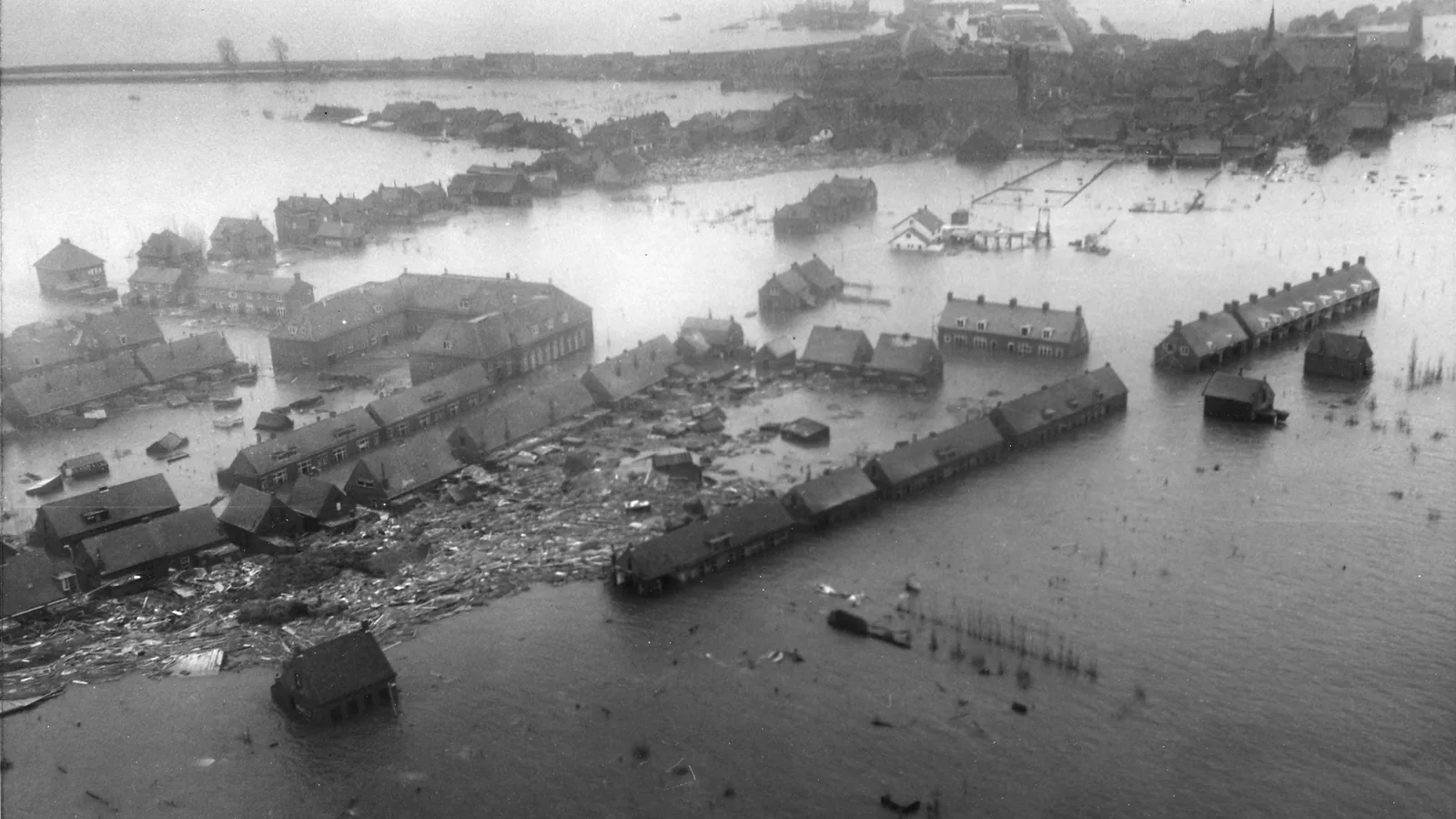
From noon on Saturday, January 31, d’Angremond wrote, a northwest gale drove water from the northern North Sea south toward the English Channel. The surge met the astronomical tide, and in the early morning of Sunday, February 1, water levels in the southwestern Netherlands exceeded any observed before. The Met Office gives a surge of nearly three meters in Norfolk and more in the Netherlands. The Watersnoodmuseum at Ouwerkerk puts it this way: “Before the tide reaches its peak, the dikes in southwestern Netherlands breach.”
In the Delta region, 187 kilometers of sea defense were damaged, 48 of them seriously. Most of the damage came from water pouring over the crest and eating away the inner slope, and most breaches lay on the southern shores of the islands, where the dikes stood lower because the northern faces had been built for waves from the northwest. Many deep polders filled to more than five meters.
In England, the Home Secretary told the Commons, the tides ran “nearly two feet above the record tides of 1949,” although higher standards for sea defenses had been adopted after the floods of 1938 and again after 1949.
Casualty lists from Middelburg, Westminster and Flanders
The Zeeuws Archief, the provincial archive of Zeeland in Middelburg, gives 1,836 Dutch dead: 865 in Zeeland, 677 in Zuid-Holland, 247 in Noord-Brabant and seven in Noord-Holland, with 40 more who died of later consequences. Statistics Netherlands recorded 1,835 in a bulletin of February 1, 1954, the figure d’Angremond uses.
The flooded area differs from one institution to the next. The Zeeuws Archief gives approximately 150,000 hectares in one paragraph and almost 200,000 in another on the same page. D’Angremond gives 135,000 hectares and the Met Office 200,000.
British figures moved during February. On February 5 Maxwell Fyfe reported, “The latest figure of deaths known to the police is 256.” By February 19 the count was 307, including 11 people first listed as missing. The Met Office uses 307, with about 160,000 hectares flooded in eastern England. For Belgium, the Flemish government’s Sigmaplan site gives about 18 dead, and Alexander Hall, writing for the Rachel Carson Center’s Environment & Society Portal, gives 22 in West Flanders.
Wemelsfelder's curve and the 300-year water level
In 1939 P.J. Wemelsfelder, an engineer with Rijkswaterstaat, the Dutch public works agency, published an article in De Ingenieur arguing that extreme water levels on the Dutch coast followed a logarithmic probability distribution. On that basis he warned that the crests of many dikes, especially in the southwest, were too low. D’Angremond’s paper continues that it could afterwards be derived that the 1953 water level had a probability of exceedance of about three in a thousand per year, “or on the average, only once in 300 years.”
The Nationaal Archief dates the Delta Committee to February 18, 1953. Its chairman was A.G. Maris, and its task was to prevent another such disaster and to study closing the sea inlets. Meanwhile 72,000 people were evacuated, and Phoenix caissons built for the wartime harbor at Arromanches were towed from Britain to block the last gaps. The final one, at Ouwerkerk, closed on November 6, and all flooded land was dry by January 1, 1954.
At Westminster, the January 1953 flood as the upper limit
On February 19 Maxwell Fyfe had announced “a strong Departmental committee” looking into the causes of January 31 and “possible warning systems.” On June 3, 1954, he told the Commons in a written answer that the Waverley committee’s report was being published that day. Its central recommendation read: “the maximum standard of protection to be afforded by public authorities against flooding should be that sufficient to withstand the floods of January, 1953.” It applied where flooding would reach valuable farmland or high-value property. Elsewhere, defenses were to meet “a standard which would reasonably have been thought adequate before the floods of January, 1953.” The government accepted the recommendation, which it said matched the policy followed since the flood.
For London, the committee suggested that “the possibility and cost of erecting a structure across the Thames which could be closed in a surge should be urgently investigated.” An interim report had already produced a flood warning system on the east coast in the winter of 1953–54.
"Average once in 10,000 years" and the barrier of 1986
The Delta Committee’s six-part final report came out on December 10, 1960, and the committee was dissolved on April 12, 1961, the Nationaal Archief records. D’Angremond wrote that the report was the first to base a required safety level on comparing the economic damage of a failed seawall with the cost of strengthening it. The result was a standard of 10⁻⁴ per year for the densely populated core, where the 1953 water had stood at about 3×10⁻³.
Rather than raise every dike on the islands, the committee proposed closing the estuaries, from Haringvliet south to Veerse Gat, with secondary dams in the Volkerak, the Grevelingen and the Zandkreek, over a schedule of 25 years. The Delta Law passed the Tweede Kamer on November 5, 1957, and was published on May 8, 1958.
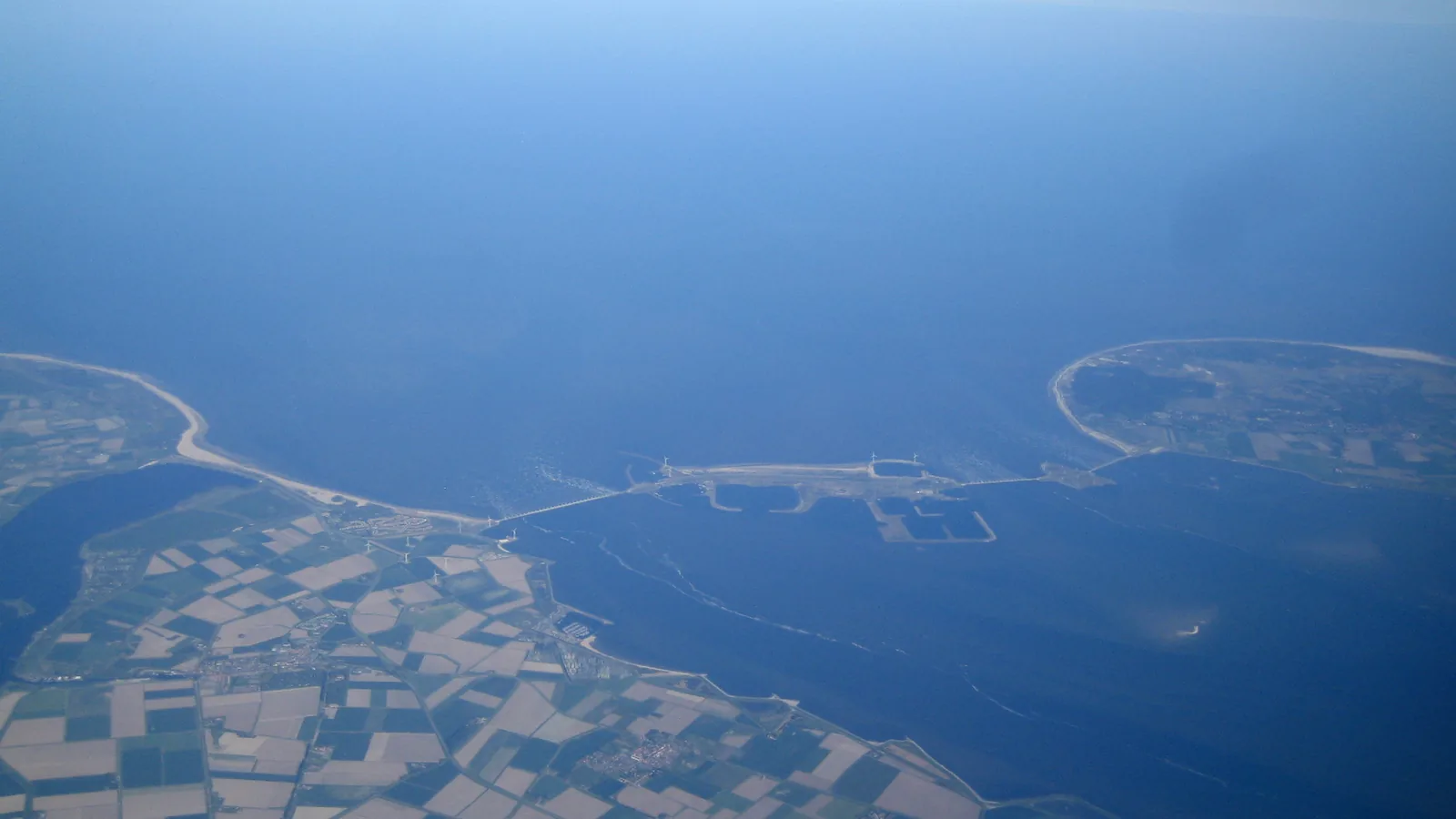
The formal decision to close the Oosterschelde, the most difficult of the inlets, came in 1969. Concern over large stagnant basins and the oyster beds near Yerseke made the closure an issue in the parliamentary elections of 1973, and after a new coalition cabinet reconsidered the project, a storm-surge barrier in the mouth replaced the planned dam. D’Angremond recorded the outcome: “The barrier was completed in 1986 instead of 1985.”
.jpg)
Key facts
- The surge struck on the night of January 31 to February 1, 1953 (Watersnoodmuseum).
- The Zeeuws Archief counts 1,836 Dutch dead; Statistics Netherlands recorded 1,835.
- In England, the Home Secretary reported 256 dead on February 5, 1953, and 307 on February 19 (Hansard).
- Dutch flooded area is given as 135,000 hectares (d’Angremond), 150,000 hectares (Zeeuws Archief) and 200,000 hectares (Met Office).
- The Delta Committee was set up on February 18, 1953, chaired by A.G. Maris, and issued a six-part final report on December 10, 1960 (Nationaal Archief).
- The 1953 water level was later put at about once in 300 years; the committee’s standard for the populated core was once in 10,000 years (d’Angremond).
- The Waverley committee’s report, published June 3, 1954, set the floods of January 1953 as Britain’s maximum standard of protection (Hansard).
FAQ
How many people died in the North Sea flood of 1953?
The Zeeuws Archief gives 1,836 in the Netherlands. The Home Secretary reported 307 dead in England on February 19, 1953. For Belgium the Flemish government's Sigmaplan site gives about 18, and the Environment & Society Portal gives 22 in West Flanders.
What safety standard did the Delta Committee set?
An annual probability of 10⁻⁴, on average once in 10,000 years, for the most densely populated part of the Netherlands, in its final report of December 10, 1960. The 1953 water level had stood at about once in 300 years.
What did the Waverley committee recommend?
Its report of June 3, 1954, set the maximum standard at the floods of January 1953 for valuable land and property, a pre-1953 standard elsewhere, and an urgent study of a closable structure across the Thames.
Sources
- Watersnoodmuseum, Ouwerkerk, "The Flood" (English pages on the flood disaster of February 1, 1953).
- Zeeuws Archief, "The North Sea Flood: facts, numbers and links" (Zeeland Stories).
- Nationaal Archief, inventory 2.16.45, "Inventaris van het archief van de Delta-Commissie, (1936) 1953-1961."
- Kees d'Angremond, "From Disaster to Delta Project: The Storm Flood of 1953," Terra et Aqua no. 90 (International Association of Dredging Companies, March 2003).
- Met Office, "Floods and flooding" case study (section "The surge of 1953" and "Storm tide warnings").
- UK Parliament, Historic Hansard, House of Commons, "East Coast Flood Disaster," HC Deb February 5, 1953, vol 510, cc2034-9.
- UK Parliament, Historic Hansard, House of Commons, "Flood Disasters," HC Deb February 19, 1953, vol 511, cc1456-580.
- UK Parliament, Historic Hansard, Written Answers, "Coastal Flooding (Committee's Report)," HC Deb June 3, 1954, vol 528, cc104-5W.
- Sigmaplan (De Vlaamse Waterweg and Agentschap Natuur en Bos, Flemish government), "De watersnoodramp van 1953."
- Alexander Hall, "The North Sea Flood of 1953," Environment & Society Portal, Arcadia 2013, no. 5 (Rachel Carson Center for Environment and Society).
Cite this article
- APA
- LETTER. (2026, September 28). Once in 300 years, once in 10,000: the North Sea flood of 1953. Our Earth's History. https://ourearthshistory.com/europe/contemporary/north-sea-flood-1953-delta-committee-10000-year-standard-waverley/
- Chicago
- LETTER. “Once in 300 years, once in 10,000: the North Sea flood of 1953.” Our Earth's History, September 28, 2026. https://ourearthshistory.com/europe/contemporary/north-sea-flood-1953-delta-committee-10000-year-standard-waverley/.
- MLA
- LETTER. “Once in 300 years, once in 10,000: the North Sea flood of 1953.” Our Earth's History, 28 Sep. 2026, https://ourearthshistory.com/europe/contemporary/north-sea-flood-1953-delta-committee-10000-year-standard-waverley/.
Text licensed CC BY-NC-ND 4.0. Found an error? Tell us.