Three commissioners, two reports: the Tay Bridge, December 28, 1879

TL;DR — Three inquiry commissioners studied the Tay Bridge fall of December 28, 1879 — one signed his own report naming Thomas Bouch, the other two would not.
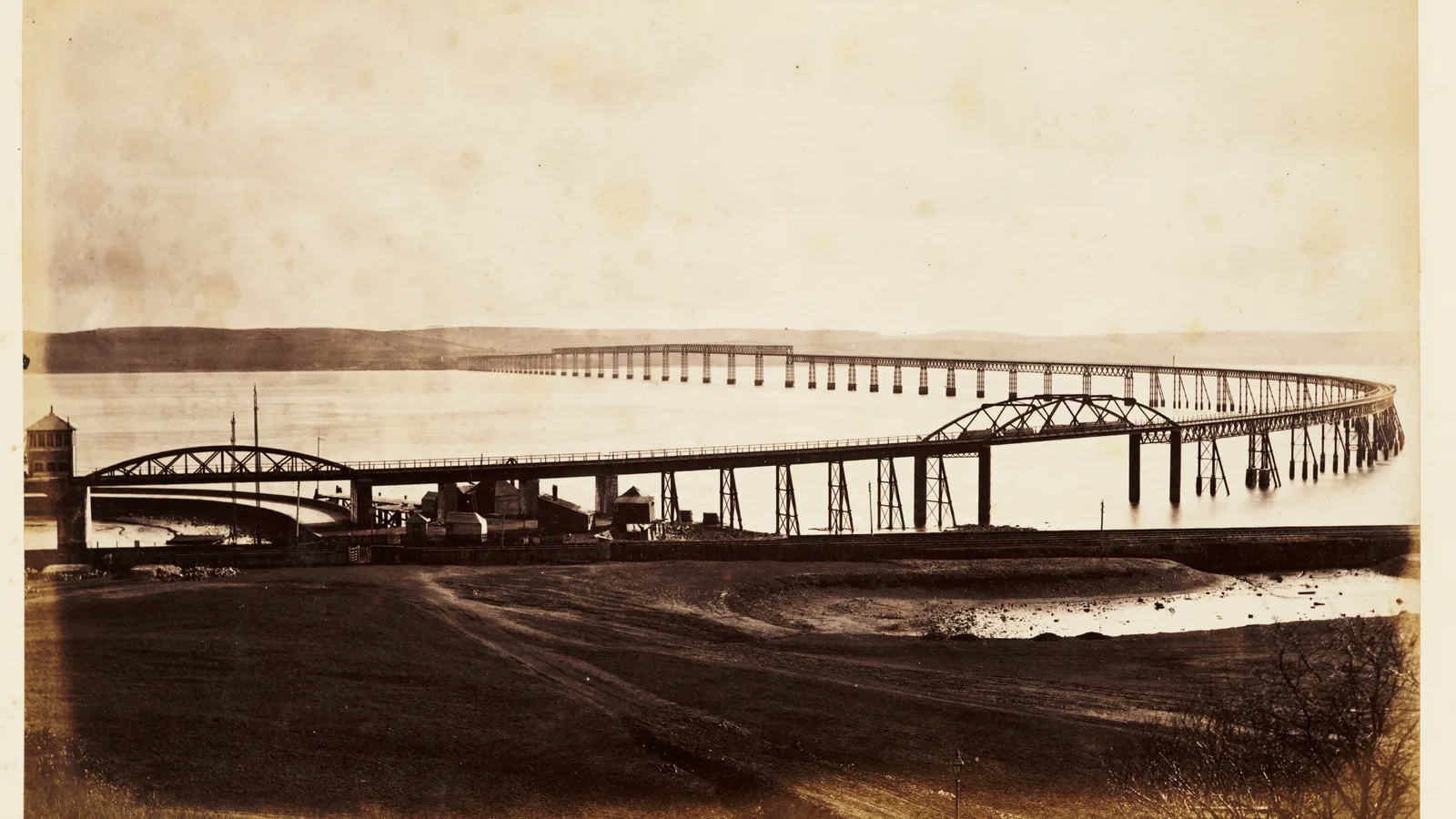
“The high girders of the first bridge blew down on 28.12.1879,” Historic Environment Scotland records in its listing for the Tay Railway Bridge. The Board of Trade’s report on the collapse states that the train had left St Fort station that evening in “a strong gale from about W.S.W.” Three commissioners examined the wreck under the Regulation of Railways Act, 1871, and one of them, Henry Cadogan Rothery, filed a report of his own naming the bridge’s engineer, Thomas Bouch, as chiefly to blame, a finding his two colleagues would not sign.
Quick facts
- When
- December 28, 1879 (the collapse) · December 31, 1879 (inquiry appointed) · January 3, 1880 (first sitting, Dundee) · June 30, 1880 (Board of Trade report) · June 20, 1887 (second bridge opened)
- Where
- the Tay Bridge, crossing the Firth of Tay between Wormit and Dundee, Scotland
- Who
- Thomas Bouch, engineer of the first bridge; Henry Cadogan Rothery, William Yolland and William Henry Barlow, inquiry commissioners; Hopkins, Gilkes & Co., ironwork contractor
- Outcome
- Rothery's separate report named Bouch "entirely responsible" for the design faults; Yolland and Barlow agreed on the causes but declined to assign blame; the Board of Trade's report counted "74 or 75" persons aboard the train; a second bridge, designed by Barlow, opened June 20, 1887
May 31, 1878: iron columns replace brick piers
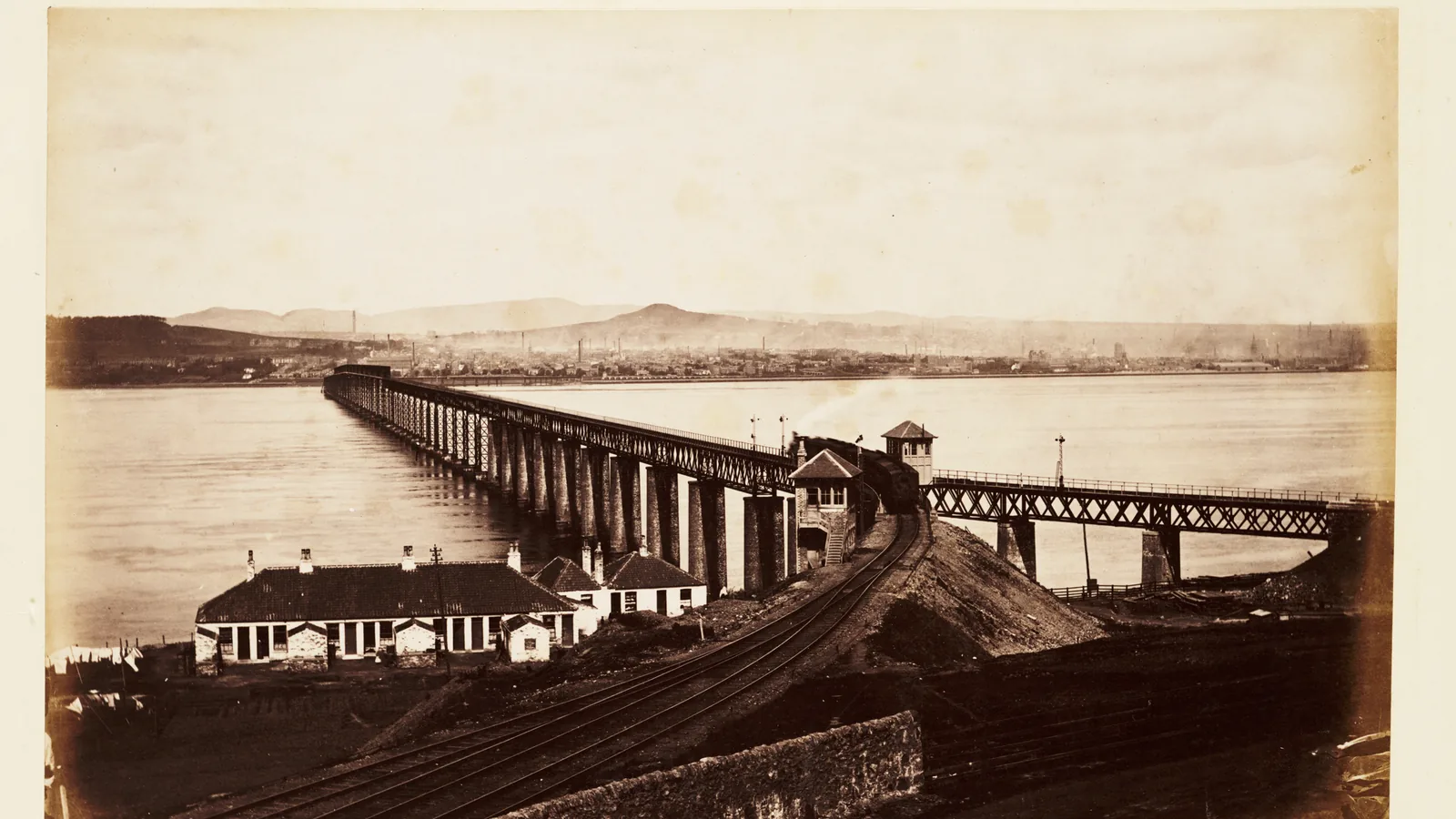
Network Rail’s history page for the bridge records that it opened on May 31, 1878, designed by Thomas Bouch for the North British Railway. Bouch’s original plan called for brick piers and spans of 227 feet across the Firth of Tay. The Board of Trade’s report states that the design changed during construction, to spans of 245 feet carried on iron columns above the high-water line, “in consequence of difficulties with the foundations.” In the Commons on July 8, 1880, Mr. Anderson, a member opposing a bill for the second bridge, said the North British Railway had obtained parliamentary powers in 1870 for a bridge “two miles long and to cost £350,000,” a figure he set against the cost of a comparable bridge at Montreal. That comparison was Anderson’s argument in debate, not a finding of the inquiry.
Sparks from the wheels
The Board of Trade’s report gives the count taken at the ticket platform: “there were in the tram at that time, 57 passengers for Dundee, 5 or 6 for Broughty Ferry, 5 for Newport, 2 season ticket holders, the engine driver, stoker, and guard of the train, and 2 other guards, making 74 or 75 persons in all.” The report does not reduce that range to a single figure. A witness near the bridge told the inquiry he saw “sparks flying from the wheels” as the train ran onto the high girders that night, in the same gale the report describes crossing from the west-southwest.

Rothery, Yolland and Barlow
On December 31, 1879, the Board of Trade appointed three men to hold the inquiry: Henry Cadogan Rothery, the Wreck Commissioner; William Yolland, the Chief Inspector of Railways; and William Henry Barlow, president of the Institution of Civil Engineers. The court first sat at Dundee on January 3, 1880. Rothery chose not to sign a joint report. “For reasons, into which it is not necessary to enter, I have thought it better to send in my own separate Report, instead of joining in a Report with my colleagues,” he wrote, adding that the two reports would agree substantially in their conclusions. His own conclusion read: “The conclusion to which I have come is that this bridge was badly designed, badly constructed, and badly maintained, and that its downfall was due to inherent defects in the structure, which must sooner or later have brought it down.” He continued: “For these defects both in the design, the construction, and the maintenance, Sir Thomas Bouch is in our opinion mainly to blame. For the faults of design he is entirely responsible.” He also found the makers of the ironwork at fault: “Messrs. Hopkins, Gilkes, & Co. are not free from blame for having allowed such grave irregularities to go on at the Wormit foundry.” Yolland and Barlow reached the same account of the causes but would not put a name to the blame. In the Commons on July 8, 1880, Mr. Anderson read their position into the record: “His two colleagues, while they agreed with him as to the cause[s] of the disaster, declined to award or apportion the blame of that disaster.”
"55 lbs. for wind pressure, and in the United States 50 lbs"
The Board of Trade’s report surveyed engineering practice before setting out its recommendation: “the practice in France appears to be to allow 55 lbs [per sq ft] for wind pressure, and in the United States 50 lbs. And although there seems to be no settled practice in England on the subject, Mr. Brunlees told us that he allowed 30 lbs. for wind pressure, and even Mr. Baker himself said that he allowed 28 lbs.” Describing the Forth Bridge’s construction ten years later, the engineer Wilhelm Westhofen wrote in Engineering that the figure had since changed: “The wind pressure to be provided for in the calculations for bridges in exposed positions is 56 lb. per square foot, according to the Board of Trade regulations.” Westhofen’s account also describes wind gauges installed on the island of Inchgarvie during the Forth Bridge’s construction, recording pressures as the new bridge went up.
Three figures for the dead
Thomas Bouch did not see the second bridge built. The Dictionary of National Biography’s account of his life says, in its own words, “Under the shock and distress of mind caused by this catastrophe Bouch’s health rapidly gave way, and he died at Moffat on 30 Oct. 1880.” The same entry puts the toll at “about seventy passengers.” The Board of Trade’s report had already given a narrower range, “74 or 75” persons, drawn from the ticket count at St Fort. A third figure comes from the memorial unveiled on both banks of the Tay on December 28, 2013: the Tay Rail Bridge Disaster Memorial Trust’s page for that memorial describes “59 known victims” named on it. William Henry Barlow, one of the three original commissioners, designed the replacement bridge, built by William Arrol & Co. Network Rail’s history page records it: “Opened to traffic: June 20, 1887.”
Key facts
- The original bridge opened May 31, 1878, designed by Thomas Bouch for the North British Railway (Network Rail).
- The design changed from brick piers and 227-foot spans to 245-foot spans on iron columns “in consequence of difficulties with the foundations” (Board of Trade report, 1880).
- The Board of Trade’s report counts “74 or 75 persons” aboard the train that fell with the high girders on December 28, 1879.
- The Board of Trade appointed Henry Cadogan Rothery, William Yolland and William Henry Barlow as inquiry commissioners on December 31, 1879, under the Regulation of Railways Act, 1871.
- Rothery’s separate report found Bouch “entirely responsible” for the design faults and “mainly to blame” for faults of construction and maintenance.
- Yolland and Barlow agreed with Rothery on the causes but “declined to award or apportion the blame,” Mr. Anderson told the House of Commons on July 8, 1880.
- The 1880 report recorded wind-pressure practice of 55 lb per square foot in France and 50 lb in the United States, against Brunlees’s 30 lb and Baker’s 28 lb in Britain.
- The replacement bridge, designed by Barlow and built by William Arrol & Co., “Opened to traffic: June 20, 1887” (Network Rail).
FAQ
How many people died in the Tay Bridge disaster?
The Board of Trade's 1880 report gives "74 or 75 persons" aboard the train. The Dictionary of National Biography's account says "about seventy passengers." A memorial unveiled in 2013 by the Tay Rail Bridge Disaster Memorial Trust names "59 known victims." No source among the three reconciles its count with the others.
Who did the 1880 inquiry blame for the Tay Bridge disaster?
Commissioner Henry Cadogan Rothery's separate report named the bridge's engineer, Thomas Bouch, saying he was "entirely responsible" for the design and "mainly to blame" for faults of construction and maintenance. Fellow commissioners William Yolland and William Henry Barlow agreed with his account of the causes but declined, in words read into the House of Commons on July 8, 1880, "to award or apportion the blame."
When did the second Tay Bridge open?
Network Rail's history page records that the replacement bridge, designed by William Henry Barlow and built by William Arrol & Co., "Opened to traffic: June 20, 1887."
Sources
- Board of Trade, "Tay Bridge Disaster: Report of the Court of Inquiry and Report of Mr. Rothery, upon the Circumstances Attending the Fall of a Portion of the Tay Bridge on the 28th December 1879" (London, June 30, 1880).
- Board of Trade, "Tay Bridge Disaster: Appendix to the Report of the Court of Inquiry" (London, August 4, 1880).
- Network Rail, "The history of the Tay Bridge, Dundee."
- UK Parliament, Historic Hansard, House of Commons, "North British Railway (Tay Bridge) Bill: Second Reading," HC Deb, July 8, 1880, vol. 253, cc1879-93.
- Historic Environment Scotland, Listed Building record LB25681, "Tay Railway Bridge."
- Tay Rail Bridge Disaster Memorial Trust, "Memorial" page.
- Wilhelm Westhofen, "The Forth Bridge," Engineering (1890), "Wind Pressure and Wind Gauges" section, via Wikisource.
- Dictionary of National Biography, 1885-1900, "Bouch, Thomas," via Wikisource.
Cite this article
- APA
- Our Earth's History. (2026, September 24). Three commissioners, two reports: the Tay Bridge, December 28, 1879. Our Earth's History. https://ourearthshistory.com/europe/modern/tay-bridge-december-28-1879-rothery-inquiry-bouch-high-girders/
- Chicago
- Our Earth's History. “Three commissioners, two reports: the Tay Bridge, December 28, 1879.” Our Earth's History, September 24, 2026. https://ourearthshistory.com/europe/modern/tay-bridge-december-28-1879-rothery-inquiry-bouch-high-girders/.
- MLA
- “Three commissioners, two reports: the Tay Bridge, December 28, 1879.” Our Earth's History, 24 Sep. 2026, https://ourearthshistory.com/europe/modern/tay-bridge-december-28-1879-rothery-inquiry-bouch-high-girders/.
Text licensed CC BY-NC-ND 4.0. Found an error? Tell us.