Written by the humble faqir Amanat Khan: the Taj Mahal, 1631–1653
.jpg)
TL;DR — Begun about 1631 for Mumtaz Mahal, who died at Burhanpur on June 17, 1631; mausoleum finished 1648, complex 1653; Amanat Khan signed the dome calligraphy in 1638.
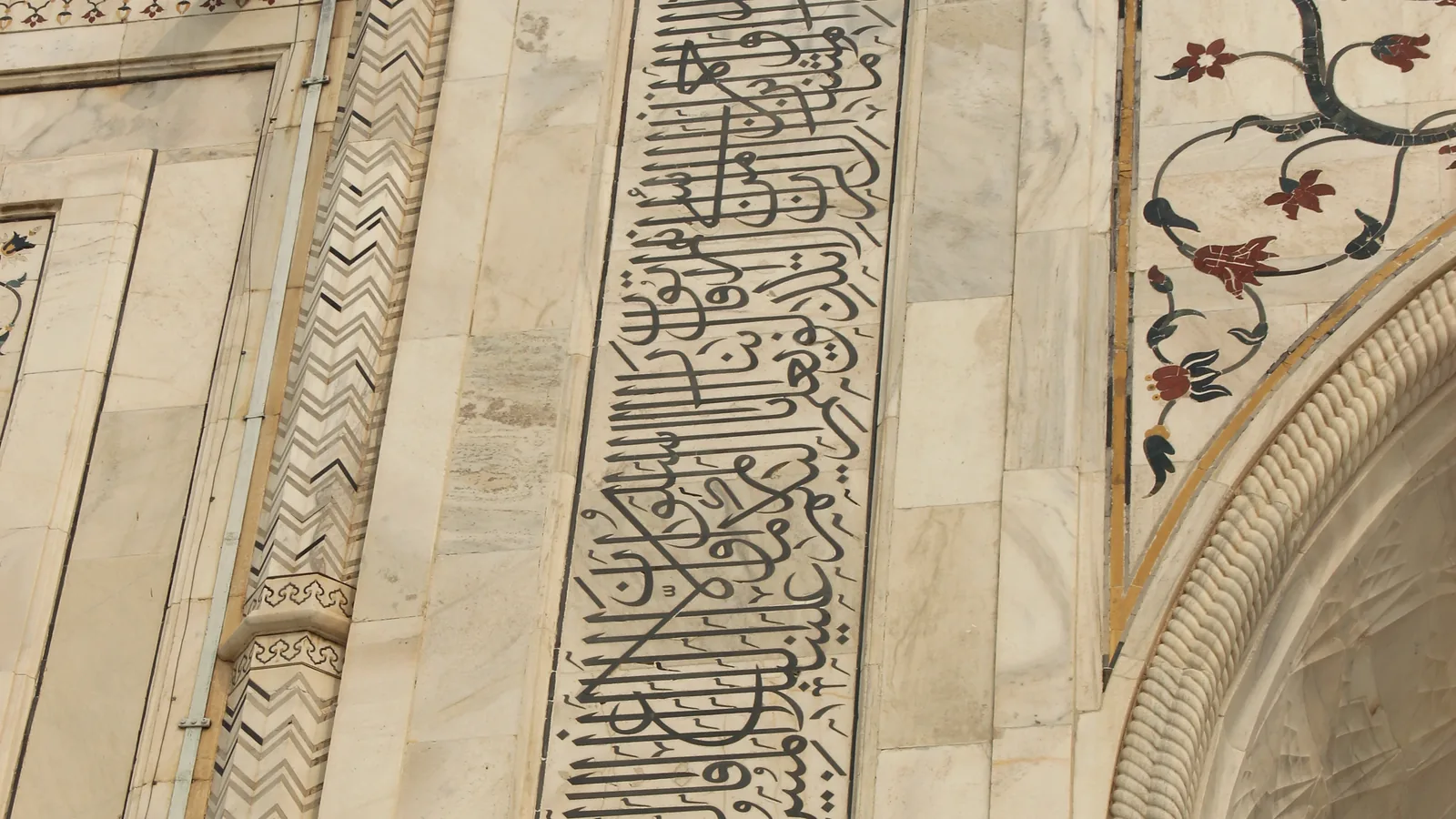
“Finished with His help; written by the humble faqīr Amānat Khan Šīrāzī in the year 1048 heǰrī, corresponding to the twelfth year of the auspicious reign.” That line, as Wayne Edison Begley transcribed it for Encyclopaedia Iranica, is the calligrapher’s signature inside the dome of the Taj Mahal at Agra; the year 1048 of the Islamic calendar is 1638. The Mughal emperor Shah Jahan raised the building over the grave of his wife Mumtaz Mahal, who died at Burhanpur on June 17, 1631. The Uttar Pradesh tourism department’s official Taj Mahal website gives three dates: construction “began about 1631 AD,” the principal mausoleum “was completed in 1648 AD,” and “the outlying buildings and gardens were finished five years later in 1653 AD.” The Archaeological Survey of India’s Agra Circle puts it in one sentence: “It took 17 years for the monument complex to be completed in 1648.”
Quick facts
- When
- April 1593 (Mumtaz Mahal born at Agra) · May 10, 1612 (marriage) · June 17, 1631 (her death at Burhanpur) · about 1631 (construction begun) · 1638 (dome calligraphy signed) · 1648 (mausoleum completed) · 1653 (outlying buildings and gardens finished) · 1857 (stones chiseled out) · 1908 (Curzon's restoration completed) · 1983 (World Heritage listing)
- Where
- Agra, on the west bank of the Yamuna (Jumna) downstream from the Agra Fort, in what is now Uttar Pradesh, India; Burhanpur, where Mumtaz Mahal died; the Makrana quarries in Rajasthan
- Who
- Shah Jahan, fifth Mughal emperor; his wife Arjumand Banu Begum, called Mumtaz Mahal; the calligrapher Abd-al-Haqq Shirazi, titled Amanat Khan; the court historian Abdul Hamid Lahauri; Lord Curzon, viceroy
- Outcome
- A white marble mausoleum on land exchanged for four havelis, its dome calligraphy signed by Amanat Khan in 1638, the tomb finished in 1648 and the complex in 1653; defaced in 1857, restored by 1908, listed as World Heritage in 1983
June 17, 1631: a death at Burhanpur
Arjumand Banu Begum was born at Agra in April 1593, the daughter of Asaf Khan, brother of the empress Nur Jahan. The tourism site’s page on her records her marriage to Prince Khurram, the future Shah Jahan, on May 10, 1612; she was his third wife, and the name Mumtaz Mahal, the page says, means “beloved ornament of the palace.” At Burhanpur in 1631 she died, in the words of the Agra Circle page, “during the birth of her fourteenth child.” Begley gives 17 Dhu’l-qa’da 1040, June 17, 1631.
Her body was buried first in the Zainabad garden. “Six months later,” the Agra Circle page continues, “her body was transferred to Agra to be finally enshrined in the crypt of the main tomb of the Taj Mahal.” Shah Jahan died at Agra on January 22, 1666, and the Agra Circle calls the Taj “the mausoleum of both Mumtaz Mahal and Shah Jahan.”
Four havelis for a riverbank
Gavin R. G. Hambly’s entry on Agra in Encyclopaedia Iranica places the tomb “downstream from the Agra Fort, on the same west bank of the Jumna.” The ground belonged to the Kachhwahas of Ajmer, and the Agra Circle page records the exchange: “The land was acquired from them in lieu of four havelis as is testified by a court historian, Abdul Hamid Lahauri, in his work titled the Badshah-Namah and the firmans (royal decrees).” A haveli is a mansion; the Badshah-Namah, or Padshahnama, is Lahauri’s chronicle of the reign.
The tourism site’s history page, citing Lahauri, records the foundations: “a network of wells was laid down along the river line and was filled with stones and other solid materials in order to lay a strong foundation of this grand mausoleum.” Two of its pages give the labor force as twenty thousand.
The marble came from Makrana in Rajasthan. The history page lists “Jasper from Punjab, jade and crystal from China, turquoise from Tibet, lapis lazuli & sapphire from Arabia and diamonds from Panna,” with red sandstone from the quarries of Sikri and Dholpur. The inlay, called parchin kari, “was developed by Mughal lapid artists from techniques taught to them by Italian craftsmen employed at court,” the calligraphy page says. On the architect the tourism site disagrees with itself. Its history page names “a Persian named Ustad Isha Khan” as chief architect; its creation-history page gives the principal design roles to Ustad Isa and Isa Muhammad Effendi of Persia.
Charbagh: four quadrants, sixteen squares, five fountains
The garden page describes “the cross-axial chahar bagh.” “The large square is divided by two main walkways (khiyaban) into four quadrants; each quadrant is in turn sub divided,” it reads, “so that sixteen sub-quadrants are formed.” At the crossing a marble pool, the hauz, holds five fountains; the writer Kanbo said it held “the water of the celestial Kausar,” the river of Paradise. Ebba Koch, professor at the Institute of Art History in Vienna, reads the plan, with the mausoleum at the edge of the garden, as a variant of the charbagh: “that of the waterfront garden.”
Water came from the Yamuna by aqueduct. Earthenware pipes 0.25 meters in diameter were laid 1.8 meters below the main walkway, and at the western wall, 9.47 meters tall, the drop gave the fountains their pressure. In 1903 some of the earthenware pipes were replaced with cast iron, the page adds.

Chiseled out in 1857, restored by 1908
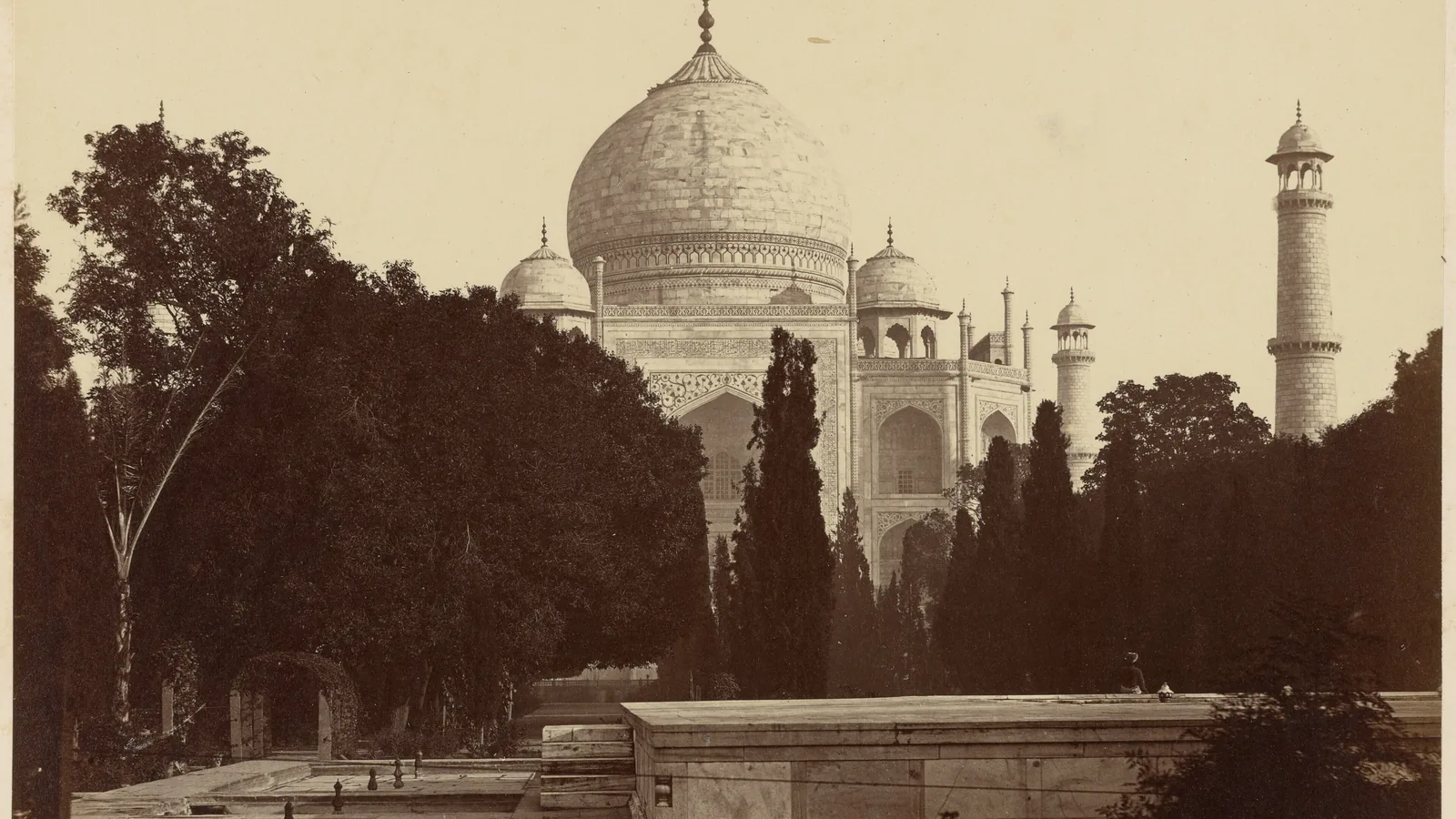
“During the time of the Indian rebellion of 1857,” the history page states, “the Taj Mahal was defaced by British soldiers and government officials, who chiseled out precious stones and lapis lazuli from its walls.” The viceroy Lord Curzon ordered a restoration that the page dates as “completed in 1908,” and he “commissioned the large lamp in the interior chamber, modeled after one in a Cairo mosque.” The garden page adds: “The four marble benches around the tank were put in 1907-08 on the order of Curzon,” and a drinking fountain “was put up in 1909-10 by the British government.” The Agra Circle lists the Taj Mahal among its World Heritage Monuments with the year 1983.
Amanat Khan, who signed the dome
Abd-al-Haqq of Shiraz and his elder brother Afzal Khan came from Iran to India “around 1017/1608,” Begley writes; the tourism site’s calligraphy page says 1609. When Mumtaz Mahal died he “was appointed to select the Koranic passages and design the calligraphy for her tomb. One year later, the emperor honored him with the title Amānat Khan and promoted him to the manṣab rank of 900.” Begley cites the Padshahnama, Calcutta edition of 1867–69, vol. Ia, p. 535.
The calligraphy page counts the program: “There are twenty two passages in all, including fourteen whole chapters, some of which are read out as part of the Islamic funeral ceremony itself.” The script is thuluth. On the Great Gate the text reads “O SOUL, THOU ART AT REST. RETURN TO THE LORD AT PEACE WITH HIM, AND HE AT PEACE WITH YOU.” Amanat Khan died, by the Padshahnama (II, p. 737) as Begley cites it, in Shah Jahan’s eighteenth regnal year, 1644–45. The calligraphy page quotes a shorter form of his name-line at the base of the dome, “Written by the insignificant being, Amanat Khan Shirazi,” and Begley’s fuller reading supplies the date. The calligraphy inside the domed hall, he writes, “was completed in 1048/1638.” The mausoleum had ten more years to go, and the humble faqir had already dated his work to the twelfth year of the reign, 1638.
Key facts
- Arjumand Banu Begum, called Mumtaz Mahal, was born at Agra in April 1593 and married Prince Khurram, the future Shah Jahan, on May 10, 1612 (Uttar Pradesh tourism site).
- She died at Burhanpur on June 17, 1631, “during the birth of her fourteenth child”; Begley gives 17 Dhu’l-qa’da 1040 (ASI Agra Circle; Encyclopaedia Iranica).
- Her body lay in the Zainabad garden and “six months later” was moved to Agra (ASI Agra Circle).
- The land belonged to the Kachhwahas of Ajmer and was acquired “in lieu of four havelis,” as Abdul Hamid Lahauri’s Badshah-Namah and the firmans record (ASI Agra Circle).
- Construction “began about 1631 AD”; the mausoleum “was completed in 1648 AD” and the outlying buildings and gardens in 1653 (tourism site); the Agra Circle gives 17 years to completion in 1648.
- Twenty thousand workers are given on two tourism-site pages; the marble came from Makrana, Rajasthan.
- Abd-al-Haqq Shirazi received the title Amanat Khan and a mansab of 900 one year after the empress’s death; the dome calligraphy was completed in 1048/1638; he died in 1644–45 (Padshahnama as cited by Begley).
- British soldiers and officials chiseled stones from the walls in 1857; Curzon’s restoration was completed in 1908, with benches in 1907–08 and a drinking fountain in 1909–10 (tourism site).
FAQ
When was the Taj Mahal built?
The Uttar Pradesh tourism department's official site says construction began about 1631, the principal mausoleum was completed in 1648 and the outlying buildings and gardens in 1653. The Archaeological Survey of India's Agra Circle says the complex took 17 years and was completed in 1648.
Who wrote the calligraphy on the Taj Mahal?
Abd-al-Haqq of Shiraz, titled Amanat Khan by Shah Jahan. His signature inside the dome is dated 1048 of the Islamic calendar, 1638. The texts are 22 passages from the Quran, including 14 whole chapters, in thuluth script.
How did Shah Jahan get the land for the Taj Mahal?
It belonged to the Kachhwahas of Ajmer and was exchanged for four havelis, or mansions. The Archaeological Survey of India cites the court historian Abdul Hamid Lahauri's Badshah-Namah and the royal decrees for the transaction.
Sources
- Government of Uttar Pradesh, Department of Tourism, official Taj Mahal website, "The Cause of The Taj :: Mumtaz Mahal."
- Government of Uttar Pradesh, Department of Tourism, official Taj Mahal website, "The Maker of The Taj :: Emperor Shah Jahan."
- Government of Uttar Pradesh, Department of Tourism, official Taj Mahal website, "History of The Taj Mahal."
- Government of Uttar Pradesh, Department of Tourism, official Taj Mahal website, "Creation History."
- Government of Uttar Pradesh, Department of Tourism, official Taj Mahal website, "Calligraphy."
- Government of Uttar Pradesh, Department of Tourism, official Taj Mahal website, "Taj Garden."
- Archaeological Survey of India, Agra Circle, "Taj Mahal" (World Heritage Monuments page).
- Encyclopaedia Iranica — Wayne Edison Begley, "AMĀNAT KHAN ŠĪRĀZĪ," vol. I, fasc. 9, pp. 923–924 (December 15, 1989; updated July 16, 2018).
- Encyclopaedia Iranica — Gavin R. G. Hambly, "AGRA," vol. I, fasc. 6, pp. 611–612 (December 15, 1984; updated June 6, 2018).
Cite this article
- APA
- Our Earth's History. (2026, September 22). Written by the humble faqir Amanat Khan: the Taj Mahal, 1631–1653. Our Earth's History. https://ourearthshistory.com/south-asia/early-modern/taj-mahal-1631-1648-padshahnama-amanat-khan/
- Chicago
- Our Earth's History. “Written by the humble faqir Amanat Khan: the Taj Mahal, 1631–1653.” Our Earth's History, September 22, 2026. https://ourearthshistory.com/south-asia/early-modern/taj-mahal-1631-1648-padshahnama-amanat-khan/.
- MLA
- “Written by the humble faqir Amanat Khan: the Taj Mahal, 1631–1653.” Our Earth's History, 22 Sep. 2026, https://ourearthshistory.com/south-asia/early-modern/taj-mahal-1631-1648-padshahnama-amanat-khan/.
Text licensed CC BY-NC-ND 4.0. Found an error? Tell us.