Three records of one escape: Shivaji at Agra, August 1666

TL;DR — Three records of Shivaji’s 1666 flight from Agra agree that he left with his son and differ on the date, the road home and the month he arrived.
“This morning Shivaji was found to have fled away from Agra,” Ballu Sah wrote to Kalyandas, the diwan of Amber, on August 18, 1666. Ballu Sah served Kumar Ram Singh, the Rajput prince who had held the Maratha leader Shivaji in his charge at the court of the Mughal emperor Aurangzeb since May. His letter belongs to one of three record traditions for the escape. The second is the Ma’asir-i-‘Alamgiri, a Mughal court chronicle finished in 1710. The third is the Sabhasad Bakhar, a Marathi life of Shivaji written at the command of his son Rajaram. All three have Shivaji leave with his son Sambhaji, and two describe baskets of sweets. They disagree on the date, on the road he took home and on the month he reached it.
Quick facts
- When
- April 5, 1666 (Aurangzeb's summons) · May 11 (Shivaji reaches Agra) · May 12 (audience on the emperor's 60th lunar birthday) · May 15 (Ram Singh's security bond) · August 18 (escape discovered, per Ram Singh's staff) or August 19 (per the Ma'asir-i-'Alamgiri) · about September 12 (return, as Sarkar dated it) or December 1666 (per the Bombay Gazetteer) · March 9, 1668 (title of Rajah)
- Where
- Maluk Chand's serai and the Diwan-i-Khas of Agra Fort; Kumar Ram Singh's camp at Agra; Amber, where the letters were sent; Rajgarh (Rajgad), Shivaji's fort; Jinji, where the Sabhasad Bakhar was finished
- Who
- Shivaji; his son Sambhaji; the emperor Aurangzeb; Kumar Ram Singh, son of Mirza Rajah Jai Singh; the kotwal Fulad Khan; the letter writers Ballu Sah and Parkal-das; the chronicler Saqi Must'ad Khan; the bakhar writer Krishnaji Anant Sabhasad; the historian Jadunath Sarkar
- Outcome
- Shivaji left Agra with his son and reached his own country. Ram Singh's staff dated the escape to the night before August 18 and his return to about September 12 (Sarkar's reckoning); the Mughal chronicle gave August 19; the Bombay Gazetteer gave December 1666 for the return; the Sabhasad Bakhar sent him home by Benares and Golkonda, a route Sarkar called "pure fiction"
May 12, 1666: one audience on a lunar birthday
Aurangzeb’s farman of April 5, 1666, told him to come “without delay, in full confidence in my grace,” and promised that after an audience he would be “given permission to return home.” The invitation followed the Treaty of Purandar of June 1665, made with the Mughal general Mirza Rajah Jai Singh, Ram Singh’s father. The Mughal chronicle and the Maharashtra State Gazetteer count 23 forts surrendered under it; the Sabhasad Bakhar counts 27.
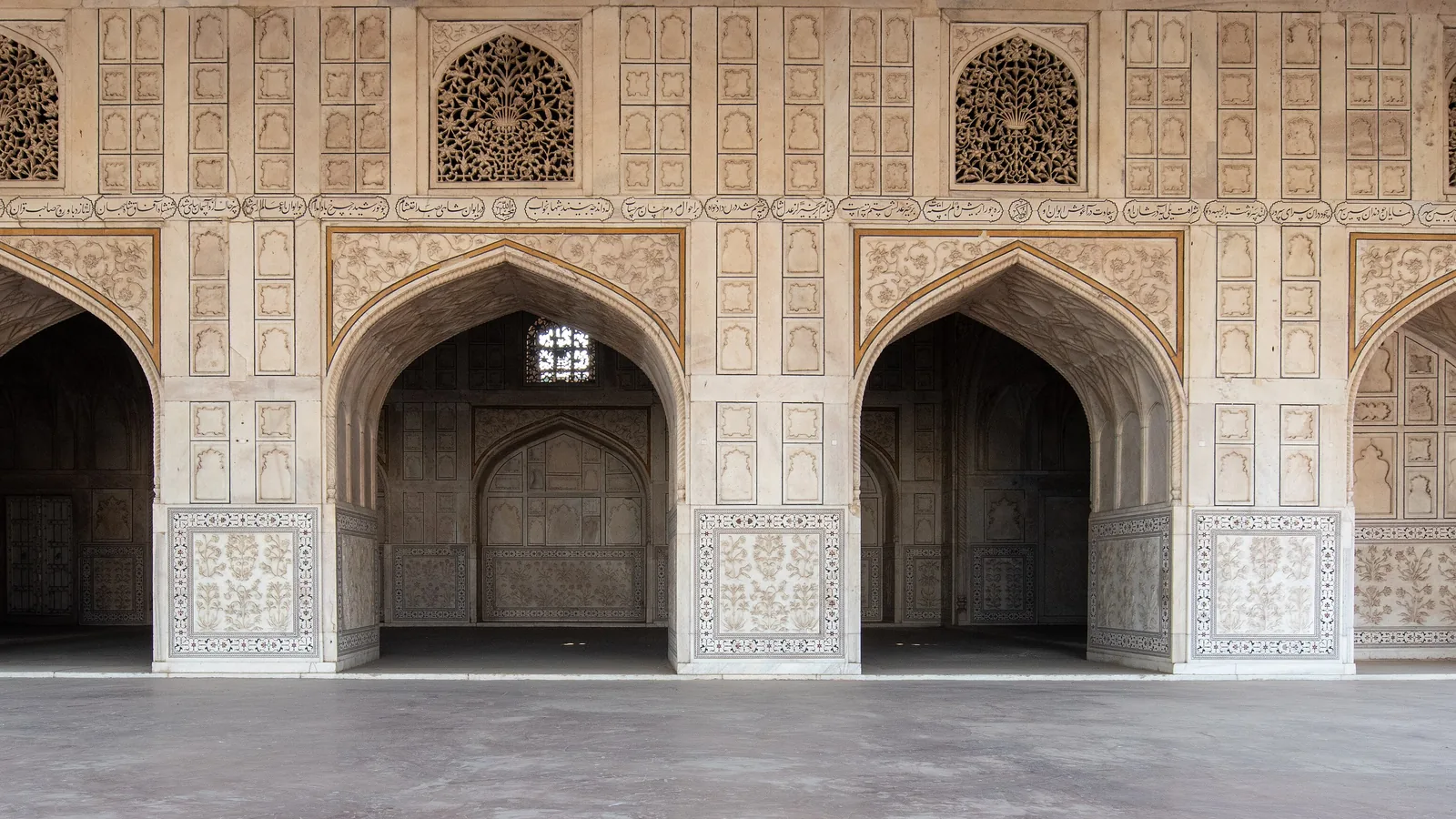
Shivaji reached Maluk Chand’s serai, a caravan lodging near Agra, on May 11. On Saturday, May 12, the Ma’asir-i-‘Alamgiri records, “the Emperor was weighed on his 60th lunar birthday,” and Shivaji and his son were received that day. A letter of Ram Singh’s staff dated Agra, May 15, describes the same audience and adds, “It was the Emperor’s birthday.” The Archaeological Survey of India places the meeting in the Diwan-i-Khas, the hall of select audience inside Agra Fort.
The two accounts of the gifts differ. The letter gives 1,000 mohars and 2,000 rupees as nazar, the ceremonial offering, and 5,000 rupees as nisar; the chronicle gives 1,600 ashrafis and 6,000 rupees. Shivaji was placed in the ranks of nobles, and “the Emperor neither talked with him nor addressed any word to him.” Robes of honor went to the grand wazir Jafar Khan and to Rajah Jaswant Singh. Shivaji told Ram Singh that he had been kept standing too long and that he cast off the mansab, his imperial rank. To the nobles who brought him a robe he said, “Kill me, imprison me, if you like; but I won’t wear the Khilat.” The chronicle records only that he went into a corner and “made improper expressions of dissatisfaction and complaint to Kumar Ram Singh.” In the Sabhasad Bakhar he is placed below Jaswant Singh and asks Ram Singh for his dagger.
Letters from Ram Singh's household
The first tradition comes from the men closest to the prisoner. Ram Singh’s officers wrote in Dingal, the Rajasthani form of Hindi, to his family’s capital at Amber, sometimes “in the very night of the conversation” they reported. The letters lay in the Jaipur state archives until 1939, when Jadunath Sarkar brought them to light; he printed translations in House of Shivaji, whose third edition appeared in 1955.
Their writers had a stake in the story. After the audience, the letters record, the emperor’s secret council considered “either to kill Shiva or to confine him in a fortress, or to throw him into prison.” Ram Singh argued that the emperor should kill him first, since Shivaji had come under his father’s guarantee of safety. Aurangzeb asked instead whether he would stand security for Shivaji, and on May 15 Ram Singh signed the bond. From then on his household answered for the prisoner.
When the escape came, the letters tracked the damage to their master. Ballu Sah’s note of August 18 asked for watch on every path and ghat and for any traveler dressed as a jogi or sannyasi to be searched. By September 2 the kotwal of Agra, Fulad Khan, had told the emperor that Shivaji slipped out on the Kumar’s side of the guard, and Ram Singh’s rank was cut and his lands reassigned. On September 3 Parkal-das wrote that Shivaji “had slipped out by crouching down in the baskets [of sweetmeats] which used to be sent out [of his camp].” Four men on guard that day were held by Fulad Khan and questioned under threat. They said Ram Singh had helped the escape, then withdrew the statement before Fidai Khan, saying the Kumar had done nothing of the kind.

Inside a Mughal chronicle finished in 1710
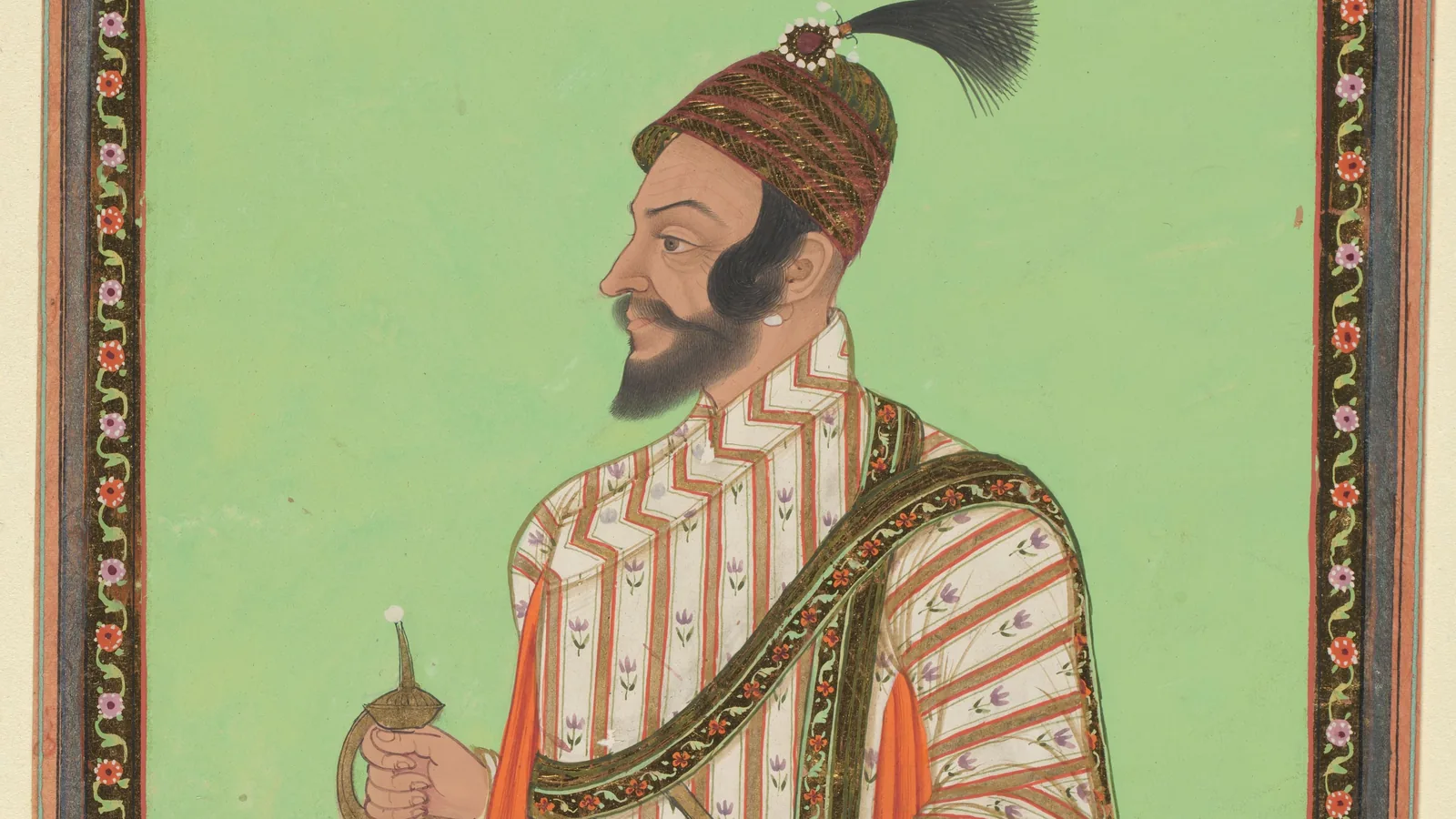
The second tradition was written for the throne. Saqi Must’ad Khan, a court official, finished the Ma’asir-i-‘Alamgiri in 1710, three years after Aurangzeb’s death, at the urging of the emperor’s last secretary, Inayetullah Khan, who had the state archives opened for him. Sarkar, who translated it in 1947, wrote in his introduction that in these official histories “no fact has been really falsified though credit is often given to the Emperor where he did not deserve it.”
Jai Singh wrote from the Deccan advising that Shivaji be pardoned, Fulad Khan’s guards were withdrawn and Ram Singh slackened his watch. Then Shivaji, whom the chronicle names in hostile terms, “feigning sickness fled with his son” on Sunday, August 19. The chronicle mentions no baskets, and it records that Ram Singh was dismissed from his rank, where his own staff wrote that the rank was reduced.
The Maharashtra State Gazetteer’s chapter on the rise of Maratha power, contributed by Sarkar himself, follows the chronicle’s date. It places the escape “in the night of 19th August,” with Shivaji and Sambhaji, then a boy of nine, hidden in baskets of sweets that had been sent out daily for holy men.
Sabhasad's life of Shivaji, finished at Jinji
The third tradition was written for Shivaji’s successors. Krishnaji Anant Sabhasad was an officer of Chhatrapati Rajaram, and by the bakhar’s closing line he finished it at Jinji in the Shaka year 1616. Its translator, Surendranath Sen, called it “Written only sixteen years after Sivaji’s death,” based mainly on the writer’s own knowledge and on hearsay. Of the Maratha chroniclers, Sen wrote, “To them Sivaji was a divinity.”
The bakhar sets the whole visit in Delhi. Sen’s footnote corrects it to Agra and credits Sarkar with first pointing out the error. The bakhar gives no calendar date for the escape. In its account Shivaji sent ten baskets of sweets to the wazirs each day, two porters to a basket. The guards opened one or two, found sweets and let them pass. “Then one day the Raje and his son crouched in a basket.” A servant, Hiroji Farzand, lay on Shivaji’s cot in his clothes with a boy massaging his legs, and the guards took him for Shivaji for most of the next day. No letter from Ram Singh’s staff and no line of the chronicle mentions Hiroji.
Twenty-five days, or December
The traditions part furthest over the road home. In the bakhar, Shivaji and his companions smeared themselves with ashes, dressed as faqirs and went to Mathura, where he left Sambhaji with three Brahman brothers. He went on to Benares, bathed at Prayag, had rites for Gaya performed, and came home by Golkonda, Bhaganagar and Bijapur to Rajgad.
Sarkar rejected the pilgrimage stories on the evidence of the Jaipur letters. A Dingal letter from Delhi dated November 19, 1666, passed on newsletters from the Deccan that cited spies: Shivaji “reached his fort in 25 days,” a son with him had died on the way, another son had been born there, and he had lain ill for many days. From it Sarkar dated the return to Rajgarh to about September 12. He wrote that stories of a flight through Allahabad, Benares and Gaya, told by the historian Khafi Khan and others, were “pure fiction,” and that the 25-day limit “bars out all these anecdotes as impossible.” The spies’ report of a son’s death did not concern Sambhaji, whom the Maharashtra gazetteer follows into his own reign after his father’s death.
Older government histories give another date. The History of the Konkan in the Bombay Gazetteer says Shivaji did not return to his fort “till December 1666, having in the interval been to and escaped from Delhi,” and W. W. Loch’s Dakhan History of 1877 has him back in the Deccan “at the end of the year.”
Named Rajah in March 1668
The court did not pursue the fugitive for long. Jai Singh died on August 28, 1667, and Sarkar wrote that no Mughal governor in the Deccan was then willing to face a war with Shivaji. A Persian newsletter of May 6, 1667, records Aurangzeb’s order to tell Shivaji’s agent that his offenses were pardoned and his son enrolled as an imperial officer. Prince Muhammad Muazzam, the new viceroy of the Deccan, sent the result. His letter of March 9, 1668, reads: “His Gracious Majesty has elevated your head by granting you the title of Rajah, which was the extreme point of your desires.”
Key facts
- Aurangzeb’s farman of April 5, 1666, summoned Shivaji to Agra and promised he would be “given permission to return home” (Sarkar, House of Shivaji).
- Shivaji reached Maluk Chand’s serai near Agra on May 11, 1666, and was received on May 12, the day the emperor was weighed on his 60th lunar birthday (Ma’asir-i-‘Alamgiri; Dingal letter of May 15).
- The Archaeological Survey of India places the meeting in the Diwan-i-Khas of Agra Fort.
- Ram Singh’s staff recorded 1,000 mohars and 2,000 rupees as nazar; the Mughal chronicle recorded 1,600 ashrafis and 6,000 rupees.
- Ram Singh signed a security bond for Shivaji on May 15, 1666 (Dingal letters).
- Ballu Sah reported the escape on the morning of August 18, 1666; the Ma’asir-i-‘Alamgiri and the Maharashtra State Gazetteer give August 19.
- Parkal-das’s letter of September 3, 1666, and the Sabhasad Bakhar both describe Shivaji leaving in a basket; the Mughal chronicle says he feigned sickness and fled.
- Sarkar dated the return to Rajgarh to about September 12, 1666, from a letter reporting 25 days on the road; the Bombay Gazetteer’s History of the Konkan gives December 1666.
- Prince Muhammad Muazzam’s letter of March 9, 1668, told Shivaji he had been granted the title of Rajah.
FAQ
How did Shivaji escape from Agra in 1666?
A letter written at Agra on September 3, 1666, by Parkal-das of Ram Singh's staff said Shivaji slipped out crouching in baskets of sweetmeats sent out of his camp. The Marathi Sabhasad Bakhar also describes baskets of sweets. The Mughal court chronicle Ma'asir-i-'Alamgiri says only that he feigned sickness and fled with his son.
On what date did Shivaji escape from Agra?
Ram Singh's staff wrote on August 18, 1666, that Shivaji had been found gone that morning. The Ma'asir-i-'Alamgiri gives Sunday, August 19, and the Maharashtra State Gazetteer chapter by Jadunath Sarkar gives the night of August 19. The Sabhasad Bakhar gives no date.
When did Shivaji get back home after escaping from Agra?
A Dingal letter of November 19, 1666, reported that he reached his fort in 25 days, and Sarkar dated his return to Rajgarh to about September 12. The Bombay Gazetteer's History of the Konkan says he did not return until December 1666.
Sources
- Jadunath Sarkar, House of Shivaji: Studies and Documents on Maratha History, Royal Period, 3rd ed. (Orient Longman, 1955): chapter "Shivaji's Visit to Aurangzib," with translations of the Dingal letters of Kumar Ram Singh's officers, Aurangzeb's farman of April 5, 1666, and Prince Muhammad Muazzam's letter of March 9, 1668 (Internet Archive text).
- Saqi Must'ad Khan, Maasir-i-'Alamgiri: A History of the Emperor Aurangzib-'Alamgir (Reign 1658–1707 A.D.), tr. and annotated by Sir Jadunath Sarkar (Royal Asiatic Society of Bengal, Bibliotheca Indica, 1947): translator's introduction and the entries for 1665 and 1666 (Internet Archive, Digital Library of India copy).
- Krishnaji Anant Sabhasad, Siva Chhatrapati: being a translation of Sabhasad Bakhar with extracts from Chitnis and Sivadigvijaya, with notes, tr. Surendranath Sen (University of Calcutta, 1920): the Agra visit, the escape and the return, translator's footnotes 83 and 88, and the notes on the bakhar's date (North Bengal University Institutional Repository).
- Government of Maharashtra, Gazetteers Department, Maharashtra State Gazetteer, History Part III: Maratha Period, chapter 1, "Rise of the Maratha Power" (chapter contributed by Sir Jadunath Sarkar).
- Government of Maharashtra, Gazetteers Department, Gazetteer of the Bombay Presidency, "History of the Konkan," section VI, "Shivaji, 1648 to 1680."
- Government of Maharashtra, Gazetteers Department, Gazetteer of the Bombay Presidency, W. W. Loch, "Dakhan History: Musalman and Maratha, A.D. 1300–1818," part I (contributed 1877).
- Archaeological Survey of India, "Agra Fort," World Heritage page.
Cite this article
- APA
- LETTER. (2026, September 28). Three records of one escape: Shivaji at Agra, August 1666. Our Earth's History. https://ourearthshistory.com/south-asia/early-modern/shivaji-agra-1666-escape-three-records-dingal-maasir-sabhasad/
- Chicago
- LETTER. “Three records of one escape: Shivaji at Agra, August 1666.” Our Earth's History, September 28, 2026. https://ourearthshistory.com/south-asia/early-modern/shivaji-agra-1666-escape-three-records-dingal-maasir-sabhasad/.
- MLA
- LETTER. “Three records of one escape: Shivaji at Agra, August 1666.” Our Earth's History, 28 Sep. 2026, https://ourearthshistory.com/south-asia/early-modern/shivaji-agra-1666-escape-three-records-dingal-maasir-sabhasad/.
Text licensed CC BY-NC-ND 4.0. Found an error? Tell us.