An envoy to Luanda in 1622: Njinga of Ndongo and Matamba
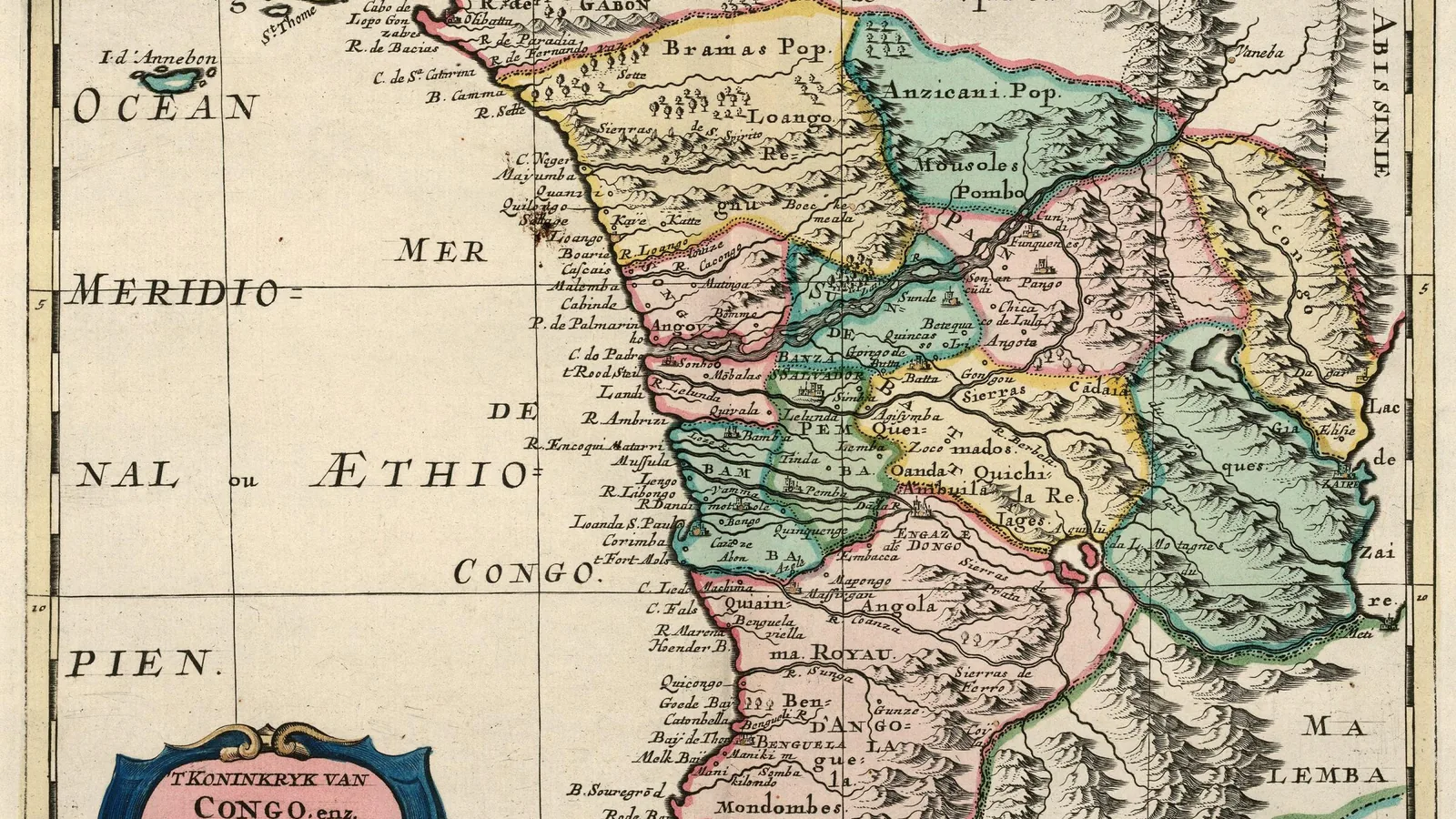

TL;DR — In Luanda in 1622, Njinga won a Portuguese withdrawal and recognition of Ndongo’s sovereignty from Governor Correia de Sousa, in exchange for open trade and a promise of conversion.
“Em seu encontro em Luanda com o governador João Correia de Sousa, conseguiu garantir a retirada das tropas portuguesas de Luanda e o reconhecimento da soberania do Dongo,” write Ronaldo Vainfas and Roberta Guimarães Franco in the journal Tempo: in her meeting in Luanda with Governor João Correia de Sousa, she secured the withdrawal of Portuguese troops from Luanda and recognition of Ndongo’s sovereignty. In exchange, per the same account, Ndongo would open its trade with the Portuguese, chiefly in captives, and its rulers would promise conversion to Catholicism. This account uses the spelling Njinga; UNESCO’s 2014 publication writes Nzinga Mbandi.
Quick facts
- When
- 1622 (Luanda mission) · 1624 (accession) · mid-1630s (conquest of Matamba) · 1641-1648 (alliance with the Dutch West India Company) · 1646 (defeat at Cavanga) · October 1656 (peace signed at Matamba) · November 24, 1657 (ratification in Lisbon) · December 17, 1663 (death)
- Where
- Luanda, Ndongo, Matamba and the Kwanza river region, in present-day Angola
- Who
- Njinga (baptized Ana de Sousa), daughter of the ngola Kiluanje; her brother Ngola Mbandi, king of Ndongo; Governor João Correia de Sousa; her sisters Kambu (Barbara) and Funji (Graça); the Italian priest Giovanni Antonio Cavazzi
- Outcome
- The 1622 meeting won a Portuguese troop withdrawal and recognition of Ndongo's sovereignty, which lapsed when Portugal kept its fort at Ambaca. After her brother's death in 1624 Njinga ruled Ndongo, conquered Matamba, allied with the Dutch from 1641 to 1648, and in October 1656 signed a peace at Matamba that Lisbon ratified on November 24, 1657
Kiluanje's daughter, born 1582
Vainfas and Franco give her origin in one clause: “Natural do Dongo ou Ngola, nasceu em 1582 de uma união do rei ngola Kiluanje (morto em 1617) com uma de suas escravas, a concubina kenguela Cacombe.” She was born in Ndongo in 1582, the daughter of the ngola Kiluanje, who died in 1617, and Kacombe, a kenguela concubine among his household. Her father’s death left the throne to her brother. UNESCO’s account of the succession is direct: “His son, Ngola Mbandi, became the new king but he had neither his father’s charisma nor the intelligence of his sister Nzinga Mbandi.” Ngola Mbandi sent Njinga to Luanda in 1622 to negotiate with Correia de Sousa, whose term as governor ran from 1621 to 1622, according to the Dictionary of African Christian Biography.
A chair for the meeting
Marina de Mello e Souza, in a paper archived by the Universidad Autónoma de Madrid, describes how the Luanda audience unfolded: “Recebida com pompa pelo governador João Correia de Sousa, mostrou sua autoridade na audiência que Cavazzi descreveu a partir do que ela própria lhe contou”: received with ceremony by Governor Correia de Sousa, she showed her authority in the audience that the priest Giovanni Antonio Cavazzi described from what she herself told him. In Cavazzi’s telling, offered no chair equal to the governor’s, she had an attendant from her retinue kneel to serve as her seat rather than stand below him. Cavazzi’s account appeared in his book of 1687, sixty-five years after the meeting and twenty-four years after Njinga’s death; Mello e Souza’s paper notes that Cavazzi worked on the manuscript until 1672 before its publication. He had been her confessor from 1657 to 1663 and set the episode down from her own later telling, not as an eyewitness. UNESCO’s publication attributes the same scene to Cavazzi’s 1687 book and adds that it inspired one of his paintings.
Ana de Sousa, baptized
The Dictionary of African Christian Biography records her baptism in Luanda: “Njinga was baptized at age 40 in Luanda after leading a diplomatic mission. She took the baptismal name ‘Ana de Sousa,’ adopting the given name of her hostess and the surname of Governor João Correia de Sousa, who served as her godfather.” Linda Heywood, in a Bostonia interview, dates the baptism to 1620. The Vainfas and Franco paper and Mello e Souza’s paper both give 1622. UNESCO’s publication gives 1623 in one section, after describing the events of 1622 in its main narrative.
War and a mysterious death, 1624 to 1646
Ngola Mbandi died in 1624. UNESCO calls the circumstances mysterious and reports rival explanations, suicide and poisoning; Njinga succeeded him. In the mid-1630s she conquered Matamba and built a new capital there, according to Enslaved.org. After the Dutch West India Company occupied Luanda in 1641, Enslaved.org records that “Njinga’s forces and the Dutch held off the Portuguese from 1641 to 1648,” until Portuguese reinforcements arrived from Brazil. Vainfas and Franco write that her army won a major victory in 1644 but lost at Cavanga in 1646, when two of her sisters were captured and executed by the Portuguese. Enslaved.org and the Dictionary of African Christian Biography instead place her sisters Kambu and Funji in Portuguese custody earlier, from a baptism in 1625 and capture in 1629, and describe both as spies for Njinga during their years at Luanda and the fort at Massangano. The Dictionary of African Christian Biography states that Funji, known also as Graça, was executed after Portuguese troops found letters showing she had spied for Njinga.
Peace at Matamba, October 1656
Mello e Souza’s paper quotes the terms recorded by the chronicler Antonio de Oliveira de Cadornega: “lhe foi concedida a paz e amizade em nome de Sua Majestade com condição que havia de viver católica.” Peace and friendship were granted in the name of the Portuguese crown, on condition that she live as a Catholic, permit the church to operate in her kingdom, set old grievances aside, recognize only enslaved people who had fled to her territory within the preceding ten years, and hand over the Jaga Calandola. The paper places the signing at Matamba in October 1656. UNESCO records that the Portuguese crown’s renunciation of its claims to Ndongo was ratified in Lisbon on November 24, 1657. In a letter of December 1655, quoted in the same paper, the Portuguese side had asked for 200 captives in ransom for her sister Barbara; Njinga called the sum too high and offered 130.

Death, December 17, 1663
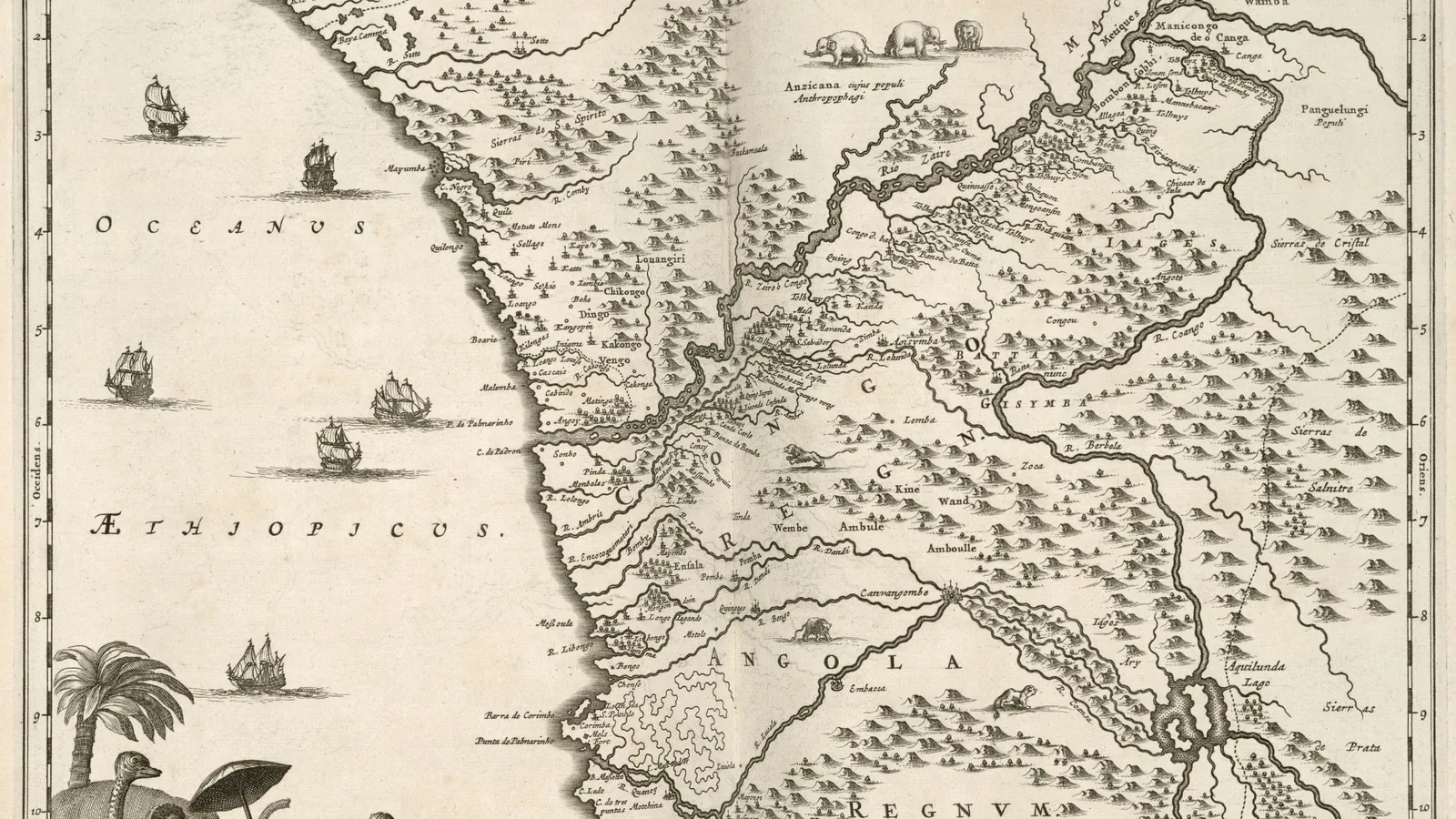
Njinga died on December 17, 1663, according to both UNESCO and Enslaved.org. UNESCO gives her age at death as 82; Mello e Souza’s paper describes her only as “mais de 80” (over 80), since her birth year is itself given as 1580 or 1582 depending on the source. Mello e Souza records that Cavazzi administered last rites and took part in a funeral combining Catholic and local rites. Enslaved.org states that her sister Barbara succeeded her to the throne.
Key facts
- Born in Ndongo in 1582, daughter of the ngola Kiluanje, who died in 1617 (Vainfas and Franco, Tempo, 2023).
- Sent to Luanda in 1622 by her brother Ngola Mbandi to negotiate with Governor João Correia de Sousa (UNESCO, 2014).
- Secured a Portuguese troop withdrawal and recognition of Ndongo’s sovereignty; the peace lapsed when Portugal kept its fort at Ambaca (Vainfas and Franco).
- Baptized as Ana de Sousa with Correia de Sousa as godfather; the year is given as 1620, 1622 or 1623 across the sources cited here (Dictionary of African Christian Biography; UNESCO; Vainfas and Franco; Mello e Souza).
- Became ruler of Ndongo after her brother’s death in 1624, in circumstances UNESCO calls mysterious (UNESCO).
- Conquered Matamba in the mid-1630s and allied with the Dutch West India Company from 1641 to 1648 (Enslaved.org).
- Defeated at Cavanga in 1646; sources disagree on when her sisters were taken into Portuguese custody (Vainfas and Franco; Enslaved.org; Dictionary of African Christian Biography).
- Signed a peace at Matamba in October 1656, ratified in Lisbon on November 24, 1657, and died on December 17, 1663 (Mello e Souza; UNESCO; Enslaved.org).
FAQ
What did Njinga win in Luanda in 1622?
A withdrawal of Portuguese troops from Luanda and recognition of Ndongo's sovereignty, in exchange for open trade with the Portuguese and a promise of conversion to Catholicism, per Vainfas and Franco's account in Tempo. The peace did not hold once Portugal kept its garrison at Ambaca.
When was Njinga baptized?
The sources give three different years: 1620 (Linda Heywood, Bostonia interview), 1622 (Vainfas and Franco; Mello e Souza; UNESCO's main narrative) and 1623 (UNESCO, a separate section). She took the name Ana de Sousa, with Governor Correia de Sousa as her godfather.
When did Njinga's war with Portugal end?
A peace was signed at Matamba in October 1656, according to Mello e Souza's account of Cadornega's chronicle, and the Portuguese crown's renunciation of its claims to Ndongo was ratified in Lisbon on November 24, 1657, per UNESCO. Njinga died on December 17, 1663, and her sister Barbara succeeded her.
Sources
- UNESCO, "Nzinga Mbandi, Queen of Ndongo and Matamba," UNESCO Series on Women in African History, Paris, 2014.
- Ronaldo Vainfas and Roberta Guimarães Franco, "O cristao-novo Cadornega e sua obra sobre as guerras angolanas no seculo XVII," Tempo (Universidade Federal Fluminense), vol. 29, no. 2, 2023.
- Nicolette M. Kostiw, adapted by Elizabeth Timbs and David Glovsky, "Njinga Mbandi," Enslaved: Peoples of the Historical Slave Trade.
- Linda M. Heywood, "Njinga," Dictionary of African Christian Biography.
- Marina de Mello e Souza, "A rainha Jinga de Matamba e o catolicismo (Africa central, seculo XVII)," Universidad Autónoma de Madrid repository.
- "The Enduring Power of Queen Njinga," Bostonia, Boston University, Winter-Spring 2011, interview with Linda Heywood.
Cite this article
- APA
- Our Earth's History. (2026, September 24). An envoy to Luanda in 1622: Njinga of Ndongo and Matamba. Our Earth's History. https://ourearthshistory.com/africa/early-modern/njinga-luanda-1622-correia-de-sousa-ndongo-matamba-peace-1656/
- Chicago
- Our Earth's History. “An envoy to Luanda in 1622: Njinga of Ndongo and Matamba.” Our Earth's History, September 24, 2026. https://ourearthshistory.com/africa/early-modern/njinga-luanda-1622-correia-de-sousa-ndongo-matamba-peace-1656/.
- MLA
- “An envoy to Luanda in 1622: Njinga of Ndongo and Matamba.” Our Earth's History, 24 Sep. 2026, https://ourearthshistory.com/africa/early-modern/njinga-luanda-1622-correia-de-sousa-ndongo-matamba-peace-1656/.
Text licensed CC BY-NC-ND 4.0. Found an error? Tell us.