Nine by the palace clock: Zanzibar, August 27, 1896, in 37 minutes
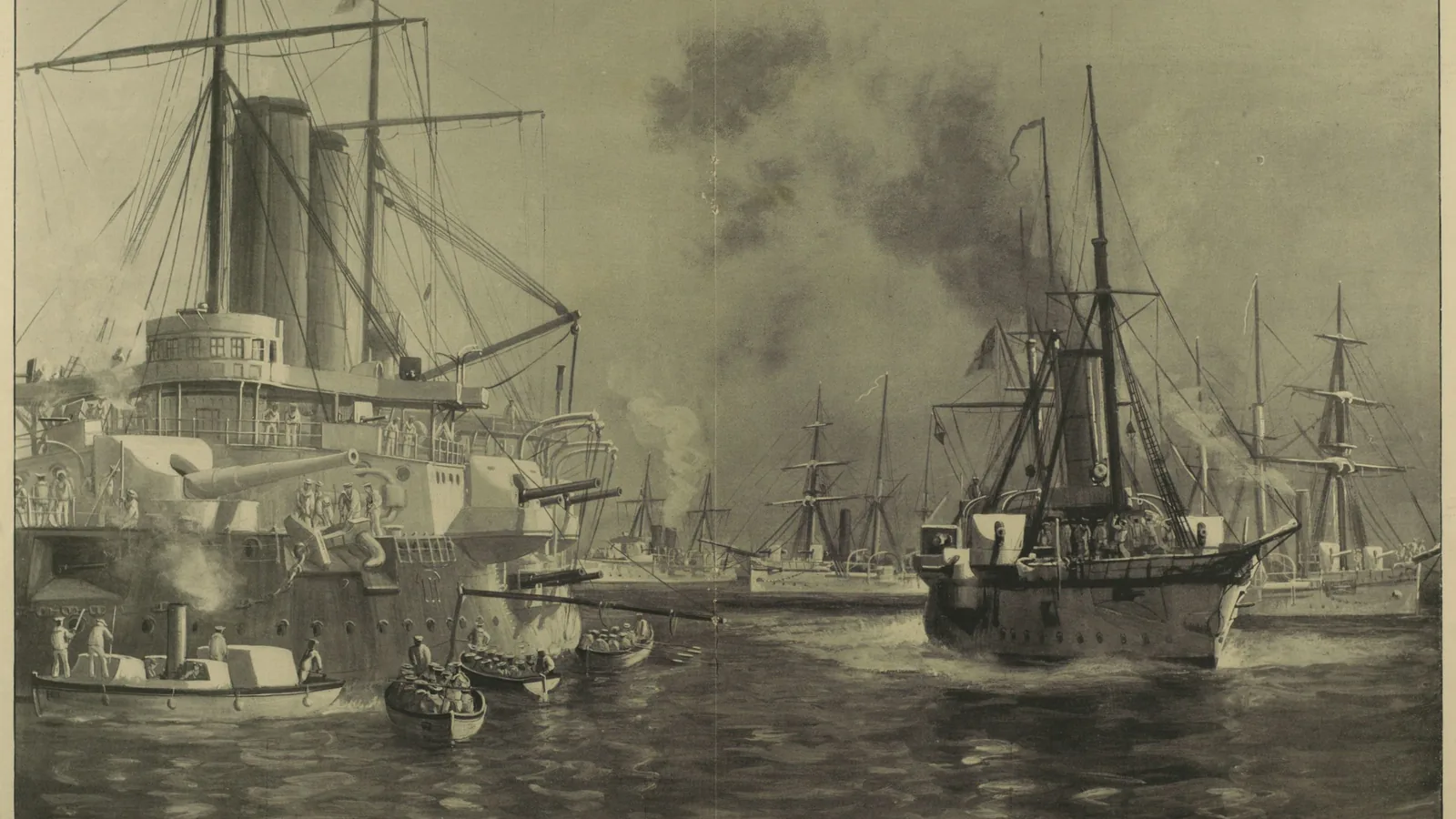

TL;DR — Five warships fired on the Zanzibar palace at nine on August 27, 1896; Lyne timed the red flag coming down at 37 minutes, and Khalid left by the German consulate.
“At seven in the morning Admiral Rawson sent an ultimatum to Seyyid Khaled, requiring him to haul down his flag, make his troops and followers pile their arms in the square and leave the Palace, and deliver himself up to him at the Custom House before nine o’clock, failing which he would open fire with the guns of his ships.” The sentence is from Robert Nunez Lyne of the Zanzibar government service, author of Zanzibar in Contemporary Times (London, 1905). Khalid bin Barghash had held the palace since the sultan’s death on August 25, 1896; the ships of Rear-Admiral Harry Holdsworth Rawson fired at nine on August 27. “Thirty-seven minutes after the bombardment had begun the red flag was hauled down from the Palace flagstaff and the ‘cease fire’ sounded,” Lyne wrote. Thirty-seven is the only duration given in any of the sources cited below.
Quick facts
- When
- August 25, 1896 (death of Hamad bin Thuwaini; Khalid bin Barghash seizes the palace) · August 27, 7 a.m. (Rawson's ultimatum) · 9 a.m. (first shot from the Thrush) · thirty-seven minutes later (red flag hauled down) · October 28 (Port Officer reports the wreck of the Glasgow) · early April 1897 (decree abolishing the legal status of slavery)
- Where
- The sultan's palace and the Custom House on the Zanzibar waterfront; the harbor off Shangani point; the German consulate; the House of Commons at Westminster
- Who
- Sultan Hamad bin Thuwaini; Khalid bin Barghash; Basil Cave, British consul; Sir Lloyd Mathews; Rear-Admiral Harry Holdsworth Rawson in the St George; Lieutenant Arthur Edward Harington Raikes; Hamoud bin Mohammed; Robert Nunez Lyne, the narrator; George Curzon in the Commons
- Outcome
- The palace and clock tower burned, the Glasgow sank in six fathoms and Khalid escaped through the German consulate to Dar es Salaam. Hamoud bin Mohammed was proclaimed sultan at the Custom House, and in April 1897 he issued the decree abolishing the legal status of slavery in Zanzibar and Pemba
August 25: fifty followers, then five hundred
The sultan Hamad bin Thuwaini “suddenly died” on August 25, 1896, in Lyne’s words; no cause is given. Basil Cave, the British consul, and Sir Lloyd Mathews, who commanded the sultan’s troops, set out for the palace at once. While they were on the stairs, Khalid entered the palace square with 50 armed followers and attacked the doors and windows; within minutes he held the palace with a crowd of 500 Arabs. “Sir Lloyd’s next impulse was to shoot Khaled on the spot, and had he done so he would probably have averted the bloodshed that followed; but he reflected that perhaps he was scarcely justified in taking upon himself this extreme step,” Lyne wrote. Khalid had seized the palace once before, on March 5, 1893, and had given it up when Rennell Rodd and Captain Campbell arrived with 160 sailors from the Philomel and the Blanche.
Five ships, 330 sailors and 120 marines
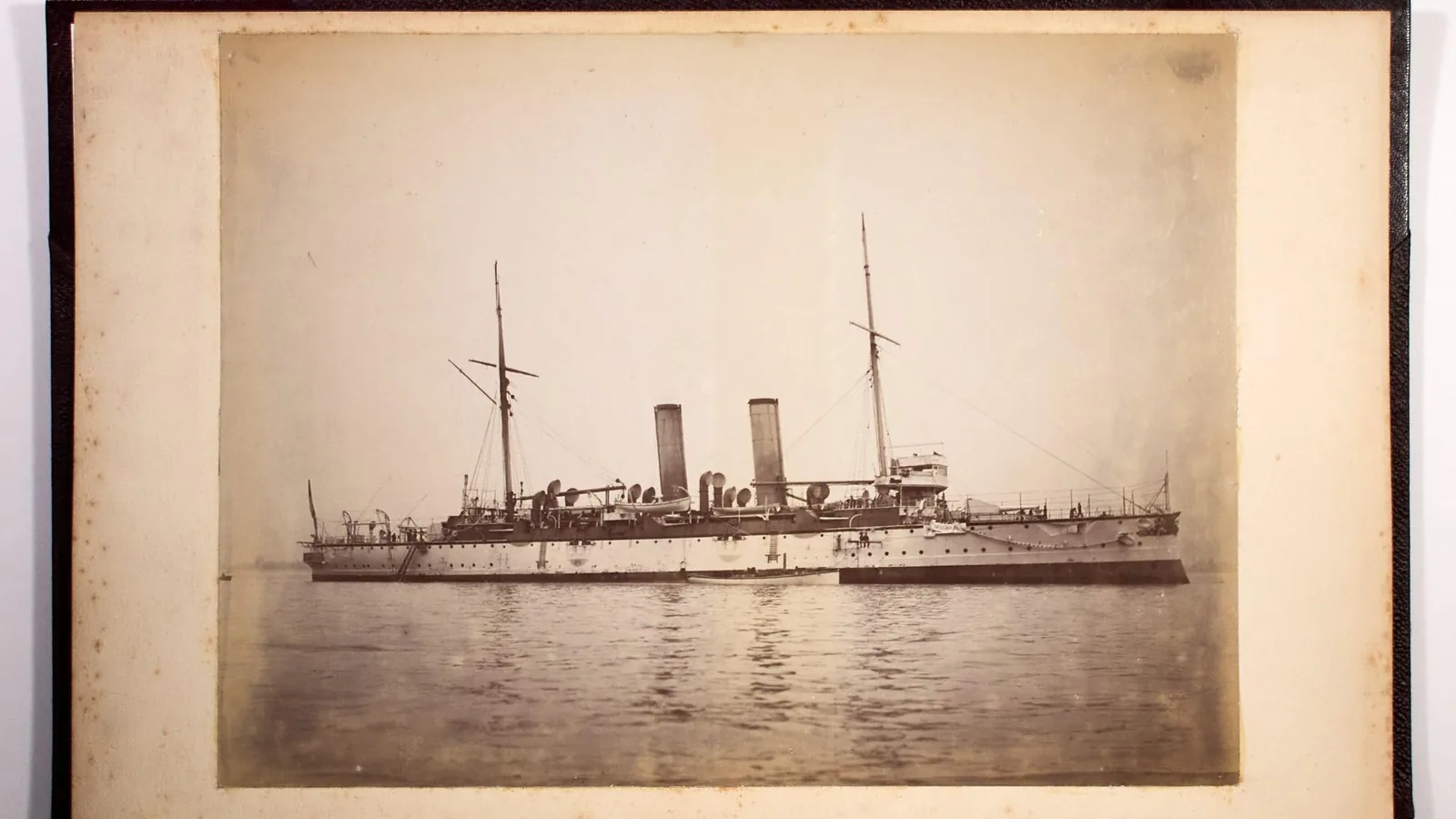
On the night of August 25 the only British warships in the harbor were the Philomel and the Thrush (Lieutenant-Commander Stoddart). The Sparrow (Lieutenant-Commander Wilkin) came in from the north and anchored 150 yards off the beach opposite the palace. The Racoon, a third-class cruiser under Commander Underwood, took a berth off the Custom House on August 26, and about noon the flagship St George, a first-class cruiser under Captain Egerton with Rawson on board, arrived two days early. She anchored south of Shangani point; the Glasgow, the sultan’s armed corvette, lay between her and the Philomel, inside the reach of her stern guns.
Ashore Rawson had 330 sailors, 120 marines with five Maxims and 500 troops of the Zanzibar government. Arthur Edward Harington Raikes of the Wiltshire Regiment, who commanded those troops, closed the outskirts of the town with 40 marines and two Maxims. At eight on August 27 an envoy from Khalid asked for a parley; Cave refused. At 8:55 Rawson signaled the ships to prepare for action.

"In half-an-hour the Palace and clock tower were in flames"
The Thrush fired the first shot as the palace clock struck nine, and the Racoon and the Sparrow followed. Lyne wrote: “In half-an-hour the Palace and clock tower were in flames, the middle palace was a ruin, the Arabs had fled, 500 dead and wounded lay in and about the square, and the Glasgow was at the bottom of the sea.” The Glasgow opened fire at once, ignored warning shots from the Philomel and the Racoon, and was silenced by the six-inch guns of the St George. Nine of her crew died or drowned, by Lyne’s count. A shell also hit the Italian warship Vulturno.
On the British side Lyne recorded: “Our casualties were mostly trifling, but one was serious, a bluejacket from the Thrush having been so severely wounded in the thigh that he subsequently died. The Thrush was hit over a hundred times, the Philomel only twice.” Dr. G. A. MacDonald divided the wounded among three hospitals in the town.
The consulate steps, and a Notice to Mariners
Khalid ran from the burning palace through the middle of the town. A marine picket stopped him, did not know who he was, took his weapons and let him pass; a few steps on he entered the German consulate. Its steps led down to the shore, and from them he boarded a German warship and was carried to Dar es Salaam. Hamoud bin Mohammed was then led to the Custom House and proclaimed sultan under a salute from the ships.
On September 25, 1896, the London Gazette approved Raikes wearing the Brilliant Star of Zanzibar as “Officer in Command of His late Majesty’s Troops”; on January 1, 1897, it listed “Basil Cave, Esq., Consul at Zanzibar” among the Companions of the Order of the Bath; on February 9 it gave the first class of the Zanzibar order to Rawson “in recognition of his active and distinguished services during Seyyid Khalid bin Barghash’s rebellion,” the government’s name for the event. No dispatch from Rawson on the bombardment appears in those issues. The most exact document is Notice to Mariners No. 681, printed on December 1, 1896, from a Port Officer’s report of October 28: “the yacht ‘Glasgow’ lies sunk in a depth of six fathoms . . . distant 2½ cables” from the British consulate, at latitude 6° 9’ 30” S. The National Archives catalogs a Colonial Office photograph file, CO 1069/177, “Damage caused by the bombardment of Zanzibar in August 1896,” with the note “Missing at transfer.”
Curzon in the Commons, February to May 1897
Lyne wrote: “Although the bombardment cannot be regarded as the direct outcome of England’s attitude towards the slave trade, it proved a salutary prelude to the Decree abolishing the legal status of slavery,” since the show of force had removed any doubt among the Arabs that Britain could compel its acceptance. A Royal Museums Greenwich record of a medal awarded to Acting Lieutenant G. E. Newman of the Philomel names the affair the Anglo-Zanzibar War and calls it brief.
In the House of Commons on February 4, 1897, George Curzon, under secretary for foreign affairs, told Joseph A. Pease that “it has always been held that the slaves of the Sultan pass with the Crown; and they have been so inherited on two occasions since 1890.” Questions followed on February 19 and 25. On April 2 Curzon told Thomas Bayley that “The Decrees concerning the abolition of the legal status of slavery in Zanzibar and Pemba will be issued in Zanzibar next week.” On May 14, 1897, he told Pease of the “Edict issued by the Sultan of Zanzibar relating to the abolition of slavery in the islands of Zanzibar and Pemba early in April.”
Key facts
- Hamad bin Thuwaini, sultan of Zanzibar, “suddenly died” on August 25, 1896; Lyne gives no cause. Khalid bin Barghash entered the palace square with 50 armed followers and within minutes held the palace with 500 (Lyne, 1905).
- In March 1893 Khalid had seized the palace once before, and gave it up when Rennell Rodd and Captain Campbell arrived with 160 sailors from the Philomel and the Blanche (Lyne).
- Rawson’s ultimatum went out at 7 a.m. on August 27 and expired at nine; Khalid’s envoy asked for a parley at eight and Cave refused (Lyne).
- Five warships took part: St George (flagship, Captain Egerton), Philomel, Racoon (Commander Underwood), Thrush (Lieutenant-Commander Stoddart) and Sparrow (Lieutenant-Commander Wilkin). Ashore were 330 sailors, 120 marines with five Maxims and 500 Zanzibar government troops (Lyne).
- The Thrush fired first as the palace clock struck nine; “Thirty-seven minutes after the bombardment had begun the red flag was hauled down” (Lyne). Lyne puts the dead and wounded in and about the square at 500.
- The Glasgow returned fire, was silenced by the St George’s six-inch guns and sank; nine of her crew died or drowned. A Thrush bluejacket wounded in the thigh “subsequently died” (Lyne).
- Notice to Mariners No. 681, London Gazette, December 1, 1896: the Glasgow “lies sunk in a depth of six fathoms,” 2½ cables from the British consulate, at 6° 9’ 30” S.
- The Gazette of February 9, 1897, named the event “Seyyid Khalid bin Barghash’s rebellion”; in the Commons on May 14, 1897, Curzon dated the sultan’s edict abolishing slavery to “early in April.”
FAQ
How long did the Anglo-Zanzibar War of 1896 last?
Lyne, who was in Zanzibar government service at the time, wrote: "Thirty-seven minutes after the bombardment had begun the red flag was hauled down from the Palace flagstaff and the 'cease fire' sounded." The fire opened at nine on August 27, 1896. No other duration appears in the documents cited on this page.
What happened to Khalid bin Barghash after the bombardment?
He ran through the town, was disarmed by a marine picket that did not recognize him, and entered the German consulate. Its steps led down to the shore, and he boarded a German warship there and was taken to Dar es Salaam. Hamoud bin Mohammed was proclaimed sultan at the Custom House the same day.
Did the bombardment end slavery in Zanzibar?
Not by itself. Lyne called it "a salutary prelude to the Decree abolishing the legal status of slavery." In the Commons, Curzon said on April 2, 1897 that the decrees for Zanzibar and Pemba would be issued the following week, and on May 14 he dated the sultan's edict to "early in April."
Sources
- Robert Nunez Lyne, Zanzibar in Contemporary Times: A Short History of the Southern East in the Nineteenth Century (London: Hurst and Blackett, 1905), chapter XVII, "The Bombardment," pp. 196–205. Full text at the Internet Archive.
- The London Gazette, issue 26780, September 25, 1896, p. 5320: permission for Lieutenant Arthur Edward Harington Raikes, Wiltshire Regiment, to wear the Brilliant Star of Zanzibar as "Officer in Command of His late Majesty's Troops."
- The London Gazette, issue 26799, December 1, 1896, p. 7111: Notice to Mariners No. 681, lights on the sunken wreck of the Glasgow in Zanzibar harbor, with position.
- The London Gazette, issue 26810, January 1, 1897, p. 65: War Office list of Companions of the Order of the Bath, including "Basil Cave, Esq., Consul at Zanzibar."
- The London Gazette, issue 26821, February 9, 1897, p. 758: Brilliant Star of Zanzibar, first class, for Rear-Admiral Harry Holdsworth Rawson, "during Seyyid Khalid bin Barghash's rebellion."
- UK Parliament, Historic Hansard, House of Commons, February 4, 1897, vol. 45, c. 1297, "Slavery in Zanzibar" (Joseph A. Pease; George Curzon).
- UK Parliament, Historic Hansard, House of Commons, February 19, 1897, vol. 46, c. 780, "Slavery in Zanzibar" (J. L. Carew; Curzon).
- UK Parliament, Historic Hansard, House of Commons, February 25, 1897, vol. 46, cc. 1131–2, "Slavery in Zanzibar" (Thomas Bayley; Curzon).
- UK Parliament, Historic Hansard, House of Commons, April 2, 1897, vol. 48, cc. 406–7, "Slavery in Zanzibar and Pemba" (Thomas Bayley; Curzon).
- UK Parliament, Historic Hansard, House of Commons, May 14, 1897, vol. 49, c. 506, "Slavery in Zanzibar" (Joseph A. Pease; Curzon).
- The National Archives, Kew, Discovery catalogue, CO 1069/177, "ZANZIBAR 11. Damage caused by the bombardment of Zanzibar in August 1896. Missing at transfer" (Colonial Office photographic collection).
- Royal Museums Greenwich, Collections Online, East and West Africa Medal 1887–99 awarded to Acting Lieutenant G. E. Newman, RNR, HMS Philomel (object rmgc-object-204811).
Cite this article
- APA
- Our Earth's History. (2026, September 22). Nine by the palace clock: Zanzibar, August 27, 1896, in 37 minutes. Our Earth's History. https://ourearthshistory.com/africa/modern/anglo-zanzibar-war-august-27-1896-thirty-seven-minutes-lyne/
- Chicago
- Our Earth's History. “Nine by the palace clock: Zanzibar, August 27, 1896, in 37 minutes.” Our Earth's History, September 22, 2026. https://ourearthshistory.com/africa/modern/anglo-zanzibar-war-august-27-1896-thirty-seven-minutes-lyne/.
- MLA
- “Nine by the palace clock: Zanzibar, August 27, 1896, in 37 minutes.” Our Earth's History, 22 Sep. 2026, https://ourearthshistory.com/africa/modern/anglo-zanzibar-war-august-27-1896-thirty-seven-minutes-lyne/.
Text licensed CC BY-NC-ND 4.0. Found an error? Tell us.