Did the Berlin Conference really carve up Africa?

TL;DR — No. The General Act of February 26, 1885, drew no borders; it set trade, river and coastal-notice rules. The borders came from treaties and wars after 1886.
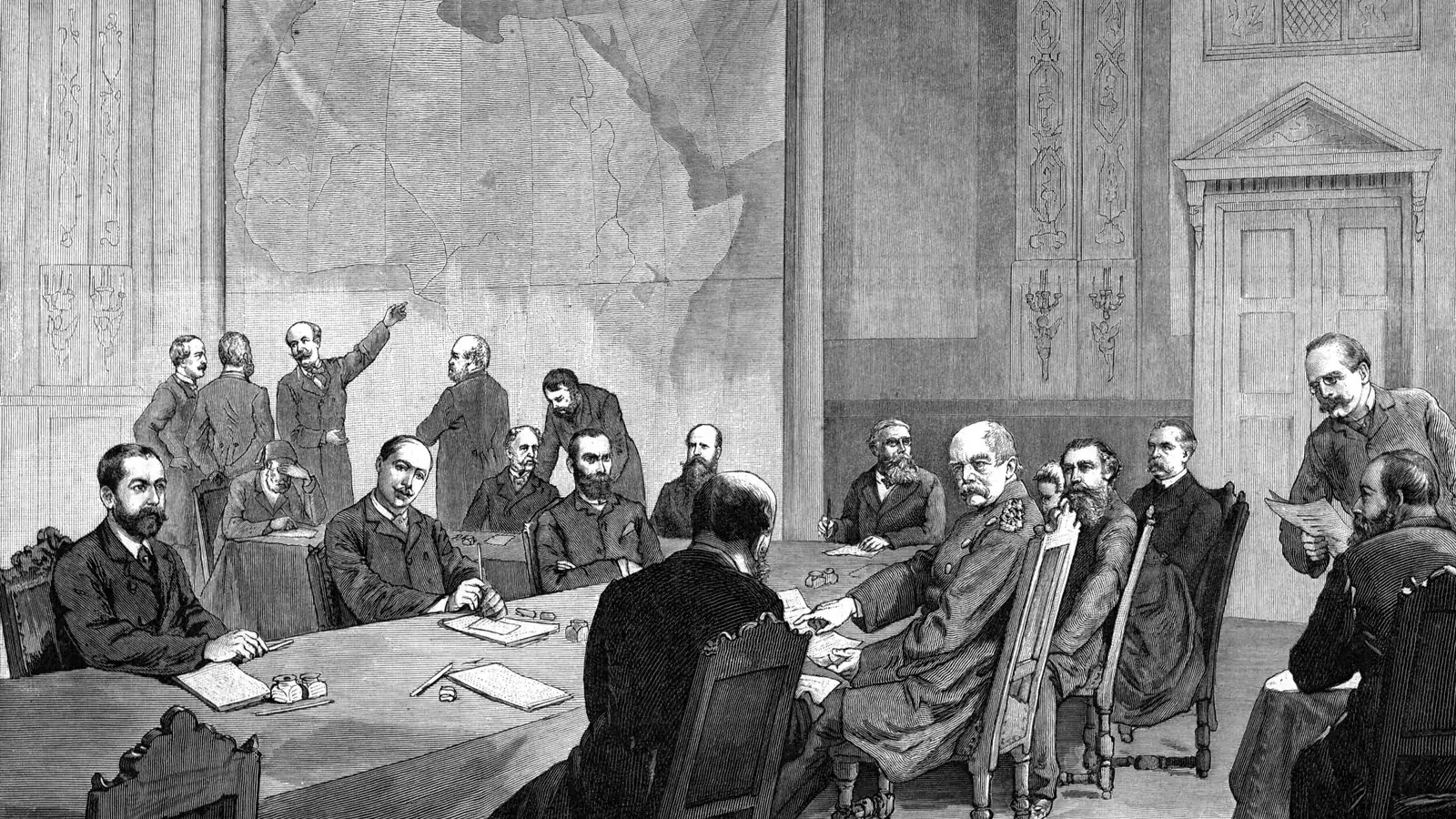
The Berlin Conference of 1884 to 1885 did not carve up Africa: the General Act its 14 signatories produced on February 26, 1885, contains no boundary line. Its 38 articles opened the Congo and Niger rivers to the trade of all nations, condemned the slave trade and required any power taking land “on the coasts of the African continent” to notify the others. World History Encyclopedia, in an entry by Mark Cartwright, states plainly that the conference “did not actually divide the continent.” The dividing came afterward, in bilateral treaties signed between 1886 and 1899 and in wars of conquest that ran to 1914, by which time only Liberia and Ethiopia remained outside European rule. Its one direct territorial result was the Congo basin, handed to Leopold II of Belgium.
Quick facts
- When
- November 15, 1884 (conference opened) · February 26, 1885 (General Act signed) · 1886 to 1899 (border treaties) · March 1, 1896 (Adwa) · 1904 to 1908 (Herero and Nama war) · 1908 (Belgium took over the Congo) · 1914 (partition complete)
- Where
- Berlin, capital of the German Empire; the Congo and Niger basins; the coasts of Africa named in Articles 34 and 35; South West Africa, now Namibia; Adwa in northern Ethiopia
- Who
- Otto von Bismarck, who convened it; delegates of 14 governments; no African delegate; Leopold II of Belgium; Menelik II and Taytu of Ethiopia; Samuel Maharero and Hendrik Witbooi; Lothar von Trotha; the consul Roger Casement
- Outcome
- A 38-article act on free trade, river navigation and notice of coastal claims; the Congo basin passed to Leopold's personal rule; European powers then divided the continent by bilateral treaty and conquest until only Liberia and Ethiopia remained independent in 1914
Why 14 governments met in Berlin in November 1884
The quarrel was over the Congo. South African History Online (SAHO) records that Leopold II sent the explorer Henry Morton Stanley to the river in 1879 to organize a private state, that France answered with the naval officer Pierre de Brazza, who raised its flag over Brazzaville in 1881, and that Portugal, claiming the river mouth from old trade with the Kingdom of Kongo, signed a treaty with Britain on February 26, 1884, to block Leopold’s access to the Atlantic.
Otto von Bismarck, the German chancellor, sent the invitations. The Act’s preamble records that the powers met “on the invitation addressed to them by the Imperial Government of Germany, in agreement with the Government of the French Republic.” Talks opened on November 15, 1884, and ran to February 26, 1885. The signatories were Britain, Germany, Austria-Hungary, Belgium, Denmark, Spain, the United States, France, Italy, the Netherlands, Portugal, Russia, Sweden-Norway and the Ottoman Empire. No African state was represented.
What the General Act actually said
The Act’s title lists its six subjects: freedom of trade in the Congo basin, the slave trade, neutrality of the Congo territories, navigation of the Congo, navigation of the Niger, and “rules for future occupation on the coast of the African continent.” Article 1 declared that “the trade of all nations shall enjoy complete freedom” in the Congo basin and on a strip of Atlantic coast. Article 6 bound the powers “to watch over the preservation of the native tribes” and to help suppress slavery.
The clauses later called the doctrine of effective occupation are two sentences in Chapter VI. Article 34 required any power that “takes possession of a tract of land on the coasts of the African continent” to notify the other signatories “in order to enable them, if need be, to make good any claims of their own.” Article 35 recognized “the obligation to insure the establishment of authority in the regions occupied by them on the coasts of the African continent sufficient to protect existing rights.” Both articles say coasts. The interior is not mentioned. Cartwright adds that what counted as effective control “was much debated.”
What it did not do: the borders came later
SAHO’s own summary says the powers “had neatly divided Africa up amongst themselves, drawing the boundaries of Africa much as we know them today.” The text of the Act does not support that reading. It names no colony and no boundary, and the words Leopold, Free State and Association do not appear in it. Its only lines on a map bound the free-trade zone of Article 1.
The borders came in the years after, in treaties between pairs of European powers. Cartwright lists them, from the Franco-Portuguese and German-Portuguese treaties of 1886 on Angola and Mozambique to the Anglo-German treaties of 1890 and 1893 on the Upper Nile and the Anglo-French Convention of 1899 on Egypt. His judgment is that Berlin’s vague rules, meant to restrain colonial activity, “only succeeded in accelerating, widening, and deepening” it, and that the military conquest of Africa “began in earnest from 1886.”
The Congo, the one territory the conference did hand over
Leopold won the Congo against Portugal because, Cartwright writes, he could produce treaties Stanley had signed with local rulers and promised scientific and humanitarian aims. The Congo Free State created in 1885 was the king’s private possession; the Belgian government wanted no part of it. After the pneumatic tire of 1888 the Free State made rubber a monopoly in all but name, and by 1901 the Congo produced a tenth of the world’s supply.
The method was recorded by a British consul. Roger Casement traveled the upper river between July 2 and September 15, 1903, and reported to Parliament in February 1904 that company sentries held “women and children seized as hostages and kept in detention until rubber or other things were brought in.” At one village on the Lulongo he found two sentries guarding 15 women, five of them nursing infants, 11 of them held, the sentry said, until their husbands brought in rubber. A commission of Belgian, Swiss and Italian investigators confirmed the abuses in 1905, and in 1908, Cartwright writes, the outcry obliged the Belgian government to take the colony over as the Belgian Congo.
Wars of conquest and resistance: Adwa and the Herero
Effective occupation had to be won in the field. Italy, which claimed a protectorate over Ethiopia under an 1889 treaty whose Amharic and Italian texts disagreed, invaded from Eritrea in 1895. On March 1, 1896, at Adwa, the army of Menelik II and his empress Taytu, about 100,000 strong by SAHO’s count against 20,000 Italians, destroyed the invading force. Fabio Sappino, writing for World History Encyclopedia, puts Italian losses at about 6,000 dead and more than 3,000 captured; the Crispi government fell.
German South West Africa, now Namibia, showed the other outcome. Fighting between Herero and Germans began at Okahandja on January 12, 1904. After the battle of Waterberg on August 11, General Lothar von Trotha drove the survivors into the Omaheke desert, and on October 2 he read out an order that “every Herero, whether armed or unarmed, with or without cattle, will be shot.” The Kaiser rescinded it on December 9; prisoners went instead to camps. The Nama under Hendrik Witbooi went to war in October 1904 and fought until 1907. SAHO describes the campaign as genocide and states that 80 percent of the Herero population died; its article on the revolt gives 65,000 to 80,000 Herero and about 10,000 Nama dead.
The map of 1914 and what lasted
By 1914, Cartwright writes, most of Africa was in the hands of six powers, Britain, France, Germany, Portugal, Belgium and Italy, and more than 100 million Africans had come under European rule in about two decades. The borders were straight lines that cut through languages and older territories, and when independence came, from 1957 onward, the new states inherited them. A memorial plaque at Wilhelmstrasse 92 in Berlin-Mitte commemorates the “Kongokonferenz.”
The popular sentence, that diplomats in Berlin carved up Africa with a ruler, misplaces the act. The Act of 1885 regulated trade and notice; the carving was done afterward, treaty by treaty and war by war, by the same governments it had bound to “watch over the preservation of the native tribes.”
Key facts
- The conference met from November 15, 1884, to February 26, 1885; 14 governments signed the General Act and no African state was represented.
- The Act has 38 articles in seven chapters; Chapter VI on new occupations covers only “the coasts of the African continent” (Articles 34 and 35).
- Article 1 opened the Congo basin to “the trade of all nations”; Article 6 bound the powers “to watch over the preservation of the native tribes.”
- The Act names no colony, no boundary, and neither Leopold nor the Congo Free State; the Free State was created in 1885 under Leopold II’s personal rule.
- Border treaties came afterward, 1886 to 1899 (Cartwright’s list), and the conquest “began in earnest from 1886.”
- Casement’s report of February 1904 recorded women held hostage for rubber; a 1905 commission confirmed the abuses; Belgium took the colony over in 1908.
- Ethiopia defeated Italy at Adwa on March 1, 1896 (about 6,000 Italian dead per Sappino); in South West Africa, SAHO records 65,000 to 80,000 Herero and about 10,000 Nama dead, 1904 to 1908.
FAQ
Did the Berlin Conference draw Africa's borders?
No. The General Act of February 26, 1885, contains no boundary. It set trade and navigation rules for the Congo and Niger and a notice rule for coastal claims. The borders were fixed by treaties between European powers from 1886 to 1899 and by conquest.
What was "effective occupation"?
Articles 34 and 35 of the Act. A power taking land "on the coasts of the African continent" had to notify the other signatories and establish enough authority there to protect existing rights and free trade. The Act did not define what enough authority meant.
Which African states stayed independent?
By 1914 only Liberia and Ethiopia. Ethiopia kept its independence by defeating Italy at Adwa on March 1, 1896.
Sources
- San Diego State University (loveman.sdsu.edu) — General Act of the Berlin Conference on West Africa, 26 February 1885, English text of the 38 articles (PDF).
- World History Encyclopedia — Mark Cartwright, "Berlin Conference 1884-5: Establishing the Rules of the Scramble for Africa" (February 25, 2026).
- World History Encyclopedia — Mark Cartwright, "Scramble for Africa: How European Empires Took Over a Continent" (June 12, 2026).
- World History Encyclopedia — Mark Cartwright, "Belgian Congo: One of Africa's Most Notorious Colonies" (March 24, 2026).
- World History Encyclopedia — Fabio Sappino, "Italian Colonialism in Eritrea" (April 10, 2025).
- South African History Online — "The Berlin Conference" (May 22, 2015).
- South African History Online — "Herero people of South West Africa, now Namibia, begin uprising," dated event, last updated January 10, 2020.
- South African History Online — "Herero Revolt 1904-1907" (March 21, 2011).
- South African History Online — "Timeline of the German and Herero, Nama War and Genocide" (June 29, 2015).
- South African History Online — "Remembering the Battle of Adwa" (April 7, 2021, updated July 5, 2024).
- Project Gutenberg — Roger Casement, Correspondence and Report from His Majesty's Consul at Boma Respecting the Administration of the Independent State of the Congo, Africa No. 1 (1904), presented to Parliament February 1904, eBook 50573.
- Fordham University, Internet Modern History Sourcebook — "Imperialism," section index with the Casement Report entry.
- Wikimedia Commons — "File:Gedenktafel Wilhelmstr 92 (Mitte) Kongokonferenz.jpg," file page and metadata.
_Kongokonferenz.jpg)
Cite this article
- APA
- Our Earth's History. (2026, September 20). Did the Berlin Conference really carve up Africa? Our Earth's History. https://ourearthshistory.com/africa/modern/berlin-conference-1884-did-it-carve-up-africa/
- Chicago
- Our Earth's History. “Did the Berlin Conference really carve up Africa?” Our Earth's History, September 20, 2026. https://ourearthshistory.com/africa/modern/berlin-conference-1884-did-it-carve-up-africa/.
- MLA
- “Did the Berlin Conference really carve up Africa?” Our Earth's History, 20 Sep. 2026, https://ourearthshistory.com/africa/modern/berlin-conference-1884-did-it-carve-up-africa/.
Text licensed CC BY-NC-ND 4.0. Found an error? Tell us.