Fort Jesus, Mombasa: a 1593 cornerstone and a siege of 33 months
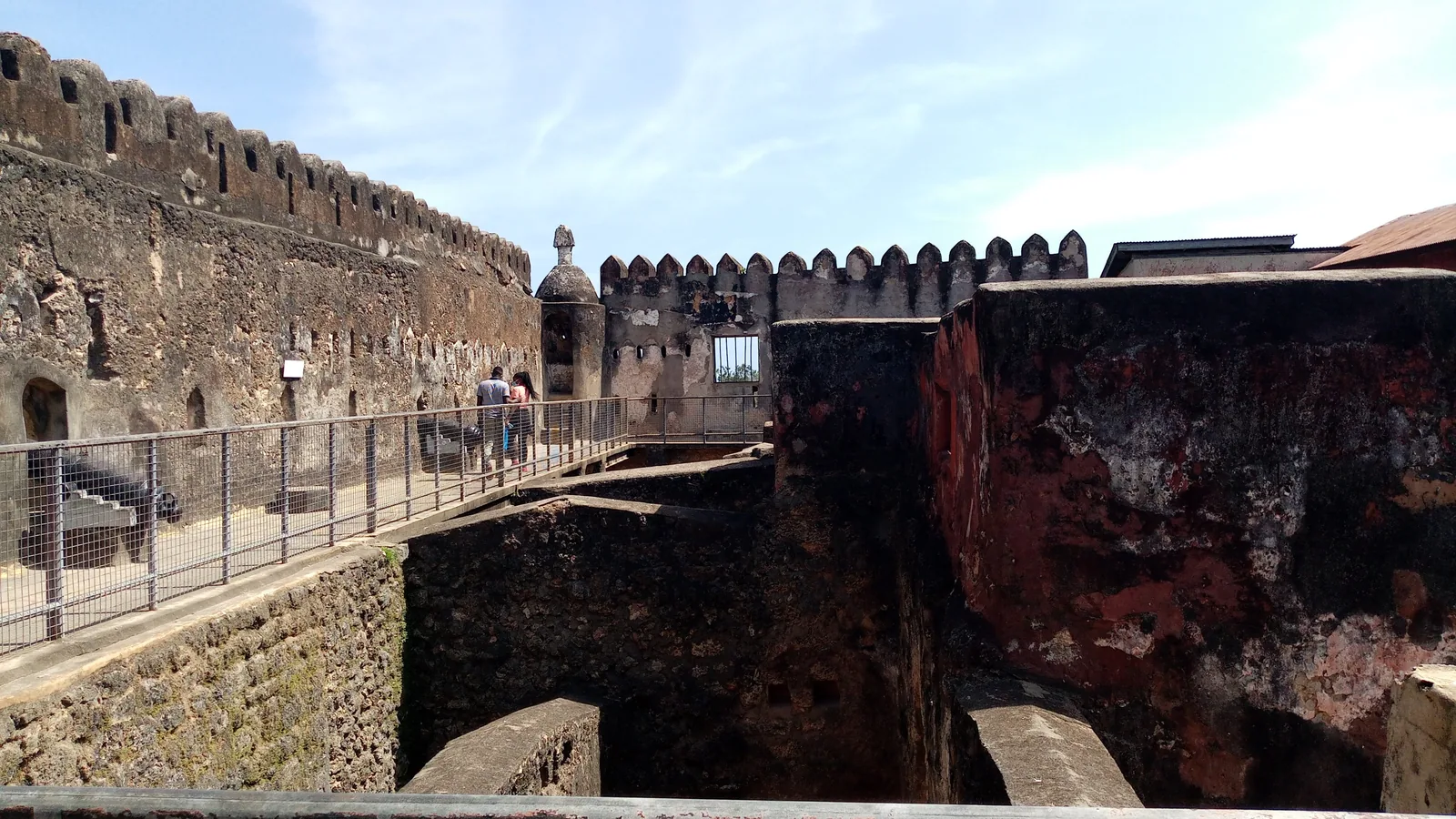

TL;DR — A 1593 cornerstone at Fort Jesus, Mombasa, an Omani siege of 33 months that ended in 1698, and the frigate Santo António de Tanná, sunk offshore in 1697.
An inscription in the entrance tunnel of Fort Jesus, on the harbor at Mombasa, once read “FORTALEZA DE NOME DE IESUS DE MOMBAÇA AOMZE DABRIL DE 1593”: the fortress named Jesus of Mombasa, the eleventh of April 1593. The National Museums of Kenya’s page on the site states: “The Portuguese built Fort Jesus in 1593.” The same inscription names the men behind the work, historians C. R. Boxer and Carlos de Azevedo recorded in 1960: viceroy Matias de Albuquerque, captain-major Mateus Mendes de Vasconcelos, chief architect João Batista Cairato and master mason Gaspar Rodrigues. More than a century later, an Omani fleet entered the harbor on March 13, 1696, and did not withdraw until the fort fell 33 months afterward. A relief frigate, the Santo António de Tanná, sank nearby the year before the end. The building later held a colonial prison, then a national monument, then a museum.
Quick facts
- When
- April 11, 1593 (cornerstone laid) · March 13, 1696 (Omani fleet enters the harbor) · October 20, 1697 (Santo António de Tanná sinks) · December 13, 1698 (fort falls, per Braz Fialho's testimony) · July 1, 1895 (British protectorate proclaimed; fort converted to a prison) · 1958 (declared a national monument) · 1962 (opens as a museum, per the National Museums of Kenya)
- Where
- Fort Jesus, on the harbor entrance at Mombasa, on the coast of present-day Kenya
- Who
- Giovanni Battista Cairato, chief architect of India; Gaspar Rodrigues, master mason; Mateus Mendes de Vasconcelos, captain-major; Governor Leonardo Barbosa Soutomaior; the witness Braz Fialho; R. C. M. Piercy, who led the excavation of the Santo António de Tanná
- Outcome
- After a siege of 33 months an Omani force took the fort in December 1698, ending Portuguese control of the Mombasa coast. The building later served as a British colonial prison from 1895, was declared a national monument in 1958 and opened as a museum in 1962, according to the National Museums of Kenya
Giovanni Battista Cairato's cornerstone, April 11, 1593
Cairato came from the town of Cairate, near Milan, and Boxer and Azevedo call him “milanez,” the word of his contemporary Diogo do Couto. He had supervised fortifications on Malta for the Knights of St. John in 1560 and was sent out as chief architect of India in 1583. He died in 1596 or soon after, Boxer and Azevedo write, without returning to Mombasa in his last three years to oversee the building.
No single year marks when Fort Jesus was finished. The National Museums of Kenya’s own pages differ: one says the Portuguese “built Fort Jesus in 1593,” the other gives a span, “built by the Portuguese in 1593-1596.” Boxer and Azevedo’s account runs longer. In 1596 the crown believed the fort complete, but on February 26, 1605, King Philip III pressed the viceroy to finish the walls and fix the cisterns, and by 1609 the walls still fell short. A 1631 rising led by Jerónimo Chingulia killed the garrison and put Swahili forces in temporary control. Fort Jesus reached its present-day proportions only between 1633 and 1639, the years of reoccupation and the end of the command of its governor Cabreira, Boxer and Azevedo write.
March 13, 1696: an Omani fleet enters the harbor
Seven ships from Muscat, carrying about 3,000 men and a prince of Lamu, appeared off the bar at Mombasa on March 11, 1696. Contrary winds held them off for two days before they entered the harbor on March 13, Boxer and Azevedo write; the flagship ran aground on a sandbank, and its guns silenced a small outer fort guarding the entrance. The siege that followed, they write, “must surely rank as one of the most remarkable sieges in history,” running “13 March 1696 to 13 December 1698.” Their main source is an anonymous manuscript, the Historia de Mombasa.
The garrison never rose above 100 men, and far more men died of disease in Mozambique and Zanzibar than fell in combat, Boxer and Azevedo record. Lacking guns able to breach the walls, the besiegers attempted to storm the fort by escalade only twice, on July 20, 1697, and December 12, 1698.
"An eleven-year-old boy": the fort falls, December 1698
Boxer and Azevedo write that for a time during the siege the fort “was defended for a time by a group of Swahili and Bantu, the only European among the defenders being an eleven-year-old boy.” Its last days are known from Braz Fialho, servant of the captain of the sunken Santo António de Tanná, who reached Goa on October 29, 1701, and testified that on December 12, 1698, Governor Leonardo Barbosa Soutomaior lay gravely ill and the fort held only eight Portuguese soldiers, three Indians, two African women and the captain’s young enslaved boy.
Fialho dated the fall to December 13, 1698, and Boxer and Azevedo judge that date correct, citing an independent Portuguese source and an old Arab ballad. Other accounts differ: the Historia de Mombasa records a relief fleet reaching the coast on December 20, the Livros das Monções gives December 14, and the German historian Justus Strandes could not decide between the 13th and the 14th. The Historia de Mombasa also credits two Portuguese soldiers, in the fort’s final hours, with luring the victors into the church and a storehouse and setting off the powder kept there rather than surrender; Boxer and Azevedo caution that the manuscript leans on one participant’s account.
A prison, a monument, a museum
After 1698 the fort “changed hands many times throughout its history, coming under Arab, Swahili and English control,” the National Museums of Kenya’s page on the monument states. Under the British its use changed again: “When the British protectorate was proclaimed on 1st July 1895, the Fort was converted into a prison.”
The museum’s own page dates the next transformation to 1958, when the fort was declared a national monument, its restoration funded by the Calouste Gulbenkian Foundation. Boxer and Azevedo’s 1960 book on the fort came out of the same funding stream, its authors thanking “the Trustees of the Calouste Gulbenkian Foundation” and the Kenya national parks authorities, including “Mr James Kirkman.” The fort became a museum in 1962, the National Museums of Kenya states.
Santo António de Tanná, sunk October 20, 1697
The frigate Santo António de Tanná, carrying 50 guns, reached Mombasa on September 16, 1697, with troops and supplies. While she was unloading at night, Boxer and Azevedo write, “either Arab gunfire or some accident cut the frigate’s cables and she drifted ashore on 20 October near one of the Arab batteries, the 150 men still aboard her being rescued by a timely sortie.”
The Institute of Nautical Archaeology’s project page records the wreck’s recovery: “The excavation of the Santo Antonio de Tanna was carried out between 1977 and 1979,” under a joint program with the National Museums of Kenya. The same page credits that work with recovering part of the hull and more than 7,000 objects tied to the ship’s operation, life on board and trade, with R. C. M. Piercy as the author of its preliminary reports. In 2025 BAR Publishing issued the full study, The Shipwreck of the Santo António de Tanná (1697), by Piercy, Jeremy N. Green, Susan Green, Sheila Matthews and André Teixeira, 802 pages as BAR International Series S3251, with Teixeira listed by the Universidade NOVA de Lisboa’s research repository as a historian there.
Key facts
- Fort Jesus’s cornerstone inscription gives its founding date as April 11, 1593, naming the architect João Batista Cairato and the master mason Gaspar Rodrigues (Boxer and Azevedo, 1960).
- Cairato, from Cairate near Milan, served as chief architect of India from 1583 and died in 1596 or soon after, without returning to Mombasa in his final years (Boxer and Azevedo).
- The National Museums of Kenya gives the fort’s building years as 1593 on one page and 1593-1596 on another; Boxer and Azevedo record walls and moat still unfinished in 1605 and 1609, and the fort reaching its present form only in 1633-1639, after the 1631 rising led by Jerónimo Chingulia.
- An Omani fleet of seven ships and about 3,000 men entered Mombasa’s harbor on March 13, 1696, opening a siege that Boxer and Azevedo date to March 13, 1696, through December 13, 1698.
- The besiegers attempted only two assaults by escalade in the whole siege, on July 20, 1697, and December 12, 1698, for lack of guns able to breach the walls (Boxer and Azevedo).
- Braz Fialho testified in Goa on October 29, 1701, that the fort fell on December 13, 1698; other sources give December 14 (Livros das Monções) and imply December 20 (Historia de Mombasa).
- The frigate Santo António de Tanná, sent to relieve the fort, drifted ashore and sank near an Arab battery on October 20, 1697, after her cables were cut; 150 men aboard were rescued.
- The Institute of Nautical Archaeology and the National Museums of Kenya excavated the wreck between 1977 and 1979, recovering part of its hull and more than 7,000 objects, the subject of a 2025 BAR Publishing volume.
FAQ
When was Fort Jesus in Mombasa built?
Its cornerstone was laid on April 11, 1593, under the architect João Batista Cairato. The National Museums of Kenya gives 1593 on one page and 1593-1596 on another, but Boxer and Azevedo's 1960 study records the walls and moat still unfinished in 1605 and 1609, with the fort reaching its present form only between 1633 and 1639.
How long did the Omani siege of Fort Jesus last, and when did it end?
Boxer and Azevedo date the siege from March 13, 1696, to December 13, 1698, about 33 months. Braz Fialho's 1701 testimony supports the December 13 date, though the Livros das Monções gives December 14 and the Historia de Mombasa implies December 20.
What happened to the frigate Santo António de Tanná?
Sent to relieve the besieged fort, it drifted ashore and sank near an Arab battery on October 20, 1697, after its cables were cut; 150 crew were rescued. The Institute of Nautical Archaeology and the National Museums of Kenya excavated the wreck between 1977 and 1979, recovering more than 7,000 objects, published in full in 2025 by BAR Publishing.
Sources
- National Museums of Kenya, "Fort Jesus Museum"
- National Museums of Kenya, "Fort Jesus National Monument"
- C. R. Boxer and Carlos de Azevedo, Fort Jesus and the Portuguese in Mombasa 1593-1729 (London: Hollis and Carter for the Calouste Gulbenkian Foundation, 1960)
- Institute of Nautical Archaeology, "Santo Antonio de Tanna Shipwreck Excavation"
- Robin C. M. Piercy and others, The Shipwreck of the Santo António de Tanná (1697), BAR Publishing, BAR International Series S3251, on Fulcrum
- Universidade NOVA de Lisboa, NOVA Research, bibliographic entry for The Shipwreck of the Santo António de Tanná (1697)
Cite this article
- APA
- Our Earth's History. (2026, September 27). Fort Jesus, Mombasa: a 1593 cornerstone and a siege of 33 months. Our Earth's History. https://ourearthshistory.com/africa/early-modern/fort-jesus-mombasa-1593-cornerstone-siege-1696-1698-santo-antonio-de-tanna/
- Chicago
- Our Earth's History. “Fort Jesus, Mombasa: a 1593 cornerstone and a siege of 33 months.” Our Earth's History, September 27, 2026. https://ourearthshistory.com/africa/early-modern/fort-jesus-mombasa-1593-cornerstone-siege-1696-1698-santo-antonio-de-tanna/.
- MLA
- “Fort Jesus, Mombasa: a 1593 cornerstone and a siege of 33 months.” Our Earth's History, 27 Sep. 2026, https://ourearthshistory.com/africa/early-modern/fort-jesus-mombasa-1593-cornerstone-siege-1696-1698-santo-antonio-de-tanna/.
Text licensed CC BY-NC-ND 4.0. Found an error? Tell us.