Who built Great Zimbabwe, and why was the answer buried?

TL;DR — Ancestors of the Shona built it between about 1100 and 1450. Excavation proved that in 1905 and 1929; Rhodesia’s government censored the finding from 1965 to 1980.
Bantu-speaking ancestors of the Shona built Great Zimbabwe, a city of mortarless granite walls in what is now southeastern Zimbabwe, between about 1100 and 1450. Its central ruins, about 19 miles (30 km) southeast of Masvingo, cover roughly 80 hectares (200 acres), the largest of more than 150 stone sites in Zimbabwe and Mozambique. European visitors from the 1870s assigned the walls to Phoenicians or Israelites. Excavations in 1905 and 1929 tied the buildings and their contents to local African culture. The government of Rhodesia censored that conclusion from 1965 until independence in 1980, when the country took its name from the ruins.
Quick facts
- When
- Built about 1100 to 1450, at its height in the 13th and 14th centuries; excavated in 1905 and 1929; censored in Rhodesia from 1965 to 1980
- Where
- Southeastern Zimbabwe, about 19 miles (30 km) southeast of Masvingo, on the Zimbabwe plateau between the Zambezi and Limpopo rivers
- Who
- Bantu-speaking ancestors of the Shona; Karl Mauch, James Theodore Bent, Richard N. Hall, David Randall-MacIver, Gertrude Caton-Thompson, Peter S. Garlake, Shadreck Chirikure, Innocent Pikirayi
- Outcome
- The central ruins cover about 80 hectares (200 acres), the largest of more than 150 stone sites in Zimbabwe and Mozambique; the country took its name from the site in 1980
What stands on the site
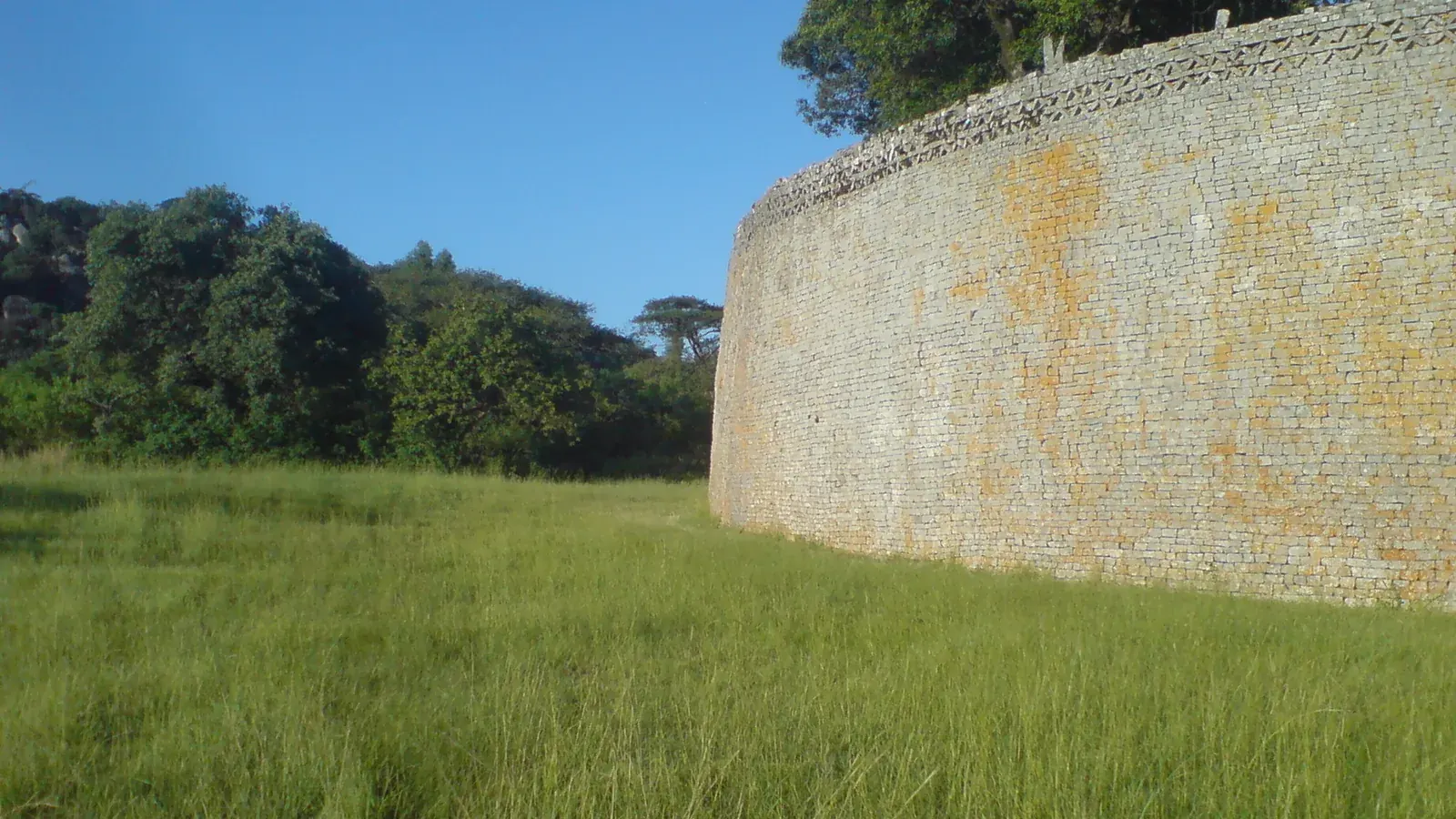
The ruins divide into three parts. The Hill Complex occupies a granite spur 262 feet (80 meters) high, where, Britannica records, the first stones were laid about the year 900. Below it lies the Great Enclosure, whose outer wall runs about 820 feet (250 meters) around; Britannica gives its maximum height as 36 feet (11 meters), National Geographic’s entry as above 9.7 meters (32 feet) in places. Between them sit the Valley Ruins, mounds left by houses of daga, earth and mud brick.
Every wall was laid dry. Builders split granite from the outcrops into slabs and stacked them without mortar, each course set slightly back so the wall leaned inward and held itself up, described in the Metropolitan Museum of Art’s 2001 essay. Inside the Great Enclosure a second wall leads to the Conical Tower, a stone cone 33 feet (10 meters) high and 16 feet (5 meters) across at the base. Its purpose is unknown; Britannica gives two guesses, a grain bin or a phallic emblem.
Who lived there and what they traded
Great Zimbabwe fed itself on cattle and grain and paid for everything else with gold, sitting on the short route between the plateau gold fields and the Indian Ocean. Gold, ivory and copper cast in x-shaped ingots went east to Kilwa and its outpost at Sofala, in what is now Mozambique. What came back turns up in the trenches: glass beads and porcelain from China and Persia and Arab coins struck at Kilwa, according to the UNESCO listing, with Syrian glass, Chinese celadon of the Ming period, Persian faience and an iron spoon, a utensil the Shona did not use, added by Webber Ndoro in Scientific American in 2005.
Eight soapstone birds were found in the ruins, on monoliths more than a meter tall. The Met essay records that six came from the Eastern Enclosure of the Hill Complex, that the carvings mix human lips and five-toed feet with avian features, and that they read as emblems of royal authority and of the rulers’ ancestors. The bird is on the flag of Zimbabwe.
How Europeans explained the walls away
Karl Mauch, a German explorer, reached the site in 1871 and decided within days that Africans had not built it. Ndoro’s account gives his reasoning: the stonework looked too sophisticated, and a lintel sample smelled like his pencil, so Mauch took it for Lebanese cedar. In 1891 James Theodore Bent, the first archaeologist officially sent to the site, dug around the Conical Tower, destroyed its stratigraphy and discarded Persian and Arab trade beads as insignificant. He concluded that a mixed local race had built the walls under white fathers from the north.
In 1895 Cecil Rhodes commissioned W. G. Neal’s Ancient Ruins Company to work all the ruins of Rhodesia, and its men stripped Great Zimbabwe of gold. A report by Neal and the journalist Richard N. Hall, published in 1902, repeated Bent’s verdict: the architecture was Phoenician or Arabian.
What the 1905 and 1929 excavations found
David Randall-MacIver, an Egyptologist trained under William Matthew Flinders Petrie, excavated at Great Zimbabwe in 1905 and found objects matching those in use among Shona people nearby. He dated the Arab and Persian beads no earlier than the 14th century, well after the age of Solomon, and wrote that the curved stonework did not follow Arab models. Africans had built the city. J. F. Schofield restated the finding in 1926, and in 1929 Gertrude Caton-Thompson dug the undisturbed Maund Ruin at the far end of the valley and reached the same result. Her drawings and sections remain the backbone of what is known about the site.
The ban, 1965 to 1980
From 1965 until independence in 1980 the Rhodesian Front, the party Ian Smith formed to keep Africans out of power, censored the books and other material available on Great Zimbabwe. Ndoro recorded the effects: displays at the site itself were censored, archaeologists who spoke publicly for African origin, among them Peter S. Garlake, were imprisoned and eventually deported, and Africans who said the same lost their jobs.
The state that replaced Rhodesia in 1980 took the name Zimbabwe from the ruins. The word means houses of stone in Shona.
What is still argued
The estimate in circulation, 18,000 to 20,000 at the peak, descends from Peter S. Garlake’s calculation from hut counts and early colonial demographic figures. In 2017 Shadreck Chirikure and four co-authors published a study in PLOS ONE arguing that the total for the site’s nearly 800 years of occupation, once generational turnover is counted, is unlikely to have passed 10,000. Their evidence was negative: no megamiddens, few artifacts per cubic meter of deposit, and none of the erosion or deforestation 20,000 people would have caused. They wrote that Thomas Huffman’s method, stripped of its inflation factor, yields 4,000 to 5,000.
Chirikure and Innocent Pikirayi published a reading of the layout in Antiquity in December 2008 that treats the hill enclosures, the Great Enclosure and the valley enclosures as the work of successive rulers, each founding his own residence, against the older view that divided the site at one time among kings, priests and wives.
Why the city emptied is unsettled. UNESCO dates the abandonment to about 1450 and gives a hinterland that could no longer feed the city, and deforestation, with the population moving to Khami. Mark Cartwright’s 2019 survey for World History Encyclopedia gives worked-out gold deposits, rival states, overpopulation and drought, with the Shona moving north to found Mutapa. Ndoro reported that no blue-and-white Chinese porcelain, common after the middle of the 15th century, has been found there. Who built Great Zimbabwe has not divided archaeologists since 1929. How many lived there, and why they left, still does.
Key facts
- Great Zimbabwe was built between about 1100 and 1450 in what is now southeastern Zimbabwe, about 19 miles (30 km) southeast of Masvingo.
- The central ruins cover about 80 hectares (200 acres), the largest of more than 150 stone sites in Zimbabwe and Mozambique (Britannica).
- The Great Enclosure’s outer wall runs about 820 feet (250 meters) around and reaches 36 feet (11 meters) at its highest, by Britannica’s figure; the Conical Tower inside is 33 feet (10 meters) high.
- Excavations produced Chinese and Persian porcelain, Syrian glass and Arab coins minted at Kilwa; gold, ivory and copper went out through Kilwa and Sofala.
- Eight soapstone birds were recovered, six of them from the Eastern Enclosure of the Hill Complex (Metropolitan Museum of Art).
- David Randall-MacIver concluded in 1905 that the ruins were medieval and African; Gertrude Caton-Thompson confirmed it in 1929.
- The Rhodesian Front censored material on Great Zimbabwe from 1965 until independence in 1980, when the country took the site’s name.
FAQ
Who built Great Zimbabwe?
Bantu-speaking ancestors of the Shona, between about 1100 and 1450. Randall-MacIver's 1905 excavation matched the objects in the ground to Shona material culture nearby, and Caton-Thompson's 1929 work at the Maund Ruin confirmed the result stratigraphically.
Why did Europeans say Africans could not have built it?
Karl Mauch in 1871, James Theodore Bent in 1891 and Richard N. Hall's 1902 report assigned the walls to Phoenicians, Israelites or Arabs, holding the stonework too sophisticated for local builders. Cecil Rhodes's Ancient Ruins Company looted the site from 1895 and destroyed much of the evidence.
How many people lived at Great Zimbabwe?
The older figure of 18,000 to 20,000 at the peak comes from hut counts. Chirikure and colleagues argued in PLOS ONE in 2017 that the total across roughly 800 years of occupation is unlikely to have exceeded 10,000.
Sources
- UNESCO World Heritage Centre, "Great Zimbabwe National Monument."
- Encyclopaedia Britannica, "Great Zimbabwe," revised by Alicja Zelazko.
- World History Encyclopedia — Mark Cartwright, "Great Zimbabwe" (March 14, 2019).
- Scientific American — Webber Ndoro, "Great Zimbabwe" (2005).
- PLOS ONE — Shadreck Chirikure, Tom Moultrie, Foreman Bandama, Collett Dandara and Munyaradzi Manyanga, "What was the population of Great Zimbabwe (CE1000-1800)?" (June 14, 2017).
- The Metropolitan Museum of Art, Department of the Arts of Africa, Oceania, and the Americas, "Great Zimbabwe (11th-15th Century)" (October 2001).
- National Geographic Education, "Great Zimbabwe" (updated October 19, 2023).
- Antiquity 82, no. 318 — Shadreck Chirikure and Innocent Pikirayi, "Inside and outside the dry stone walls: revisiting the material culture of Great Zimbabwe" (December 2008), pp. 976-993.
Cite this article
- APA
- Our Earth's History. (2026, September 19). Who built Great Zimbabwe, and why was the answer buried? Our Earth's History. https://ourearthshistory.com/africa/medieval/who-built-great-zimbabwe/
- Chicago
- Our Earth's History. “Who built Great Zimbabwe, and why was the answer buried?” Our Earth's History, September 19, 2026. https://ourearthshistory.com/africa/medieval/who-built-great-zimbabwe/.
- MLA
- “Who built Great Zimbabwe, and why was the answer buried?” Our Earth's History, 19 Sep. 2026, https://ourearthshistory.com/africa/medieval/who-built-great-zimbabwe/.
Text licensed CC BY-NC-ND 4.0. Found an error? Tell us.