Twelve articles, no Japanese signature: Kanagawa, March 31, 1854
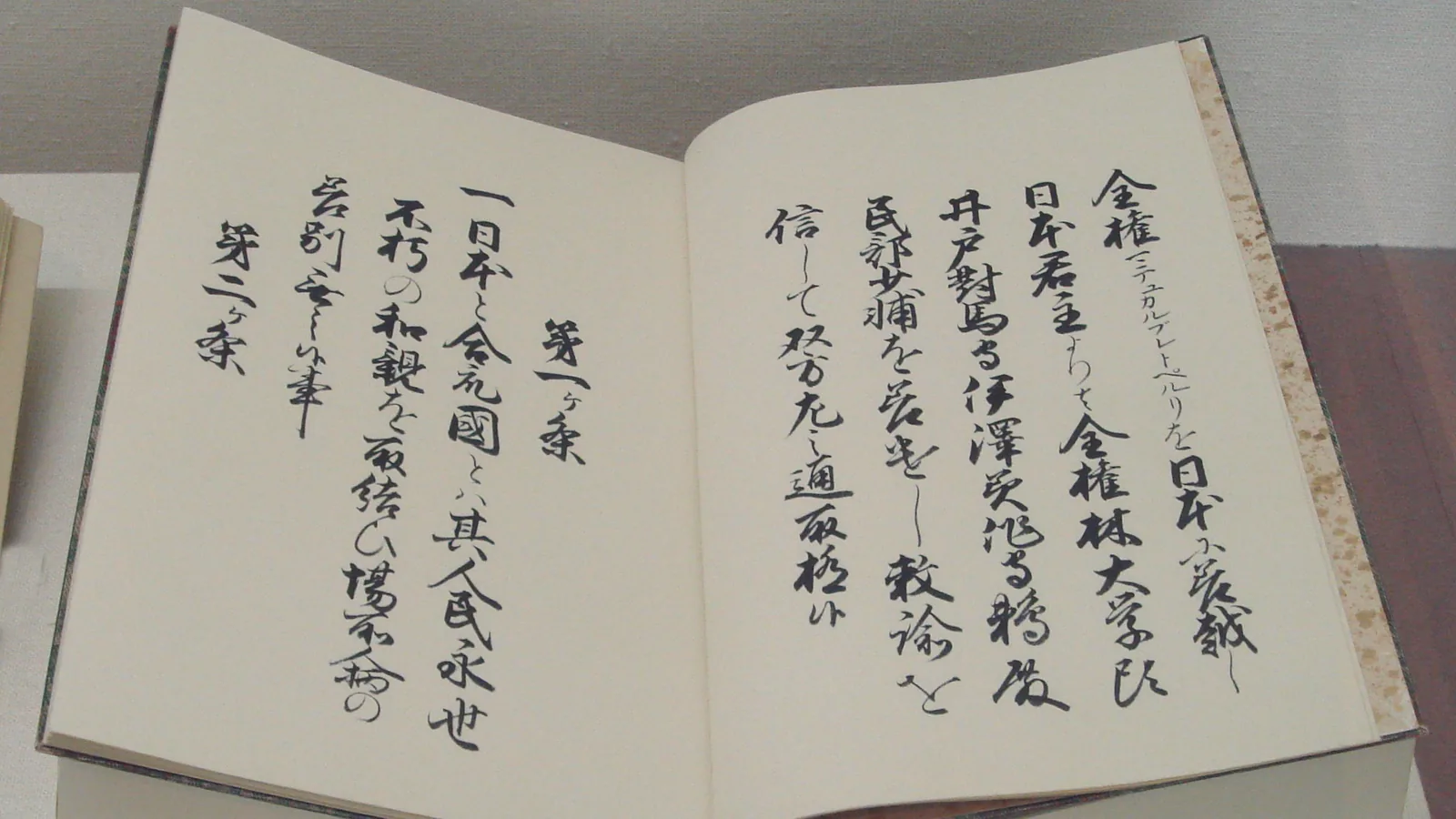

TL;DR — Perry’s twelve articles of March 31, 1854 opened Shimoda and Hakodate for supplies and protected shipwrecked sailors; the English text bears no Japanese signature and granted no trade.
“Done at Kanagawa, this thirty-first day of March, in the year of our Lord Jesus Christ one thousand eight hundred and fifty-four and of Kayei the seventh year, third month and third day.” That sentence closed the twelve articles agreed between Commodore Matthew Calbraith Perry and four Japanese commissioners. The English original, kept at the National Archives in Washington, ends with one name, “[signed] M.C. Perry.” Perry explained the blank to the Secretary of the Navy: “It will be observed that the practice usually pursued in affixing signatures to treaties was departed from on this occasion, and for reason assigned by the Japanese, that their laws forbade the subjects of the Empire from putting their names to any document written in a foreign language.” The articles opened two ports for wood, water, provisions and coal, promised care for shipwrecked Americans and allowed a consul at Shimoda after eighteen months. The State Department’s Office of the Historian says it “did not guarantee the right to trade with Japan.”
Quick facts
- When
- July 8, 1853 (four ships enter Edo Bay) · July 14, 1853 (Fillmore's letter received at Kurihama) · March 17, 1854 (points agreed at the treaty house) · March 24, 1854 (gifts exchanged, wrestlers, locomotive) · March 31, 1854 (treaty signed) · February 21, 1855 (ratifications exchanged at Shimoda) · July 29, 1858 (Treaty of Amity and Commerce)
- Where
- Uraga and Kurihama on Edo Bay; the treaty house by the village of Yokohama, three miles from Kanagawa; Shimoda in Izu; Hakodate in Matsumae
- Who
- Commodore Matthew Calbraith Perry, "special ambassador of the United States to Japan"; the commissioners Hayashi-Daigaku-no-kami, Ido, Izawa and Udono; the interpreter Moryama Yenoske; Captain H. A. Adams; Townsend Harris
- Outcome
- Shimoda opened at once and Hakodate in the following Japanese year for wood, water, provisions and coal; shipwrecked Americans were to be received and not confined; a consul could reside at Shimoda after eighteen months; the treaty granted no right to trade
July 14, 1853: a letter received against the law
On July 8, 1853, the Office of the Historian records, Perry led four ships into Edo Bay, now Tokyo Bay. The expedition’s own Narrative, compiled by Francis L. Hawks in 1856 from Perry’s journals and under his supervision, names them: the steamers Susquehanna and Mississippi and the sloops Saratoga and Plymouth. He carried a letter from President Millard Fillmore addressed to the emperor, though “the true leadership of Japan was in the hands of the Tokugawa Shogunate,” as the Office of the Historian writes.
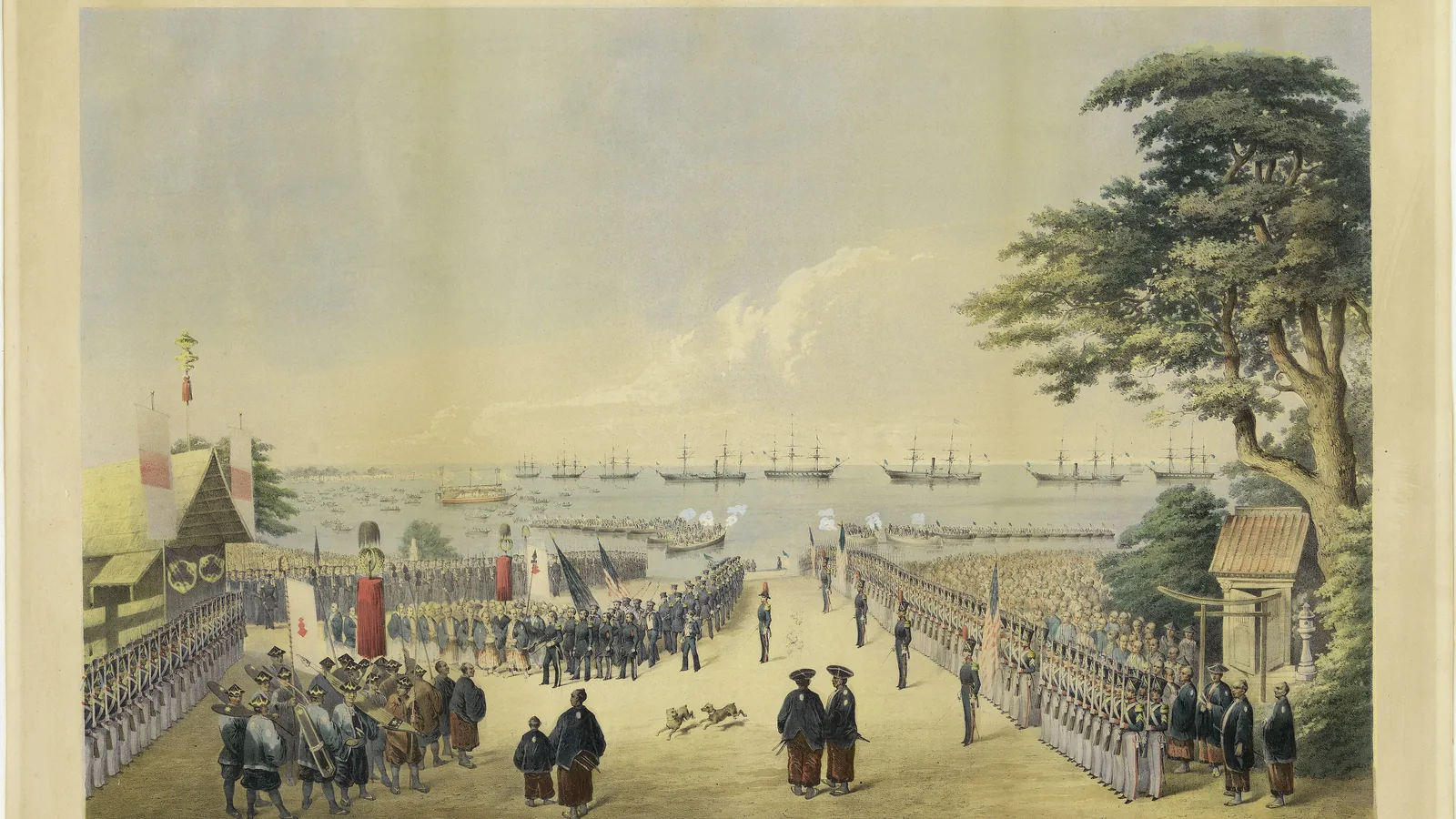
On July 14 the letter was handed over in a reception house built near the village of Kurihama, with nearly three hundred Americans ashore by Hawks’s count. The Japanese receipt, printed in the Narrative, said that since the ambassador “would feel himself insulted by a refusal to receive the letter at this place,” the letter “is hereby received in opposition to the Japanese laws.” Before the ships left, an officer told the interpreters what the next visit would bring: “Among them is a steam engine or locomotive, for railroads,” and a telegraph “long enough to reach from Uraga to Yedo.”
Yenoske's minutes of March 17
Perry returned “the following spring” with “an even larger squadron,” the Office of the Historian says. The commissioners met him in a building the Americans called the treaty house, on the shore by the village of Yokohama, three miles from Kanagawa; the treaty itself names only Kanagawa. The Japanese interpreter Moryama Yenoske kept a record of the points agreed on March 17, 1854, which Hawks printed. Its first point: “The citizens of the United States will not submit to degradations like those imposed upon the Dutch and Chinese, in their confinement at Nagasaki.” Its third: “Matsmai is a very distant place, and belongs to a prince. This point cannot be settled now.”
Shimoda, on the Izu peninsula, was offered in place of Nagasaki. Hakodate, in Matsumae domain, took longer: the commissioners’ statement of March 23 proposed September 17, 1855, and on March 25 Yenoske came aboard the Powhatan to say the port “might be ready for American ships as early as March of that year.”

"Wood, water, provisions and coal": the twelve articles
Article 2 granted “the port of Simoda, in the principality of Idzu and the port of Hakodadi, in the principality of Matsmai” as ports “where they can be supplied with wood, water, provisions and coal.” Shimoda opened “immediately on signing this treaty”; Hakodate “immediately after the same day in the ensuing Japanese year.”
Articles 3 to 5 dealt with sailors wrecked on the coast, whom Japanese vessels were to carry to the two ports. They were to be “free as in the other countries and not subjected to confinement but shall be amenable to just laws,” and at Shimoda could go where they pleased “within the limits of seven Japanese miles from a small island in the harbor.” Article 9 promised that any privilege later granted to another nation “shall be granted likewise to the United States,” which the Office of the Historian calls a most-favored-nation clause. Article 11 allowed consuls “to reside in Simoda at any time after the expiration of eighteen months.” Article 12 required ratification by the President and by “the august Sovereign of Japan,” exchanged “within eighteen months from the date of the signature therefore, or sooner if practicable.”
A locomotive on the beach and 200 bundles of rice
The American presents had landed on March 13. On March 24 the commissioners returned the courtesy. Hawks’s list, dated that day, runs from the emperor’s gifts down through the commissioners. Its seventh entry names “Abe, 1st Imperial councillor,” giving “14 pieces striped-figured silk,” with ten pieces each from five other councilors. The list ends with “200 bundles of rice, each 5 Japanese pecks” and “300 chickens” for the squadron; Yenoske explained that rice always went with royal presents, and “four small dogs of a rare breed” went to the President.
The rice came with the men who carried it. Hawks describes “professional wrestlers,” “some twenty-five in number,” among them “Koyanagi, the reputed bully of the capital,” who moved the sacks: “Each of the sacks weighed not less than one hundred and twenty-five pounds,” and most carried two at a time. Then the Americans ran their exhibit. “The Japanese took great delight in again seeing the rapid movement of the Lilliputian locomotive; and one of the scribes of the commissioners took his seat upon the car,” Hawks wrote, the crowd “unable to repress a shout of delight at each blast of the steam whistle.” On March 27 the commissioners dined with Perry aboard the Powhatan, the five principals in his cabin because their etiquette barred a table shared with subordinates.
Shimoda, February 21, 1855: the exchange of ratifications
Captain H. A. Adams sailed from Edo Bay on April 4, 1854 with the signed treaty and returned with the ratified copy to Shimoda, a town leveled by an earthquake on December 23, 1854. His report to Perry, printed in the Narrative’s second volume, records the arguments. The governor said the emperor “never signs anything; it is contrary to the custom of Japan.” The Japanese text, compared on February 13, read “after eighteen months” where the English read “within”; the commissioners answered, “the error is ours.” The ratified copy that came from Edo bore “the signature and seal of Tai-Koen, in full,” with the seals of six supreme councilors below, and the exchange was made on shore on February 21, 1855.
Townsend Harris accepted appointment as consul to Shimoda on August 4, 1855, and full diplomatic relations came with the Treaty of Amity and Commerce that Harris signed at Edo on July 29, 1858.
Key facts
- Perry led four ships into Edo Bay on July 8, 1853, the Office of the Historian records; Hawks names them as the Susquehanna, Mississippi, Saratoga and Plymouth.
- Fillmore’s letter was received on July 14, 1853 “in opposition to the Japanese laws,” with nearly three hundred Americans ashore (Hawks, Narrative, vol. I).
- Yenoske’s record of March 17, 1854 rejected “confinement at Nagasaki” and deferred Matsumae, “a very distant place.”
- Article 2 opened Shimoda at once and Hakodate “in the ensuing Japanese year” for “wood, water, provisions and coal” (Avalon Project text).
- Articles 3 to 5 covered shipwrecked sailors, free “within the limits of seven Japanese miles” at Shimoda; Article 11 allowed a consul after eighteen months; Article 9 was a most-favored-nation clause.
- The Japanese gifts of March 24, 1854 included “200 bundles of rice,” “300 chickens” and “four small dogs of a rare breed”; twenty-five wrestlers carried the 125-pound sacks (Hawks).
- The English original in the National Archives (NAID 299806) ends with Perry’s signature only; the Japanese, he wrote, said their laws forbade signing “any document written in a foreign language.”
- Ratifications were exchanged at Shimoda on February 21, 1855; the treaty “was not a commercial treaty,” and the Treaty of Amity and Commerce followed on July 29, 1858.
FAQ
What did the Treaty of Kanagawa actually grant?
Two ports, Shimoda and Hakodate, where American ships could buy wood, water, provisions and coal; protection and freedom of movement for shipwrecked sailors; a consul at Shimoda after eighteen months; and most-favored-nation treatment. The State Department's Office of the Historian states that it "did not guarantee the right to trade with Japan."
Why is there no Japanese signature on the English treaty?
Perry told the Secretary of the Navy that the Japanese gave one reason: their laws forbade subjects "from putting their names to any document written in a foreign language." The Japanese version was signed separately, and the ratified copy exchanged in February 1855 carried the seal of the "Tai-Koen" and six councilors.
When did Hakodate open to American ships?
The treaty says only "immediately after the same day in the ensuing Japanese year." The commissioners first proposed September 17, 1855; on March 25, 1854 the interpreter Yenoske said the port might be ready "as early as March of that year."
Sources
- Yale Law School, The Avalon Project, "Japanese-American Diplomacy: Treaty of Kanagawa; March, 31, 1854," full text of the twelve articles, from Hunter Miller, ed., Treaties and Other International Acts of the United States of America, vol. 6 (Washington: Government Printing Office, 1942).
- U.S. Department of State, Office of the Historian, "Milestones in the History of U.S. Foreign Relations: The United States and the Opening to Japan, 1853" (retired series, text still published).
- U.S. Department of State, Office of the Historian, "A Guide to the United States' History of Recognition, Diplomatic, and Consular Relations, by Country: Japan."
- U.S. National Archives and Records Administration, DocsTeach, "Treaty of Kanagawa," 3/31/1854; Perfected Treaties, 1778–1945; General Records of the United States Government, Record Group 11; National Archives Identifier 299806 (transcription, with Perry's letter to the Secretary of the Navy on the signatures).
- Francis L. Hawks, Narrative of the Expedition of an American Squadron to the China Seas and Japan, Performed in the Years 1852, 1853, and 1854, under the Command of Commodore M. C. Perry, vol. I (Washington: A. O. P. Nicholson, 1856), chapters on Uraga, the treaty house, the presents and the wrestlers; full text on the Internet Archive.
- Francis L. Hawks, Narrative of the Expedition, vol. II (Washington: A. O. P. Nicholson, 1856), "Letter of Captain H. A. Adams to Commodore Perry, communicating the particulars of the ratification of the treaty of Ka-na-ga-wa," pp. 201–209; full text on the Internet Archive.
Cite this article
- APA
- Our Earth's History. (2026, September 22). Twelve articles, no Japanese signature: Kanagawa, March 31, 1854. Our Earth's History. https://ourearthshistory.com/east-asia/modern/treaty-of-kanagawa-march-31-1854-twelve-articles/
- Chicago
- Our Earth's History. “Twelve articles, no Japanese signature: Kanagawa, March 31, 1854.” Our Earth's History, September 22, 2026. https://ourearthshistory.com/east-asia/modern/treaty-of-kanagawa-march-31-1854-twelve-articles/.
- MLA
- “Twelve articles, no Japanese signature: Kanagawa, March 31, 1854.” Our Earth's History, 22 Sep. 2026, https://ourearthshistory.com/east-asia/modern/treaty-of-kanagawa-march-31-1854-twelve-articles/.
Text licensed CC BY-NC-ND 4.0. Found an error? Tell us.