How did one morning at Sekigahara settle Japan for 250 years?
.jpg)
TL;DR — Fog, a matchlock volley and Kobayakawa Hideaki’s charge broke the western army in a few hours on October 21, 1600; Tokugawa Ieyasu then redrew the map of Japan.
Tokugawa Ieyasu beat Ishida Mitsunari’s western army at Sekigahara, in what is now Gifu Prefecture, on October 21, 1600, in fighting that lasted a few hours. The lines formed in fog between six and seven in the morning. Fewer than half of the western troops fought, the Mōri contingent never moved, and after hours of deadlock Kobayakawa Hideaki led his men down Mount Matsuo into his own side. Ieyasu then confiscated about a third of Japan’s rice land, became shogun in 1603, destroyed the Toyotomi house at Osaka in 1615, and left a government that lasted until 1868.
Quick facts
- When
- September 18, 1598 (Hideyoshi died) · April 1599 (Maeda Toshiie died) · October 21, 1600, Keichō 5/9/15 (battle) · November 6, 1600 (Mitsunari beheaded) · 1603 (Ieyasu made shogun) · 1614–15 (Osaka campaigns) · 1635 (sankin-kōtai formalized) · 1868 (Meiji Restoration)
- Where
- Sekigahara, now Sekigahara Town in Gifu Prefecture, Japan; Ōgaki Castle 15 kilometers to the east; Osaka Castle, where Toyotomi Hideyori stayed
- Who
- Tokugawa Ieyasu, the strongest of Hideyoshi's Five Great Elders; Ishida Mitsunari, a former commissioner; Kobayakawa Hideaki, who changed sides; Mōri Terumoto, the absent western commander; Kikkawa Hiroie, who kept the Mōri army still
- Outcome
- The western army collapsed in a few hours; 88 clans lost rank, 6.3 million koku changed hands, Ieyasu became shogun in 1603, and the Tokugawa house ruled until 1868
The vacuum Hideyoshi left in 1598
Toyotomi Hideyoshi, who had reunited Japan after a century of civil war, died at Fushimi Castle on September 18, 1598. His heir Hideyori was five. The historian Kawai Atsushi, writing for Nippon.com in 2023, described the arrangement Hideyoshi left: Five Commissioners, among them Ishida Mitsunari, to run the administration, and Five Great Elders, Ieyasu, Maeda Toshiie, Mōri Terumoto, Uesugi Kagekatsu and Ukita Hideie, to decide great matters. The will asked Ieyasu to protect the boy and govern from Fushimi.
The balance held for seven months. In April 1599 Toshiie died, and that night seven commanders who had fought in Korea, Katō Kiyomasa among them, went after Mitsunari, whose reports as an inspector in 1597 had gotten them punished. Ieyasu’s mediation ended with Mitsunari resigning and withdrawing to Sawayama Castle, in what is now Hikone, and Ieyasu moved into Osaka Castle. In July 1600 he marched north against Kagekatsu, who had refused a summons; at Oyama, north of Edo, he learned that Mitsunari was raising an army in his rear. Terumoto entered Osaka Castle, took charge of Hideyori, and the Toyotomi government circulated a document naming Ieyasu a rebel.
Two armies in the fog, October 21
Kawai wrote that no letters or diaries describe the battle itself. The best of the later accounts, in his judgment, is the Sekigahara shimatsuki, compiled in 1656 by the Confucian scholars Hayashi Razan and Hayashi Gahō from the memories of Sakai Tadakatsu, a teenager in 1600.
Ieyasu left Edo on October 7 with an army Kawai puts at 32,000, “accounts vary,” and reached the front near Ōgaki Castle on October 20 without his son Hidetada, whose main force was stuck at Ueda in Shinano. That night Mitsunari moved the western army out of Ōgaki in rain and darkness, torches unlit and horses’ mouths tied, to a line 15 kilometers west at Sekigahara, where holding the pass would leave the eastern army no other road west. Ieyasu heard at about two in the morning and followed.
Both armies were in position between six and seven. The rain had stopped and fog covered the ground. Ii Naomasa opened the fighting with about 50 horsemen, taking Ieyasu’s fourth son Matsudaira Tadayoshi past Fukushima Masanori’s front line and into the 17,000 men of Ukita Hideie. Owada Tetsuo, director of the battlefield museum at Sekigahara, wrote that the two sides together numbered more than 150,000, and that the labels “eastern army” and “western army” were not used at the time.
The turn: Kobayakawa comes down the mountain
Kawai estimated the western army at 80,000 and wrote that fewer than half of them fought. The 16,000 men of the Mōri house stood on Mount Nangū and never came down, because Kikkawa Hiroie, Terumoto’s cousin, had sent hostages to Ieyasu and received a pledge sealed in blood that the Mōri would keep their lands if their loyalty was clear. Their neighbors stood still too; Kawai counted more than 30,000 men who did nothing.
Kobayakawa Hideaki, on Mount Matsuo with the western army, had also promised Ieyasu that he would change sides. When hours passed and he had not moved, the Sekigahara shimatsuki has Ieyasu order matchlock fire toward the mountain as a question. Hideaki’s men then charged down into Ōtani Yoshitsugu’s position, others changed sides at the same moment, and the western line collapsed. Kawai reported a newer reading, that Hideaki fought for the east from the start, and left it open. None of the sources read for this article gives a casualty count; the figures vary widely.
Heads, castles and 6.3 million koku
Mitsunari fled to Mount Ibuki, was caught, and was beheaded at Rokujōgawara in Kyoto on November 6, 1600; his head hung on the Sanjō bridge. Kawai counted fewer than ten daimyo executed or made to kill themselves. The punishment came in land. Some 88 houses lost their rank. Terumoto kept two provinces of eight; Kagekatsu went from 1.2 million koku at Aizu to 300,000 at Yonezawa. Ieyasu confiscated 6.3 million koku, about a third of the country’s assessed rice yield, and raised his own house from 2.5 million to 4 million.
The winners were paid with the losers’ land, mostly far from Edo; Ieyasu set his son-in-law Ikeda Terumasa at Himeji with 521,000 koku, in Kawai’s words, “as a check on Hideyori.” In 1603 the emperor made Ieyasu shogun. Graham Squires, writing for World History Encyclopedia in 2022, recorded that Ieyasu passed the title to Hidetada in 1605 to make it hereditary, attacked Osaka Castle in 1614, made peace, and returned in 1615 to destroy the castle. Hideyori was killed. Ieyasu died the next year, aged 75.
The system that held until 1868
Squires wrote that the third shogun, Tokugawa Iemitsu, made alternate attendance, sankin-kōtai, a legal duty for the outer lords in 1635 and for the hereditary vassals in 1642: every daimyo spent alternate years in Edo and left his family there as hostages. The historian Arano Yasunori, writing for Nippon.com in 2013, listed a ban on Japanese voyages to the China seas in 1635 and the exclusion of Portuguese ships in 1639; Columbia University’s Asia for Educators page dates its “Act of Seclusion” to 1636.
The word for all this, sakoku, was not in use then. Arano wrote that it was coined to translate a Dutch term and entered Japanese with Shizuki Tadao’s Sakoku ron of 1801. He proposed in 1983 that historians drop it for kaikin, maritime restrictions, and count four portals that stayed open: Nagasaki for the Dutch and Chinese, Tsushima for Korea, Satsuma for Ryūkyū and Matsumae for the Ainu. On the length of the peace the sources agree: the Columbia page counts more than 250 years of Tokugawa rule, ending with the Meiji Restoration of 1868.
Reading a battle with no eyewitness record
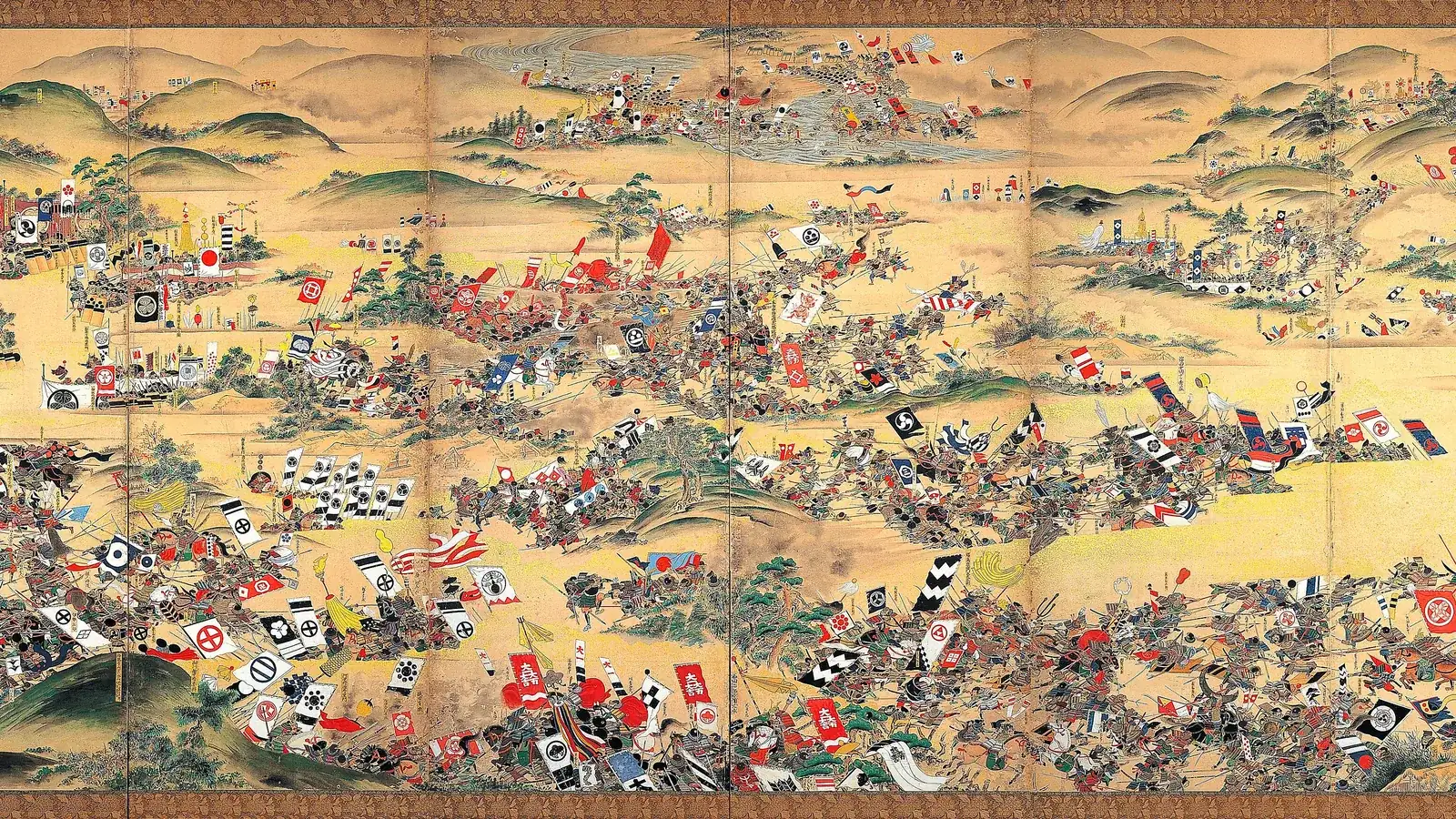
Because the Sekigahara shimatsuki was written 56 years after the fact, almost every scene above has been questioned. Kawai reported doubts that Naomasa’s 50 horsemen struck first, a theory that the council at Oyama never happened, and the argument that Hideaki was an eastern soldier all along. The Gifu Sekigahara Battlefield Memorial Museum, opened by Gifu Prefecture in October 2020 on the site of Ieyasu’s last camp, shows the day on a floor-sized screen beside an Edo-period painting of it. Kawai’s closing point survives the revisions: the daimyo had expected months of war, and it was over in a morning. A morning was enough because most of the western army had already been bought.
Key facts
- Toyotomi Hideyoshi died at Fushimi Castle on September 18, 1598; his heir Hideyori was five (Kawai; Squires).
- Maeda Toshiie died in April 1599; the same night seven commanders, including Katō Kiyomasa, moved against Ishida Mitsunari, who withdrew to Sawayama (Kawai).
- The battle was fought on October 21, 1600, Keichō 5/9/15, at Sekigahara, in what is now Gifu Prefecture; formations were complete between six and seven in the morning, in fog (Kawai).
- Owada Tetsuo puts the two armies together at more than 150,000; Kawai estimates the western army at 80,000, of whom fewer than half fought and more than 30,000 never moved.
- The best of the later accounts, in Kawai’s judgment, the Sekigahara shimatsuki, was compiled in 1656 by Hayashi Razan and Hayashi Gahō; no letters or diaries describe the fighting (Kawai).
- Mitsunari was beheaded in Kyoto on November 6, 1600; 88 houses lost rank; 6.3 million koku, about a third of Japan’s assessed yield, changed hands (Kawai).
- Ieyasu became shogun in 1603, took Osaka Castle in 1615, and died in 1616 aged 75; sankin-kōtai was formalized in 1635; Tokugawa rule ended in 1868 (Squires; Columbia).
FAQ
Who won the Battle of Sekigahara?
Tokugawa Ieyasu's eastern army. The western army led in the field by Ishida Mitsunari collapsed in a few hours after Kobayakawa Hideaki attacked his own side and other contingents changed sides with him.
How long did the battle last?
A few hours. Kawai Atsushi's account has the lines formed by seven in the morning, a deadlock for the first few hours, and then a collapse once Kobayakawa Hideaki moved; no source read for this article gives a closing time.
Why did Ieyasu wait until 1603 to become shogun?
Kawai wrote that the outer lords who had joined him before the battle won most of the fighting, because his son Hidetada's main army arrived late, so Ieyasu spent two and a half years paying them in land before the emperor named him shogun.
Sources
- Nippon.com — Kawai Atsushi, "Ieyasu's Ambition: The Road to Sekigahara" (December 1, 2023).
- Nippon.com — Kawai Atsushi, "The Battle of Sekigahara: A Fight for the Future of Japan" (December 6, 2023).
- Nippon.com — Kawai Atsushi, "After Sekigahara: Reshaping Japan" (December 11, 2023).
- Nippon.com — Arano Yasunori, "Foreign Relations in Early Modern Japan: Exploding the Myth of National Seclusion" (January 18, 2013).
- World History Encyclopedia — Graham Squires, "Tokugawa Ieyasu" (September 1, 2022).
- World History Encyclopedia — Graham Squires, "Tokugawa Iemitsu" (September 13, 2022).
- Columbia University, Asia for Educators — "Key Points Across East Asia, 1450–1750," Japan: The Tokugawa (1600–1868).
- The Metropolitan Museum of Art, Heilbrunn Timeline of Art History — Department of Asian Art, "Momoyama Period (1573–1615)" (October 2002).
- The Metropolitan Museum of Art, Heilbrunn Timeline of Art History — Department of Asian Art, "Art of the Edo Period (1615–1868)" (October 2003).
- Gifu Prefecture — Gifu Sekigahara Battlefield Memorial Museum, "About the Museum," with a greeting by the director Owada Tetsuo.
- VisitGifu (Gifu Prefecture Tourism Federation) — "Gifu Sekigahara Battlefield Memorial Museum Now Open" (November 12, 2020).
Cite this article
- APA
- Our Earth's History. (2026, September 20). How did one morning at Sekigahara settle Japan for 250 years? Our Earth's History. https://ourearthshistory.com/east-asia/early-modern/sekigahara-1600-one-morning-250-years/
- Chicago
- Our Earth's History. “How did one morning at Sekigahara settle Japan for 250 years?” Our Earth's History, September 20, 2026. https://ourearthshistory.com/east-asia/early-modern/sekigahara-1600-one-morning-250-years/.
- MLA
- “How did one morning at Sekigahara settle Japan for 250 years?” Our Earth's History, 20 Sep. 2026, https://ourearthshistory.com/east-asia/early-modern/sekigahara-1600-one-morning-250-years/.
Text licensed CC BY-NC-ND 4.0. Found an error? Tell us.