The Charter Oath of 1868: five sentences at the start of modern Japan

TL;DR — Five clauses sworn in the Meiji emperor’s name in April 1868 promised assemblies and knowledge from abroad; their authors had a constitution by 1889 and a Diet by 1890.
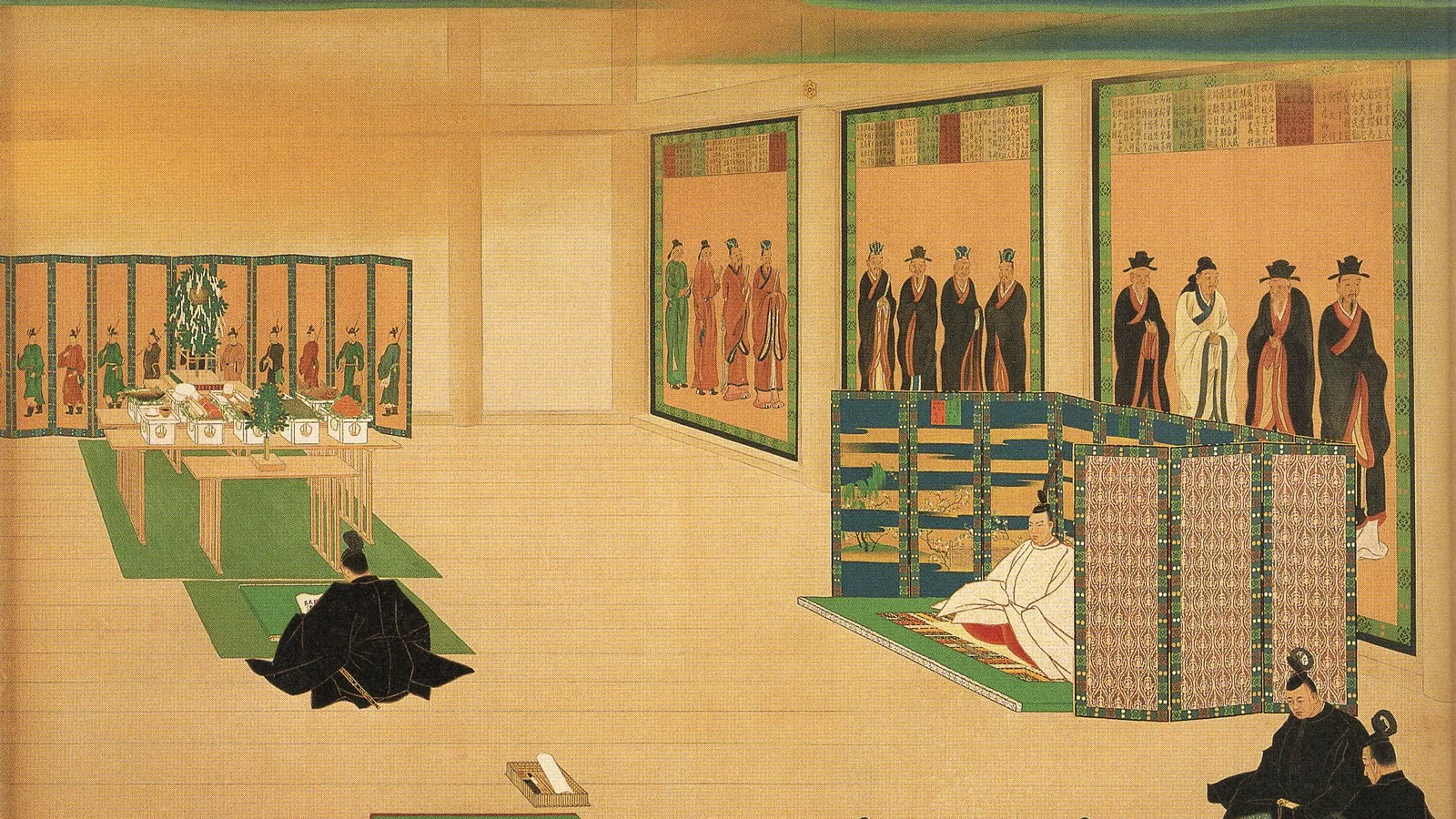
“Deliberative assemblies shall be widely established and all matters decided by public discussion.” That was the first of five clauses issued in the name of the Meiji emperor in April 1868, in the translation printed in Sources of Japanese Tradition (1964) and reproduced by Columbia University’s Asia for Educators. The emperor was 15. The text, Columbia’s introduction says, was written by young samurai, mainly from domains in southwestern Japan, who had just overthrown the Tokugawa shogunate. Over the next 22 years those samurai turned the domains into prefectures, sent a mission around the world, crushed a rising led by one of their own, and in 1889 gave Japan a constitution. The first Imperial Diet opened on November 29, 1890.
Quick facts
- When
- January 27, 1868 (fighting at Fushimi, by Satow's diary) · April 1868 (the Charter Oath issued) · April 4, 1868 (Edo forts handed over) · 1871 (domains made prefectures) · December 1871 to September 1873 (Iwakura Mission) · October 1873 (Saigō and others resign) · February 15 to September 24, 1877 (Satsuma Rebellion) · February 11, 1889 (constitution promulgated) · November 29, 1890 (first Imperial Diet opens)
- Where
- Kyoto and Fushimi; Osaka; Edo, renamed Tōkyō; Fukui in Echizen; Kagoshima and Shiroyama; Berlin, where Itō Hirobumi kept his diary in March 1873
- Who
- The Meiji emperor, 15 in 1868; Ōkubo Toshimichi, Kido Takayoshi and Iwakura Tomomi; Saigō Takamori; Itō Hirobumi; Katsu Kaishū for the Tokugawa; Ernest Satow and William Elliot Griffis, who wrote down what they saw
- Outcome
- A five-clause oath became the stated basis of the new government; the domains were abolished in 1871, the samurai rising of 1877 was crushed, a constitution was promulgated in 1889 and the first Diet met in 1890
Five clauses, sworn by a boy
The other four clauses, in the same translation, run: “All classes, high and low, shall unite in vigorously carrying out the administration of affairs of state”; “The common people, no less than the civil and military officials, shall each be allowed to pursue his own calling so that there may be no discontent”; “Evil customs of the past shall be broken off and everything based upon the just laws of Nature”; and “Knowledge shall be sought throughout the world so as to strengthen the foundations of imperial rule.”
William Elliot Griffis, an American teacher in Japan from 1870 to 1874, wrote in The Mikado’s Empire (first published 1876) that the young emperor came in person to the council of state and took the oath before the court nobles and daimyo, and that “this oath is the basis of the new Government.” He would not say what it was worth. The promises, he wrote, “are either the pompous bombast of a puppet or the pregnant utterances of a sovereign.”
Fushimi in January, Edo in April
The men who wrote the oath were still at war when it was issued. Ernest Satow, then an interpreter at the British legation, recorded in A Diplomat in Japan (1921) that on the evening of January 27, 1868, “a great blaze was seen in the direction of Kioto.” It was Fushimi, three miles from the capital, where the former shogun’s troops and those of Satsuma and its allies were fighting.
By April 1 Satow was back in Edo, visiting Katsu Awa no Kami, known as Katsu Kaishū, after dark to avoid attention. Katsu, now commanding the Tokugawa forces, told him that he and Ōkubo Ichiō had charge of the negotiations and that Saigō Takamori spoke for the imperial side. The demands on the former shogun, Tokugawa Yoshinobu, were to surrender all arms and warships, evacuate Edo castle, and execute the officers who had led the attack at Fushimi; then the emperor “would show clemency.” The forts in Edo bay were handed over on April 4, Katsu and Saigō talked terms at a house in Shinagawa, and on April 28 Saigō told Sir Harry Parkes at Yokohama that the former shogun’s life would not be demanded.
Satow later dined with Ōkubo Toshimichi of Satsuma and wrote that he had “no doubt that the final decision to make Yedo the centre of government, and to change its name to Tokio or Eastern Capital was largely his work.”
The last year of feudalism, seen from Fukui
Griffis recorded that the four great domains, Satsuma, Chōshū, Tosa and Hizen, sent a memorial to the throne arguing that daimyo fiefs “ought not to be looked on as private property, but as the mikado’s own,” and offered to restore their registers to the sovereign. Behind them, he wrote, “there were at least three men who were determined to sweep feudalism away utterly. They were Kido, Okubo, Iwakura,” that is Kido Takayoshi, Ōkubo and Iwakura Tomomi.
His diary at Fukui for July 18, 1871, begins, “The thunder-bolt has fallen!” A messenger from Tōkyō had reached the domain office at ten that morning with a proclamation reducing the hereditary incomes of the samurai, making the domain’s property the imperial government’s, converting the Fukui han into a ken, and ordering that all officials be appointed from Tōkyō. In September 1871 the daimyo were called to Tōkyō to retire, and Griffis watched the lord of Echizen bid farewell to 3,000 two-sworded retainers in the castle hall. Taxes followed the domains: on January 4, 1877, Griffis recorded, the national land tax was cut from 3 percent to 2.5 percent.
Abroad in 1871, split in 1873, in arms in 1877
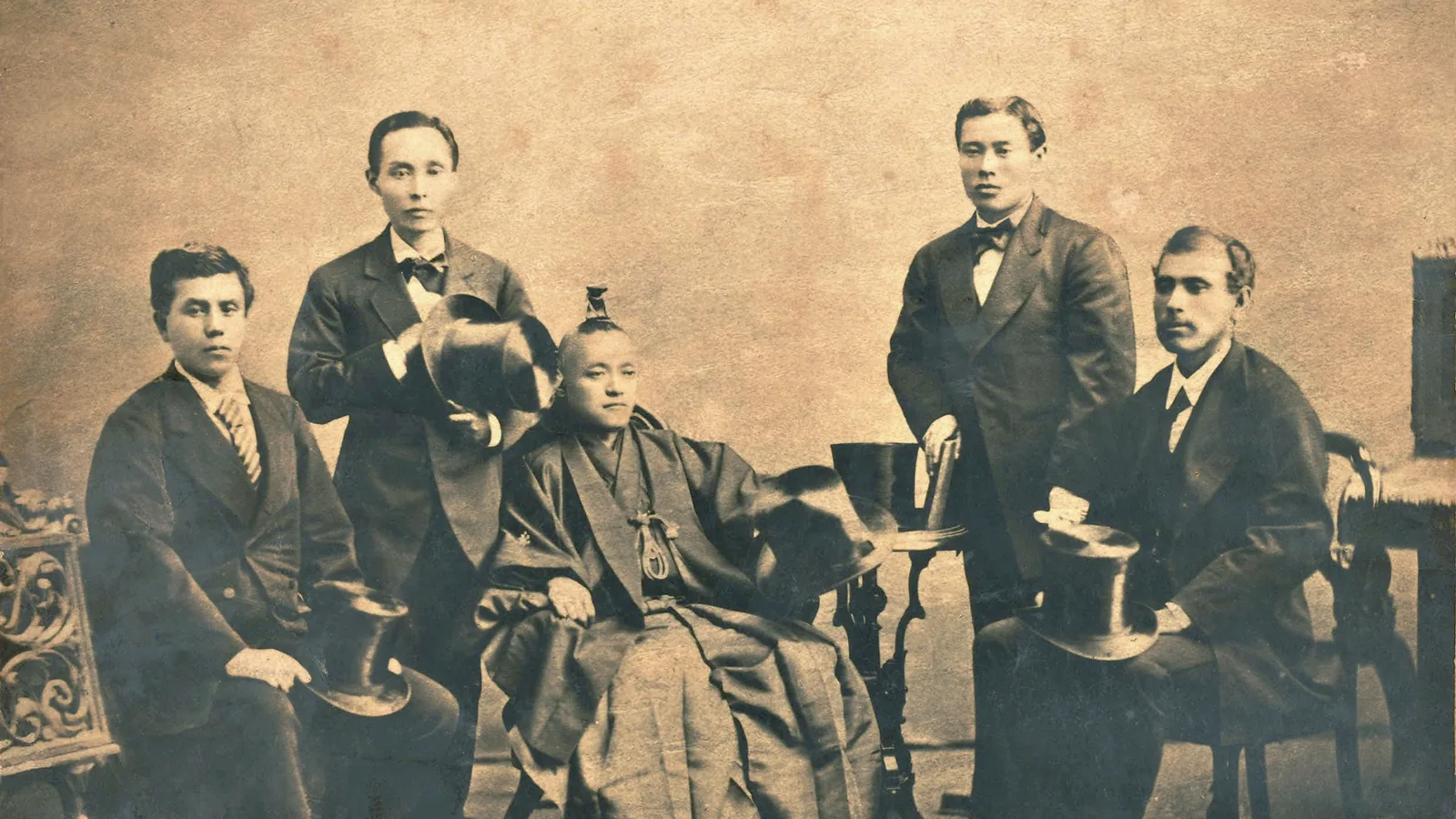
In December 1871 a mission left Japan under Iwakura as ambassador plenipotentiary, with Kido, Ōkubo and Itō Hirobumi among the deputies; the National Diet Library’s guide to its archives says it spent about two years in the United States, Britain, France, Eastern Europe and Russia.
The mission came home to a quarrel. Saigō, who had stayed behind, proposed invading Korea; Ōkubo and the returned travelers argued for domestic priorities and won, and Saigō, Itagaki Taisuke and Soejima Taneomi resigned from the government in October 1873. Samurai risings, sporadic since 1868, gained strength after the Korea debate collapsed. In Kagoshima the graduates of Saigō’s private school raided an ammunition depot early in 1877, and on February 15 Saigō marched toward Tōkyō. His army reached Kumamoto and Miyazaki, fell back to Shiroyama above Kagoshima in September, and was crushed there on September 24, 1877, by government forces under Ōyama Iwao. Ōkubo was murdered on the road to the palace on May 14, 1878.

Restoration or revolution, and the Diet of 1890
Columbia’s Key Points call the events of 1868 a reform launched “under the guise of restoring the emperor to power,” and conclude that the Meiji “Restoration” “was in many ways a profound revolution.” MIT’s essay goes further: the rebels rode to power on the reactionary slogans “expel the barbarians” and “revere the emperor,” then “immediately flip-flopped and embraced the foreign barbarians,” and “had the movement to overthrow the government in 1868 failed, its leaders would have gone down in history as reactionary and ruthless terrorists.”
The first clause of the oath was the slowest to be kept. By 1878, Griffis wrote, the promise of a deliberative assembly “had never been fully carried out.” On October 12, 1881, a proclamation in the emperor’s name set a date: “We shall in the 23d year of Meiji (1890) establish a Parliament.” The Constitution of the Empire of Japan was promulgated on February 11, 1889; the next day the prime minister, Kuroda Kiyotaka, gave a speech separating government from political parties. The first general election for the House of Representatives was held on July 1, 1890, and the first Imperial Diet opened on November 29, 1890.
Key facts
- The Charter Oath was issued in the name of the Meiji emperor, then 15, in April 1868; Columbia University’s Asia for Educators says its text was written by young samurai, mainly from southwestern domains.
- Its first clause, in the Sources of Japanese Tradition translation: “Deliberative assemblies shall be widely established and all matters decided by public discussion.”
- Ernest Satow saw the blaze of the fighting at Fushimi on the evening of January 27, 1868; the Edo forts were handed over on April 4, and Saigō Takamori told Sir Harry Parkes on April 28 that the former shogun’s life would not be demanded.
- Satow wrote that the decision to make Edo the seat of government and rename it Tōkyō was “largely” the work of Ōkubo Toshimichi.
- William Elliot Griffis recorded at Fukui on July 18, 1871, the proclamation converting the domain into a prefecture, and in September 1871 the order calling the daimyo to Tōkyō.
- The Iwakura Mission left in December 1871 and returned in September 1873; Saigō, Itagaki Taisuke and Soejima Taneomi resigned in October 1873 after losing the debate over invading Korea (National Diet Library).
- Saigō marched from Kagoshima on February 15, 1877, and his forces were destroyed at Shiroyama on September 24, 1877 (National Diet Library).
- The constitution was promulgated on February 11, 1889; the first general election was held on July 1, 1890, and the first Imperial Diet opened on November 29, 1890 (National Diet Library).
FAQ
What did the Charter Oath of 1868 promise?
Five things, in the Columbia translation: deliberative assemblies and decision by public discussion; unity of high and low in running the state; freedom for commoners and officials alike to pursue their callings; a break with "evil customs of the past" in favor of "the just laws of Nature"; and knowledge sought "throughout the world" to strengthen imperial rule.
Who actually wrote it?
Columbia's Asia for Educators attributes the text to the young samurai, mainly from southwestern domains, who led the overthrow of the Tokugawa. Griffis, writing in the 1870s, said the words were put into the emperor's mouth by the men who had made him ruler in fact; none of the sources cited below names a single author.
Was the Meiji Restoration a restoration?
Columbia's Key Points call it "in many ways a profound revolution" carried out in the name of restoring imperial rule, and MIT's Visualizing Cultures describes a coup by young samurai whose reactionary slogans were dropped once they held power. The emperor's position was the symbol; the men who used it built the new state.
Sources
- Columbia University, Asia for Educators — "The Charter Oath (of the Meiji Restoration), 1868," primary source document with questions; translation from Sources of Japanese Tradition, ed. de Bary, Tsunoda and Keene (Columbia University Press, 1964), p. 137.
- Columbia University, Asia for Educators — "Key Points," Japan and the West: The Meiji Restoration (1868–1912).
- Ernest Satow, A Diplomat in Japan (London, 1921), chapters XXV, XXXI and XXXII: the fighting at Fushimi, the Edo negotiations, Ōkubo and the capital; full text on the Internet Archive.
- William Elliot Griffis, The Mikado's Empire, fifth edition with supplementary chapters "Japan in 1883" and "Japan in 1886" (New York: Harper & Brothers; first published 1876); the oath, the Fukui diary of July 1871, the land tax of 1877, the proclamation of October 12, 1881; full text on the Internet Archive.
- National Diet Library, "Modern Japan in archives" — Chronological Table (1853–1890s).
- National Diet Library, "Modern Japan in archives" — 1-7 Iwakura Mission, with Itō Hirobumi's handwritten diary of March 1873.
- National Diet Library, "Modern Japan in archives" — 1-8 OKUBO Toshimichi's Opinion on Constitutional Government (the 1873 political crisis).
- National Diet Library, "Modern Japan in archives" — 1-11 Satsuma Rebellion, with Ōyama Iwao's report on the attack at Shiroyama, September 19–24, 1877.
- MIT Visualizing Cultures — "Throwing Off Asia I," essay chapter 1, Westernization (2008).
- MIT Visualizing Cultures — "Throwing Off Asia I," essay chapter 2, "Civilization & Enlightenment" (2008).
Cite this article
- APA
- Our Earth's History. (2026, September 21). The Charter Oath of 1868: five sentences at the start of modern Japan. Our Earth's History. https://ourearthshistory.com/east-asia/modern/charter-oath-1868-meiji-japan/
- Chicago
- Our Earth's History. “The Charter Oath of 1868: five sentences at the start of modern Japan.” Our Earth's History, September 21, 2026. https://ourearthshistory.com/east-asia/modern/charter-oath-1868-meiji-japan/.
- MLA
- “The Charter Oath of 1868: five sentences at the start of modern Japan.” Our Earth's History, 21 Sep. 2026, https://ourearthshistory.com/east-asia/modern/charter-oath-1868-meiji-japan/.
Text licensed CC BY-NC-ND 4.0. Found an error? Tell us.