Sixteen bonds a mile, trebled in the mountains: Promontory, 1869

TL;DR — The Act of July 1, 1862, paid railroads in bonds and land by the mile; on May 10, 1869, the rails met at Promontory Summit and a telegraph sent “DONE.”
“An Act To aid in the construction of a railroad and telegraph line from the Missouri River to the Pacific Ocean, and to secure to the Government the use of the same for postal, military, and other purposes.” So begins the law of July 1, 1862, printed at 12 Stat. 489, in the National Archives’ transcription. Section 5 set the price: for every 40 consecutive miles certified complete, the Treasury would issue “bonds of the United States of one thousand dollars each, payable in thirty years after date, bearing six per centum per annum interest,” at “sixteen of said bonds per mile.” On Monday, May 10, 1869, the Central Pacific from Sacramento and the Union Pacific from Omaha met at Promontory Summit in Utah Territory, and a telegraph key sent the word the National Park Service spells out as “D-O-N-E.” Whose hand sent it is disputed inside the Park Service itself.
Quick facts
- When
- July 1, 1862 (Pacific Railway Act) · early 1864 (Central Pacific hires its first Chinese workers) · June 24, 1867 (strike from Cisco to Truckee) · April 28, 1869 (10 miles and 56 feet of track in one day) · May 10, 1869 (last spike at Promontory Summit) · late 1869 (junction moved to Ogden) · March 12, 2019 (Golden Spike National Historical Park)
- Where
- Sacramento and the Sierra Nevada, California; Omaha, Nebraska; Piedmont, Wyoming; Promontory Summit and Ogden, Utah Territory; Washington, D.C.
- Who
- The Central Pacific Railroad Company of California and the Union Pacific; Leland Stanford; Thomas Durant; Charles Crocker; David Hewes; Samuel S. Montague; Grenville M. Dodge; Andrew J. Russell; the Chinese workforce of the Central Pacific
- Outcome
- The two roads met at Promontory Summit on May 10, 1869, and the last spike was driven; the junction moved to Ogden late in 1869. The National Park Service names W.N. Shilling as the telegrapher who sent "DONE"; its historian Robert Spude found no contemporary paper that names him
"Sixteen of said bonds per mile": the terms of 1862
Section 3 gave land as well: “every alternate section of public land, designated by odd numbers, to the amount of five alternate sections per mile on each side of said railroad . . . within the limits of ten miles on each side of said road,” with “all mineral lands” excepted. Section 11 raised the count where the ground rose: for the 150 miles east of the Rocky Mountains and the 150 miles west of the Sierra Nevada the bonds “shall be treble the number per mile hereinbefore provided,” and between the ranges “double the number per mile.” The Archives sums up what followed: from 1863 the Union Pacific built west from Omaha with “more than 8,000 Irish, German, and Italian immigrants,” the Central Pacific east from Sacramento with “over 10,000 Chinese laborers.”
Sacramento, 1864: fifty men on trial
The Park Service records 50 Chinese men taken on early in 1864 as a trial, a reputation for “strength, efficiency, and reliability,” and then Chinese graders, foremen, masons and cooks paid on average 30 percent less than white workers. Stanford University’s Chinese Railroad Workers in North America Project counts, by February 1867, 8,000 in the tunnels and 3,000 on the track, 90 percent of the workforce. Its FAQ gives the peak as “as many as 10,000 to 15,000 Chinese” at one time; its home page gives “between 10-12,000 at any one moment.”
Tunnel No. 6, the Summit Tunnel, ran 1,695 feet through granite, 124 feet below the surface; nitroglycerin mixed on site sped the work until an explosion in April 1866 killed six men. On June 24, 1867, the Chinese workers from Cisco to Truckee, 30 miles of line, stopped work for higher pay and a ten-hour day, “the largest organized labor strike in the United States” at that date in the Park Service’s words; the company cut off food, and the strike ended within a week. The company kept no death roll; Stanford’s FAQ states that “Some estimate that 50 to 150 to over 1000 Chinese workers were killed.”
April 28, 1869: ten miles and 56 feet
To win a bet between Charles Crocker and Thomas Durant, eight Irish tracklayers began dropping rail at dawn on April 28, 1869, and by dusk the crew had laid “10 miles and 56 feet.” The Park Service puts “no fewer than 400 Chinese laborers” behind the eight; Stanford’s FAQ puts “a small army of 5000 workers, mostly Chinese” on the same day. Neither institution reconciles the two counts.
The ceremony was fixed for May 8. Durant’s train was held at Piedmont, Wyoming, by some 400 discharged workers owed three months’ wages, and then rain damaged the Devil’s Gate bridge over the Weber River. Robert Spude, a Park Service historian, wrote in 2006 that the change of date “may have been more a result from the undermining and near collapse of the Devil’s Gate bridge of the UP than the well publicized capture and holding-for-ransom of vice-president Durant.”
The spike, a swing that hit the tie and the word "DONE"
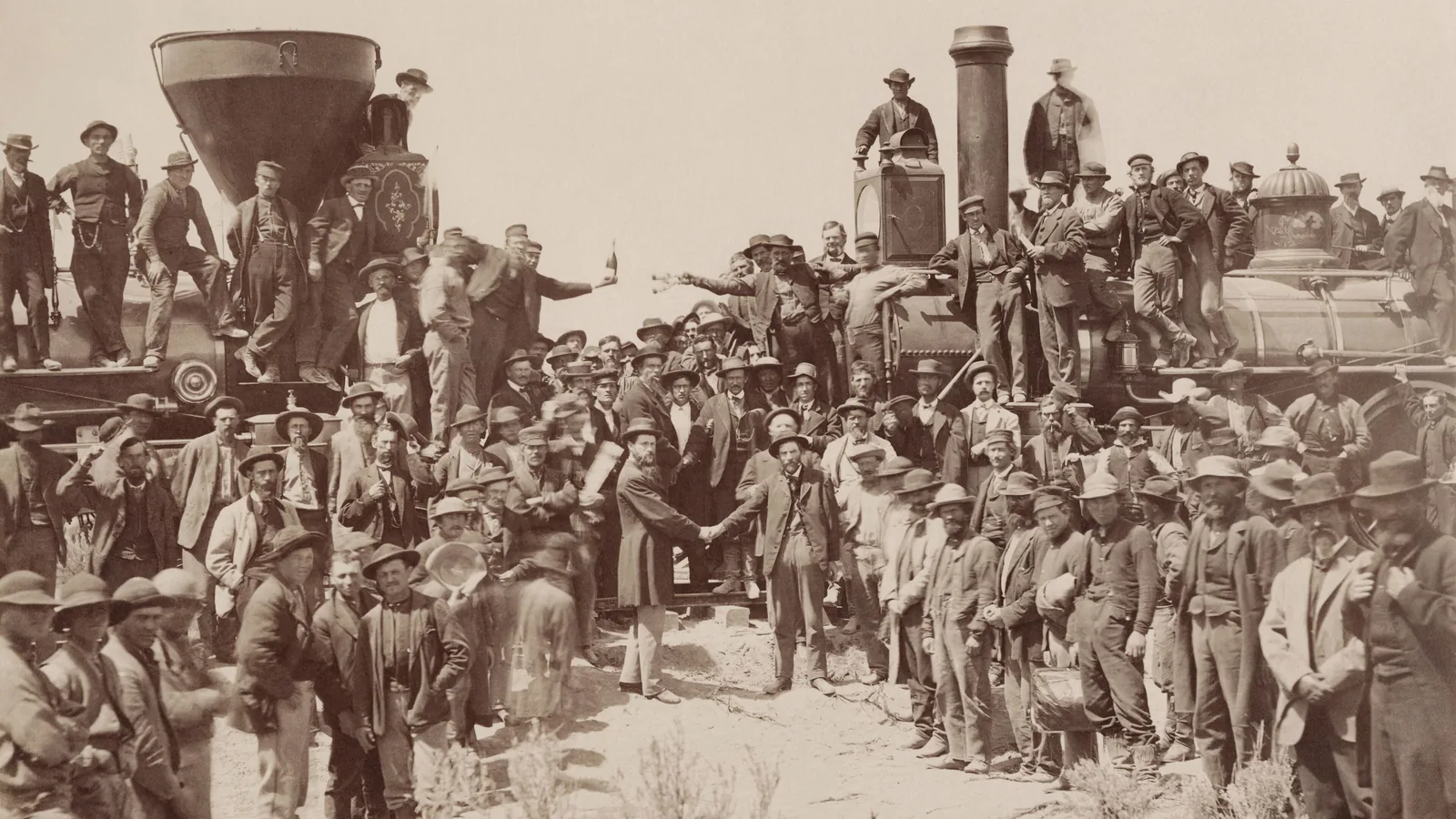
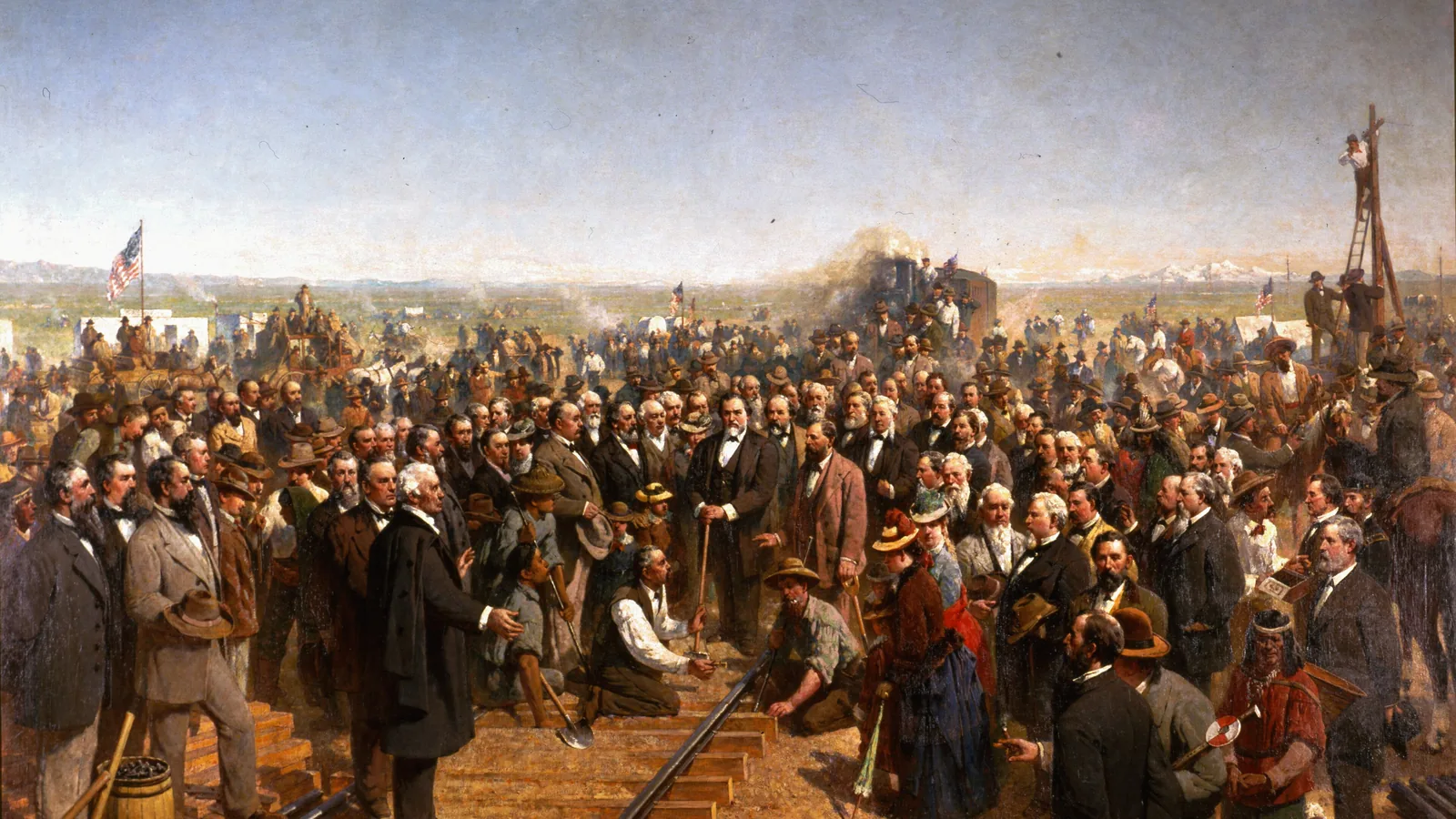
About 1,000 people stood at the gap on May 10; Spude cites Paul Hedren for “264 soldiers present.” The spike came from David Hewes of San Francisco: “5 5/8 inches long, weighed 14.03 ounces and was made of 17.6 carat gold.” The Park Service prices Hewes’s gold at $400, with about $350 worth in the spike; the Mining & Scientific Press of May 8, 1869, reported “$360, U. S. Coin, San Francisco Mint, melted together.” One face, engraved before the delay, read “completed May 8th 1869”; another, “May God continue the unity of our Country as this Railroad unites the two great Oceans of the world.” Kyle K. Wyatt of the California State Railroad Museum wrote in 2005 that “it appears that David Hewes had two gold spikes cast in 1869.”
The Park Service’s account of the blow: “Stanford took a mighty swing at the spike, and struck the tie instead. Durant, still not feeling too well, took a feeble swing, and did not even hit the tie!” A rail worker drove the spike home, “and the telegrapher, W.N. Shilling of Western Union, sent the long awaited message, ‘D-O-N-E.’ The time was 12:47 p.m.” Spude’s reading of the 1869 papers differs. Shilling’s account was told in the 1920s, and “none of the contemporary newspapers or other contemporary sources checked to date mention either Bowsher or Shilling in a prominent let alone any role at the ceremony”; the Utah Daily Reporter of May 9 and the Chicago Tribune of May 11 name F. S. Vandenberg, the Central Pacific’s telegraph superintendent. Even 12:47 is a conversion from “2:47 P.M., Washington time” using time zones of the 1880s; by sun time, “Promontory time would have been approximately 12:27.”

After the champagne: two engines, Ogden and a park
The engines in the photographs got there by accident. Jupiter, built at Schenectady and in service from March 20, 1869, took Stanford’s train because the Antelope hit a log rolled onto the line; No. 119 was the nearest of five engines at Ogden when Durant’s train arrived without one. Andrew J. Russell’s plate “East and West Shaking Hands at Laying of Last Rail” shows Samuel S. Montague of the Central Pacific and Grenville M. Dodge of the Union Pacific clasping hands between them.
Late in 1869 the two companies agreed to move the junction to Ogden. In 1872, the Miller Center at the University of Virginia records, “the Credit Mobilier scandal was exposed,” railroad companies having overcharged the government by millions and bribed officials with shares. The site became a National Historic Site on April 2, 1957, and federal property on July 30, 1965, after “38 long years of struggle by Bernice Gibbs Anderson.” On March 12, 2019, the John D. Dingell, Jr. Conservation, Management, and Recreation Act renamed the site Golden Spike National Historical Park.
Key facts
- The Pacific Railway Act of July 1, 1862, 12 Stat. 489, issued 30-year, 6 percent bonds of $1,000 at “sixteen of said bonds per mile,” trebled for the 150 miles east of the Rockies and the 150 miles west of the Sierra Nevada, doubled between (National Archives).
- Section 3 granted five alternate odd-numbered sections of public land per mile on each side of the line, within ten miles, mineral lands excepted.
- The Central Pacific hired 50 Chinese workers early in 1864 and paid them about 30 percent less than white workers (National Park Service); Stanford’s project counts up to 10,000 to 15,000 at one time.
- The Summit Tunnel ran 1,695 feet through granite, 124 feet below the surface; a nitroglycerin explosion in April 1866 killed six (Stanford FAQ).
- On June 24, 1867, Chinese workers from Cisco to Truckee struck for a week, “the largest organized labor strike in the United States” at that date (National Park Service).
- On April 28, 1869, Central Pacific crews laid “10 miles and 56 feet” in one day; the Park Service counts 400 Chinese workers, Stanford about 5,000.
- The gold spike was 5 5/8 inches, 14.03 ounces and 17.6 carat; the Park Service gives its gold as $350 to $400, the Mining & Scientific Press of May 8, 1869, as “$360, U. S. Coin.”
- The Park Service names W.N. Shilling as sender of “DONE” at 12:47 p.m.; Robert Spude found the 1869 papers name F. S. Vandenberg and put the time at “2:47 P.M., Washington time.”
FAQ
What did the Pacific Railway Act of 1862 give the railroads?
Government bonds of $1,000, at 6 percent for 30 years, at 16 per mile of finished track, trebled for the 150 miles east of the Rockies and the 150 miles west of the Sierra Nevada and doubled between, plus five alternate sections of public land per mile on each side of the line.
Who sent the telegraph "DONE" from Promontory on May 10, 1869?
The National Park Service names W.N. Shilling of Western Union. Park Service historian Robert Spude wrote in 2006 that no 1869 newspaper he checked mentions Shilling, and that the Utah Daily Reporter and Chicago Tribune name Central Pacific telegraph superintendent F. S. Vandenberg.
Where is the golden spike now, and what happened to Promontory?
Kyle K. Wyatt of the California State Railroad Museum wrote in 2005 that Hewes had two gold spikes cast. The junction moved to Ogden late in 1869; the site became a National Historic Site in 1957 and Golden Spike National Historical Park on March 12, 2019.
Sources
- National Archives, Milestone Documents: "Pacific Railway Act (1862)," transcription of the Act of July 1, 1862, 12 Stat. 489, Enrolled Acts and Resolutions of Congress, Record Group 11.
- National Park Service, Golden Spike National Historical Park, "Chinese Labor and the Iron Road."
- Chinese Railroad Workers in North America Project, Stanford University (Gordon H. Chang and Shelley Fisher Fishkin, co-directors), "FAQs."
- Chinese Railroad Workers in North America Project, Stanford University, project home page.
- National Park Service, Golden Spike National Historical Park, "Four Special Spikes."
- National Park Service, Golden Spike National Historical Park, "Everlasting Steam: The Story of Jupiter and No. 119."
- Robert L. Spude (National Park Service), "Commentary on J. N. Bowman's article, 'Driving the Last Spike at Promontory, 1869,' Fifty Years Later," Appendix H, 2006 (PDF hosted by the Central Pacific Railroad Photographic History Museum).
- National Park Service, Golden Spike National Historical Park: "Andrew J. Russell" (A Moment in Time), "Promontory Station," "Golden Spike National Historical Park Facts" and "The Last Spike: History at a Glance."
- Miller Center, University of Virginia, "Ulysses S. Grant: Domestic Affairs."
Cite this article
- APA
- Our Earth's History. (2026, September 22). Sixteen bonds a mile, trebled in the mountains: Promontory, 1869. Our Earth's History. https://ourearthshistory.com/americas/modern/promontory-may-10-1869-done-telegraph-pacific-railway-act-1862/
- Chicago
- Our Earth's History. “Sixteen bonds a mile, trebled in the mountains: Promontory, 1869.” Our Earth's History, September 22, 2026. https://ourearthshistory.com/americas/modern/promontory-may-10-1869-done-telegraph-pacific-railway-act-1862/.
- MLA
- “Sixteen bonds a mile, trebled in the mountains: Promontory, 1869.” Our Earth's History, 22 Sep. 2026, https://ourearthshistory.com/americas/modern/promontory-may-10-1869-done-telegraph-pacific-railway-act-1862/.
Text licensed CC BY-NC-ND 4.0. Found an error? Tell us.