Two letters from Khrushchev, October 26 and 27, 1962

TL;DR — Khrushchev’s letters of October 26 and 27, 1962, made two different offers; Kennedy answered the first, and on October 28 Radio Moscow announced the missiles would be removed.
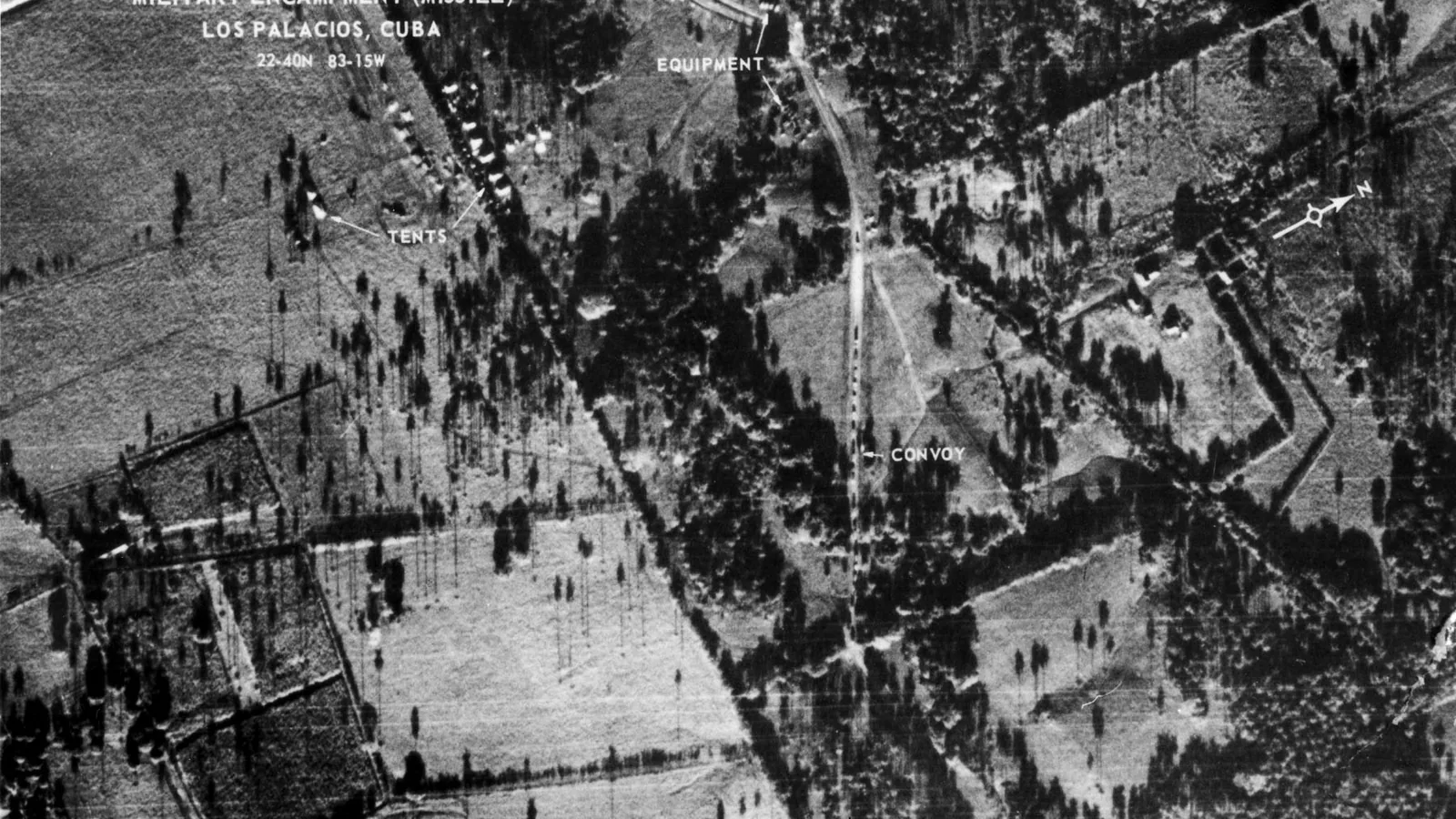
On the morning of October 14, 1962, a U-2 piloted by Air Force Major Richard D. Heyser flew over western Cuba and brought back 928 photographs. The State Department’s published record, Foreign Relations of the United States, states that the pictures from that six-minute pass “produced the first verified evidence of the existence of Soviet offensive missile sites in Cuba.” Analysts at the National Photographic Intelligence Center found three medium-range ballistic missile sites under construction near San Cristóbal, in Pinar del Río province. Flights on October 15 found a fourth site, two intermediate-range sites at Guanajay and 21 crates for IL-28 bombers. Two weeks of meetings, a naval quarantine and two letters from Nikita Khrushchev followed. On October 28 Radio Moscow announced that the missiles would go in exchange for an American pledge not to invade Cuba, and on November 20 Kennedy’s advisers decided that the quarantine would be lifted.
Quick facts
- When
- October 14, 1962 (U-2 flight over western Cuba) · October 16 (first White House meeting) · October 22 (Kennedy announces a quarantine) · October 26 (Khrushchev's first letter) · October 27 (second letter; U-2 shot down; Robert Kennedy meets Dobrynin) · October 28 (Khrushchev's message; Radio Moscow announcement) · November 20 (decision to lift the quarantine)
- Where
- San Cristóbal and Guanajay in western Cuba; the White House and the Justice Department in Washington; Moscow; the sea lanes around Cuba
- Who
- President John F. Kennedy; Chairman Nikita Khrushchev; Secretary of State Dean Rusk; Attorney General Robert F. Kennedy; Soviet Ambassador Anatoly Dobrynin; Major Richard D. Heyser; Major Rudolf Anderson, Jr.; Admiral Robert L. Dennison
- Outcome
- Khrushchev's letter of October 26 asked for an assurance against invasion; his letter of October 27 asked also for the removal of American missiles from Turkey. Kennedy answered the first. On October 28 Radio Moscow announced that the missiles would be dismantled and returned to the Soviet Union, and on November 20 the quarantine was lifted
October 16: two courses of action
The photographs reached President John F. Kennedy on the morning of Tuesday, October 16. The State Department prints a transcript of a White House meeting that began at 11:50 a.m., and after seven and a half pages on the pictures the president turned to Dean Rusk, his secretary of state. Rusk said that “there is no such thing, I think, as unilateral action by the United States,” since the country was tied to 42 allies and to confrontations in many places, and he set out two courses: “the quick strike,” or building up the crisis until the other side had to consider giving in. The group that met that day, and almost daily afterward, was the Executive Committee of the National Security Council, called ExComm. The Kennedy Library’s day page for October 16 gives the two principal courses as an air strike and invasion, or a naval quarantine with the threat of further military action.
Quarantine, October 22
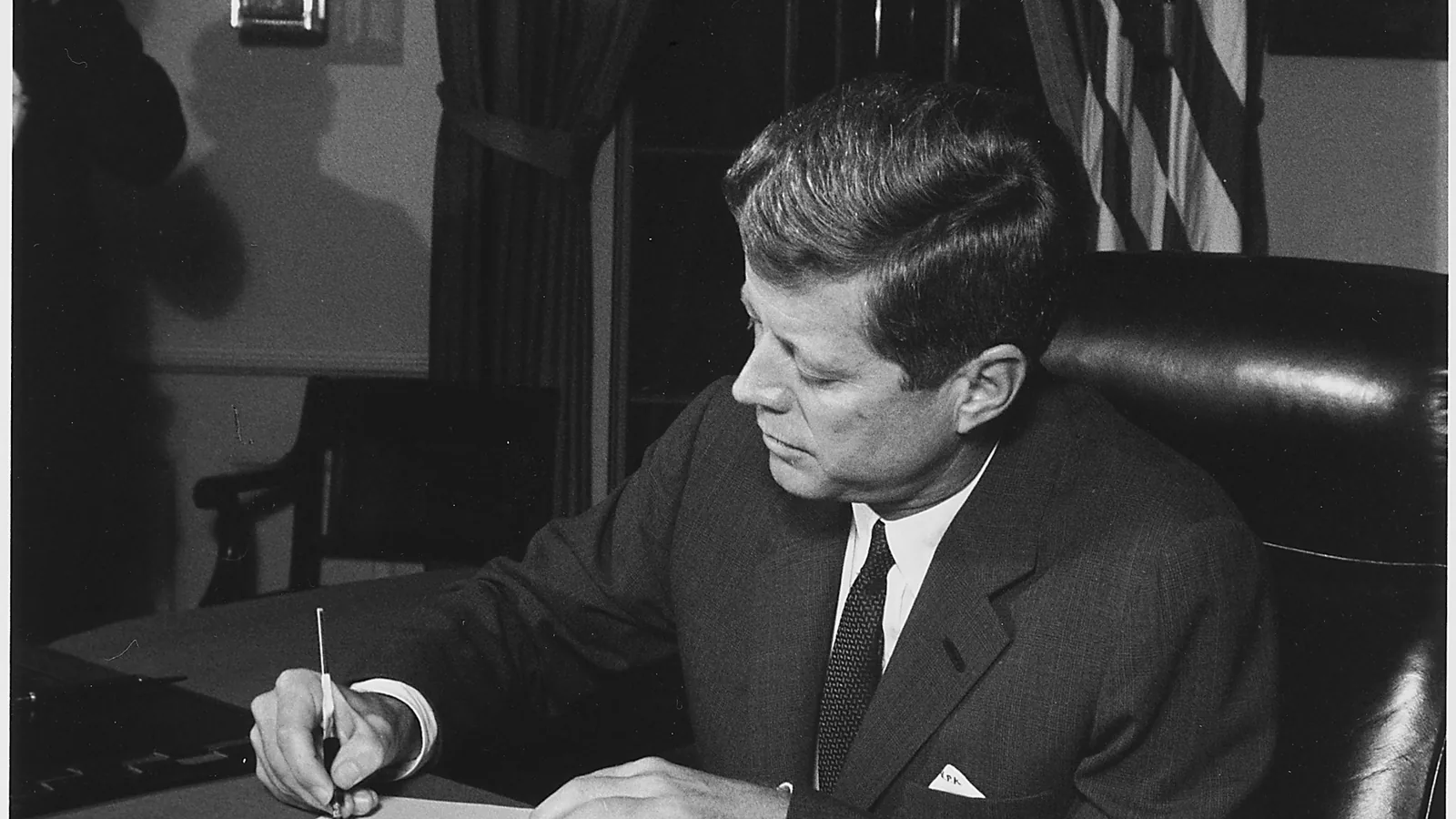
Kennedy spoke on radio and television on the evening of October 22. The buildup, he said, was a “sudden, clandestine decision to station strategic weapons for the first time outside of Soviet soil,” and the first step was already ordered: “To halt this offensive buildup, a strict quarantine on all offensive military equipment under shipment to Cuba is being initiated.” The quarantine was not, “at this time,” denying the necessities of life, as the Soviets had attempted in the Berlin blockade of 1948.
At sea, the Naval History and Heritage Command records, forces of the Atlantic Command under Admiral Robert L. Dennison steamed out to intercept merchant ships bound for Cuba and the Soviet submarines operating near them. Destroyers and frigates, kept on station by oilers and stores ships, held a “month-long” quarantine of the island, and ships from Canada, Britain, Argentina and Venezuela took part in maritime support operations that Dennison coordinated.

A private letter, October 26
The embassy in Moscow cabled the first letter to Washington at 7 p.m. on Friday, October 26. It opened “Dear Mr. President: I have received your letter of October 25.” Its offer came near the end: “If assurances were given by the President and the Government of the United States that the USA itself would not participate in an attack on Cuba and would restrain others from actions of this sort . . . this would immediately change everything.” The letter did not mention Turkey. The Kennedy Library’s day page for October 27 calls it “the more conciliatory Friday message.”
The second letter and a U-2 lost over Cuba, October 27
A second message, dated Moscow, October 27, was broadcast by Moscow and reached Washington in pieces. “Your missiles are located in Turkey,” it said. Khrushchev proposed to remove from Cuba “the means which you regard as offensive” in return for an American declaration that “its analogous means” would leave Turkey, with United Nations inspection of both.
ExComm met at 10 a.m. that Saturday. The summary record states that the partial text of the Soviet statement was read out as it arrived, and that the president commented that it “was a very tough position and varied considerably from the tone of Khrushchev’s personal letter” received the night before; he said the group should consider making the private letter public. Rusk argued that the Turkish missiles had to be kept separate from Cuba and dealt with between NATO and the Warsaw Pact. The same day a U-2 was shot down over Cuba by a Soviet-supplied surface-to-air missile. The pilot, Major Rudolf Anderson, Jr., was killed, and the president wrote to his widow awarding him the Distinguished Service Medal.
At 7:45 p.m. Attorney General Robert F. Kennedy received Soviet Ambassador Anatoly Dobrynin at the Justice Department. His memorandum to Rusk, dated October 30, records that he told the ambassador of the downed aircraft, and that the missile bases “had to go and they had to go right away.” Dobrynin asked about Turkey. The memorandum records the reply “that there could be no quid pro quo” and that any decision belonged to NATO. The department’s footnote adds that a typed sentence at the end of that paragraph “was crossed out”: that if some time elapsed, “I mentioned four or five months,” these matters “could be resolved satisfactory.” The Kennedy Library’s day page describes the result as a basic understanding, missiles out under United Nations supervision for a pledge not to invade, with “an additional secret understanding” that the Jupiter missiles in Turkey would eventually be removed.
Radio Moscow, October 28, and a proclamation on November 20
Khrushchev’s message of Sunday, October 28, answered the letter Kennedy had sent the previous evening, which took up the terms of October 26. The Soviet government, he wrote, “has given a new order to dismantle the arms which you described as offensive, and to crate and return them to the Soviet Union.” Radio Moscow announced that the Soviet Union had accepted the proposed solution and released the text; the Kennedy Library’s day page reads that “the thirteen days marking the most dangerous period of the Cuban missile crisis end.” Kennedy issued a public statement the same day.
The ships stayed at sea for three more weeks while the removal of the IL-28 bombers was negotiated. On November 20 a reply from Khrushchev on the bombers was read to ExComm at 3:30 p.m., before the president arrived, and the record of that meeting states: “The quarantine is to be lifted immediately and a proclamation revoking it is to be prepared.” Kennedy announced the lifting at a 6 p.m. press conference. The second letter had been answered in a room at the Justice Department, in a sentence the department’s own copy shows crossed out; the first letter had been answered in public, and it was the first that Radio Moscow confirmed.
Key facts
- On October 14, 1962, a U-2 flown by Major Richard D. Heyser took 928 photographs over western Cuba in a six-minute pass; analysts found three medium-range missile sites near San Cristóbal (FRUS, Document 16).
- Flights on October 15 found a fourth site, two intermediate-range sites at Guanajay and 21 crates for IL-28 bombers at San Julián (Document 16).
- At the White House meeting of October 16, 11:50 a.m., Rusk set out two courses: “the quick strike” or building up the crisis (Document 18).
- Kennedy announced “a strict quarantine on all offensive military equipment under shipment to Cuba” on October 22 (Kennedy Library, speech text).
- Khrushchev’s letter cabled from Moscow at 7 p.m. on October 26 offered that an assurance against attack “would immediately change everything” and did not mention Turkey (Document 84).
- His message of October 27 stated “Your missiles are located in Turkey” and proposed a matching withdrawal there (Document 91).
- On October 27 a U-2 was shot down over Cuba and Major Rudolf Anderson, Jr., was killed; that evening Robert Kennedy told Dobrynin “there could be no quid pro quo,” and a typed sentence mentioning “four or five months” was crossed out of his memorandum (Kennedy Library day page; Document 96).
- On October 28 Khrushchev ordered the arms dismantled, crated and returned, and Radio Moscow announced it; on November 20 ExComm decided “The quarantine is to be lifted immediately” (Documents 102 and 197).
FAQ
What was the difference between Khrushchev's letters of October 26 and October 27, 1962?
The letter of October 26 asked for an assurance that the United States would not attack Cuba and would restrain others; it did not mention Turkey. The message of October 27 added that American missiles in Turkey were to be withdrawn as well, with United Nations inspection on both sides.
Who was the pilot killed during the Cuban Missile Crisis?
Major Rudolf Anderson, Jr., of the United States Air Force, whose U-2 was shot down over Cuba on October 27, 1962, by a Soviet-supplied surface-to-air missile. Kennedy awarded him the Distinguished Service Medal posthumously.
When did the naval quarantine of Cuba end?
On November 20, 1962. ExComm decided that afternoon that "the quarantine is to be lifted immediately and a proclamation revoking it is to be prepared," and Kennedy announced the lifting at his 6 p.m. press conference.
Sources
- U.S. Department of State, Office of the Historian, Foreign Relations of the United States, 1961–1963, vol. XI, Cuban Missile Crisis and Aftermath: Document 16 (Editorial Note on the U-2 flights of October 14 and 15, 1962) and Document 18 (Transcript of a Meeting at the White House, October 16, 1962, 11:50 a.m.).
- FRUS 1961–1963, vol. XI, Document 84: Telegram From the Embassy in the Soviet Union to the Department of State, Moscow, October 26, 1962, 7 p.m. (Khrushchev's letter of October 26).
- FRUS 1961–1963, vol. XI, Document 91: Message From Chairman Khrushchev to President Kennedy, Moscow, October 27, 1962.
- FRUS 1961–1963, vol. XI, Document 90 (Summary Record of the Seventh Meeting of the Executive Committee of the National Security Council, October 27, 1962, 10 a.m.) and Document 96 (Memorandum From Attorney General Kennedy to Secretary of State Rusk, October 30, 1962, with editorial footnote 2).
- FRUS 1961–1963, vol. XI, Document 102 (Message From Chairman Khrushchev to President Kennedy, Moscow, October 28, 1962), Document 197 (Summary Record of the 28th Meeting of the Executive Committee, November 20, 1962, 3:30 p.m.) and Document 198 (Editorial Note, November 20, 1962).
- John F. Kennedy Presidential Library and Museum, Cuban Missile Crisis microsite: Radio and Television Report to the American People on the Soviet Arms Buildup in Cuba, October 22, 1962 (full text).
- John F. Kennedy Presidential Library and Museum, Cuban Missile Crisis microsite: day pages for October 16, October 27 and October 28, 1962.
- U.S. Navy, Naval History and Heritage Command, "Cuban Missile Crisis, 1962" (online reading room, published April 2, 2015).
Cite this article
- APA
- Our Earth's History. (2026, September 22). Two letters from Khrushchev, October 26 and 27, 1962. Our Earth's History. https://ourearthshistory.com/americas/contemporary/cuban-missile-crisis-1962-two-khrushchev-letters/
- Chicago
- Our Earth's History. “Two letters from Khrushchev, October 26 and 27, 1962.” Our Earth's History, September 22, 2026. https://ourearthshistory.com/americas/contemporary/cuban-missile-crisis-1962-two-khrushchev-letters/.
- MLA
- “Two letters from Khrushchev, October 26 and 27, 1962.” Our Earth's History, 22 Sep. 2026, https://ourearthshistory.com/americas/contemporary/cuban-missile-crisis-1962-two-khrushchev-letters/.
Text licensed CC BY-NC-ND 4.0. Found an error? Tell us.