Six hundred feet by one hundred and twenty: Dejima, Nagasaki, 1641
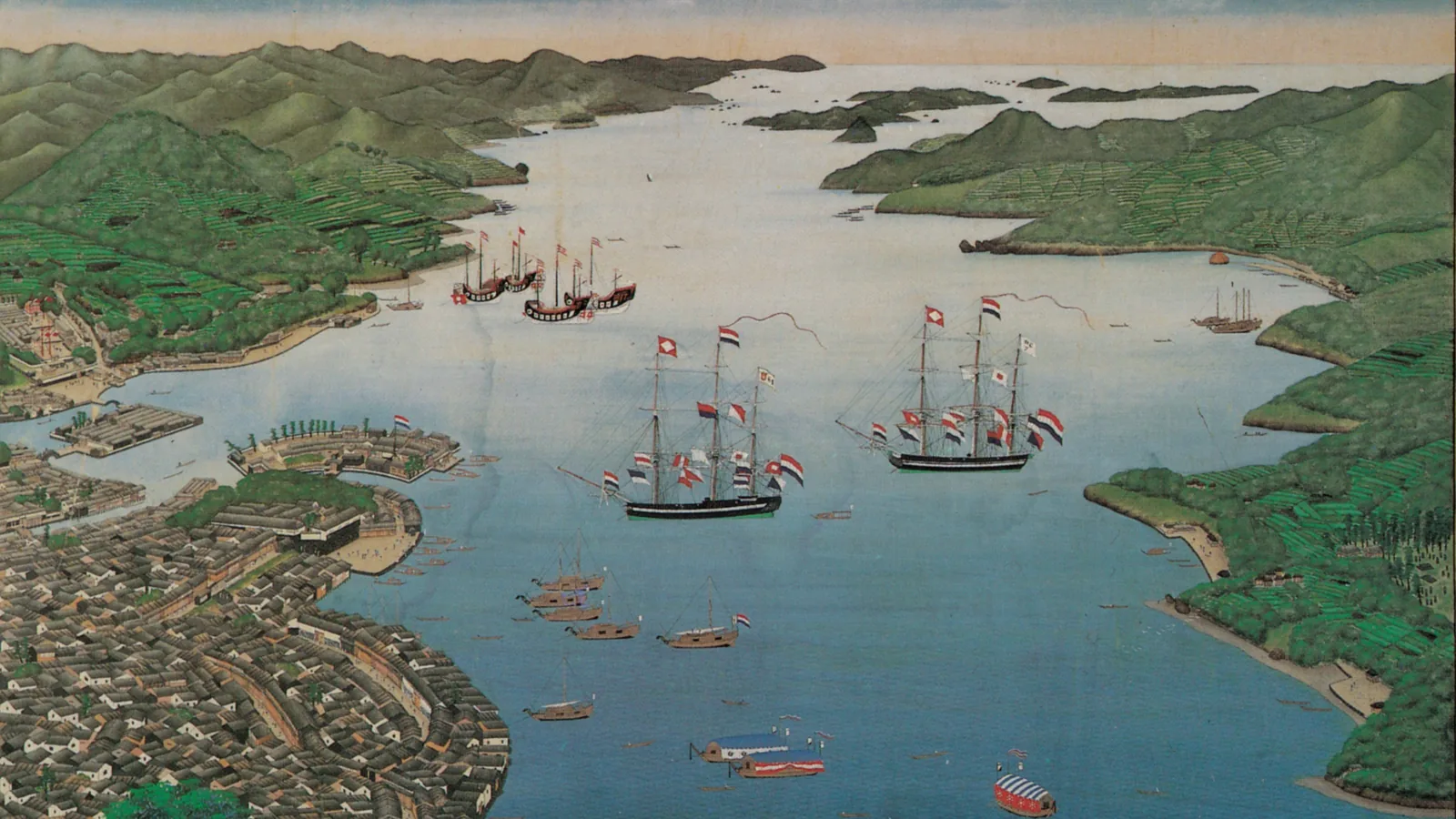

TL;DR — Nagasaki merchants built Dejima in 1634–1636 and let it to the Dutch East India Company from 1641 to 1859; Thunberg measured it at 600 by 120 feet.
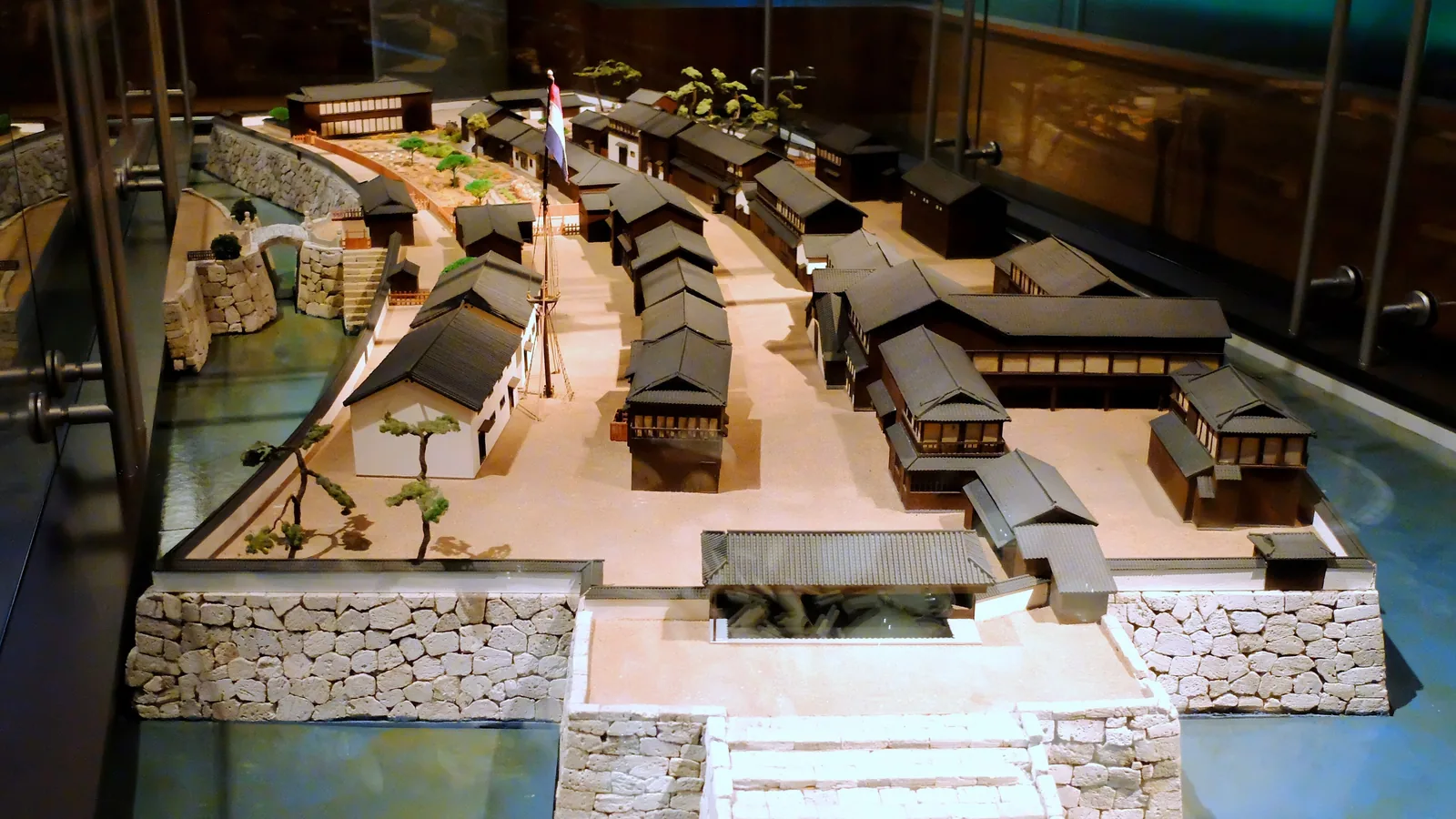
“About six hundred feet in length, and one hundred and twenty in breadth. It is planked in on all sides, and has two gates, the one towards the town near the bridge, and the other towards the water-side.” So Carl Peter Thunberg, a Swedish physician and botanist, described Dejima after living there in 1775 and 1776. The city of Nagasaki’s history of the island supplies the dates. Construction began in 1634. The island was finished in 1636 and the Portuguese were confined to it the same year. They were expelled from Japan in 1639, and in 1641 the Dutch East India Company moved its factory, its trading post, from Hirado to Dejima, where it stayed for the following 218 years.
Quick facts
- When
- 1634 (construction begins) · 1636 (island completed; Portuguese confined) · 1639 (Portuguese expelled) · 1641 (Dutch factory moved from Hirado; List of Rumors ordered) · 1686 and 1688 (rent of 19,530 guilders in the company accounts) · March 4, 1776 (Thunberg leaves for Edo) · 1790 (one ship a year; court journey every four years) · 1859 (factory abolished) · 1904 (fan shape lost) · 1996 (restoration project launched)
- Where
- Dejima, an artificial island in the harbor of Nagasaki, Kyushu, joined to the town by a single bridge; the road from Nagasaki to Edo
- Who
- 25 Nagasaki merchants (city account) or 24 landlords (Kaempfer); the Dutch East India Company; Engelbert Kaempfer; Carl Peter Thunberg; Philipp Franz von Siebold; the Nagasaki Magistrate; the Tokugawa Shogunate; the City of Nagasaki
- Outcome
- The company rented the island for 218 years under the town's fire and gate rules; the factory became a consulate in 1859, the island lost its fan shape in 1904, and the city has been rebuilding it since 1996 with buildings finished in 2000, 2006 and 2016 and a plan to restore water on all four sides
Twenty-five merchants, or four and twenty landlords
Private money built the island. The city’s history states that it “was completed in 1636 through the investment of 25 leading Nagasaki merchants,” and adds: “The proposal to build the island, the craftsmen who designed and supervised the construction work, and the civil engineering techniques they implemented remain a mystery to this day.”
Engelbert Kaempfer, a German physician who reached Dejima in 1690, counted differently. The regulations he translated for his History of Japan, printed in London in 1727, list the “Defima Tsjoonin, that is, the landlords, or proprietors of our Island and Houses, being four and twenty in number.” The two counts, 25 investors in the city’s account and 24 landlords in Kaempfer’s, stand unreconciled.
The landlords collected rent. Kaempfer printed the company’s Dejima accounts for 1686 and 1688; both carry the same line, “Hire for Defima and our warehouses,” at 19,530 guilders. Thunberg, nearly 90 years later, gave the arrangement rather than the sum: the island “is let by the town of Nagasaki to the Dutch company, and is considered merely as a street belonging to the town,” and the town “builds all the dwelling-houses, and, when they stand in need of it, repairs and makes alterations in them.” Thunberg did not say which foot he measured in.
"Defimamatz, that is, the street of Defima"
Dejima, the first article of Kaempfer’s regulations reads, “is comprehended among the streets of Nagasaki, and subject to the same regulations, for which reason it is call’d Defimamatz, that is, the street of Defima.” One clause begins “No Dutchman shall be permitted to go out,” and most of the chapter concerns fire: who might enter the island when one broke out, and who had to wait at the gate. The roster of Japanese officers to turn out names the otona; eight “Hollanda Tsjufi,” the Dutch interpreters; the 24 landlords; 36 “Kannaba bannamono,” the accounts men; and 15 overseers of the porters. The tenants lived in a street whose fire brigade, interpreters and bookkeepers were all appointed from the town side of the bridge.

Ships, silver and the List of Rumors
A second obligation dates from the year of the move. “In 1641, the Tokugawa Shogunate ordered the Dutch to provide information about the Portuguese in order to thoroughly enforce the Christian prohibition and expulsion of Portuguese nationals.” When a Dutch ship entered the port, the Japanese interpreters questioned the chief factor about events abroad and sent a report to the Shogunate over the signature of the Nagasaki Magistrate. The document was the Orandafūsetsugaki, which the city renders as “List of Rumors from the Dutch.”
The city has counted the ships: “From 1621 to 1847, more than 700 Dutch ships visited Japan.” The Shogunate cut the trade in steps. In 1685 it was limited to 3,000 kanme of silver, in 1715 to two ships a year, and in 1790 to one ship and 700 kanme. The French Revolutionary Army occupied the Netherlands in 1795, and in 1799 the Dutch East India Company was dissolved; the factory on the island stayed open for 60 more years.
March 4, 1776: three Europeans and about 200 Japanese set out for Edo
Once a year in Thunberg’s time, the chief of the factory went to the shogun’s court, the journey the Dutch called the hofreis. “On the 4th of March, 1776, the ambassador set out from Dezima, on his journey to Jedo.” Only three Europeans went: Mr. Feith, the chief of the factory; Thunberg as physician; and the secretary. “The rest of our retinue, which consisted of about 200 men, were merely Japanese place-men, interpreters, servants, and valets.” The chief interpreter carried the cash and paid every expense “for the Dutch Company’s account,” and did so “with such care and parsimony, that he is sometimes a considerable gainer by it.”
The city’s chronology records a Dutch envoy on the journey in 1650, the change to once every four years in 1790, and the last journey in 1850. Philipp Franz von Siebold, another German physician, arrived in 1823, opened the Narutaki Medical School in 1824, put up a monument to Kaempfer and Thunberg in the Dejima herb garden in 1826, and in 1828 was charged with trying to export banned items. Earlier, in 1720, the Shogunate had lifted its ban on Western studies, and Kaitai Shinsho, the New Book on Anatomy, appeared in 1774.
Nakashima River works, 1885, and the fan shape lost in 1904
The Ansei Five-Power Treaties of 1858 ended the arrangement. In 1859 the Dejima Dutch Factory was abolished and converted into a consulate. In 1866 Dejima was absorbed into the Nagasaki Foreign Settlement. Diversion works on the Nakashima River began in 1885 and, by the city’s Japanese-language page, cut about 18 meters from the north side. In 1904 a second harbor reclamation was completed and, the city’s chronology reads, “Dejima’s fan shape is lost.” The site became a National Historic Site in 1922 by the city’s history page, in 1911 by its restoration page.
The Nationaal Archief in The Hague holds the archives of the Dutch factory at Hirado from 1609 to 1641 and at Deshima from 1641 to 1860 under inventory 1.04.21, among them the daily registers, the Dagregisters. The University of Tokyo’s Historiographical Institute publishes overseas sources on Japan as Nihon Kankei Kaigai Shiryo.
The city’s restoration page states that Nagasaki has been implementing plans for the island since 1948 and launched a full-scale restoration project in 1996. Five buildings, among them the Chief Clerk’s residence, were completed in 2000; five more in 2006; six in 2016. The long-term aim is one sentence: “The water surfaces on all four sides will be restored, completely reviving the historic fan-shaped island.” The shape it describes was last whole before the reclamation of 1904.
Key facts
- Carl Peter Thunberg, who lived on Dejima in 1775 and 1776, wrote that the island was “about six hundred feet in length, and one hundred and twenty in breadth,” planked on all sides with two gates; he did not name the unit (Thunberg, Travels, vol. III).
- The city of Nagasaki dates construction to 1634–1636, the confinement of the Portuguese to 1636, their expulsion to 1639 and the Dutch move from Hirado to 1641, followed by 218 years of Dutch tenancy (City of Nagasaki, History of Dejima).
- The city credits the island to “the investment of 25 leading Nagasaki merchants”; Kaempfer’s translated regulations count the landlords as “four and twenty” (City of Nagasaki; Kaempfer, History of Japan, 1727).
- The company’s Dejima accounts for 1686 and 1688 list “Hire for Defima and our warehouses” at 19,530 guilders in both years (Kaempfer).
- Kaempfer’s regulations call the island “Defimamatz, that is, the street of Defima” and list the Japanese officers to turn out at a fire: the otona, eight interpreters, 24 landlords, 36 accounts men and 15 overseers of porters (Kaempfer).
- More than 700 Dutch ships visited Japan between 1621 and 1847; the trade was limited to 3,000 kanme of silver in 1685, two ships a year in 1715, and one ship and 700 kanme in 1790 (City of Nagasaki).
- Thunberg left Dejima for Edo on March 4, 1776, with two other Europeans and about 200 Japanese; the journey was changed to once every four years in 1790 and last made in 1850 (Thunberg; City of Nagasaki).
- The factory became a consulate in 1859, the fan shape was lost in 1904, and the city’s restoration project, launched in 1996, completed buildings in 2000, 2006 and 2016 with a plan to restore water on all four sides (City of Nagasaki, Dejima Restoration Project).
FAQ
How big was Dejima?
Thunberg, writing from his stay in 1775 and 1776, put it at "about six hundred feet in length, and one hundred and twenty in breadth," fenced with planks and entered by two gates. He did not say which foot he used, so the figure is given here as he wrote it.
Who owned Dejima, and what did the Dutch pay?
The town of Nagasaki owned it and let it to the Dutch East India Company as if it were one of its streets. The city credits the construction to 25 merchants; Kaempfer's regulations count 24 landlords. The company's accounts printed by Kaempfer show 19,530 guilders for "Hire for Defima and our warehouses" in 1686 and again in 1688.
Does Dejima still exist?
The Dutch factory was abolished in 1859, and by 1904 harbor reclamation had joined the island to the mainland and erased its fan shape. Since 1996 the city of Nagasaki has rebuilt its buildings in three stages, finished in 2000, 2006 and 2016, and plans to restore water on all four sides.
Sources
- City of Nagasaki, Dejima official site (English), "History of Dejima": text and chronology from the Muromachi period to the Heisei period (construction 1634–1636, the move from Hirado in 1641, the List of Rumors, ship numbers, trade limits, the court journey, Kaempfer and Siebold, 1859–1904, Historic Site designation 1922).
- City of Nagasaki, Dejima official site (Japanese), "出島の歴史": more than 700 Dutch ships in the 227 years from 1621 to 1847; the Nakashima River works of 1885 and the roughly 18 meters cut from the north side.
- City of Nagasaki, Dejima official site (English), "Dejima Restoration Project": plans since 1948, the council of 1978, the full-scale project of 1996, buildings restored in 2000, 2006 and 2016, the plan to restore water on all four sides, Historic Site designation given as 1911.
- Engelbert Kaempfer, The History of Japan, translated by J. G. Scheuchzer, vol. 1 (London, 1727), Internet Archive full text: the Dejima regulations ("Defimamatz, that is, the street of Defima"; "four and twenty" landlords; the fire roster) and the company's Dejima accounts for 1686 and 1688 ("Hire for Defima and our warehouses," 19,530 guilders).
- Carl Peter Thunberg, Travels in Europe, Africa, and Asia, Performed Between the Years 1770 and 1779, 3rd ed., vol. III (a voyage to Japan in 1775 and 1776), Internet Archive full text: the size of the island, the town as landlord, the departure for Edo on March 4, 1776, and the chief interpreter's handling of the money.
- Nationaal Archief (The Hague), inventory 1.04.21, archives of the Dutch Factory in Japan at Hirado [1609–1641] and Deshima [1641–1860]: resolutions of the chief and council, "Positive Ordres" 1750–1807, daily registers (Dagregisters).
- University of Tokyo, Historiographical Institute, English introduction: the institute and its series of overseas sources on Japan, Nihon Kankei Kaigai Shiryo.
Cite this article
- APA
- Our Earth's History. (2026, September 22). Six hundred feet by one hundred and twenty: Dejima, Nagasaki, 1641. Our Earth's History. https://ourearthshistory.com/east-asia/early-modern/dejima-nagasaki-1641-fan-shaped-island-voc/
- Chicago
- Our Earth's History. “Six hundred feet by one hundred and twenty: Dejima, Nagasaki, 1641.” Our Earth's History, September 22, 2026. https://ourearthshistory.com/east-asia/early-modern/dejima-nagasaki-1641-fan-shaped-island-voc/.
- MLA
- “Six hundred feet by one hundred and twenty: Dejima, Nagasaki, 1641.” Our Earth's History, 22 Sep. 2026, https://ourearthshistory.com/east-asia/early-modern/dejima-nagasaki-1641-fan-shaped-island-voc/.
Text licensed CC BY-NC-ND 4.0. Found an error? Tell us.