A hull on the seabed off Takashima, the Mongol fleet of 1281

TL;DR — Matsuura City records a Yuan warship’s keel found off Takashima in autumn 2011, 23 to 25 meters down. The site became Japan’s first undersea national historic site in 2012, and a second hull followed in 2014.
Matsuura City’s cultural properties office describes the discovery in one line: in the autumn of 2011, a University of the Ryukyus survey team studying the Takashima seabed site found a Yuan warship after digging about a meter into the seafloor, 23 to 25 meters down and roughly 200 meters off Kōzakimen Komenouchibana. The Agency for Cultural Affairs’ national database records that on March 27, 2012, the education ministry designated the surrounding waters, covering 384,073.67 square meters, as the Takashima Kōzaki site, a Kamakura-period battlefield tied to the Mongol invasions and, in the agency’s words, a site “important for understanding the concrete reality of the Mongol invasions.” It was Japan’s first national historic site located entirely underwater.
Quick facts
- When
- 1274 (Bun'ei invasion) and 1281 (Kōan invasion); site surveys from 1980; keel found autumn 2011; second hull found October 2014, confirmed 2015; national historic site designation March 27, 2012
- Where
- Takashima, off Matsuura City, Nagasaki Prefecture; Hakata Bay, Fukuoka; Kyushu University's Hakozaki campus
- Who
- Ikeda Yoshifumi (University of the Ryukyus, later Kokugakuin University); Hayashida Kenzo and the Kyushu and Okinawa Society for Underwater Archaeology; Thomas D. Conlan (Princeton University); Takezaki Suenaga, the samurai whose scrolls record the fighting
- Outcome
- The Takashima Kōzaki site became Japan's first undersea national historic site in 2012. A first Yuan hull was found in 2011 and a second in 2014, both left in place; the stone wall the shogunate built at Hakata Bay and Suenaga's illustrated scrolls remain the other physical record of the invasions
Two invasions, 1274 and 1281
Kyushu National Museum’s exhibition page marks 750 years since “the first incursion into Japan in 1274,” the Bun’ei invasion. A second and larger invasion followed in 1281, the Kōan invasion. Matsuura City’s page on the Takashima Kōzaki designation states that the waters off Takashima “are handed down as the point where the Yuan fleet sank in a storm during the Kōan invasion (1281),” and that local fishermen had long pulled up jars, swords and anchor stones from the water before any formal survey began. The same page calls the Mongol invasions “one of the causes that led the Kamakura shogunate to collapse,” describing them as a well-known event in Japanese history. Thomas Conlan’s research site, hosted at Princeton University, argues that Japanese warriors were “capable of fighting the Mongols to a standstill” well before any storm struck, a point Conlan makes to push back on the idea that a “divine wind” alone decided the outcome.
The wall at Hakata Bay
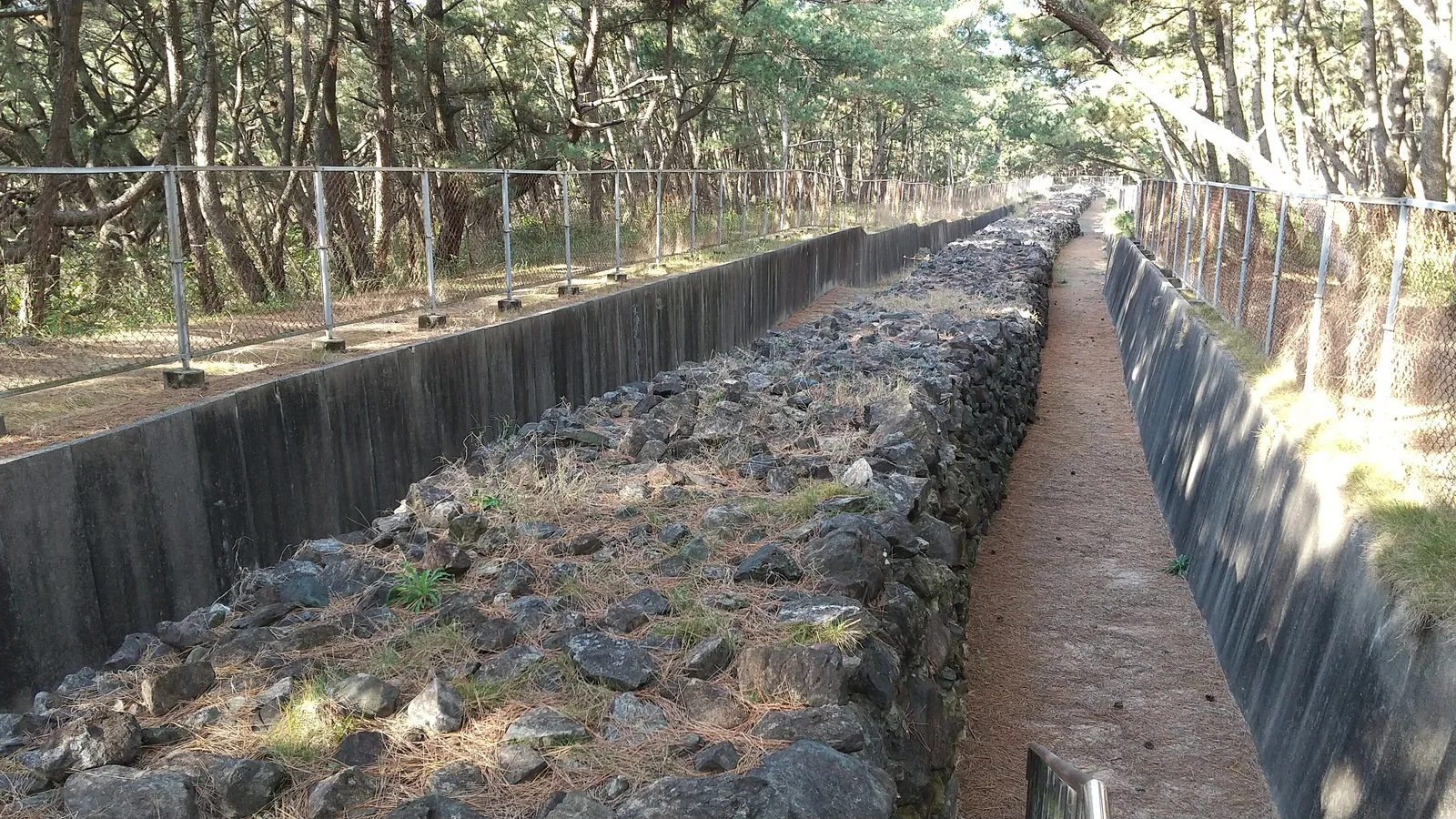
Fukuoka City’s official tourism guide describes the shogunate’s response after the first invasion: “Starting from March of 1276 and in the course of six months they hastily constructed a 20 kilometer long stone fortification along the coastline.” The structure’s original name was ishitsuiji, the guide states, and it was archaeologists of the Taishō era (1912–1926) who began calling it the Genko Borui, the name still used today. The same page reports that additional segments of the wall have turned up in excavations on the Kyushu University Hakozaki campus and have been added to the national registry of historically important ruins. Fukuoka’s page gives no designation year for the wall itself.
Takezaki Suenaga's scrolls
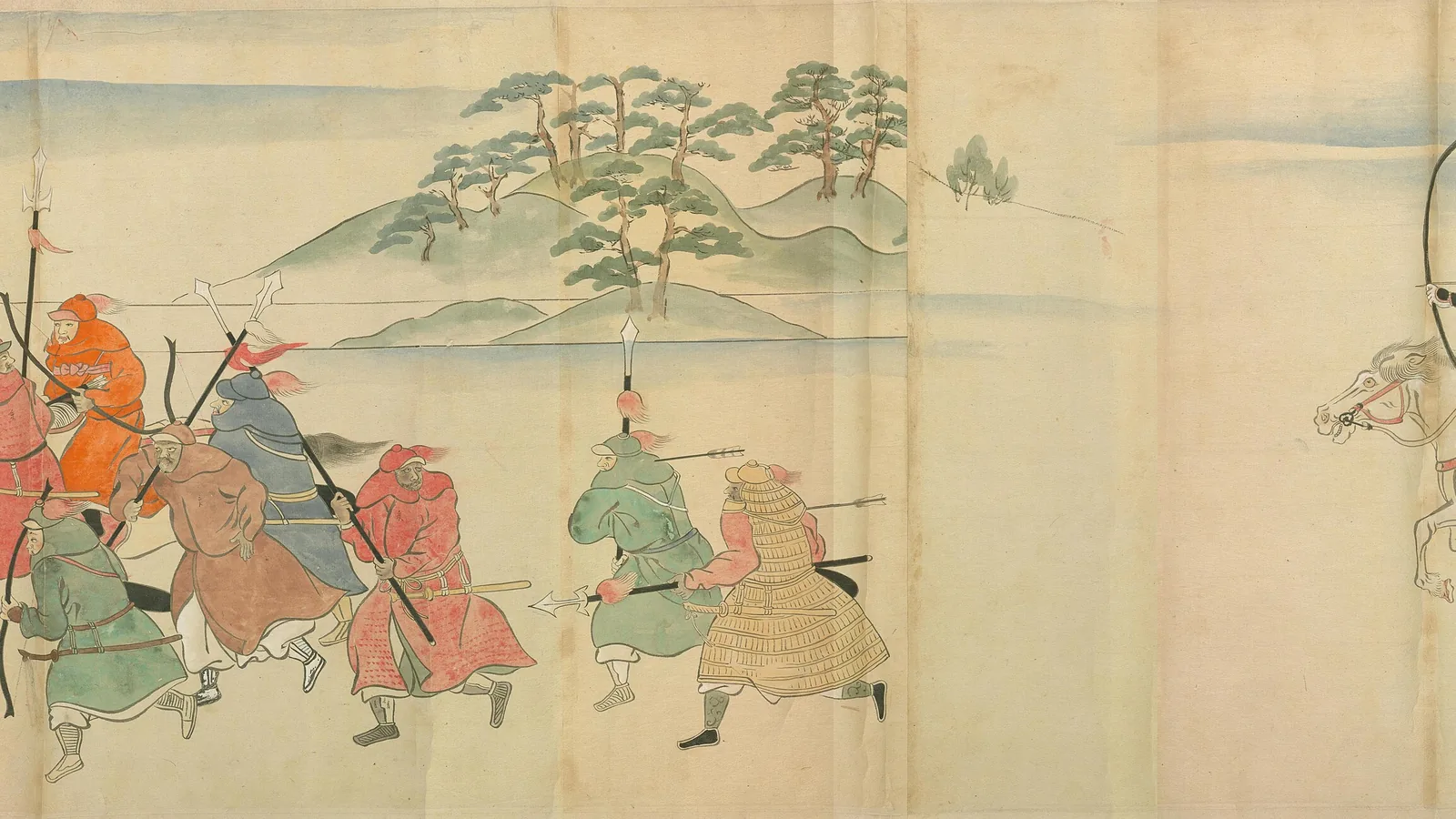
The Mōko Shūrai Ekotoba, the illustrated scrolls commissioned by the samurai Takezaki Suenaga to record his own part in the fighting, record the fighting in pictures. Kyushu University Library announced that its digitized images of the scrolls, previously available at 2,947 by 2,348 pixels and 1 to 1.5 megabytes, were replaced after October 2018 with files at 9,823 by 7,825 pixels, roughly 10 to 15 megabytes each, and that users may “reuse them freely at no charge, including any modifications and commercial uses, without any advance application.” Matsuura City’s page on the first Takashima wreck notes that the scrolls let researchers picture what a Yuan warship looked like, but calls the 2011 discovery of an actual hull on the seabed “a very valuable discovery in world historical terms” because it gave that picture a physical counterpart. A separate bibliographic record at Kyushu University lists a 2015 paper by Hattori Hideo, a professor at the university’s Faculty of Humanities, examining what the direction of arrow feathers and wind in the scrolls’ battle scenes shows about the fighting at Torikai marsh in 1274 and in Hakata Bay in 1281.

The Takashima No. 1 ship
Matsuura City’s page on the find states that it was made between September 30 and October 23, 2011, by a research group led by Ikeda Yoshifumi, then a professor at the University of the Ryukyus and later at Kokugakuin University. What the team found, the city says, was the keel, the backbone of the ship’s hull, about 50 centimeters wide and 12 meters long, from which the full vessel is estimated at around 20 meters. Chinese-made ceramics, fragments of tetsuhau explosive shells and bricks turned up above the timber, the city’s page adds. As of October 2024, Matsuura City counts three Yuan wrecks found at the site in total, and calls this first one the Takashima No. 1 ship.
The No. 2 ship and the survey behind it
A second hull, found in October 2014, was confirmed as a Yuan wreck during a 2015 survey, according to Matsuura City. The city’s account describes the timber joinery at the base of the hull as “in very good condition,” calling it valuable material for understanding Yuan ship construction, and lists finds of white porcelain bowls, brown-glazed jars and tenmoku bowls made in China during the 12th and 13th centuries and used by Yuan soldiers. The city states that the wreck has since been reburied and is preserved in place, with periodic monitoring planned to check for deterioration. The Asia Research Institute of Underwater Archaeology’s own account of the wider project credits Hayashida Kenzo with leading seasons of fieldwork at Takashima, including an excavation from October 16 to November 24, 2000, with members of the Kyushu and Okinawa Society for Underwater Archaeology, and a further dig at Kōzaki Harbor from December 9 to 20, 2002, covering 16 square meters. Earlier work, the institute records, recovered wooden anchors from red oak in 1994, one of which, Wooden Anchor 3, was dated by carbon-14 analysis to 770 plus or minus 90 years before the present.
Key facts
- The Agency for Cultural Affairs designated the Takashima Kōzaki site a national historic site on March 27, 2012, covering 384,073.67 square meters, Japan’s first such site located underwater.
- Matsuura City records the Kōan invasion of 1281 as the event in which a Yuan fleet sank off Takashima in a storm, a point at which local jars, swords and anchor stones had already surfaced from fishing before formal surveys began.
- Fukuoka City’s guide dates the Genko Borui stone wall at Hakata Bay to a six-month construction from March 1276, running 20 kilometers along the coast.
- A University of the Ryukyus team led by Ikeda Yoshifumi found the keel of the Takashima No. 1 ship between September 30 and October 23, 2011, 23 to 25 meters deep and about 200 meters off Kōzakimen Komenouchibana.
- The keel measured about 50 centimeters wide and 12 meters long, from which Matsuura City estimates a hull of around 20 meters.
- A second wreck, the Takashima No. 2 ship, was found in October 2014 and confirmed as a Yuan wreck in a 2015 survey; it carries 12th- and 13th-century Chinese ceramics and remains reburied at the site.
- Kyushu University Library made high-resolution scans of the Mōko Shūrai Ekotoba, up to 9,823 by 7,825 pixels, freely reusable after October 2018.
- The Asia Research Institute of Underwater Archaeology dates a wooden anchor recovered at Takashima in 1994 to 770 plus or minus 90 years before the present by carbon-14 analysis.
FAQ
When did Japan designate the Takashima seabed site a national historic site?
On March 27, 2012, the Agency for Cultural Affairs designated the Takashima Kōzaki site off Matsuura City, Nagasaki Prefecture, as a national historic site covering 384,073.67 square meters, the first such designation for a site located entirely underwater in Japan.
What did the 2011 discovery at Takashima actually find?
A University of the Ryukyus team led by Ikeda Yoshifumi located the keel of a Yuan warship, about 50 centimeters wide and 12 meters long, 23 to 25 meters below the surface. Matsuura City estimates the full hull at around 20 meters and calls it the Takashima No. 1 ship.
How many Mongol invasion shipwrecks have been found at Takashima?
Matsuura City states that as of October 2024, three Yuan wrecks have been located at the Takashima Kōzaki site, with the first two designated the Takashima No. 1 ship (2011) and Takashima No. 2 ship (2014).
Sources
- Agency for Cultural Affairs, National Database of Registered Cultural Properties, entry for "Takashima Kōzaki Iseki" (鷹島神崎遺跡)
- Matsuura City Board of Education, Cultural Properties Division, "Japan's first undersea national historic site: Takashima Kozaki Iseki"
- Matsuura City Board of Education, Cultural Properties Division, "The Takashima No. 1 sunken ship"
- Matsuura City Board of Education, Cultural Properties Division, "The Takashima No. 2 sunken ship"
- Fukuoka City official tourism guide, "The Wall that Drove Back the Mongols: The Genko Borui Fortifications"
- Asia Research Institute of Underwater Archaeology, "Project Takashima"
- Kyushu University Library, "High resolution digitized images are available: Moko Shurai Ekotoba"
- Kyushu National Museum, special exhibition page marking 750 years since the 1274 invasion
- Thomas D. Conlan, "Mongol Invasions of Japan"
- Kyushu University academic repository, bibliographic entry for Hattori Hideo, "Moko Shurai Ekotoba ... the direction of feathers, the direction of the wind" (2015)
Cite this article
- APA
- Our Earth's History. (2026, September 27). A hull on the seabed off Takashima, the Mongol fleet of 1281. Our Earth's History. https://ourearthshistory.com/east-asia/medieval/mongol-invasions-japan-1274-1281-takashima-seabed-hull-2011-2014/
- Chicago
- Our Earth's History. “A hull on the seabed off Takashima, the Mongol fleet of 1281.” Our Earth's History, September 27, 2026. https://ourearthshistory.com/east-asia/medieval/mongol-invasions-japan-1274-1281-takashima-seabed-hull-2011-2014/.
- MLA
- “A hull on the seabed off Takashima, the Mongol fleet of 1281.” Our Earth's History, 27 Sep. 2026, https://ourearthshistory.com/east-asia/medieval/mongol-invasions-japan-1274-1281-takashima-seabed-hull-2011-2014/.
Text licensed CC BY-NC-ND 4.0. Found an error? Tell us.