A letter that ended a siege: Baybars at Krak des Chevaliers, 1271
.jpg)
TL;DR — Baybars took Krak des Chevaliers from the Hospitallers in 1271; Ibn al-Furat writes that a forged letter from Tripoli ended the siege of the keep.
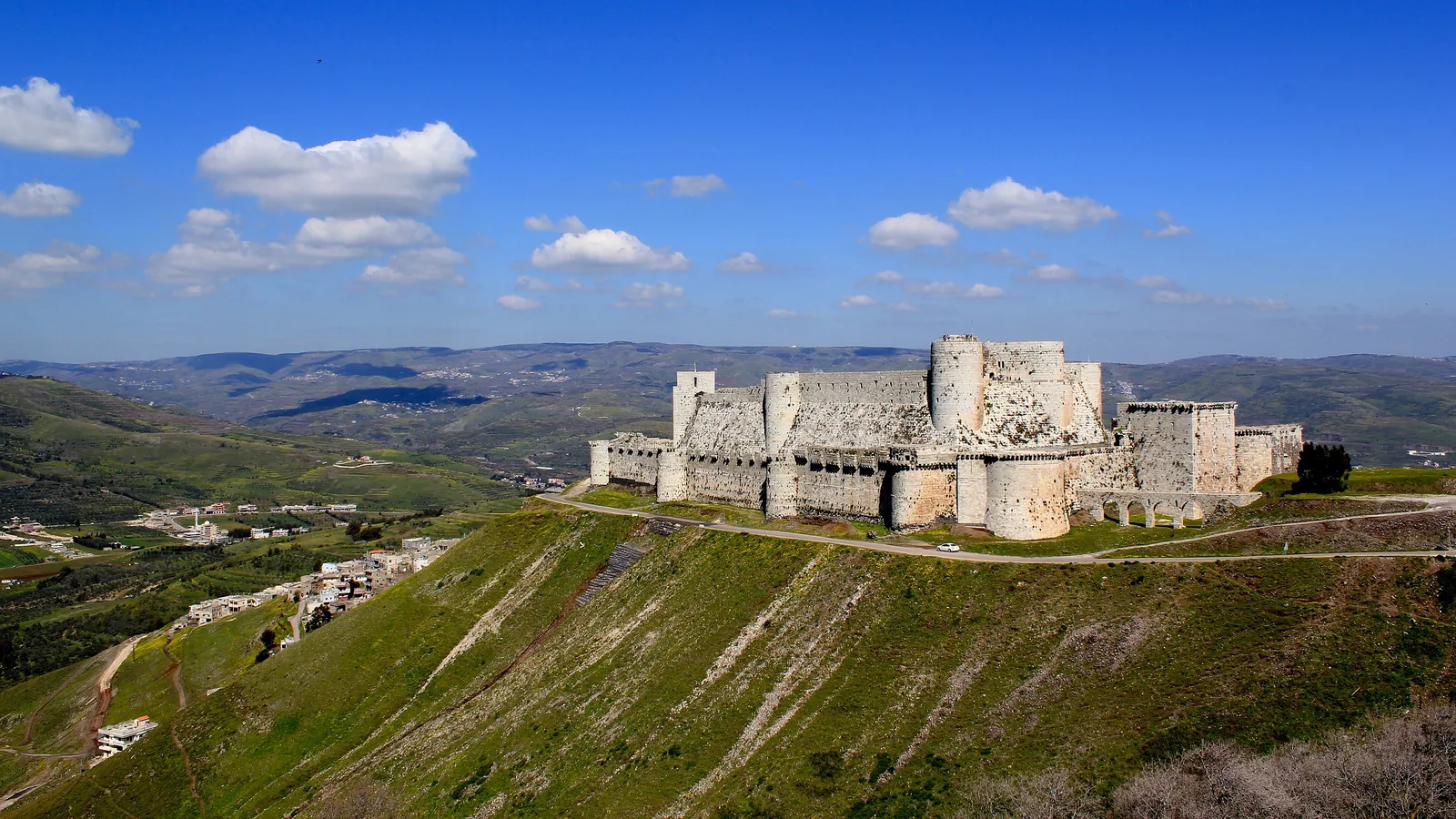
France’s Ministry of Culture, in its online collection on Krak des Chevaliers, states that in 1142, “following the loss of the fortress of Montferrand and the town of Raphanea, the Count of Tripoli made several grants to the Hospitallers,” giving them land at “the county’s most exposed points: the Krak, Castellum Bochee (Anaz), Felicium, and Lacum.” Ibn al-Furat, in the translation by U. and M. C. Lyons, dates the start of Baybars’s final siege of the same fortress, by then called Hisn al-Akrad, to February 21, 1271. The outer town fell on March 4, the barbican was stormed on March 21, and a tower of the citadel was breached on March 30, opening the way to the keep.
Quick facts
- When
- 1030-1 (Kurdish garrison settled at the site) · 1142 (transfer to the Hospitallers) · February 21 to April 7 or 8, 1271 (Baybars's siege) · 1934 (Paul Deschamps's study published) · July 12-13, 2013 (air raid)
- Where
- Hisn al-Akrad (Krak des Chevaliers), the Homs Gap, Syria; the county of Tripoli; the sultan's court in Cairo
- Who
- Shibl al-Dawla Nasr b. Mirdas, Emir of Homs; the Count of Tripoli; Sultan Baybars; Hugh Revel, Master of the Hospital; the chroniclers Ibn al-Athir, Ibn 'Abd al-Zahir and Ibn al-Furat; Paul Deschamps
- Outcome
- Baybars took the keep after sending its garrison a letter forged in the name of the Count of Tripoli; the fortress was rebuilt under Mamluk administrators and separate truces followed with Tortosa and Marqab; the site was damaged by an air raid in 2013
Hisn al-Akrad before the Hospitallers
Ibn al-Furat records that the emir Shibl al-Daula Nasr b. Mirdas, ruler of Homs, “settled some Kurds in it in the year 422 (1030-1) and it was then named after them.” The Ministry of Culture gives the fortress its earlier name, Hisn al-Safh, “the Fortress of the Slope,” before that garrison turned it into Hisn al-Akrad, “the Fortress of the Kurds.” The same Ministry page quotes the twelfth-century chronicler Ibn al-Athir, writing of the Master of the Krak: “It is like a bone stuck in the throat of the Muslims.” Ibn al-Furat notes that the fortress “was not among Saladin’s Frankish conquests.” According to the Ministry, the 1142 grants “transformed the order,” which “began to assert itself as a military order” while it controlled what the same page calls “a large, semi-independent lordship.”
February 1271: Ibn al-Furat's siege timeline
Ibn al-Furat records that a year before the siege, on January 28, 1270, Baybars approached the fortress with 200 men, of whom only forty climbed the hill to meet the Frankish garrison, and rode off telling a messenger: “let the western Franks come out, for we are no more than forty horsemen, wearing (only) white gowns.” The same source adds that the sultan’s troops let their animals graze on the castle’s pasture and crops that year, and calls the loss of that harvest, since the garrison depended on its own fields, one reason the fortress later fell. In 1271, Ibn al-Furat writes, “the Sultan came down against Hisn al-Akrad” on February 21, “the rabads were taken” on March 4, mangonels were in place by March 14, and “the bashura was stormed” on March 21. The Ministry of Culture adds that the fall of that outer defense was “celebrated with the distribution of robes of honour.” Ibn al-Furat then records that “on the 16th of Shaʿban (30 March), a breach was made in one of the towers of the citadel and the Muslims advanced up to the citadel and took it, while the Franks retired up to the keep.”
'Purporting to come from the Frankish leader': the forged letter
With the keep still holding out, Ibn al-Furat writes that “the Sultan wrote letters to the garrison of the keep purporting to come from the Frankish leader in Tripoli ordering them to surrender.” The Ministry of Culture describes the same episode: “Baybars resorted to subterfuge. He forged a letter signed by the Count of Tripoli ordering the Krak garrison to surrender.” On the date the garrison left, the two sources differ by a day. Ibn al-Furat gives “Tuesday, the 24th of Shaʿban (7 April),” when the defenders “came out and were sent off to their own lands, while the Sultan took possession of the fortress.” The Ministry of Culture states that the garrison “requested aman” on April 8, 1271, and that the sultan granted it. Ibn ‘Abd al-Zahir’s account, preserved by Ibn al-Furat, records a separate letter Baybars then sent to Hugh Revel, Master of the Hospital, opening “We bring the news that God has granted us an easy conquest of Hisn al-Akrad,” and closing “No fortress can hold out when these Muslim armies come down against it.” Ibn al-Furat names the sultan’s appointees for the site afterward: Sarim al-Din al-Kafiri as governor, with reconstruction entrusted to the emirs ‘Izz al-Din al-Afram and ‘Izz al-Din Aibak al-Shaikh. The Ministry of Culture adds that the south face, hit hardest by the siege engines, “had to be completely refaced.” Ibn al-Furat also records that Baybars agreed separate truces covering Tortosa (Antartus) and Marqab, excluding Safitha, requiring the return of Balda, the surrender of Hospitaller revenues in Muslim territory, a half share of Marqab’s revenue, and a ban on further building at Marqab.
Paul Deschamps and a debate over building dates
The Ministry of Culture calls Paul Deschamps “the true inventor of the site,” recording that he surveyed the castle in 1927-29 with the architect François Anus and Captain Frédéric Lamblin, and published his findings in 1934 as “Château des croisés en terre sainte. Le Crac des chevaliers.” A paper by the Wartburg-Gesellschaft zur Erforschung von Burgen und Schlössern compares that chronology with newer fieldwork: a radiocarbon sample from one of the oldest walls, labeled H15, came back “late 10th century,” ahead of the 1031 date Deschamps drew from the chronicles, though the paper’s authors Zimmer et al. give a wider range of “975 and 1180” once margins of error are included. The same paper reports a separate dispute over the castle’s major rebuilding: Deschamps placed it “around 1200,” while the researcher H.-H. Häffner argues, from comparative buildings and an inscription on the northern sally port, for “a dating from circa 1220.” D. J. Cathcart King published “The Taking of Le Krak des Chevaliers in 1271” in Antiquity in 1949. The Ministry of Culture’s page on the site’s early researchers records that T. E. Lawrence used the 1871 study of Guillaume Rey in the thesis he wrote at Oxford, now held in scanned form by the Oxford Research Archive.

Air raids reach the castle, 2013
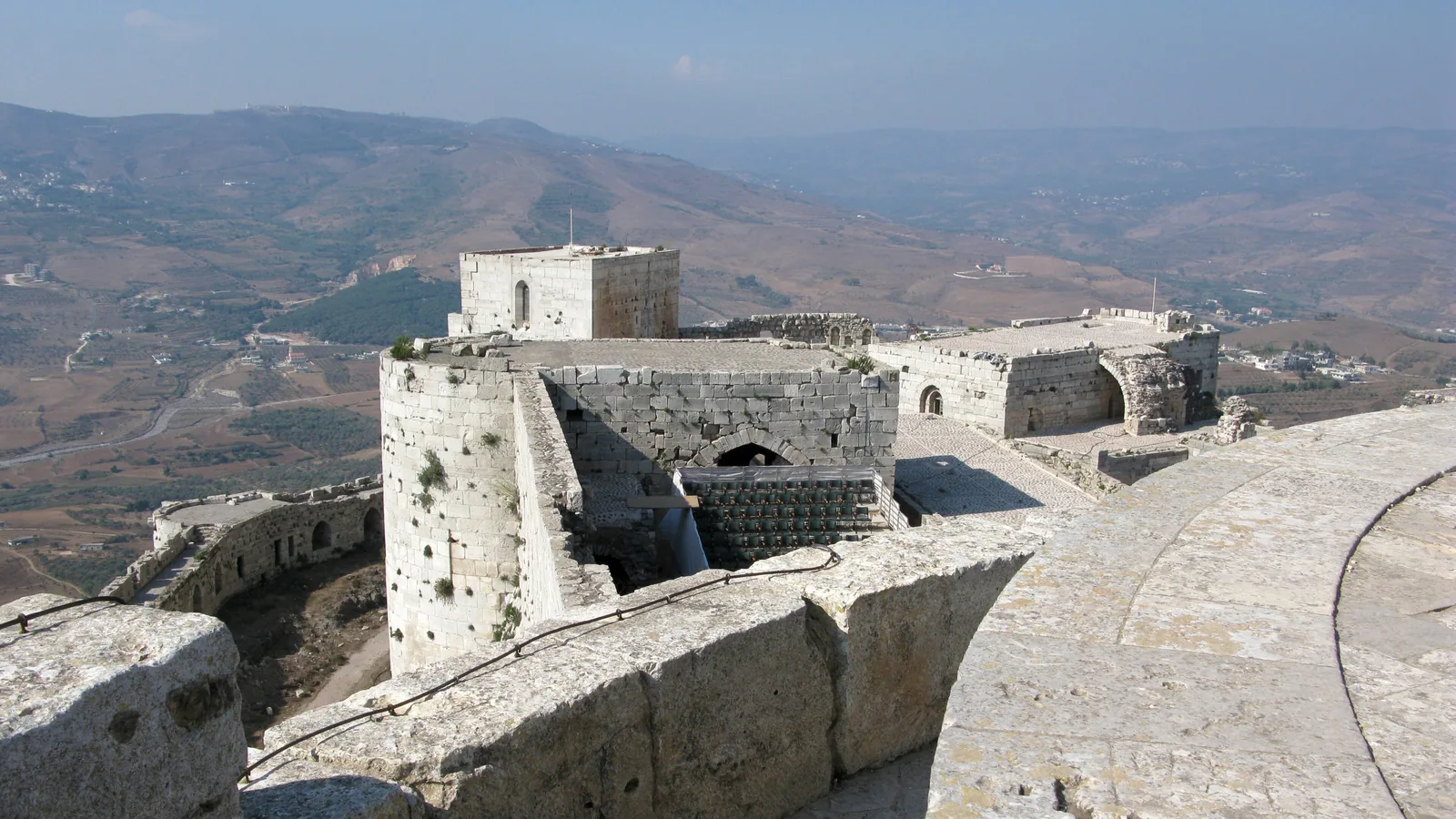
Al Jazeera reported on July 13, 2013, that video filmed inside the castle a day earlier showed a tower struck directly, with a hole opened in its ceiling and rubble piled beneath it. The report quotes an activist on that footage saying, “This is the destruction caused by MiG air strike on the Crac des Chevaliers.” Syria’s Directorate-General of Antiquities and Museums lists the site on its own pages under the name Qalat al-Hisn, without a dated account of the 2013 damage.
Key facts
- France’s Ministry of Culture records that in 1142 the Count of Tripoli granted the Hospitallers “the Krak, Castellum Bochee (Anaz), Felicium, and Lacum.”
- Ibn al-Furat dates the site’s renaming to 422 AH (1030-1), when the Emir of Homs, Shibl al-Dawla Nasr b. Mirdas, settled Kurdish troops there.
- The chronicler Ibn al-Athir called the fortress’s master “a bone stuck in the throat of the Muslims,” per France’s Ministry of Culture.
- Ibn al-Furat dates Baybars’s 1271 siege from February 21 (approach) through March 4 (outer town), March 21 (barbican) and March 30 (citadel breach).
- Ibn al-Furat and France’s Ministry of Culture agree that Baybars forged a surrender letter in the name of the Count of Tripoli to take the keep.
- The garrison’s departure is dated April 7 by Ibn al-Furat and April 8 by France’s Ministry of Culture.
- Paul Deschamps published his study of the castle in 1934, after surveys in 1927-29, per France’s Ministry of Culture.
- Al Jazeera reported on July 13, 2013, that video filmed a day earlier showed a castle tower struck from the air.
FAQ
Who forged the letter that ended the 1271 siege of Krak des Chevaliers?
Ibn al-Furat and France's Ministry of Culture's collection both state that Sultan Baybars had a letter written in the name of the Count of Tripoli, ordering the garrison of the keep to surrender.
When did the Hospitaller garrison leave Krak des Chevaliers?
Ibn al-Furat dates the departure to April 7, 1271. France's Ministry of Culture's collection gives April 8, 1271, as the date the garrison requested and received terms.
Who is credited with the modern study of Krak des Chevaliers?
France's Ministry of Culture calls Paul Deschamps "the true inventor of the site," crediting his 1927-29 surveys and his 1934 study, though building-phase dates he proposed have since been debated by other researchers, including those of the Wartburg-Gesellschaft.
Sources
- Ministere de la Culture, "The Krak des Chevaliers" archaeological collection: the "Historical and geographical context," "The transfer of the Krak to the Hospitallers" and "Baybars' siege of 1271" pages.
- Ministere de la Culture, "The Krak des Chevaliers" collection: the "Paul Deschamps: inventor of the Krak" and "Pioneers" pages.
- U. and M. C. Lyons (translators) and J. S. C. Riley-Smith, "Ayyubids, Mamlukes and Crusaders: Selections from the Tarikh al-Duwal wa'l-Muluk of Ibn al-Furat," vol. II (Cambridge: W. Heffer and Sons, 1971), via Internet Archive.
- University of Oxford, Oxford Research Archive, record for T. E. Lawrence, "The influence of the Crusades on European military architecture to the end of the twelfth century" (1910).
- Cambridge Core, abstract record for D. J. Cathcart King, "The Taking of Le Krak des Chevaliers in 1271," Antiquity 23 (1949).
- Wartburg-Gesellschaft zur Erforschung von Burgen und Schlössern, "The Crac des Chevaliers - once again" (PDF).
- Al Jazeera, "Syria Crusader castle damaged by air raid," July 13, 2013.
- Directorate-General of Antiquities and Museums, Syria, page on Qalat al-Hisn.
Cite this article
- APA
- Our Earth's History. (2026, September 27). A letter that ended a siege: Baybars at Krak des Chevaliers, 1271. Our Earth's History. https://ourearthshistory.com/west-asia/medieval/krak-des-chevaliers-1142-hospitallers-baybars-1271-letter-deschamps-1934/
- Chicago
- Our Earth's History. “A letter that ended a siege: Baybars at Krak des Chevaliers, 1271.” Our Earth's History, September 27, 2026. https://ourearthshistory.com/west-asia/medieval/krak-des-chevaliers-1142-hospitallers-baybars-1271-letter-deschamps-1934/.
- MLA
- “A letter that ended a siege: Baybars at Krak des Chevaliers, 1271.” Our Earth's History, 27 Sep. 2026, https://ourearthshistory.com/west-asia/medieval/krak-des-chevaliers-1142-hospitallers-baybars-1271-letter-deschamps-1934/.
Text licensed CC BY-NC-ND 4.0. Found an error? Tell us.