Alamut's library, 1256: what Juvayni kept and what he burned

TL;DR — Khurshah surrendered to Hülegü on November 19, 1256; Juvayni, Hülegü’s secretary, kept Korans, choice books and instruments from Alamut’s library and burned the rest.
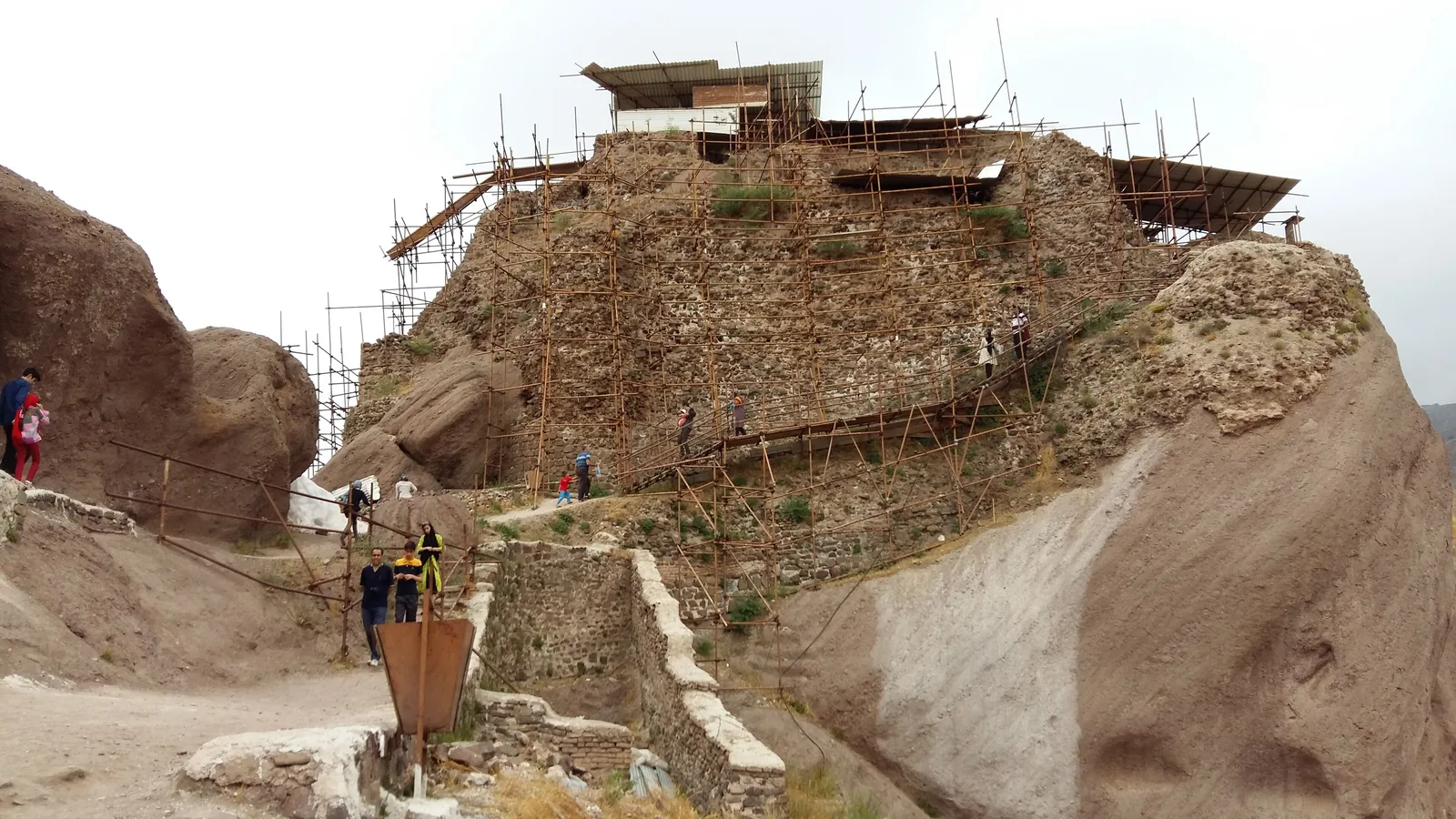
On November 19, 1256, Rukn al-Din Khurshah, imam of the Nizari Ismailis, came down from the fortress of Maymundez and presented himself before the Mongol prince Hülegü. The castle of Alamut, seat of the Nizari state since 1090, surrendered soon after, in November or December 1256 depending on the historian. Its library was then sorted by ‘Ata-Malik Juvayni, a Persian official in Mongol service who had drafted Khurshah’s safe-conduct. Juvayni wrote that he kept copies of the Koran, “choice books” and astronomical instruments, and burned the remaining books, which he said related to “their heresy and error.”
Quick facts
- When
- December 1, 1255 (Rukn al-Din Khurshah succeeds his father) · November 8, 1256 (Hülegü encamps facing Maymundez) · November 19, 1256 (Khurshah surrenders) · end of Dhu'l-qa'da 654/December 1256 (Alamut surrenders, in Farhad Daftary's dating) · 1 Rabi' I 655/March 1257 (Khurshah leaves for Mongolia) · late spring 1257 (Khurshah killed) · December 1270 (Gerdkuh surrenders)
- Where
- Maymundez, Alamut and Lammasar in the Rudbar district of northern Iran; Qazvin; Qaraqorum and the Khangai mountains in Mongolia; Gerdkuh near Damghan
- Who
- Rukn al-Din Khurshah; Hülegü; 'Ata-Malik Juvayni; Muqaddim, commander of Alamut; Nasir al-Din Tusi; the Great Khan Möngke; Shams al-Din Muhammad
- Outcome
- Some 40 Nizari castles surrendered on Khurshah's orders and the Nizari Ismaili state in Iran ended. Juvayni, by his own account, kept copies of the Koran, choice books and astronomical instruments from the Alamut library and burned the remaining books
November 1256 at Maymundez
Khurshah’s reign lasted one year. He succeeded his father, ‘Ala’ al-Din Muhammad, who was murdered in the fortress of Shirkuh on December 1, 1255, a date given both by Farhad Daftary in the Encyclopaedia Iranica and by Juvayni. Daftary writes that he offered submission at once and was told to appear in person before Hülegü, who reached Iran in April 1256. Embassies followed, led by his vizier or his brothers.
Accounts of the campaign in Rudbar, the district around Alamut, differ. Daftary places the start of Hülegü’s assault on the Nizari strongholds there in the middle of Sha’ban 654, September 1256. Peter Willey, in the same encyclopedia, dates the Mongol entry into the Alamut Valley to November 654/1256, and says they made first for Maymundez, the weakest of the castles militarily.
Daftary gives November 8 as the day Hülegü encamped on a hilltop facing Maymundez; one passage of Juvayni gives the same day, another November 7. After a few days of fighting, Khurshah asked for safe conduct. Daftary records that the decree was drawn up by Juvayni, then acting as Hülegü’s secretary. After a battle on November 15, Juvayni wrote, Khurshah sent out “his son, his only one,” with a brother and a delegation of notables the next day. On Sunday, November 19, “he came in person before the World-King.” Nasir al-Din Tusi came down from Maymundez with him.
Muqaddim, the commander who would not come down
Khurshah’s trusted men then went out with Mongol envoys to demolish the other castles. Juvayni counted “some 40 castles” razed after their garrisons came down, and Daftary gives the same figure. Two held back: Alamut and Lammasar.
Hülegü took Khurshah to the foot of Alamut to call on the garrison to surrender. Its commander, a man Juvayni names as Muqaddim, “was refractory and refused to come down.” Hülegü left Prince Balaghai to besiege the castle and moved on to Lammasar. The defenders of Alamut then sent messages to Khurshah, who obtained a pardon and a yarligh, the Mongol decree of safe-conduct, for them. According to Juvayni, “The inmates asked for three days’ grace” to carry out their goods, and on the fourth day the Mongol troops went up and took what was left.
The date of Alamut’s surrender depends on the author. Daftary puts it at the end of Dhu’l-qa’da 654, December 1256. Reuven Amitai, in the encyclopedia’s entry on Hülegü, dates “the capture of Alamut” to November 19, 1256. Juvayni recorded that Hülegü turned back toward his camp on 1 Dhu’l-hijja, which Boyle’s translation converts to December 21, 1256, and sent Khurshah and his relatives to live at Qazvin.
"Neither founded on tradition nor supported by reason"
Juvayni was at the foot of Lammasar, he wrote, “being desirous of inspecting the library, the fame of which had spread throughout the world,” when he suggested to Hülegü that “the valuable books in Alamut ought not to be destroyed.” Hülegü agreed and gave orders. He then sorted the collection himself. In John Andrew Boyle’s translation the central sentence runs:
“As for the remaining books, which related to their heresy and error and were neither founded on tradition nor supported by reason, I burnt them all.”
Before that sentence he lists what he removed: copies of the Koran, “[other] choice books,” and astronomical instruments, “armillary spheres, complete and partial astrolabes.” In an earlier chapter he describes the same work as an order to take from the treasury and library “whatever was worthy of the Private Treasury.” He gave no count of the books that went into the fire, or of those he saved.
Some of what he saved went into his own history. Among the books he found a life of Hasan-i Sabbah, the founder of the Nizari state, which its readers called the Sar-Guzasht-i Sayyidna, and Juvayni copied from it what he judged suitable. He also found a history of Jil and Dailam written for the Buyid ruler Fakhr al-Dawla, which recorded that a king of Dailam began building a castle on the mountain in 246/860-1.
A secretary in Mongol service
Juvayni did not come to Alamut as a neutral witness. George E. Lane’s Iranica entry on him records that he was born in 1226, spent 1243 to 1256 in the camp of the amir Arghun Aqa, and began his history in Qaraqorum in 1251-52 to immortalize the Mongol rulers and their conquests, finishing it in 1260. In 1257 he marched with Hülegü to Baghdad, and in 1259 he was put in charge of that city.
Of the victory over the castles he wrote that “the truth of God’s secret intent by the rise of Chingiz-Khan has become clear.” Lane wrote that for Juvayni the end of the Ismailis closed “an evil chapter in history,” and that critics were “not always sympathetic to his apparently accommodating attitude” toward the Mongols.
The Institute of Ismaili Studies entry by Daftary states only that the Mongols took Alamut in 1256, “partially demolished it, also burning its famous library.” Willey notes that Juvayni “complains bitterly how difficult it was to demolish the castle of Alamut” and was “astonished at the amount of stores, both liquid and solid,” it held.

From Qazvin to Qaraqorum, 1257–1270
Khurshah asked to visit the Great Khan Möngke, and Hülegü agreed. He set out with nine companions and a Mongol escort on 1 Rabi’ I 655. Daftary converts that date to March 19, 1257; Boyle’s translation of Juvayni converts it to March 9.
At Qaraqorum, Daftary writes, Möngke refused to see him. Juvayni reported the khan’s words: “It was unnecessary to bring him on so long a journey,” and demanded “why hast thou not destroyed certain castles such as Girdkuh and Lammasar?” Daftary writes that Möngke had by then approved a general massacre of the Persian Nizaris in Mongol custody; Juvayni wrote that in Quhistan “12,000 persons were put to death.”
On the way back, in the late spring of 1257, Khurshah and his companions were killed by their Mongol guards near the Khangai mountains in northwestern Mongolia, according to Daftary. His family held at Qazvin was also killed. One son, Shams al-Din Muhammad, had been moved to safety and survived; the later Nizari imams descend from him.
Lammasar held out for another year. Gerdkuh, besieged since May 1253, was the last Nizari castle in Iran to fall: its garrison surrendered in December 1270, Daftary wrote, “for the want of clothing.”
Key facts
- Rukn al-Din Khurshah succeeded his father on December 1, 1255, and surrendered to Hülegü at Maymundez on November 19, 1256 (Daftary, Iranica; Juvayni).
- Juvayni, then Hülegü’s secretary, drew up the decree of safe conduct (Daftary, Iranica).
- Some 40 Nizari castles surrendered on Khurshah’s orders; Alamut and Lammasar held back (Juvayni; Daftary).
- Daftary dates Alamut’s surrender to the end of Dhu’l-qa’da 654, December 1256; Amitai dates its capture to November 19, 1256.
- Juvayni wrote that he kept copies of the Koran, choice books and astronomical instruments from the Alamut library and burned the remaining books; he gave no count.
- He copied from a life of Hasan-i Sabbah found in the library, the Sar-Guzasht-i Sayyidna (Juvayni).
- Khurshah left for Mongolia on 1 Rabi’ I 655, March 19, 1257 in Daftary’s conversion and March 9 in Boyle’s; Möngke refused to receive him, and he was killed on the return journey in late spring 1257 (Daftary).
- Gerdkuh surrendered in December 1270 after a siege begun in May 1253 (Daftary, Iranica).
FAQ
Did the Mongols burn the whole library of Alamut?
By Juvayni's own account, no. He wrote that he removed copies of the Koran, other choice books and astronomical instruments, and burned the remaining books, which he classed as "heresy and error." He gave no count of the books burned or kept.
What happened to Rukn al-Din Khurshah after he surrendered?
He was kept by the Mongols while he arranged the surrender of other castles, then traveled to Mongolia in March 1257. Möngke refused to see him, and he was killed by his guards on the return journey in the late spring of 1257. His son Shams al-Din Muhammad survived.
Sources
- Farhad Daftary, "Alamut," The Institute of Ismaili Studies, Scholarly Contributions (posted January 1, 2022; originally published in The Oxford Dictionary of Islam, 2004).
- Farhad Daftary, "ḴORŠĀH, ROKN-AL-DIN," Encyclopaedia Iranica (published January 1, 2000; updated December 15, 2014).
- Peter Willey, "ISMAʿILISM xv. NEZĀRI ISMAʿILI MONUMENTS," Encyclopaedia Iranica, vol. XIV, fasc. 2, pp. 205–208 (published December 15, 2007; updated April 5, 2012).
- Reuven Amitai, "HULĀGU KHAN," Encyclopaedia Iranica, vol. XII, fasc. 5, pp. 554–557 (published December 15, 2004; updated June 11, 2013).
- George E. Lane, "JOVAYNI, ʿALĀʾ-AL-DIN," Encyclopaedia Iranica, vol. XV, fasc. 1, pp. 63–68 (published June 15, 2009; updated May 8, 2017).
- Farhad Daftary, "GERDKŪH," Encyclopaedia Iranica, vol. X, fasc. 5, p. 499 (published December 15, 2001; updated June 2, 2013).
- 'Ata-Malik Juvayni, The History of the World-Conqueror, translated by John Andrew Boyle, vol. II (Manchester University Press, 1958), chapters XII–XVI, pp. 618–725 (full text at the Internet Archive).
Cite this article
- APA
- LETTER. (2026, September 28). Alamut's library, 1256: what Juvayni kept and what he burned. Our Earth's History. https://ourearthshistory.com/west-asia/medieval/alamut-library-1256-juvayni-khurshah-surrender/
- Chicago
- LETTER. “Alamut's library, 1256: what Juvayni kept and what he burned.” Our Earth's History, September 28, 2026. https://ourearthshistory.com/west-asia/medieval/alamut-library-1256-juvayni-khurshah-surrender/.
- MLA
- LETTER. “Alamut's library, 1256: what Juvayni kept and what he burned.” Our Earth's History, 28 Sep. 2026, https://ourearthshistory.com/west-asia/medieval/alamut-library-1256-juvayni-khurshah-surrender/.
Text licensed CC BY-NC-ND 4.0. Found an error? Tell us.