What was the House of Wisdom in Baghdad, and what did it translate?
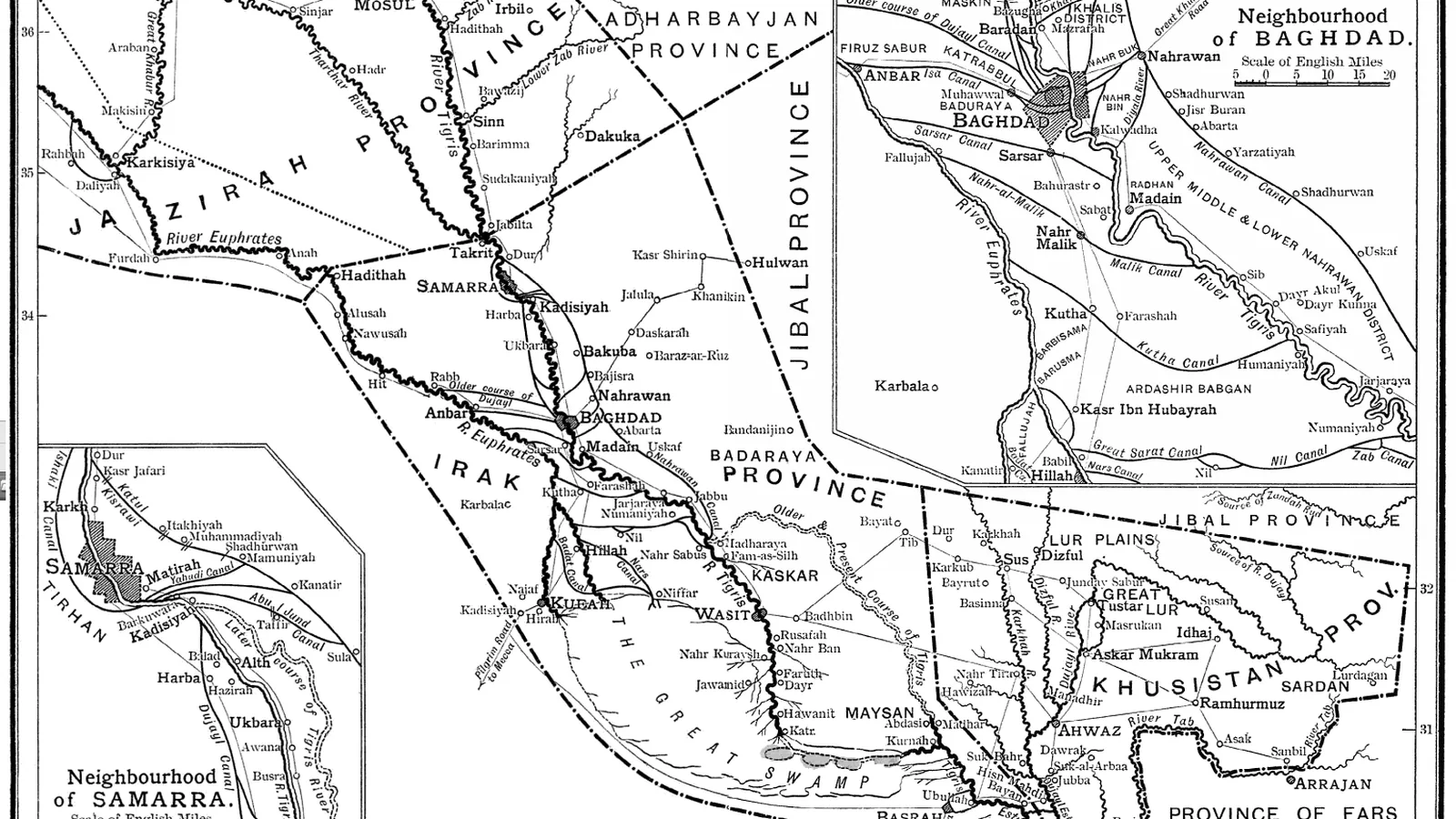

TL;DR — From 762 to 833 the Abbasid caliphs paid translators in Baghdad, most of them Syriac-speaking Christians, to put Greek, Persian and Indian science into Arabic.
From 762 to 833 the Abbasid court in Baghdad paid translators to turn Greek, Persian and Indian works of medicine, astronomy and mathematics into Arabic. Most of the translators were Syriac-speaking Christians who had learned Greek in the monasteries of Syria and Mesopotamia, and they worked for pay, from the caliph and from private patrons. “House of Wisdom,” in Arabic Bayt al-Hikma, is the name medieval writers gave the caliphal library where al-Ma’mun installed some of these scholars; “translation movement” is the phrase historians now use for the whole effort. Its clearest product is a book by al-Khwarizmi, written for al-Ma’mun, whose title gave English the word algebra.
Quick facts
- When
- 762 walls of the Round City begun · 754–775 reign of al-Mansur · 786–809 Harun al-Rashid · 813–833 al-Ma'mun · 836–892 capital at Samarra · 847 al-Mutawakkil's turn to orthodoxy · 988 the Fihrist compiled · 1258 Mongol sack of Baghdad
- Where
- Baghdad on the west bank of the Tigris, in what is now Iraq; the medical school at Jundishapur in Khuzistan; Harran in upper Mesopotamia
- Who
- The caliphs al-Mansur and al-Ma'mun; the vizier Khalid ibn Barmak; the translators Hunayn ibn Ishaq, Qusta ibn Luqa and Thabit ibn Qurra; the mathematician al-Khwarizmi; the Banu Musa brothers; the bibliographer Ibn al-Nadim
- Outcome
- Euclid, Ptolemy, Galen, Aristotle and an Indian astronomical text were put into Arabic; al-Khwarizmi wrote the book that gave algebra its name; the caliphs left for Samarra in 836, and Baghdad fell to the Mongols in 1258
A round city on the Tigris, 762
The second Abbasid caliph, al-Mansur, chose a village on the west bank of the Tigris, in what is now Iraq, and in 762 the walls of his new capital began to rise. Reynold A. Nicholson, in his 1907 Literary History of the Arabs, wrote that al-Mansur laid the first brick with his own hand and that the Round City was finished in about four years. Damascus had been too far from Persia, where Abbasid power came from, and too near the Byzantine frontier.
The adviser at his side came from a family of Balkh. Ihsan Abbas, writing for Encyclopaedia Iranica in 1988, recorded that Khalid ibn Barmak gave al-Mansur “advice about the plan of the future capital” and dissuaded him from destroying the Sasanian arch at Ctesiphon. His son Yahya and grandsons al-Fadl and Ja’far ran the government under Harun al-Rashid, and Abbas described them as patrons of poets and writers. Harun had Ja’far killed in 803. Abbas does not say the Barmakids paid for translations, and this article does not either.
Translation began under al-Mansur himself. Nicholson wrote that works on logic and medicine were put into Arabic from Pahlavi, the language of Sasanian Persia, by Ibn al-Muqaffa, who died about 760. An Indian embassy brought an astronomical text to the court around 770, according to the MacTutor history of mathematics at the University of St Andrews, and Muhammad ibn Ibrahim al-Fazari translated tables from it, per Frederic Rosen’s 1831 preface.
Who translated, and from what
The Greek books came by way of Syriac. Nicholson traced the route: when the school of Edessa broke up at the end of the fifth century, its scholars took refuge in Persia, and Khusraw Anushirvan (531–578) founded an academy at Jundishapur, where Greek medicine was still taught in Abbasid times. Harran, in upper Mesopotamia, whose pagan inhabitants the Muslims called Sabians, was a second center. “The work of translation was done almost entirely by Syrians,” Nicholson wrote. In the monasteries the writings of Aristotle, Galen and Ptolemy had been rendered into Syriac, and those versions were then turned into Arabic. The three ninth-century translators he named were the Christians Qusta ibn Luqa and Hunayn ibn Ishaq and the Sabian Thabit ibn Qurra. MacTutor adds that they were working scientists, “not language experts ignorant of mathematics.”
Al-Ma’mun (813–833) took the throne after a civil war with his brother al-Amin, according to the Library of Congress country study of Iraq. Nicholson repeated a story from the Fihrist, the catalogue of Arabic books that the Baghdad copyist Ibn al-Nadim compiled in 988: al-Ma’mun dreamed of Aristotle seated on a throne and afterward sent an embassy to the Byzantine emperor Leo the Armenian to obtain scientific books. Nicholson gave it as a tale, recorded more than 150 years after the event. Private money followed the caliph’s. Three brothers known as the Banu Musa, in words Nicholson quoted from the Fihrist and Ibn Khallikan, “drew translators from distant countries by the offer of ample rewards,” and his footnote, citing the Fihrist, put the pay at about 500 dinars a month.
What the caliph got for his money
MacTutor, quoting J. L. Berggren, records that five works of Euclid were translated, the Elements among them; of Archimedes only two, Sphere and Cylinder and Measurement of the Circle; nearly all of Apollonius; one book each of Diophantus and Menelaus; and Ptolemy’s Almagest. The first Arabic Elements was made by al-Hajjaj under Harun al-Rashid, before al-Ma’mun came to power. Galen came through the same monasteries, and in astronomy the court got tables: al-Khwarizmi’s Sindhind zij, built on the Indian text of about 770, covered calendars, the positions of the sun, moon and planets, and eclipses, according to MacTutor, and survives only in Latin.
Paper was reaching Baghdad in these same decades; how it traveled west after the Battle of Talas in 751 is told in our article on Talas.
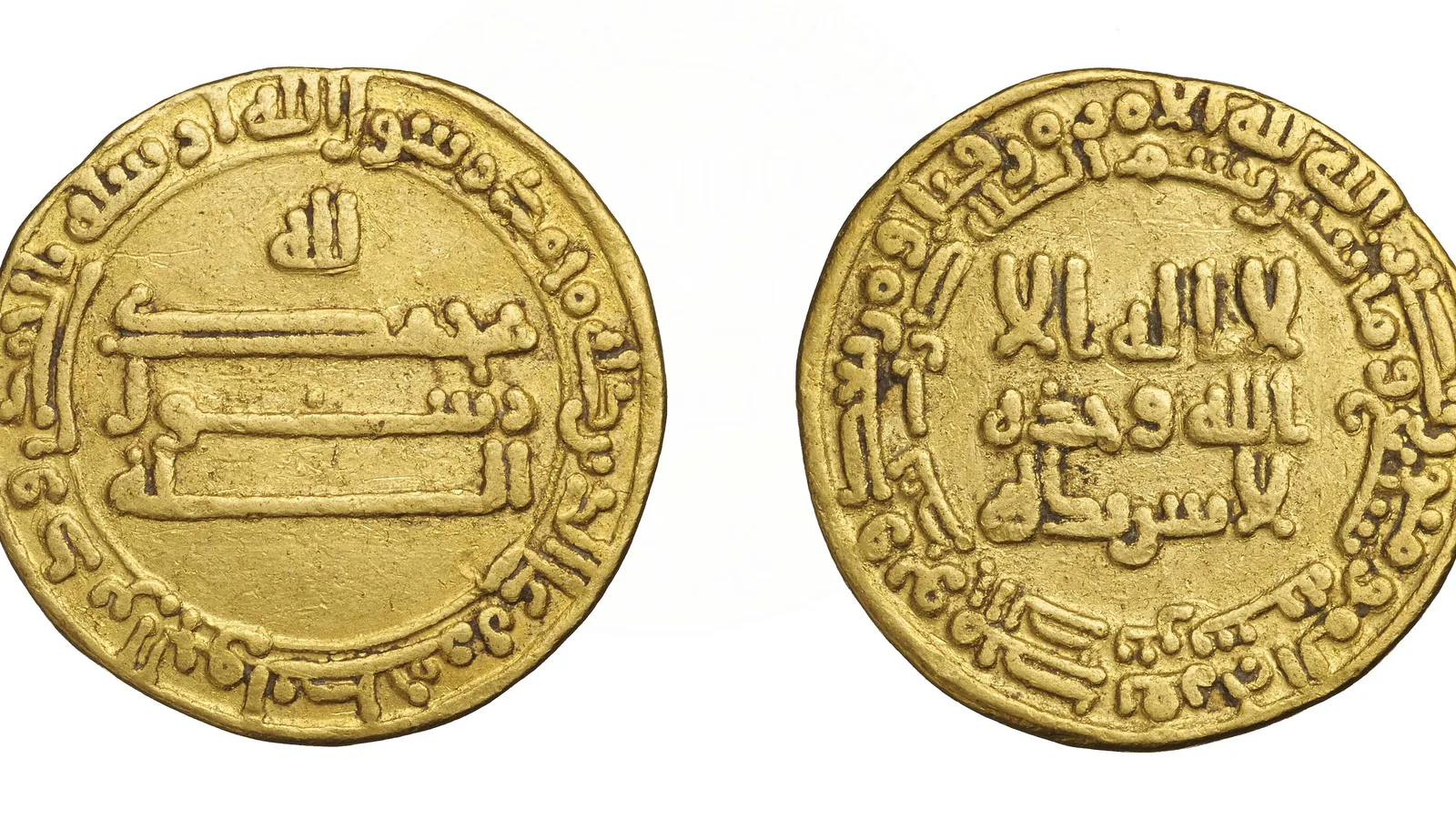

Al-Khwarizmi's book of completion and balancing
Muhammad ibn Musa al-Khwarizmi worked at the House of Wisdom with the Banu Musa and al-Hajjaj and dedicated two books to al-Ma’mun, on algebra and on astronomy. The algebra reached Rosen in one Arabic manuscript, the only copy he could trace, copied in 1342 and kept in the Bodleian Library at Oxford; he edited and translated it in 1831. “That fondness for science, by which God has distinguished the Imam al Mamun, the Commander of the Faithful,” al-Khwarizmi wrote, “has encouraged me to compose a short work on Calculating by (the rules of) Completion and Reduction, confining it to what is easiest and most useful in arithmetic, such as men constantly require in cases of inheritance, legacies, partition, law-suits, and trade.” The last part of the book deals with the Islamic law of inheritance.
MacTutor explains that al-jabr, “completion,” removed negative terms from an equation, and al-muqabala, “balancing,” canceled like terms on both sides, reducing each equation to one of six standard forms. All of it is in words, without symbols. Al-Khwarizmi’s rank is disputed. G. J. Toomer, in the Dictionary of Scientific Biography, wrote that his “scientific achievements were at best mediocre”; Roshdi Rashed, in a 1994 study, wrote that “it is impossible to overstress the originality of the conception and style of al-Khwarizmi’s algebra.”
What the name meant then and now
The medieval sources describe a library. Nicholson wrote that al-Ma’mun installed the Banu Musa, Yahya ibn Abi Mansur and other scientists “in the House of Wisdom (Baytu ‘l-Hikma) at Baghdad, an institution which comprised a well-stocked library and an astronomical observatory.” MacTutor calls the same place an academy. The geographer Yakut, who died in 1229, remembered a city of “numerous colleges of learning, hospitals, infirmaries for both sexes, and lunatic asylums,” as a 1912 sourcebook prints him.
What remains open
Samarra, 130 kilometers up the Tigris, was the Abbasid capital from 836 to 892, and UNESCO’s listing calls it the second capital after Baghdad. The caliph al-Mutawakkil (847–861), Nicholson wrote, opened his reign by declaring the Mu’tazilite doctrines heretical, and “stern measures were taken against dissenters.” In 1258 Hulagu Khan seized Baghdad, killed the last Abbasid caliph and, according to the Library of Congress study, made a pyramid of the skulls of the city’s scholars, religious leaders and poets.
What survives is the translations and the catalogue that lists them. No contemporary account fixes the year the House of Wisdom was founded, and no source read for this article records a Barmakid paying a translator. Paid Syriac Christians, an Indian embassy’s gift and a caliph’s library produced, in seventy years, an Arabic Euclid, an Arabic Ptolemy and a book of completion and balancing.
Key facts
- Al-Mansur began the walls of Baghdad in 762 on the west bank of the Tigris; Nicholson wrote that the Round City took about four years to finish.
- Khalid ibn Barmak, from a family of Balkh, advised al-Mansur on the plan of the capital (Encyclopaedia Iranica, 1988); his grandson Ja’far was executed in 803.
- Ibn al-Muqaffa, who died about 760, translated logic and medicine from Pahlavi; an Indian astronomical text reached the court around 770.
- Nicholson wrote that Greek works were rendered into Syriac in monasteries and then into Arabic; the translators he named were Hunayn ibn Ishaq, Qusta ibn Luqa and Thabit ibn Qurra.
- The Banu Musa paid translators about 500 dinars a month, per Nicholson’s footnote citing the Fihrist.
- Al-Khwarizmi dedicated his algebra to al-Ma’mun; Rosen edited it in 1831 from a Bodleian manuscript copied in 1342.
- The Abbasid capital was at Samarra from 836 to 892 (UNESCO); Hulagu Khan took Baghdad in 1258.
FAQ
Who founded the House of Wisdom?
Nicholson, following the Arabic sources, wrote that al-Ma'mun (813–833) installed the Banu Musa and other scientists there, and MacTutor says al-Ma'mun set it up. No contemporary record gives a founding year, and translation in Baghdad began under al-Mansur (754–775).
What language were the Greek texts translated from?
Mostly from Syriac. Nicholson wrote that the work was done almost entirely by Syrians, who had put Aristotle, Galen and Ptolemy into Syriac in the monasteries of Syria and Mesopotamia; those versions were then turned into Arabic. Persian works came from Pahlavi, and the Sindhind came from an Indian text brought to the court around 770.
Where does the word algebra come from?
From al-jabr, "completion," in the title of al-Khwarizmi's book Hisab al-jabr wa'l-muqabala, written for al-Ma'mun. MacTutor explains that al-jabr removed negative terms from an equation and al-muqabala, "balancing," canceled like terms on both sides.
Sources
- Reynold A. Nicholson — A Literary History of the Arabs (London, 1907), chapters on the Abbasid period, via Project Gutenberg.
- MacTutor History of Mathematics, University of St Andrews — J. J. O'Connor and E. F. Robertson, "Abu Ja'far Muhammad ibn Musa Al-Khwarizmi" (1999).
- MacTutor History of Mathematics, University of St Andrews — J. J. O'Connor and E. F. Robertson, "Arabic mathematics: forgotten brilliance?" (1999).
- Frederic Rosen (ed. and trans.) — The Algebra of Mohammed ben Musa (London, Oriental Translation Fund, 1831), via Internet Archive.
- Encyclopaedia Iranica — Ihsan Abbas, "Barmakids" (December 15, 1988).
- UNESCO World Heritage Centre — "Samarra Archaeological City."
- Internet History Sourcebooks Project, Fordham University — "Yakut: Baghdad under the Abbasids, c. 1000 CE," from William Stearns Davis, Readings in Ancient History (1912–13).
- Library of Congress Country Studies — "Iraq: The Abbasid Caliphate, 750-1258."
- Library of Congress Country Studies — "Iraq: The Mongol Invasion."
Cite this article
- APA
- Our Earth's History. (2026, September 21). What was the House of Wisdom in Baghdad, and what did it translate? Our Earth's History. https://ourearthshistory.com/west-asia/medieval/house-of-wisdom-baghdad-translation-movement/
- Chicago
- Our Earth's History. “What was the House of Wisdom in Baghdad, and what did it translate?” Our Earth's History, September 21, 2026. https://ourearthshistory.com/west-asia/medieval/house-of-wisdom-baghdad-translation-movement/.
- MLA
- “What was the House of Wisdom in Baghdad, and what did it translate?” Our Earth's History, 21 Sep. 2026, https://ourearthshistory.com/west-asia/medieval/house-of-wisdom-baghdad-translation-movement/.
Text licensed CC BY-NC-ND 4.0. Found an error? Tell us.