The Oseberg ship: buried in 834, dug out in 1904
.jpg)
TL;DR — “In the year 834, two very special women died,” the Museum of the Viking Age writes. Their oak ship, built around 820, was unearthed by Gabriel Gustafson in 1904.
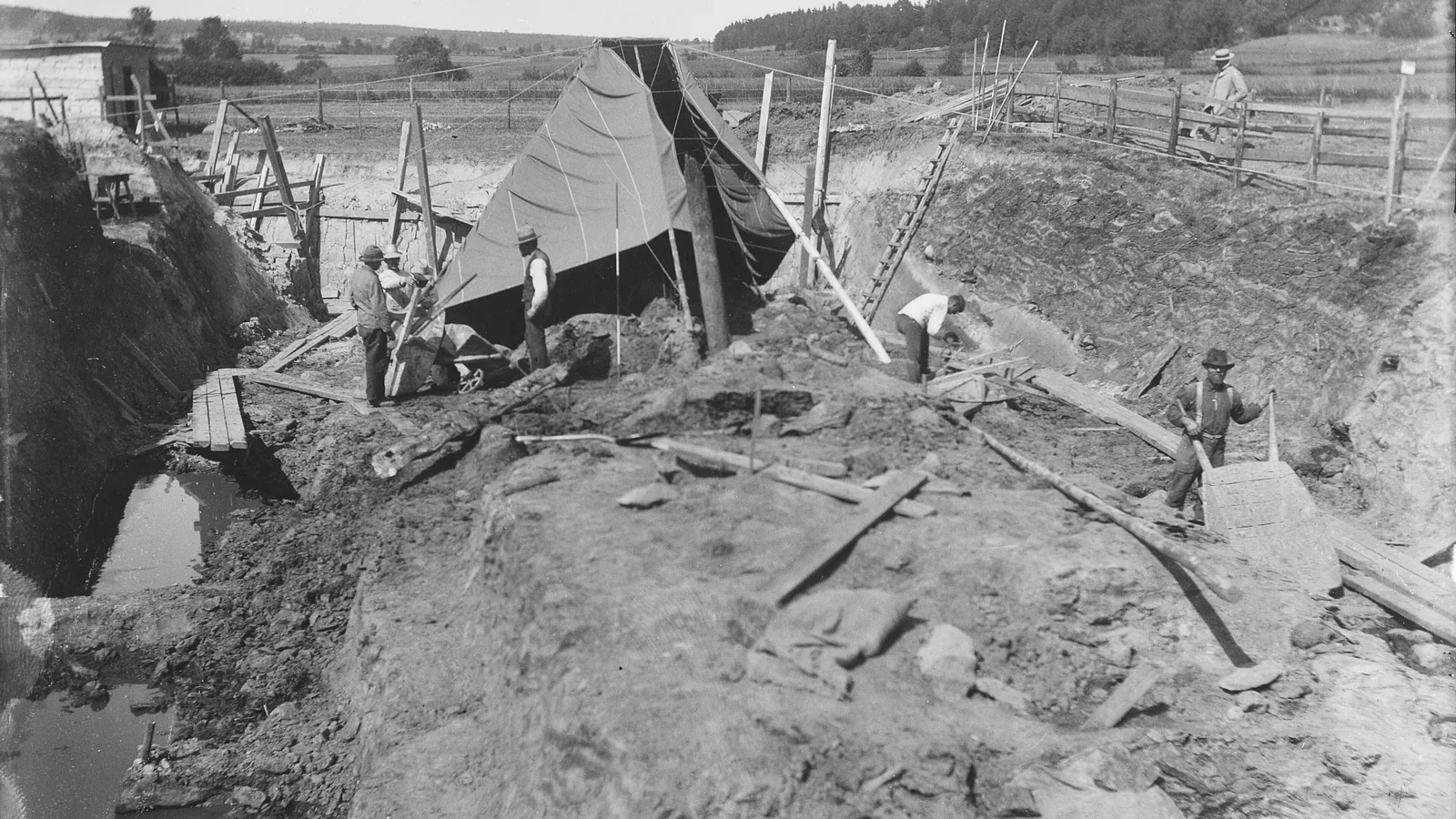
“On 8 August 1903, the archaeologist Gabriel Gustafson was visited by the farmer Oskar Rom, who had been digging in a large mound on his property and discovered that it was a burial mound containing the remains of a ship,” the Museum of the Viking Age at the University of Oslo writes. Two days later Gustafson opened a preliminary investigation at the mound and found ship components carved with Viking Age ornamentation. He held off the full dig until the following summer, so that autumn weather would not interfere, and the excavation itself took less than three months. Tree-ring dating later fixed the ship’s timber at about 820 and the burial itself at 834. Conservation of the ship and its several hundred wooden objects then took 21 years, and the alum salts used on some of the objects later left them degraded.
Quick facts
- When
- August 8, 1903 (Oskar Rom's report) · summer 1904 (full excavation) · around 820 (ship built) · 834 (burial) · 1926 (move to Bygdøy) · 2026 (budget reallocated for the old museum building)
- Where
- A burial mound at Oseberg, near Tønsberg in Vestfold, Norway (given as Slagen by the Museum of the Viking Age and as Sem by Riksantikvaren)
- Who
- The farmer Oskar Rom; the archaeologist Gabriel Gustafson; two women buried together in 834, unnamed in the sources
- Outcome
- The excavation of 1904 took less than three months; conservation of the ship and its objects took 21 years; alum treatment of the most damaged wooden objects later caused further chemical decay, and the ship has since moved twice
August 8, 1903: a farmer's report
Gustafson’s preliminary work took place at the farm Lille Oseberg, in Slagen, Vestfold county, the Museum of the Viking Age writes. Riksantikvaren, Norway’s national heritage agency, records the same 1903 discovery but places the mound at Sem, in Tønsberg. The full excavation opened the following summer and drew a crowd once it began. The Museum of the Viking Age records that the site needed railings, signs and an attendant to hold back visitors, and that Gustafson complained in his diary that he had to work “on display.”
Gabriel Gustafson's ship
Gustafson’s find turned out to be an oak vessel, “built in Southwest Norway around the year 820,” the Museum of the Viking Age writes, with a hull of twelve strakes and a pine mast that stood between ten and thirteen meters. Fifteen oar holes ran down each side, enough for thirty rowers, and the museum notes that the oars show no wear, so they may have been made especially for the burial. Riksantikvaren’s own account gives the same two dates independently of the museum: the ship built around 820, the burial around 834. The dating rests on dendrochronology. A 1993 paper in Antiquity by Niels Bonde, of the National Museum of Denmark, and Arne Emil Christensen, of the Viking Ship Museum in Oslo, states that tree-ring analysis “now provides a date, exact nearly to the year, for three Viking Age burial mounds of special importance for chronology in Scandinavia,” at Oseberg, Gokstad and Tune, where earlier dating had relied on the carving style of the grave goods alone.
The grave goods
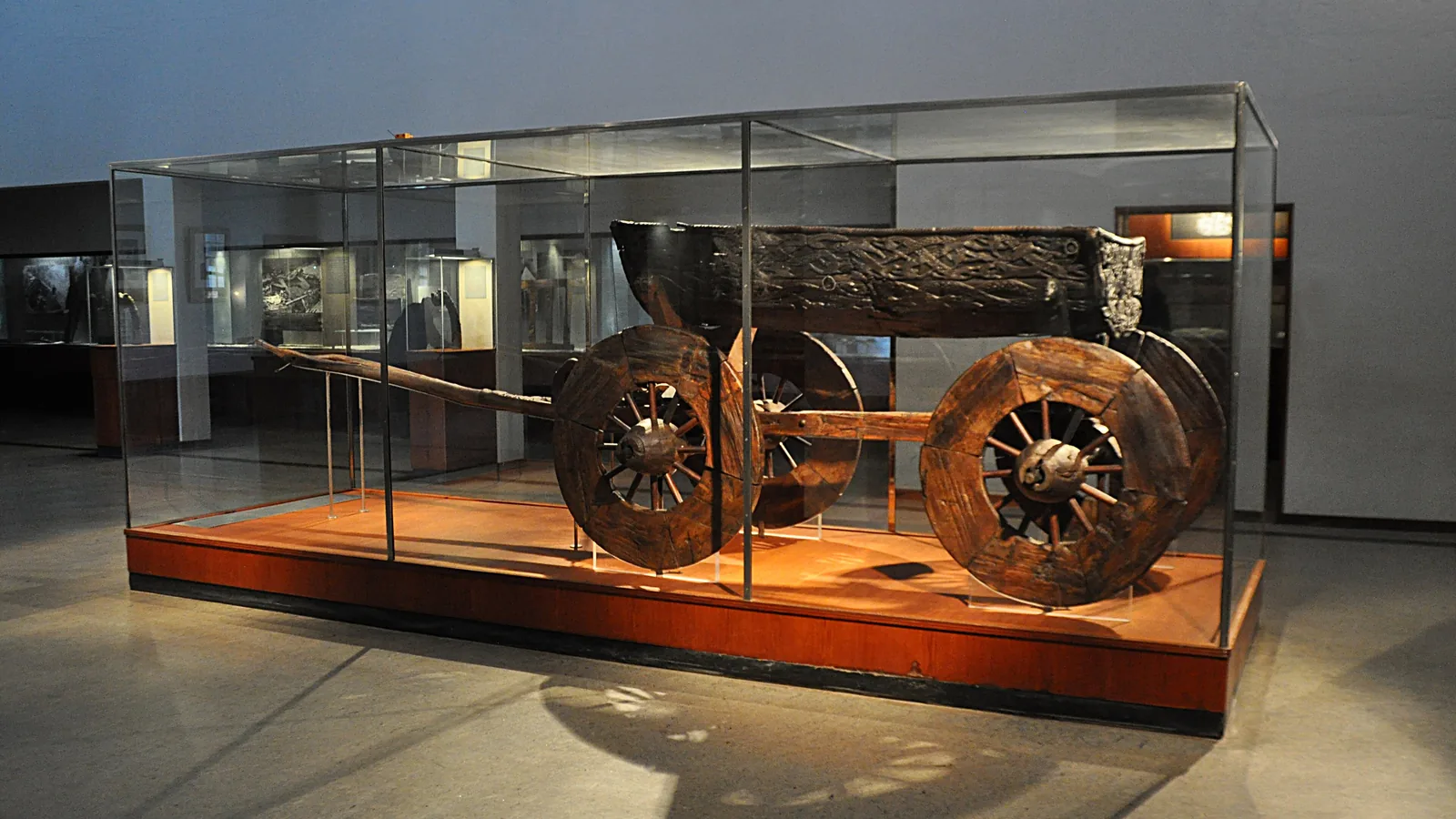
The grave goods filled the ship. The Museum of the Viking Age lists clothes, shoes and combs, ship’s equipment, kitchen utensils and farm equipment, three ornate sledges and one work sledge, a wagon, five carved animal heads, five beds, two tents, fifteen horses, six dogs and two small cows. The wagon was already old when it went into the grave, the museum’s page on the object states, probably made before the year 800; its carvings include cats and a man lying on his back, attacked by snakes. Fifteen different silk fabrics also came out of the mound. The museum’s study of the textiles, written by Marianne Vedeler, states that their patterns show close similarities to reliquary cloths in churches at Aachen, Chelles, Liège and Mariastein, and that the silk was imported from Central Asia and the regions around the eastern Mediterranean. After examination by the archaeologist Anne Stine Ingstad, the textiles were divided into nineteen quality groups, probably used for tent cloth, clothing and bedding.
,_Norway._Viking_Ship_Museum,_Oslo,_Norway_(Vikingskipshuset_på_Bygdøy)_2011.jpg)
"Two very special women"
“In the year 834, two very special women died; they were honoured with a magnificent burial,” the Museum of the Viking Age writes. The museum’s account of the research on the remains gives the age of the older woman as between 70 and 80 and the younger as just over 50, and states that the remains do not reveal the younger woman’s cause of death. A 2012 paper in Antiquity by Jan Bill and Aoife Daly reports that the Oseberg and Gokstad ship burials “had been later broken into,” and that the intruders defaced the ship and damaged the grave goods. Dendrochronology dates that break-in to the tenth century, during the reign of Harald Bluetooth.
Ninety percent original timber
More than 90 percent of the ship’s timber is original, the Museum of the Viking Age writes, the result of a conservation effort that took 21 years. Riksantikvaren states that the hull itself, built of clinker-laid oak, was conserved with linseed oil and creosote. The individual wooden objects that came out of the grave in the worst condition were treated differently. The Museum of Cultural History, in its Saving Oseberg project, records that after the 1904 excavation, “the most deteriorated wooden objects were treated with alum salts,” a treatment the project describes as having produced “alarming conditions” in the objects today. A paper hosted in the PMC archive explains the chemistry, citing Braovac and Kutzke’s 2012 finding that heating alum solutions generates sulfuric acid, “leading to the degraded state that these artefacts are in today.” In 1926 the ship left its restoration site in the university gardens in Oslo, now Tullinløkka, for the newly built Viking Ship Museum at Bygdøy, designed by the architect Arnstein Arneberg; Riksantikvaren records that guardsmen pulled it on rails to the harbor and across the fjord on a purpose-built raft. Almost a century later it moved again. Riksantikvaren states that the floor of the protected old museum building could not bear the weight of the ships together with their steel transport rigs, close to 50 tons in all, so the move used overhead crane rails instead, at a speed of about 25 centimeters a minute. The Museum of the Viking Age’s 2026 announcement of the renovation states that the old building will keep the main entrance and add space for school classes, an auditorium and a museum shop, funded in part by 135 million kroner reallocated in Norway’s revised 2026 national budget.
Key facts
- On August 8, 1903, the farmer Oskar Rom told the archaeologist Gabriel Gustafson he had found a ship inside a burial mound on his farm (Museum of the Viking Age).
- The full excavation began in the summer of 1904 and took less than three months; conservation of the ship and its objects took 21 years (Museum of the Viking Age).
- The Oseberg ship was built of oak in southwest Norway around 820, with 12 strakes, a mast 10 to 13 meters tall and 15 oar holes on each side (Museum of the Viking Age).
- The burial is dated to 834, a date the Museum of the Viking Age and Riksantikvaren give independently of each other.
- Two women were buried in the ship; the older was 70 to 80 years old, the younger just over 50 (Museum of the Viking Age).
- The grave goods included a wagon, four sledges, five carved animal heads, fifteen horses, six dogs, two cows and fifteen types of imported silk (Museum of the Viking Age).
- After the 1904 excavation, the most damaged wooden objects were treated with alum salts, a process later shown to generate sulfuric acid and degrade them further (Museum of Cultural History; PMC).
- The ship moved to the Viking Ship Museum at Bygdøy in 1926 and to the new Museum of the Viking Age nearly a century later, using overhead crane rails to spare a floor that could not bear the roughly 50 tons of ship and rigging (Riksantikvaren).
FAQ
Why is the Oseberg ship dated to 834?
Dendrochronology, tree-ring dating of the ship's timber, places its construction around 820 and its burial around 834. The Museum of the Viking Age and Riksantikvaren give this date independently, and a 1993 paper in Antiquity by Niels Bonde and Arne Emil Christensen describes the method as providing dates "exact nearly to the year" for the Oseberg, Gokstad and Tune burials.
Who were the two women buried in the Oseberg ship?
The Museum of the Viking Age's research on the remains found one woman aged 70 to 80 and a second just over 50. The museum does not identify either of them with any known historical figure.
Why did the alum treatment damage the Oseberg finds?
The Museum of Cultural History's Saving Oseberg project records that the most deteriorated wooden objects from the 1904 excavation were treated with alum salts. A paper in the PMC archive, citing research by Braovac and Kutzke, states that heating alum solutions generates sulfuric acid, which degraded the treated objects further over time. The ship's hull itself was conserved separately, with linseed oil and creosote.
Sources
- Museum of the Viking Age, University of Oslo, "The Adventure Begins."
- Museum of the Viking Age, "The Oseberg Ship – A Magnificent Vessel."
- Museum of the Viking Age, "The Women in the Oseberg Grave."
- Museum of the Viking Age, "Textiles in the Oseberg Find," by Marianne Vedeler.
- Museum of the Viking Age, "The Viking Ship Museum is now being renovated!" (news, June 19, 2026).
- Riksantikvaren (Norwegian Directorate for Cultural Heritage), "Bevaring i bevegelse: Osebergskipet til nytt museum."
- Museum of Cultural History, University of Oslo, "Saving Oseberg" (research project page).
- PMC (National Library of Medicine), "Evaluation of two terpene-derived polymers as consolidants for archaeological wood."
- Niels Bonde and Arne Emil Christensen, "Dendrochronological dating of the Viking Age ship burials at Oseberg, Gokstad and Tune, Norway," Antiquity 67(256), 1993.
- Jan Bill and Aoife Daly, "The plundering of the ship graves from Oseberg and Gokstad: an example of power politics?," Antiquity 86(333), 2012.
Cite this article
- APA
- LETTER. (2026, September 28). The Oseberg ship: buried in 834, dug out in 1904. Our Earth's History. https://ourearthshistory.com/europe/medieval/oseberg-ship-1904-gustafson-834-burial-wagon-sledges/
- Chicago
- LETTER. “The Oseberg ship: buried in 834, dug out in 1904.” Our Earth's History, September 28, 2026. https://ourearthshistory.com/europe/medieval/oseberg-ship-1904-gustafson-834-burial-wagon-sledges/.
- MLA
- LETTER. “The Oseberg ship: buried in 834, dug out in 1904.” Our Earth's History, 28 Sep. 2026, https://ourearthshistory.com/europe/medieval/oseberg-ship-1904-gustafson-834-burial-wagon-sledges/.
Text licensed CC BY-NC-ND 4.0. Found an error? Tell us.