Joseon, an autonomous state: the treaty of Ganghwa, February 26, 1876

TL;DR — Article 1 of the treaty signed at Ganghwa on February 26, 1876 called Joseon an autonomous state; Articles 4, 5 and 10 opened three ports and set consular jurisdiction.
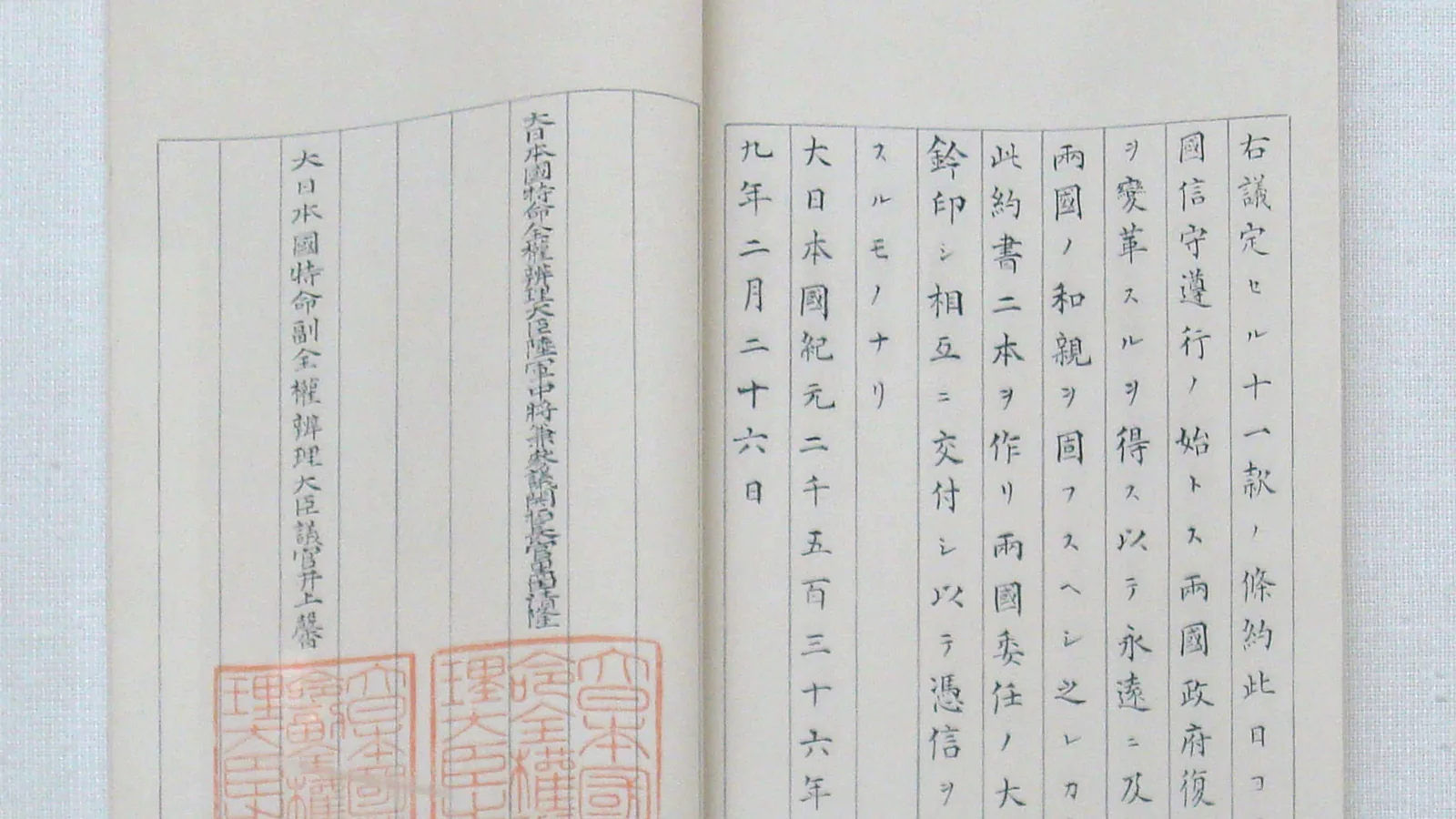
“第一款, 朝鮮國自主之邦, 保有與日本國平等之權.” So opens the treaty as the Veritable Records of King Gojong print it: Article 1, Joseon is an autonomous state and holds rights equal to those of Japan. The document carries two dates side by side, “大朝鮮國開國四百八十五年丙子二月初二日,” the 2nd day of the 2nd month in the 485th year since the founding of Joseon, and “明治九年二月二十六日,” February 26 in the ninth year of Meiji, the same day on two calendars. The report that accompanies it, from Sin Heon, the official sent to receive the Japanese envoys, says the signing took place “今三日辰刻,” at the hour of the dragon on the 3rd. The Records carry both the 2nd and the 3rd and do not reconcile them. Sin and Yun Ja-seung signed for Joseon, Kuroda Kiyotaka and Inoue Kaoru for Japan, at Ganghwa, on the island west of Seoul.
Quick facts
- When
- 8th month, 22nd day, 1875 by the Joseon calendar (a ship reported off Nanjido) · 8th month, 26th day (loss of Yeongjong reported) · 1st month, 3rd and 5th days, 1876 (ministers convened; Sin Heon appointed) · 1st month, 17th day (first meeting at the Yeonmudang) · 2nd month, 2nd day = February 26, 1876 (treaty signed) · 7th month, 6th day = August 24, 1876 (supplement and trade regulations signed)
- Where
- Yeongjong and Nanjido at the mouth of the Han River; the Yeonmudang drill hall and the town of Ganghwa; Busan and the Japan House at Choryang
- Who
- King Gojong; Sin Heon and Yun Ja-seung for Joseon; Kuroda Kiyotaka and Inoue Kaoru for Japan; Yi Min-deok, commander at Yeongjong; Jo In-hui and Miyamoto Koichi, signers of the supplement
- Outcome
- Twelve articles signed at Ganghwa. Article 1 called Joseon an autonomous state with rights equal to Japan's; Articles 4 and 5 opened Busan and two further ports; Article 10 gave each country jurisdiction over its own subjects. A supplement of 11 articles and 11 trade rules followed in the 7th month
A ship off Nanjido, 1875
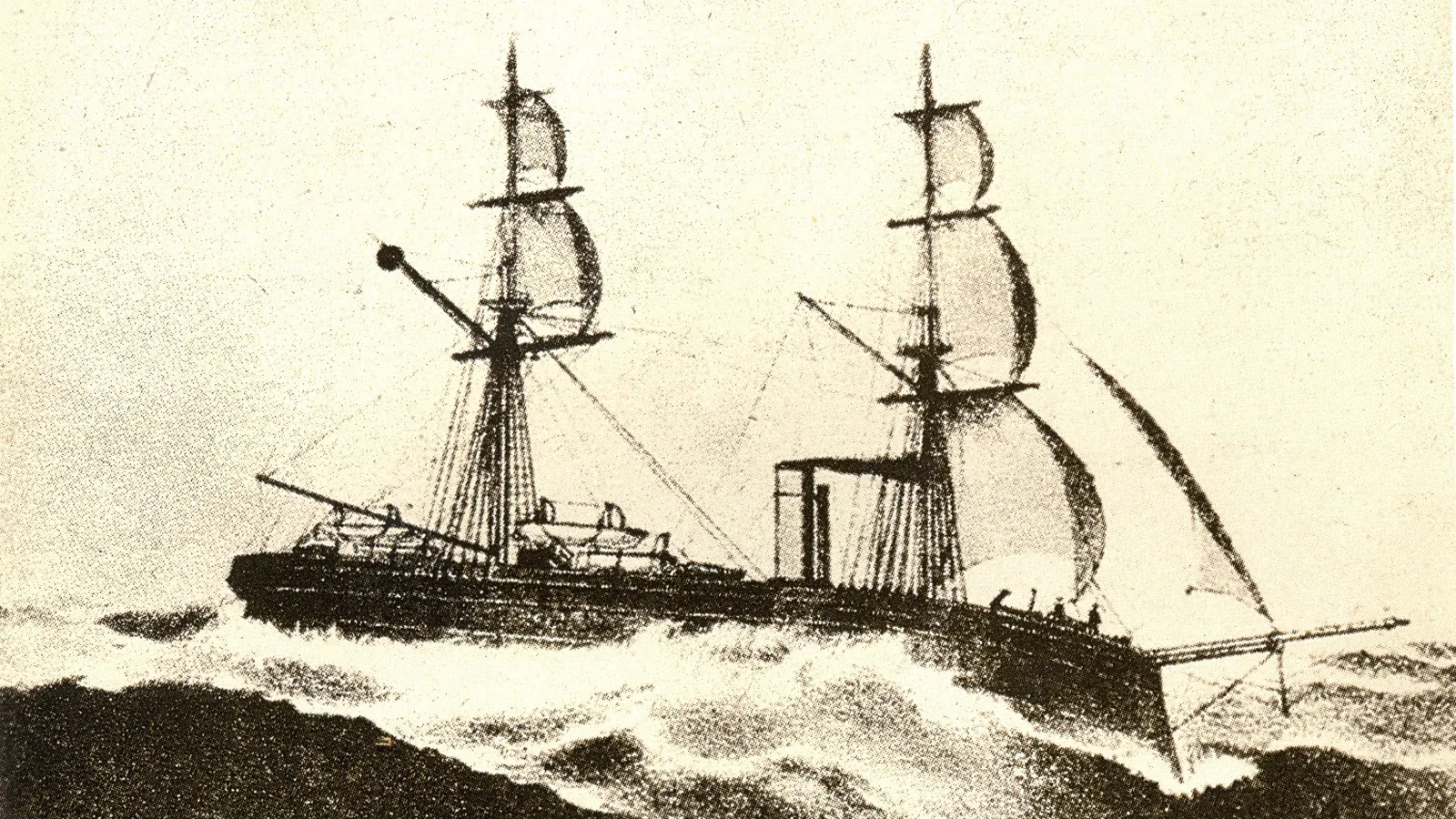
On the 22nd day of the 8th month of 1875 by the Joseon calendar, Yi Min-deok, the commander at Yeongjong, an island fort at the mouth of the Han River, reported: “異樣船蘭芝島留碇,” a ship of strange shape lay at anchor off Nanjido. The compilers of the Records added a note: “日本軍艦雲揚號, 航路測量時,” the Japanese warship Unyo, surveying the sea route. On the 26th the Three Armies Office reported to King Gojong: “永宗失守之報, 纔到矣,” the report of the loss of Yeongjong had just arrived. The government buildings had been burned to ash, “廨宇焉蕩爲灰燼,” and the office asked that Yi be dismissed and tried; the king agreed. An edict of the same day ordered burial money for the dead and medicine for the wounded, whose numbers “姑未有臚數登聞,” had not yet been counted. The Records give no casualty figure. A second edict raised Incheon to a defense command and placed Yeongjong under it: “仁川陞作防禦營, 永宗移屬於仁川防營.”
January 1876: a great official and a deputy
On the 3rd day of the first month of 1876, Gojong ordered the serving and retired chief ministers and the State Council to assemble and confer, since “當此邊報日至之時,” reports from the frontier were arriving daily. On the 5th the council reported that questioning of the Japanese warships had produced one answer, “期欲見我國大官,” they were determined to see a high official, and proposed sending Sin Heon, 判中樞府事. The king approved. The council added that a deputy could not be dispensed with, “不可無副官,” and named Yun Ja-seung, 副總管. The Records call Sin from then on the receiving great official, 接見大官.
Kuroda and Sin Heon at the Yeonmudang, the 17th
Sin’s report of the 19th sets out, question by question, his meeting on the 17th with Kuroda and Inoue at the Yeonmudang, the drill hall in the camp at Ganghwa. Kuroda raised the ship: “我船雲揚艦, 昨年向牛莊, 過貴境, 貴境人砲擊焉,” the Unyo had been on its way to Niuzhuang the year before, passing Joseon’s waters, when Joseon’s people fired on it. Sin answered that the ship had come the previous autumn without notice of its country or its business and had sailed straight into a defended zone, so the border troops had had no choice but to fire. He then turned the complaint around: the burning of the whole garrison at Yeongjong and the carrying off of its stores, “永宗鎭戍, 一切焚蕩, 取去軍物,” did not look like the good faith of a neighbor.
Kuroda asked why Joseon had refused envoys and letters, “不接使臣, 不受書契,” for six or seven years. Sin answered with a newspaper: in 1867 a paper sent from China had printed a piece by a Japanese named Yado Masayoshi (八戶順叔) saying that the king of Joseon had by old custom gone to Edo every five years to pay tribute, had long since stopped, and would be punished by an army. Court and people alike had taken it as slander. Kuroda answered that this was rumor.

Twelve articles, six documents and a draft with "某" for names
The treaty gives the negotiators’ full titles: Kuroda, special plenipotentiary, lieutenant general of the army, councilor and director of the Colonization Office (陸軍中將兼參議開拓長官); Inoue, deputy plenipotentiary and councilor (議官); Sin, 判中樞府事; Yun, 副總管.
Article 3 let Japan write its official letters in its own script, with a Chinese translation attached for ten years; Joseon would write in Chinese. Article 4 kept Busan, where the Japan House at Choryang had long stood, and abolished the old customs, the annual ships among them. Article 5 required two more ports on the coasts of Gyeonggi, Chungcheong, Jeolla, Gyeongsang and Hamgyeong provinces, to be opened inside twenty months counted from the 2nd month of 1876; it named no port. Article 10 gave each country’s officials jurisdiction over their own people: “日本國人民在朝鮮國指定各口, 如其犯罪, 交涉朝鮮國人民, 皆歸日本國審斷,” a Japanese subject who committed a crime at a designated port in a matter involving Joseon subjects would be judged by Japan, and a Joseon subject in a case involving Japanese by Joseon officials, each under his own law. Article 12 declared the eleven articles in force from that day, “以此日爲兩國信守遵行之始.”
Sin sent six documents up to the State Council: the treaty in Chinese and Japanese translation; Joseon’s ratification; the draft ratification the Japanese had brought; the treaty original; a letter from the Japanese envoys; and a memorandum in Miyamoto Koichi’s hand. The Japanese draft is a form: it names the plenipotentiary as “某,” a certain person, and ends “右擬案也,” the above is a draft. The envoys’ letter is dated Meiji 9, February 27, the day after the signing. Miyamoto’s memorandum required Japanese merchant ships to show their government license to the Japanese consul no more than twenty-four hours after reaching port; a ship flying a flag it had no right to would be treated as a pirate.
The Records use two names for one text: Sin’s report calls what he signed the 修好條款, the articles of amity, while the heading over the text reads 修好條規, the regulations of amity. Neither uses the name Ganghwa Treaty. After the sealing, Sin reported, the Japanese were feasted at the Yeonmudang and left at midday for their ships; Miyamoto and some seventy soldiers stayed behind.
Busan, ten ri from the wharf: the 7th month, 6th day
On the 6th day of the 7th month of 1876, Meiji 9, August 24 by the Japanese date on the document, Jo In-hui, 講修官, and Miyamoto Koichi, Japan’s 理事官, signed a supplement to the treaty in eleven articles and trade regulations in eleven rules. Article 3 of the supplement abolished the guard gate and the outer gate of the Japan House at Choryang, “從今廢撤,” and replaced them with boundary markers. Article 4 fixed how far Japanese could go from the port at Busan: “自埠頭起算, 東西南北各直徑十里,” ten ri in each direction measured from the wharf, by the Joseon ri. Rule 7 set port dues: 5 yen for a multi-masted ship or a steamship, 2 yen for a single-masted ship carrying more than 500 seok, 1 yen 50 sen for one carrying less, and nothing for Japanese government ships. Rule 10 read “嚴禁鴉片煙販賣,” the sale of opium is strictly prohibited. The document closes as the treaty had, with the 485th year of Joseon and the 2,536th year of the Japanese era on one line.
Key facts
- Article 1 of the treaty reads “朝鮮國自主之邦, 保有與日本國平等之權”: Joseon is an autonomous state holding rights equal to Japan’s (Gojong Sillok, 1876, 2nd month, 3rd day).
- The treaty is dated both “丙子二月初二日” (Joseon, 2nd month, 2nd day) and “明治九年二月二十六日” (Meiji 9, February 26); Sin Heon’s report says the signing took place “今三日辰刻,” on the 3rd.
- Yi Min-deok reported a ship of strange shape at Nanjido on the 22nd day of the 8th month of 1875; the compilers’ note names it “日本軍艦雲揚號” (8th month, 22nd day).
- On the 26th the Three Armies Office reported “永宗失守之報, 纔到矣”; an edict said the dead and wounded “姑未有臚數登聞,” were not yet counted, and Incheon was raised to a defense command (8th month, 26th day, entries 1 to 3).
- On the 5th day of the 1st month of 1876 the State Council sent Sin Heon to meet the Japanese, who “期欲見我國大官,” insisted on seeing a high official, with Yun Ja-seung as deputy (1st month, 5th day).
- At the Yeonmudang on the 17th, Kuroda said “我船雲揚艦, 昨年向牛莊, 過貴境, 貴境人砲擊焉”; Sin answered that no notice had been given and that Yeongjong had been burned and its stores taken (1st month, 19th day).
- Article 10 reads “日本國人民在朝鮮國指定各口, 如其犯罪, 交涉朝鮮國人民, 皆歸日本國審斷”: Japanese at the open ports were to be judged by Japan.
- On the 6th day of the 7th month (August 24, 1876) Jo In-hui and Miyamoto Koichi signed a supplement of 11 articles and 11 trade rules: ten ri from the wharf at Busan, port dues of 5, 2 and 1.5 yen, and “嚴禁鴉片煙販賣” (7th month, 6th day).
FAQ
What did Article 1 of the 1876 treaty between Joseon and Japan say?
In the Chinese text printed in the Gojong Sillok it reads "朝鮮國自主之邦, 保有與日本國平等之權": Joseon is an autonomous state and holds rights equal to those of Japan. The article goes on to say the two countries should treat each other with equal courtesy.
When was the Treaty of Ganghwa signed?
The document carries the 2nd day of the 2nd month of 1876 by the Joseon calendar and February 26 of Meiji 9 by the Japanese calendar, the same day. Sin Heon's report to the court says the signing took place on the 3rd; the Records print both dates.
Which ports did the 1876 treaty open?
Article 4 kept Busan, where the Japan House at Choryang already stood, under new rules. Article 5 required two more ports on the coasts of Gyeonggi, Chungcheong, Jeolla, Gyeongsang or Hamgyeong provinces, to be chosen inside twenty months; the treaty names none of them.
Sources
- National Institute of Korean History, Veritable Records of Gojong (Gojong Sillok), vol. 13, 13th year (1876), 2nd month, 3rd day, entry 1: Sin Heon's report of the signing, the text of the twelve articles, the two ratification texts, the State Council's letter, the Japanese envoys' letter and Miyamoto Koichi's memorandum (Chinese original with Korean translation).
- Gojong Sillok, vol. 12, 12th year (1875), 8th month, 22nd day, entry 1: report of Yi Min-deok, commander at Yeongjong, on a ship anchored off Nanjido, with the compilers' note naming the Unyo.
- Gojong Sillok, vol. 12, 12th year (1875), 8th month, 26th day, entry 1: the Three Armies Office's report on the loss of Yeongjong and the dismissal of Yi Min-deok.
- Gojong Sillok, vol. 12, 12th year (1875), 8th month, 26th day, entry 2: edict on burial money and medicine for the dead and wounded at Yeongjong.
- Gojong Sillok, vol. 12, 12th year (1875), 8th month, 26th day, entry 3: edict raising Incheon to a defense command and placing Yeongjong under it.
- Gojong Sillok, vol. 13, 13th year (1876), 1st month, 3rd day, entry 1: edict convening the serving and retired chief ministers and the State Council.
- Gojong Sillok, vol. 13, 13th year (1876), 1st month, 5th day, entry 1: State Council report appointing Sin Heon to receive the Japanese envoys and Yun Ja-seung as his deputy.
- Gojong Sillok, vol. 13, 13th year (1876), 1st month, 19th day, entry 1: Sin Heon's report of his meeting with Kuroda Kiyotaka and Inoue Kaoru at the Yeonmudang on the 17th, question and answer.
- Gojong Sillok, vol. 13, 13th year (1876), 7th month, 6th day, entry 1: the supplement to the treaty in 11 articles and the trade regulations in 11 rules, signed by Jo In-hui and Miyamoto Koichi.
Cite this article
- APA
- Our Earth's History. (2026, September 22). Joseon, an autonomous state: the treaty of Ganghwa, February 26, 1876. Our Earth's History. https://ourearthshistory.com/east-asia/modern/ganghwa-treaty-february-26-1876-twelve-articles-gojong-sillok/
- Chicago
- Our Earth's History. “Joseon, an autonomous state: the treaty of Ganghwa, February 26, 1876.” Our Earth's History, September 22, 2026. https://ourearthshistory.com/east-asia/modern/ganghwa-treaty-february-26-1876-twelve-articles-gojong-sillok/.
- MLA
- “Joseon, an autonomous state: the treaty of Ganghwa, February 26, 1876.” Our Earth's History, 22 Sep. 2026, https://ourearthshistory.com/east-asia/modern/ganghwa-treaty-february-26-1876-twelve-articles-gojong-sillok/.
Text licensed CC BY-NC-ND 4.0. Found an error? Tell us.