Why did Britain fight over opium, and what did the 1842 treaty start?

TL;DR — Lin Zexu destroyed the opium, the Commons backed war by nine votes, an iron steamer took the coast, and the 1842 treaty opened five ports and ceded Hong Kong.
Britain fought China from 1840 to 1842 to be repaid for opium seized at Canton and to open a trade the Qing court had confined to one port. The Treaty of Nanjing, signed on August 29, 1842, did both. The House of Commons argued for three nights in April 1840 and refused, by 271 votes to 262, to censure the ministers who were sending a fleet. The treaty set an indemnity of 21 million dollars, opened five ports to British residents and consuls, abolished the Cohong monopoly and gave Britain Hong Kong in perpetuity. It said nothing about the drug that had started the fighting.
Quick facts
- When
- March 1839 (Lin Zexu reaches Canton) · June 1839 (opium destroyed at Humen) · April 7 to 9, 1840 (Commons debate) · January 7, 1841 (Nemesis at Chuanbi) · July 21, 1842 (Zhenjiang falls) · August 29, 1842 (treaty signed at Nanjing)
- Where
- Canton (Guangzhou) and the Pearl River estuary; the coast from Amoy to Shanghai; the Yangtze at Zhenjiang and Nanjing, in what is now China; the House of Commons in London
- Who
- The Daoguang emperor and his commissioner Lin Zexu; Captain Charles Elliot and his successor Sir Henry Pottinger; Lord Palmerston and William Gladstone in London; the Qing negotiators Keying and Elepoo
- Outcome
- China opened five ports, ceded Hong Kong and agreed to pay 21 million dollars; the Cohong monopoly ended; the treaty said nothing about opium, and a second war followed in 1856
The Canton trade and the silver problem
In the eighteenth century the Qing court let Western merchants trade at one port, Canton (now Guangzhou), through a licensed guild of Chinese merchants called the Cohong. Britain’s problem was tea. According to the MIT Visualizing Cultures unit on the war, written by the Yale historian Peter C. Perdue, the East India Company was buying 23 million pounds of tea a year by 1800 and paying 3.6 million pounds of silver for it. The British looked for something China would buy in return and found it in opium, grown in Bengal after they took the province in 1757.
Perdue’s table, drawn from Jonathan Spence, gives about 4,000 chests a year in 1790, 18,000 in 1828 and some 40,000 on the eve of the war, each chest holding about 140 pounds of Patna opium. Silver, the unit records, was now flowing out of China. The Daoguang emperor’s court argued through the 1830s between taxing the drug and banning it. In 1838 the emperor chose the ban and sent Lin Zexu to Canton with full powers.
Lin Zexu and the opium destroyed at Humen, 1839
Lin reached Canton in March 1839 and demanded the foreign merchants’ stocks. When they stalled, he arrested two leading hong merchants, stopped trade and held some 350 foreigners in their quarters for about six weeks. Captain Charles Elliot, the British superintendent of trade, then took the opium into his own hands “on behalf of Her Britannic Majesty’s Government” and handed it over. Lin’s own letter to Queen Victoria put the amount at 20,283 chests; the MIT unit gives 21,306.
The destruction took 23 days in June 1839 at Humen, the strait below Canton that British charts called the Bocca Tigris. About 500 workers broke the opium balls into three stone-lined trenches, each 150 feet long, stirred them into water with salt and lime, and let the mixture run out to sea. Lin watched from a pavilion with about 60 officials.
The letter to the queen and the vote in London
Lin also wrote to Queen Victoria, asking why a country that, as he believed, banned opium at home should ship it abroad. “By what principle of reason then, should these foreigners send in return a poisonous drug,” he wrote, and he advised her to have India’s poppy fields “plucked up by the very root.” No record shows that the queen saw it; the MIT unit states that a sea captain carried a copy to London in January 1840 and that the Foreign Office refused to accept it.
The Commons debated the coming war from April 7 to 9, 1840, on a motion by Sir James Graham that blamed the crisis on the ministers’ “want of foresight and precaution.” William Gladstone, then the Tory member for Newark, said on April 8 that “a war more unjust in its origin, a war more calculated in its progress to cover this country with permanent disgrace, I do not know, and I have not read of,” though he added that a force would still have to be sent. Lord Palmerston, the foreign secretary, answered on April 9 that the House would never have paid for cruisers to guard the morals of a people “disposed to buy what other people were disposed to sell to them.” The motion failed, 262 to 271.
The war: an iron steamer and the coastal cities, 1840 to 1842
The British declaration of war was dated January 31, 1840, and issued in India on London’s behalf. A fleet of 48 ships under Rear Admiral George Elliot, Charles Elliot’s cousin, reached Canton in June 1840 with about 4,000 troops, took the island of Zhoushan on July 5 and sailed north to deliver Palmerston’s demands near Tianjin. The emperor dismissed Lin in September.
The Nemesis, a 660-ton paddle steamer built of iron in Liverpool for the East India Company, reached Macao in November 1840. Its six-foot draft let it work the rivers, and on January 7, 1841, at Chuanbi, it blew up a war junk with a rocket. Sir Henry Pottinger replaced Elliot in August 1841, and the fleet took Amoy on August 26, Dinghai on October 1 and Ningbo on October 13. In 1842, with 12,000 men and five iron steamers, it took Zhapu in May, Shanghai in June and Zhenjiang on July 21, then anchored off Nanjing. A report to the British government in 1847 counted 69 British killed and 451 wounded in combat and estimated Chinese casualties at 18,000 to 20,000; disease killed far more British soldiers than battle did.
The treaty of August 29, 1842
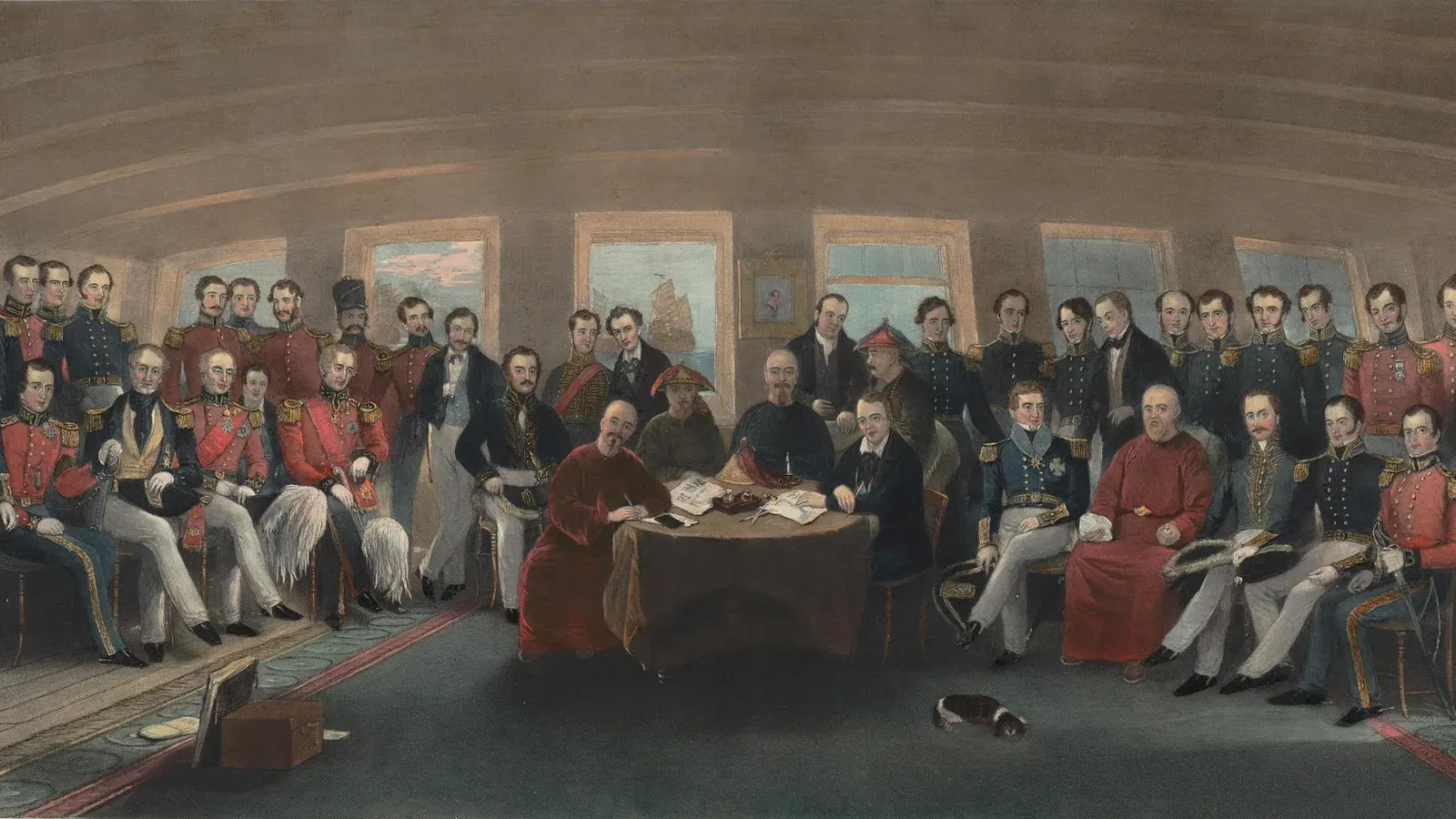
Pottinger and the Qing commissioners Keying and Elepoo signed aboard the Cornwallis at Nanjing. Article 2 opened Canton, Amoy, Fuzhou, Ningbo and Shanghai to British residents and consuls. Article 3 ceded Hong Kong “to be possessed in perpetuity.” Article 4 set six million dollars for the opium, described as a ransom for the imprisoned superintendent and merchants. Article 5 abolished the Cohong and added three million dollars for the hong merchants’ debts. Article 6 charged 12 million for the expedition, and Article 7 fixed the total at 21 million, payable by the end of 1845 with five percent interest on arrears. The MIT unit gives the total as 20 million with five for the opium; the treaty text gives 21 and six. The word opium appears once, in Article 4, as property to be paid for.
What the treaty started
The United States and France signed their own treaties with the Qing court in 1844, and the Columbia Asia for Educators reading records that those treaties carried extraterritoriality, the rule that foreigners in China answered only to their own consuls. Perdue names three provisions as the core of the system that grew from 1842: extraterritoriality, most-favored-nation clauses and a low fixed tariff. The opium trade went unresolved, and in 1856 Britain and France fought a second war with China. The Columbia reading calls the period that followed China’s “treaty century,” most of it voided in 1943; the MIT unit ends it with the return of Hong Kong in 1997.
In China the war is remembered as the opening of a long defeat. The historian Immanuel C. Y. Hsü, quoted in the MIT unit, wrote that the war and the treaty “introduced a century of humiliation for the Chinese people.” Britain struck a gold medal for “The Triumph of the British Arms.” Between the two stands the treaty itself: five ports, one island and 21 million dollars, and nothing about the drug.
Key facts
- The Cohong guild held the monopoly on Western trade at Canton; the treaty’s Article 5 abolished it.
- Opium imports from India rose from about 4,000 chests in 1790 to some 40,000 in 1839, at about 140 pounds a chest (Perdue, after Spence).
- Lin Zexu’s letter to Queen Victoria counted 20,283 chests surrendered; the MIT unit gives 21,306.
- The opium was dissolved in salt and lime over 23 days in June 1839 at Humen, by about 500 workers in three trenches.
- The Commons rejected Graham’s censure motion on April 9, 1840, by 271 votes to 262 (Hansard).
- The Nemesis, a 660-ton iron paddle steamer of six-foot draft, first fought at Chuanbi on January 7, 1841.
- The Treaty of Nanjing set 21 million dollars (six for the opium, three for hong debts, 12 for the expedition), opened five ports and ceded Hong Kong in perpetuity.
FAQ
Did Queen Victoria read Lin Zexu's letter?
No record shows that she did. The MIT unit states that a copy reached London in January 1840 with the captain of the Thomas Coutts and that the Foreign Office refused it; the Chinese Repository printed a translation in February 1840.
How much did China pay under the Treaty of Nanjing?
Article 7 of the treaty fixed 21 million dollars: six million for the opium, three million for hong merchants' debts and 12 million for the cost of the expedition, paid in installments through 1845.
Did the Treaty of Nanjing legalize opium?
No. The treaty named opium only as property to be paid for, in Article 4, and did not address the trade. The question stayed open until the second war, which began in 1856.
Sources
- Internet Modern History Sourcebook (Fordham University) — "Commissioner Lin: Letter to Queen Victoria, 1839," from the Chinese Repository, vol. 8 (February 1840), pp. 497–503.
- Wikisource — text of the Treaty of Peace, Friendship, and Commerce between Her Majesty the Queen of Great Britain and Ireland and the Emperor of China (Treaty of Nanking), signed August 29, 1842, with the royal ratification of December 28, 1842 (transcription of the treaty).
- UK Parliament, Historic Hansard — House of Commons, "War with China," April 7, 1840, Series 3, vol. 53, cc. 669–748 (Sir James Graham's motion).
- UK Parliament, Historic Hansard — House of Commons, "War with China: Adjourned Debate," April 8, 1840, Series 3, vol. 53, cc. 749–837 (Gladstone's speech).
- UK Parliament, Historic Hansard — House of Commons, "War with China: Adjourned Debate," April 9, 1840, Series 3, vol. 53, cc. 844–950 (Palmerston, Peel, and the division).
- MIT Visualizing Cultures — Peter C. Perdue and John W. Dower, "The First Opium War: The Opium Trade" (2011).
- MIT Visualizing Cultures — "The First Opium War: Lin's Pyrrhic Victory" (2011).
- MIT Visualizing Cultures — "The First Opium War: War Graphics" and the four phases of hostilities (2011).
- MIT Visualizing Cultures — "The First Opium War: The First Unequal Treaty" (2011).
- Columbia University, Asia for Educators — "The Opium War and Foreign Encroachment," reading for students, consultant Sue Gronewold.
- Columbia University, Asia for Educators — "Key Points in Developments in East Asia, 1750–1919."
Cite this article
- APA
- Our Earth's History. (2026, September 20). Why did Britain fight over opium, and what did the 1842 treaty start? Our Earth's History. https://ourearthshistory.com/east-asia/modern/first-opium-war-1839-treaty-of-nanjing/
- Chicago
- Our Earth's History. “Why did Britain fight over opium, and what did the 1842 treaty start?” Our Earth's History, September 20, 2026. https://ourearthshistory.com/east-asia/modern/first-opium-war-1839-treaty-of-nanjing/.
- MLA
- “Why did Britain fight over opium, and what did the 1842 treaty start?” Our Earth's History, 20 Sep. 2026, https://ourearthshistory.com/east-asia/modern/first-opium-war-1839-treaty-of-nanjing/.
Text licensed CC BY-NC-ND 4.0. Found an error? Tell us.