'Taxation without representation is tyranny': Eureka, 1854–55
.jpg)
TL;DR — Ballarat miners adopted a charter on November 11, 1854, against a 30-shilling license; troops stormed their stockade on December 3, and 13 treason trials in 1855 convicted no one.
“THAT TAXATION WITHOUT REPRESENTATION IS TYRANNY.” The line is the second principle of the Ballarat Reform League, in a clerk’s copy held by the Public Record Office Victoria, written throughout in capitals. Its heading records a meeting held on Bakery Hill “IN THE PRESENCE OF ABOUT TEN THOUSAND MEN ON SATURDAY NOVEMBER 11TH, 1854.” The tax in question was the miner’s license, which the National Museum of Australia gives as 30 shillings a month, imposed under Governor Charles Fitzroy of New South Wales and Lieutenant-Governor Charles La Trobe of Victoria. Before dawn on Sunday, December 3, 1854, soldiers and police stormed a timber stockade at the Eureka diggings outside Ballarat; the two museums that hold the story count the dead differently. Of 113 miners arrested, 13 were tried for treason in Melbourne, and no jury convicted any of them. In March 1855 a government commission recommended that the license go.
Quick facts
- When
- October 7, 1854 (James Scobie killed at the Eureka Hotel) · October 17 (the hotel burned) · November 11 (charter adopted on Bakery Hill) · November 27 (charter presented to Governor Hotham) · November 29 (Southern Cross flag first raised) · November 30 (the oath) · December 3 (the stockade stormed) · March 1855 (commission report; reward withdrawn) · November 1855 (Lalor elected unopposed) · 2013 (flag installed at the Eureka Centre)
- Where
- Ballarat, on the Victorian goldfields, in what is now the Australian state of Victoria; Bakery Hill; the Eureka diggings; Melbourne, where the trials were held
- Who
- Peter Lalor; Governor Charles Hotham; Robert Rede, resident gold commissioner at Ballarat; James Scobie; James Bentley; John D'Ewes; trooper John King; the miners of the Ballarat Reform League
- Outcome
- The stockade fell in 15 or 20 minutes, depending on the museum; 22 miners were registered dead; 113 were arrested and 13 tried for treason, none convicted; in March 1855 the license was replaced by a one-pound miner's right and Lalor entered the Legislative Council in November 1855
Thirty shillings a month
The National Museum of Australia gives the arithmetic behind the grievance: in 1852 about 35,000 miners on the Victorian fields took out about five ounces of gold per head; by 1854 the population had nearly tripled and the yield had fallen to 1.5 ounces per head. The museum calls the fee “a substantial sum for most miners.” From 1853 the diggers held what they called monster meetings against it, and said that the police who enforced it took bribes and jailed men without cause. The police in turn ran regular license hunts through the diggings for anyone without a paper.
James Scobie, the Eureka Hotel and a burned building, October 1854
Early on October 7, 1854, the museum records, a Scottish miner named James Scobie was killed in a fight at the Eureka Hotel in Ballarat, and the proprietor, James Bentley, was accused of killing him. A court of inquiry cleared Bentley quickly; one of its members, the magistrate John D’Ewes, was known to have taken money from Bentley, and the diggers read the result as a bought verdict. On October 17 about 5,000 people met to protest it. After the crowd broke up, a smaller group set fire to the hotel, and the arrest of those men gave the miners three prisoners to demand back.
"We swear by the Southern Cross": the charter and the oath, November 1854
The charter adopted on November 11 listed five “Political changes contemplated by the Reform League”: “A FULL AND FAIR REPRESENTATION,” “MANHOOD SUFFRAGE,” “NO PROPERTY QUALIFICATION OF MEMBERS FOR THE LEGISLATIVE COUNCIL,” “PAYMENT OF MEMBERS” and “SHORT DURATION OF PARLIAMENT.” Its immediate objects were local: “AN IMMEDIATE CHANGE IN THE MANAGEMENT OF THE GOLD FIELDS, BY DISBANDING THE COMMISSIONERS” and “THE TOTAL ABOLITION OF THE DIGGERS’ AND STOREKEEPERS LICENCE TAX.” Delegates carried it to Governor Charles Hotham on November 27, the Victorian Heritage Database records, and demanded the release of the three men held for the hotel fire. Hotham refused, and the museum records that he sent 150 soldiers of the 40th Regiment to Ballarat.
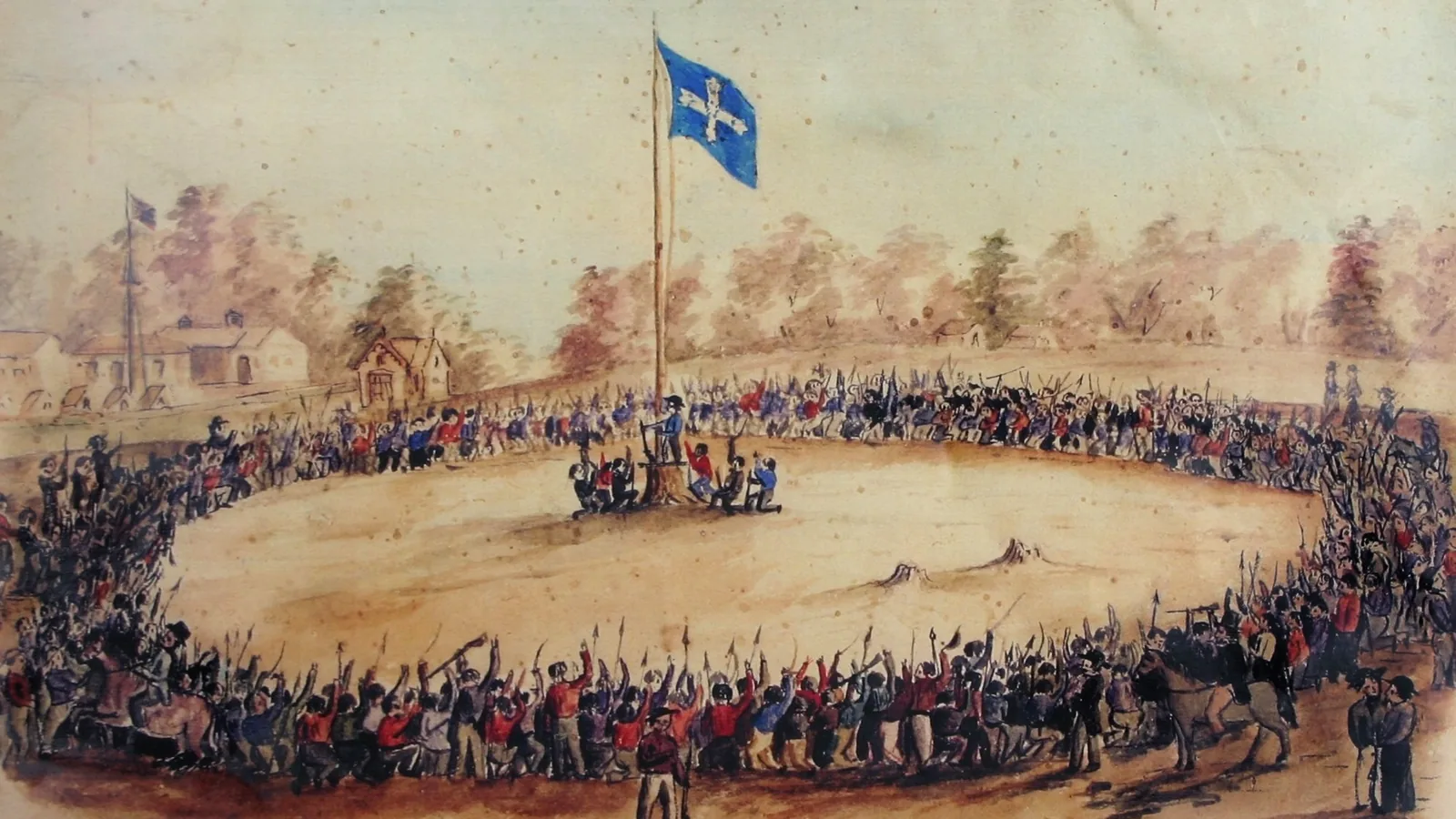
On November 29 the miners raised the Southern Cross flag for the first time on Bakery Hill. The next morning the police began another license hunt, and the diggers gathered again. Peter Lalor, a miner on the Eureka lead, came forward as leader and brought them to the Eureka diggings, where men and women swore an oath that the Eureka Centre Ballarat prints in his name and dates to November 30, 1854: “We swear by the Southern Cross to stand truly by each other, and fight to defend our rights and liberties.” They dragged timber from nearby shafts, built a stockade, and drilled inside and around it for two days.

December 3, 1854: two counts of the dead
Robert Rede, the resident gold commissioner at Ballarat, ordered the stockade destroyed on the Sunday morning. The National Museum of Australia writes that “almost 300 mounted and foot troopers, and police attacked the stockade,” that “the assault was over in 15 minutes,” and that “at least 22 miners,” among them “one woman,” and “five soldiers” died, with a note that “five or six soldiers” may have died. The Eureka Centre Ballarat gives “276 British soldiers and police,” “only 120 people” inside the stockade, a fight “over within 20 minutes,” “six soldiers” killed and “22 rebels” registered as casualties, and adds that estimates of the total dead run “as high as 60.”
Lalor was hit in the left arm and hid under a log to escape the bayonets, the Australian Dictionary of Biography records, and was carried to the house of Father Smyth, where doctors took the arm off at the shoulder. The dictionary passes on the story that he woke during the operation and told the surgeon “Courage! Courage! Take it off!” as legend. Hotham then posted a reward of 200 pounds for a man the notice spelled “Lawlor,” who had used “TREASONABLE AND SEDITIOUS LANGUAGE” and incited men “to make war against Our Sovereign Lady the QUEEN.” Nobody informed. The reward was withdrawn in March 1855.
Trials, a commission and a flag, 1855 to 2013
Police detained 113 miners, and 13 were taken to Melbourne. The Public Record Office Victoria describes the result as “show trials that failed to convict any of those charged”; the Victorian Heritage Database says the 13 “were all found not guilty” and calls them “the only treason trials to have taken place in Australia.” The commission that examined the goldfields is dated two ways: the heritage database says Hotham established it on November 16, 1854, and the museum says he called for it on December 7. Its report came in March 1855. The license was abolished and replaced by an export duty and a one-pound miner’s right, half the goldfields police were dismissed, and 12 members were added to the Legislative Council, eight of them elected by holders of a miner’s right. Lalor was one of them, returned unopposed for Ballarat in November 1855. He was Speaker of the Legislative Assembly from 1880, resigned in September 1887 and died on February 9, 1889.
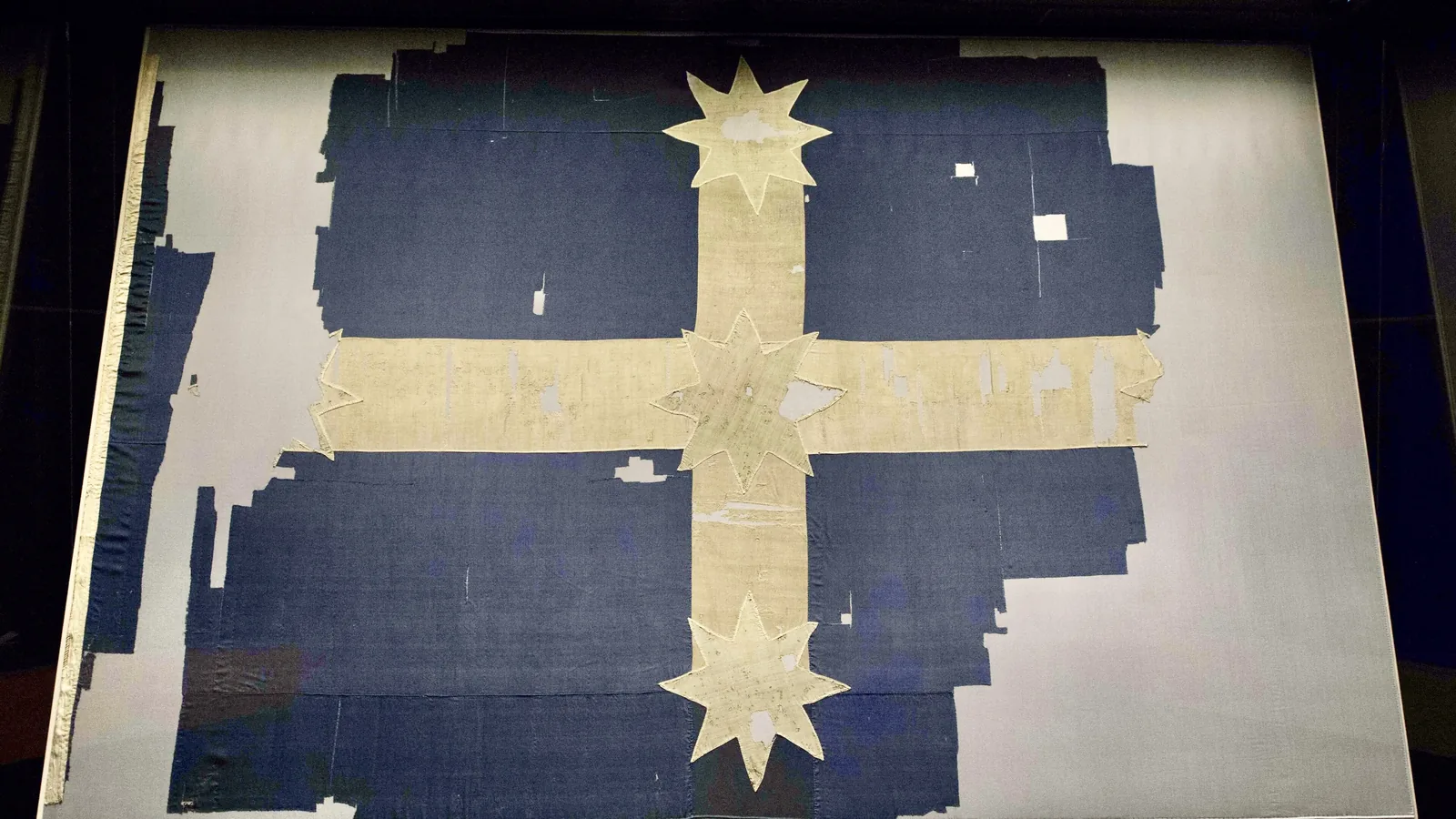
By the Eureka Centre’s account, a police trooper, John King, took the flag from the stockade as a souvenir. The Eureka Centre gives its size as 2.6 meters high by 4 meters wide, in cotton and wool. King’s family lent it to the Art Gallery of Ballarat in the 1890s and his descendants gave it to the gallery in 2001. Restored in 1973 and again in 2011, it was moved in 2013 to the Eureka Centre, on loan from the gallery, and set in a case built for it.
Key facts
- The miner’s license cost 30 shillings a month; the National Museum of Australia gives 35,000 miners and about five ounces per head in 1852, and 1.5 ounces per head by 1854.
- James Scobie was killed at the Eureka Hotel on October 7, 1854; James Bentley was cleared by an inquiry that included the magistrate John D’Ewes, and the hotel was burned on October 17.
- The Ballarat Reform League charter was adopted on Bakery Hill on November 11, 1854, “IN THE PRESENCE OF ABOUT TEN THOUSAND MEN,” and presented to Governor Hotham on November 27 (Public Record Office Victoria copy; Victorian Heritage Database).
- The charter’s five political changes were full and fair representation, manhood suffrage, no property qualification for the Legislative Council, payment of members and short parliaments.
- The Southern Cross flag was first raised on November 29, 1854; the oath “We swear by the Southern Cross” was sworn on November 30 (Eureka Centre Ballarat).
- On December 3, 1854, the museum counts almost 300 attackers, 15 minutes, at least 22 miners and five or six soldiers dead; the Eureka Centre counts 276 attackers, 20 minutes, six soldiers and 22 registered rebel dead, with estimates up to 60.
- Of 113 miners arrested, 13 were tried for treason in Melbourne and none was convicted (Public Record Office Victoria; Victorian Heritage Database).
- The commission’s report of March 1855 replaced the license with a one-pound miner’s right and an export duty; Lalor was elected unopposed in November 1855 (National Museum of Australia; Australian Dictionary of Biography).
FAQ
How many people died at the Eureka Stockade?
The two museums differ. The National Museum of Australia gives at least 22 miners, including one woman, and five or six soldiers. The Eureka Centre Ballarat gives 22 rebels registered as casualties and six soldiers, and says estimates of the total run as high as 60.
What happened at the Eureka treason trials?
Thirteen of the 113 miners arrested were taken to Melbourne and tried for treason in 1855. The Public Record Office Victoria describes the trials as having "failed to convict any of those charged," and the Victorian Heritage Database says all 13 were found not guilty.
Where is the Eureka flag now?
At the Eureka Centre Ballarat, on loan from the Art Gallery of Ballarat, where it has been since 2013. The flag measures 2.6 meters by 4 meters, in cotton and wool, and came to the gallery from the family of trooper John King.
Sources
- National Museum of Australia, Defining Moments: Eureka Stockade (the 30-shilling license, production figures for 1852 and 1854, the Scobie killing, the burning of the Eureka Hotel, the 150 soldiers of the 40th Regiment, the attack of December 3, 1854, the arrests and the commission of March 1855).
- Public Record Office Victoria, VPRS 4066/P0, Unit 1, A1: clerk's copy of the Ballarat Reform League Charter, four pages, as hosted in PDF by Eureka Australia (eurekaaustralia.org.au).
- Heritage Council of Victoria, Victorian Heritage Database, H2081: Ballarat Reform League Charter (statement of significance; the meeting of November 11, 1854, the presentation to Hotham on November 27, the flag on November 29, the commission of November 16 and its report, and the treason trials).
- Public Record Office Victoria, Eureka on trial (online exhibition introduction).
- Eureka Centre Ballarat, About Eureka (the oath of November 30, 1854, the attack of December 3 with the centre's figures, and the flag's measurements, material and custody).
- Eureka Centre Ballarat, home page (the flag on loan from the Art Gallery of Ballarat).
- Ian Turner, "Lalor, Peter (1827–1889)," Australian Dictionary of Biography, vol. 5 (1974), National Centre of Biography, Australian National University (the wound and amputation, the reward notice, the election of 1855, the Speakership of 1880, the resignation of 1887 and the death of February 9, 1889).
- Ballarat Reform League Inc, BRL Charter (summary of the five political changes and the meeting of November 11, 1854).
Cite this article
- APA
- Our Earth's History. (2026, September 22). 'Taxation without representation is tyranny': Eureka, 1854–55. Our Earth's History. https://ourearthshistory.com/oceania/modern/eureka-stockade-december-3-1854-charter-trials/
- Chicago
- Our Earth's History. “'Taxation without representation is tyranny': Eureka, 1854–55.” Our Earth's History, September 22, 2026. https://ourearthshistory.com/oceania/modern/eureka-stockade-december-3-1854-charter-trials/.
- MLA
- “'Taxation without representation is tyranny': Eureka, 1854–55.” Our Earth's History, 22 Sep. 2026, https://ourearthshistory.com/oceania/modern/eureka-stockade-december-3-1854-charter-trials/.
Text licensed CC BY-NC-ND 4.0. Found an error? Tell us.