Did the moai of Rapa Nui walk? What the 2012 experiment showed
.jpg)
TL;DR — In 2012 Terry Hunt and Carl Lipo showed that 18 people with three ropes could rock a 5-ton replica moai upright for a few hundred yards. The fallen road statues fit that method.
The statues could be walked: in 2012 Terry Hunt and Carl Lipo moved a 5-ton replica moai upright a few hundred yards with 18 people and three ropes. Thor Heyerdahl had tested the rival method in 1955, when 180 islanders dragged a statue on a sledge. The statues that fell beside the island’s roads lean forward on D-shaped bases, which is what rocking requires, and Rapanui tradition said that the moai walked. The claim that the islanders felled their forest and destroyed their own society is contested; what happened after 1862, when Peruvian slave raiders and smallpox cut the population to about 110, is not.
Quick facts
- When
- Settled about AD 1200 (radiocarbon, 2011 study) · statues carved about 1300 to 1600 · Heyerdahl trials 1955–56 · walking experiment 2011, published 2012 · Peruvian slave raids 1862–63 · population 110 or 111 in 1877
- Where
- Rapa Nui (Easter Island), 3,700 kilometers west of mainland Chile; Rano Raraku quarry, Anakena, the ahu along the coast; Hoa Hakananai'a in London
- Who
- Terry Hunt and Carl Lipo; Sergio Rapu Haoa; Thor Heyerdahl and Pavel Pavel; Jo Anne Van Tilburg; Jared Diamond; the Rapanui community and its 2018 delegation
- Outcome
- An upright rocking method moved a 5-ton replica with 18 people; fallen road statues and paths fit it; two 2024 studies found no pre-contact population collapse; the 1860s raids and smallpox cut the population to about 110
Where the statues stand and how they were made
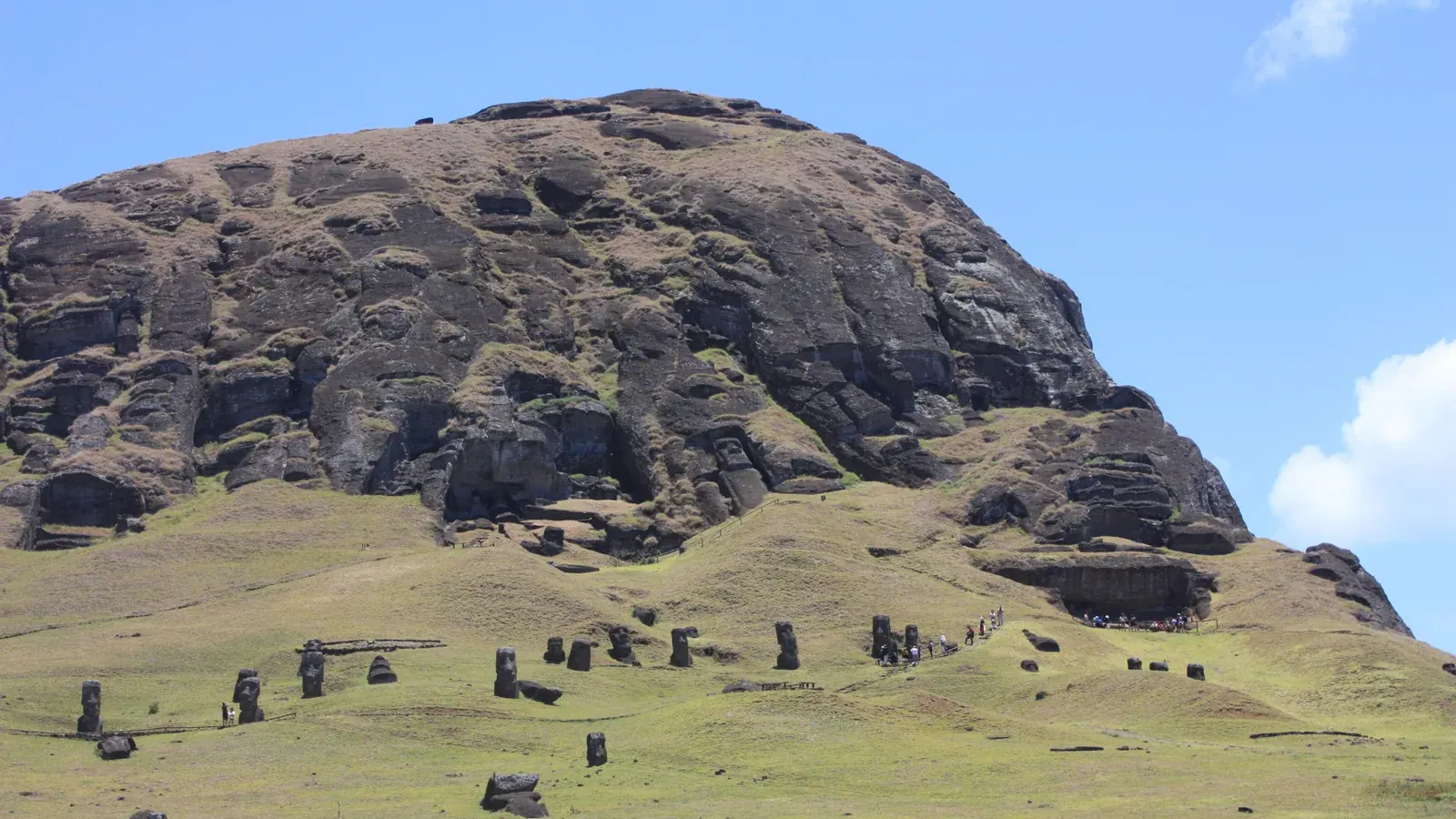
Rapa Nui, the island Europeans named Easter Island, lies 3,700 kilometers west of mainland Chile. A 2011 radiocarbon study by Janet Wilmshurst, Hunt, Lipo and Atholl Anderson put its settlement at about AD 1200 to 1253, part of the pulse that reached the last islands of East Polynesia between about AD 1190 and 1290. UNESCO’s World Heritage listing, an older summary, opens with settlement “c. A.D. 300.”
Counts vary with the method: Jo Anne Van Tilburg’s 1989 survey located 887 statues, UNESCO says about 900, and National Geographic reported 1,043 complete moai at its latest count. Almost all were cut from the tuff of Rano Raraku, an extinct crater on the south shore, with basalt picks called toki. National Geographic gives the average statue as 13 feet and 10 metric tons; Van Tilburg’s statistically average moai weighed 12.5 metric tons. El Gigante, 69 feet long and about 200 metric tons, never left the quarry.
Finished statues stood on stone platforms called ahu with their backs to the sea, some topped by a pukao, a cylinder of red scoria that stood for a topknot. In 1978, during a restoration of Ahu Nau Nau at Anakena directed by the Rapanui archaeologist Sergio Rapu Haoa, Sonia Haoa found an oval of white coral with a socket for a red scoria iris. It fit a statue’s eye, and six more came from the same dig, according to the island magazine Moe Varua. The eyes were removable, so no eighteenth-century visitor saw them.
Two ways to move a 10-ton statue
Heyerdahl’s expedition of 1955 and 1956 tried the obvious method at Anakena: a 13-foot, 10-ton original tied on its back to a sledge made from a tree fork, hauled by 180 islanders on two ropes. Jared Diamond’s books made sledges and log rails the popular picture, with an implication: moving hundreds of statues that way would have eaten the island’s trees.
The Czech engineer Pavel Pavel took the tradition literally. In 1986 he and Heyerdahl rocked two original statues forward at Anakena by tilting and swiveling them on alternate edges, until one base was damaged and the test stopped. In 2011 Hunt, of the University of Hawaii, and Lipo, then of California State University Long Beach, built a 10-foot, 5-ton replica moai and walked it at Kualoa Ranch on Oahu with National Geographic funding. Eighteen people with three ropes moved it a few hundred yards; no logs were used. National Geographic ran the result as its July 2012 cover story.
What the fallen statues along the roads show
Van Tilburg’s survey recorded 92 statues “in transport,” 47 of them on prepared roads outside the quarry zone, against 288 that reached a platform. The road statues have bellies that tilt the figure forward and D-shaped bases that let handlers roll them from side to side. Hunt and Lipo wrote that the roads leaving Rano Raraku were not a planned network but the remnants of paths along which statues were walked.
The tradition they tested was old. Katherine Routledge, who lived on the island for a year from 1914, recorded a story of a cook to the image-makers who “moved the images by supernatural powers (mana), ordering them about at her will.” Other accounts credited a king or the god Make Make. The stories agree on the verb.
The forest, Jared Diamond and the 2024 studies
By the time the Dutch captain Jacob Roggeveen arrived on Easter Sunday 1722, the palm forest was gone. In Collapse (2005) Diamond presented Rapa Nui as a case of ecocide: islanders felled trees for farming, fuel and statue transport, and society fell into war and famine before Europeans came. Hunt and Lipo answered in The Statues That Walked that the islanders had adapted, building rock gardens in which broken stone fertilizes poor soil, and that no collapse preceded 1722. Live Science and the 2024 genome study both name the Polynesian rat, which ate palm seeds, as a large part of the reason the trees went.
Two studies in 2024 tested the argument. Dylan Davis, Robert DiNapoli, Gonzalo Pakarati, Hunt and Lipo mapped rock gardens from satellite imagery and found 0.76 square kilometers, against an earlier estimate of 4.9 to 21.1 by T. N. Ladefoged’s team, enough for about 3,000 people, the number eighteenth-century visitors estimated. Other scientists called the method too simple to fix a population, Live Science reported. J. Víctor Moreno-Mayar’s team sequenced 15 Rapanui genomes from remains collected in 1877 and 1935 and found no trace of the bottleneck a 1600s collapse would have left. The genome study states that its data say nothing about ecological damage; the garden study measured farmland, not forest.
What happened in the 1860s
The population fall has a documented cause. In 1862 and 1863 Peruvian slave raiders kidnapped about a third of the Rapanui population. Few came back, and those who did brought smallpox. By 1877 the population had fallen to about 110, a figure the genome study and Smithsonian give and National Geographic puts at 111. The community recovered through the twentieth century: National Geographic counted about 2,000 people of Rapanui descent on the island in 2012, and the 2024 genome study went ahead with the approval of its development commission, CODEIPA.
The statue in London
Hoa Hakananai’a, a basalt moai of about 4 tons dated to roughly AD 1200, stood on a clifftop until 1868, when Richard Powell, captain of the British frigate HMS Topaze, took it to England; Queen Victoria gave it to the British Museum in 1869. In November 2018 a Rapanui delegation, backed by Chile’s government, met museum officials in London to ask for its return; the museum agreed to talks and spoke of a possible loan. The island’s governor, Tarita Alarcón Rapu, put the case in one sentence: “You, the British people, have our soul.” The request was made in 2018; this article makes no claim about what followed.
The 2012 experiment did not prove how every statue traveled. It showed that a small team could walk a moai upright, that the road statues were built for it, and that the tradition described a technique. The forest debate stays open; the 1860s do not.
Key facts
- Radiocarbon dates published in 2011 put the settlement of Rapa Nui at about AD 1200 to 1253; UNESCO’s listing still says about AD 300.
- Counts run from 887 (Van Tilburg, 1989) to 1,043 complete statues (National Geographic); average about 13 feet and 10 to 12.5 metric tons, depending on the survey.
- Coral eyes with red scoria irises were found in 1978 at Ahu Nau Nau, Anakena, during a restoration directed by Sergio Rapu Haoa.
- Heyerdahl’s 1955–56 trial dragged a 10-ton statue on a sledge with 180 people; in 2011 Hunt and Lipo walked a 5-ton replica upright with 18 people and three ropes, published in 2012.
- Van Tilburg’s survey recorded 47 statues lying on roads; road statues lean forward and have D-shaped bases.
- The 2024 Science Advances study measured 0.76 square kilometers of rock gardens and a carrying capacity of about 3,000; the 2024 Nature genome study found no 1600s bottleneck.
- Peruvian slave raids in 1862–63 took about a third of the population; smallpox followed; 110 or 111 people remained in 1877.
FAQ
How were the Easter Island moai moved?
Two methods have been tested. Heyerdahl in 1955–56 dragged a 10-ton statue lying on a sledge with 180 people. Pavel Pavel in 1986 and Hunt and Lipo in 2011 walked statues upright by rocking; the 2011 test moved a 5-ton replica a few hundred yards with 18 people and three ropes.
Did the people of Rapa Nui destroy their island?
Diamond's Collapse (2005) said so. Hunt and Lipo argued that the islanders adapted with rock gardens, and Live Science and the 2024 genome study point to the Polynesian rat for the loss of the palms. Two 2024 studies, one on garden area and one on ancient genomes, found no pre-contact population collapse, while other scientists called the satellite method too simple. The documented fall came with the 1862–63 slave raids and smallpox.
Why is a moai in the British Museum?
Hoa Hakananai'a was taken from the island in 1868 by Richard Powell of HMS Topaze and given to the museum by Queen Victoria in 1869. A Rapanui delegation asked for its return in November 2018; the museum spoke of a possible loan.
Sources
- National Geographic — "Easter Island Mystery Solved? New Theory Says Giant Statues Rocked" (June 24, 2012).
- National Geographic — Allie Yang, "Everything to know about Easter Island's iconic statues" (October 19, 2022).
- Smithsonian Magazine — Sarah Laskow, "How Easter Island Statues 'Walked' To Their Stations" (June 21, 2012).
- University of Hawaii System News — "Easter Island research garnering national attention" (June 26, 2012).
- NOVA Online (PBS), "Secrets of Easter Island" — "Past Attempts: Moai Transport Theories & Attempts" (1998).
- NOVA Online (PBS), "Secrets of Easter Island" — "Stone Giants," Jo Anne Van Tilburg's 1989 survey figures (1998).
- UNESCO World Heritage Centre — "Rapa Nui National Park."
- PNAS 108(5) via PubMed Central — Wilmshurst, Hunt, Lipo and Anderson, "High-precision radiocarbon dating shows recent and rapid initial human colonization of East Polynesia" (2011).
- Smithsonian Magazine — Paul Trachtman, "The Secrets of Easter Island" (March 2002).
- Moe Varua Rapa Nui — "The Eyes of the Moai: From Mystery to Archaeological Discovery."
- Live Science — Owen Jarus, "Easter Island (Rapa Nui) and its famous Moai statues" (October 16, 2012, updated June 21, 2024).
- Science Advances 10(25) via PubMed Central — Davis, DiNapoli, Pakarati, Hunt and Lipo, "Island-wide characterization of agricultural production challenges the demographic collapse hypothesis for Rapa Nui (Easter Island)" (June 21, 2024).
- Nature via PubMed Central — Moreno-Mayar, Sousa da Mota et al., "Ancient Rapanui genomes reveal resilience and pre-European contact with the Americas" (2024).
- Smithsonian Magazine — Katherine J. Wu, "New Research Rewrites the Demise of Easter Island" (February 11, 2020).
- History.com — Ratha Tep, "What Happened to the People of Easter Island?"
- Smithsonian Magazine — Meilan Solly, "Rapa Nui Representatives Visit British Museum to Discuss Repatriation of Moai Statue" (November 21, 2018).
Cite this article
- APA
- Our Earth's History. (2026, September 20). Did the moai of Rapa Nui walk? What the 2012 experiment showed. Our Earth's History. https://ourearthshistory.com/oceania/medieval/moai-rapa-nui-did-the-statues-walk/
- Chicago
- Our Earth's History. “Did the moai of Rapa Nui walk? What the 2012 experiment showed.” Our Earth's History, September 20, 2026. https://ourearthshistory.com/oceania/medieval/moai-rapa-nui-did-the-statues-walk/.
- MLA
- “Did the moai of Rapa Nui walk? What the 2012 experiment showed.” Our Earth's History, 20 Sep. 2026, https://ourearthshistory.com/oceania/medieval/moai-rapa-nui-did-the-statues-walk/.
Text licensed CC BY-NC-ND 4.0. Found an error? Tell us.