A forty-meter arc under a Samarkand hill: Ulugh Beg's observatory

TL;DR — Ulugh Beg’s Samarkand observatory held a meridian arc of about 40 m radius. Its star tables were done by 1440; on October 25, 1449, his son had him put to death.
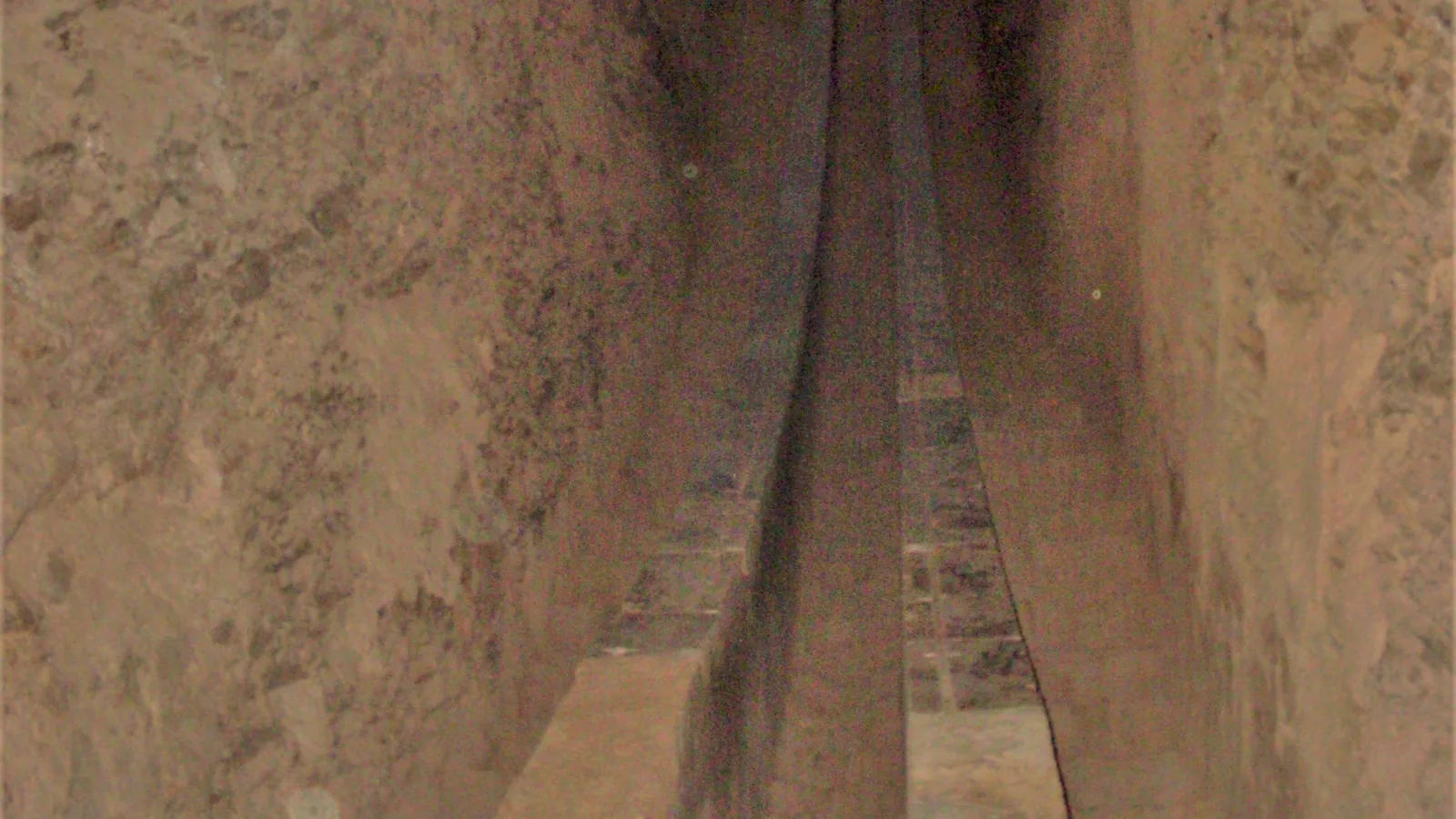
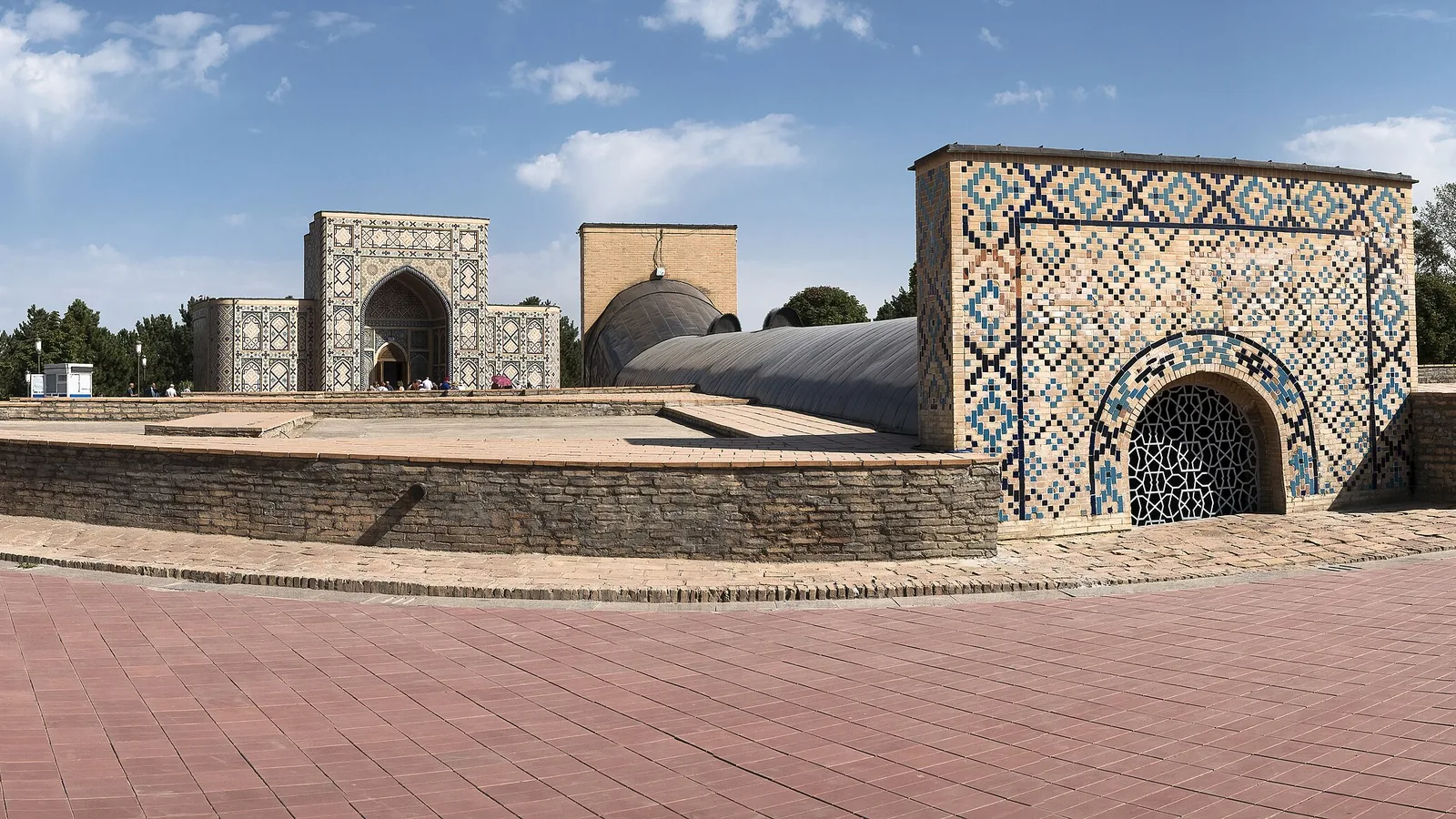
The Samarkand State Museum-Reserve describes Ulugh Beg’s observatory as a cylindrical building of three stories, 30.4 m high, with a giant quadrant of 40.2 m radius. Another paragraph on the same page gives the arc a radius of 41 m, so the safest figure is about 40 m. The founding date is no firmer. Encyclopaedia Iranica prints two: George Saliba, citing Aydın Sayılı, writes that the observatory “was founded in the year 823/1420, but construction probably did not begin until around the year 825/1422,” while Frantz Grenet’s Samarqand entry dates it to 1421. The museum’s page dates the building to 1424–28 in one place and 1428–29 in another. Ulugh Beg, the grandson of Timur and ruler of Transoxiana, kept a team of astronomers on that hill until his son Abd al-Latif Mirza had him sentenced to death in 1449.
Quick facts
- When
- 1420 to 1429 (founding and building, dated differently by Iranica and the Samarkand museum) · 1424–25 (al-Kashi's letters to his father) · 1437 or about 1440 (the Zij) · spring 1449 (Abd al-Latif's revolt) · October 25, 1449 (Ulugh Beg sentenced to death) · May 8, 1450 (Abd al-Latif murdered) · 1908 (V. L. Vyatkin digs on the hill)
- Where
- Kuhak (Chupan-Ata) hill on the Ob-i Rahmat canal, northeast of Afrasiab, Samarkand, in what is now Uzbekistan; Tabriz; Istanbul
- Who
- Ulugh Beg, grandson of Timur and ruler of Transoxiana; Ghiyath al-Din Jamshid al-Kashi; Qadi Zada al-Rumi; Ali Qushji; Abd al-Latif Mirza; John Greaves; John Flamsteed; V. L. Vyatkin
- Outcome
- The observatory produced the Zij-i Sultani, a star catalogue with 1,018 stars by one count. After Ulugh Beg's death in 1449 his successor stopped supporting the scientists, Ali Qushji left for Tabriz and Istanbul, and the building was lost until Vyatkin dug on the hill in 1908
Tali Rasad, the observatory hill on the Ob-i Rahmat canal
The building stood on Kuhak hill, also called Chupan-Ata, beside the Ob-i Rahmat canal northeast of Afrasiab, the old city of Samarkand. A waqf deed, an endowment document, called the spot “Tali rasad,” the observatory hill. The main instrument was the arc set along the meridian, called the Fakhri sextant. Nargis Nurulla-Khoja, in a 2025 paper in F1000Research citing M. S. Bulatov’s 1986 study, writes that it “paid homage to the pioneering work of al Khujandi (who lived in the late 10th century) and his benefactor Fakhr al-Dawla (which is why the sextant was named after Fakhri).” Bulatov’s radius, as she gives it, is 40 m. The museum lists an armillary sphere, the Zat al-Khalaq, and a triquetrum, the Zat ash-Shu’batayn, among the other instruments. The observing rota, in Nurulla-Khoja’s summary of Bulatov, required “the surveillance of the Sun and Moon without fail each day, Mercury every five days, and comprehensive scrutiny of the remaining planets on a ten-day cycle.”
Sixty scientists and "a beginner in theoretical astronomy"
Two letters from Ghiyath al-Din Jamshid al-Kashi to his father, which Iranica dates to 828, that is 1424–25, describe the place while the arc was still being built. Al-Kashi, from Kashan in what is now Iran, wrote that Ulugh Beg’s madrasa was finished before the observatory, and that “some sixty distinguished scientists, particularly astronomers,” were already gathered there. He praised his colleague Qadi Zada al-Rumi as “the most learned among them” and then, in the same letter, called him “only a beginner in theoretical astronomy.”
Al-Kashi died first, in 1429 by notes on two manuscripts that E. S. Kennedy found, or in 1436 by Heinrich Suter’s dating; Saliba prefers 1429, since two directors followed him before the tables were done. Qadi Zada died in 1436. The work passed to Ali Qushji, son of Ulugh Beg’s falconer and a pupil of Qadi Zada. Iranica’s entry on Qushji records that he “succeeded his teacher and father-in-law Qāżī-zāda as its director” and produced the tables “most probably with Uluḡ Beg’s cooperation.”
Zij-i Sultani: 1,018 stars, 108 manuscripts and an Oxford printing
The result was the Zij-i Sultani, also called the Zij-i Gurkani, astronomical tables with a star catalogue. Saliba dates its completion to “around the year 843/1440,” and David Pingree’s history of astronomy in Iran gives “about 1440.” Nurulla-Khoja, citing T. N. Niyazov’s 1967 study, writes that the catalogue was “completed in 1437” and lists “the coordinates of 1,018 stars.” B. Pasilov’s 2011 count, as she cites it, puts 108 handwritten copies in existence. Nizam al-Din al-Birjandi wrote the fullest commentary on it in 1523, according to the museum, and a Cairo astronomer of the sixteenth century, Muhammad al-Misri, adapted its tables to the latitude of Cairo.
In Europe the tables reached print through John Greaves, professor of astronomy at Oxford, who published part of them in 1648; Nurulla-Khoja gives the title as Binae Tabulae Geographicae. John Flamsteed, the first director of the Greenwich observatory, printed Ulugh Beg’s catalogue in his own star history in 1725, by the museum’s account.
October 25, 1449: a death sentence and an empty hill
Abd al-Latif Mirza rose against his father early in 853, the spring of 1449, after a dispute over customs duties, according to Claus-Peter Haase’s Iranica entry. The two armies met on the Oxus, deserters left Ulugh Beg’s side, and after a final battle near Samarkand he “was refused shelter in the citadel of Samarqand or in Šāhroḵīya and had to submit to ʿAbd-al-Laṭīf.” Haase records the sentence with its date: Abd al-Latif “had his father sentenced to death (8 Ramażān 853/25 October 1449) and killed his own brother,” Abd al-Aziz. Most sources condemn both acts, Haase writes, with the single exception of Hasan Rumlu. Abd al-Latif ruled six months before notables and clan chiefs murdered him on May 8, 1450.
The observatory did not outlive its founder. Pingree and Fazlur Rahman write that after the assassination “his successor was unwilling to support scholars and scientists at Samarqand,” and Qushji left. At Tabriz the Aq Qoyunlu ruler Uzun Hasan sent him as an envoy to Istanbul, where Mehmed II asked him to stay. He became professor of natural sciences at the Aya Sofya madrasa at 200 akce a day, with posts for nearly 200 companions. He died there in 1474.
.jpg)
"Tali rasad": a line in a waqf deed, 1908
Pingree writes that in the early eighteenth century Jayasimha, the Maharaja of Amber, “built observatories at Benares, Mathura, Delhi, Ujjayini, and Jaipur in imitation of that at Samarkand.” Giovanni Riccioli, the museum’s page records, proposed in 1651 that lunar craters carry the names of past scholars, and one on the shore of the Oceanus Procellarum was given Ulugh Beg’s.
The museum’s page says that the Russian scholar V. L. Vyatkin found, in one of the waqf deeds, a record that a place called Naqshi Jahon on the Ob-i Rahmat canal held the “Tali rasad,” and then: “1908 yilda u huddi shu erda qazish ishlarini olib boradi,” in 1908 he dug at that very spot. Grenet’s entry gives the same year. A museum opened beside the trench in 1964, was refitted in 1994 for the 600th anniversary of Ulugh Beg’s birth, and got a new building in 2010. The arc that al-Kashi watched being built in 1424–25 came out of the hill in 1908.
Key facts
- The Samarkand State Museum-Reserve describes the observatory as cylindrical, three stories and 30.4 m high, with a quadrant of 40.2 m radius; another paragraph on its page gives 41 m, and Bulatov (1986, as cited in F1000Research) gives 40 m.
- Founding dates differ: 823/1420 with building from about 825/1422 (Sayılı, cited by Saliba in Iranica), 1421 (Grenet in Iranica), 1424–28 and 1428–29 (the museum), 1428–29 (Nurulla-Khoja, 2025).
- The main instrument, the Fakhri sextant, was named for al-Khujandi’s patron Fakhr al-Dawla (Nurulla-Khoja, citing Bulatov).
- Al-Kashi’s letters to his father, dated by Iranica to 828/1424–25, count “some sixty distinguished scientists” already at Samarkand and call Qadi Zada “only a beginner in theoretical astronomy.”
- Al-Kashi died in 832/1429 (Kennedy) or 839/1436 (Suter); Qadi Zada died in 839/1436; Ali Qushji, son of Ulugh Beg’s falconer, finished the tables.
- The Zij-i Sultani was completed “around the year 843/1440” (Saliba) or “in 1437” with 1,018 stars (Nurulla-Khoja); 108 manuscripts survive by Pasilov’s 2011 count.
- Abd al-Latif Mirza had his father sentenced to death on 8 Ramadan 853, October 25, 1449, and was himself murdered on 26 Rabi I 854, May 8, 1450 (Haase in Iranica).
- V. L. Vyatkin located the site from a waqf deed naming “Tali rasad” and dug there in 1908 (Samarkand museum; Grenet in Iranica).
FAQ
How big was the sextant at Ulugh Beg's observatory?
About 40 m in radius. The Samarkand State Museum-Reserve gives 40.2 m in one paragraph and 41 m in another, running from 11 m below ground to 29 m above it, and Bulatov's 1986 study, as cited by Nurulla-Khoja, gives 40 m.
When was the Zij-i Sultani completed?
Encyclopaedia Iranica dates it to about 843/1440, nine years before Ulugh Beg's death. Nurulla-Khoja's 2025 paper gives 1437 for the star catalogue of 1,018 stars. The two dates have not been reconciled in the sources cited below.
Who killed Ulugh Beg?
His son Abd al-Latif Mirza, who rebelled in the spring of 1449, defeated him near Samarkand and had him sentenced to death on October 25, 1449. Abd al-Latif also killed his brother Abd al-Aziz and was himself murdered on May 8, 1450.
Sources
- Encyclopaedia Iranica, George Saliba, "KĀŠI, ḠIĀṮ-AL-DIN," vol. XVI, fasc. 1, pp. 64–67 (published May 1, 2012; updated March 27, 2013).
- Encyclopaedia Iranica, David Pingree and Fazlur Rahman, "ʿALĪ QŪŠJĪ," vol. I, fasc. 8, pp. 876–877 (published December 15, 1985; updated October 16, 2017).
- Encyclopaedia Iranica, Claus-Peter Haase, "ʿABD-AL-LAṬĪF MĪRZĀ," vol. I, fasc. 2, pp. 126–127 (published December 15, 1982; updated May 4, 2018).
- Encyclopaedia Iranica, Frantz Grenet, "SAMARQAND i. History and Archaeology" (published July 20, 2002; updated April 22, 2013).
- Encyclopaedia Iranica, David Pingree, "ASTROLOGY AND ASTRONOMY IN IRAN i. History of Astronomy in Iran," vol. II, fasc. 8, pp. 858–871 (published December 15, 1987; updated October 5, 2016).
- Samarkand State Museum-Reserve, "Memorial Museum and Observatory of Mirzo Ulugbek" (official museum page, text in Uzbek).
- Nargis Nurulla-Khoja, "Reconstructing the intellectual neighbourhood: tracing Ali Qushji's influence in science," F1000Research 14:288 (2025), full text via Europe PMC (PMC11992511).
Cite this article
- APA
- Our Earth's History. (2026, September 22). A forty-meter arc under a Samarkand hill: Ulugh Beg's observatory. Our Earth's History. https://ourearthshistory.com/central-asia/medieval/ulugh-beg-observatory-samarkand-forty-metre-arc-zij-1437-1449/
- Chicago
- Our Earth's History. “A forty-meter arc under a Samarkand hill: Ulugh Beg's observatory.” Our Earth's History, September 22, 2026. https://ourearthshistory.com/central-asia/medieval/ulugh-beg-observatory-samarkand-forty-metre-arc-zij-1437-1449/.
- MLA
- “A forty-meter arc under a Samarkand hill: Ulugh Beg's observatory.” Our Earth's History, 22 Sep. 2026, https://ourearthshistory.com/central-asia/medieval/ulugh-beg-observatory-samarkand-forty-metre-arc-zij-1437-1449/.
Text licensed CC BY-NC-ND 4.0. Found an error? Tell us.