Four scripts on one stone: the Torghuts' march to the Ili, 1771
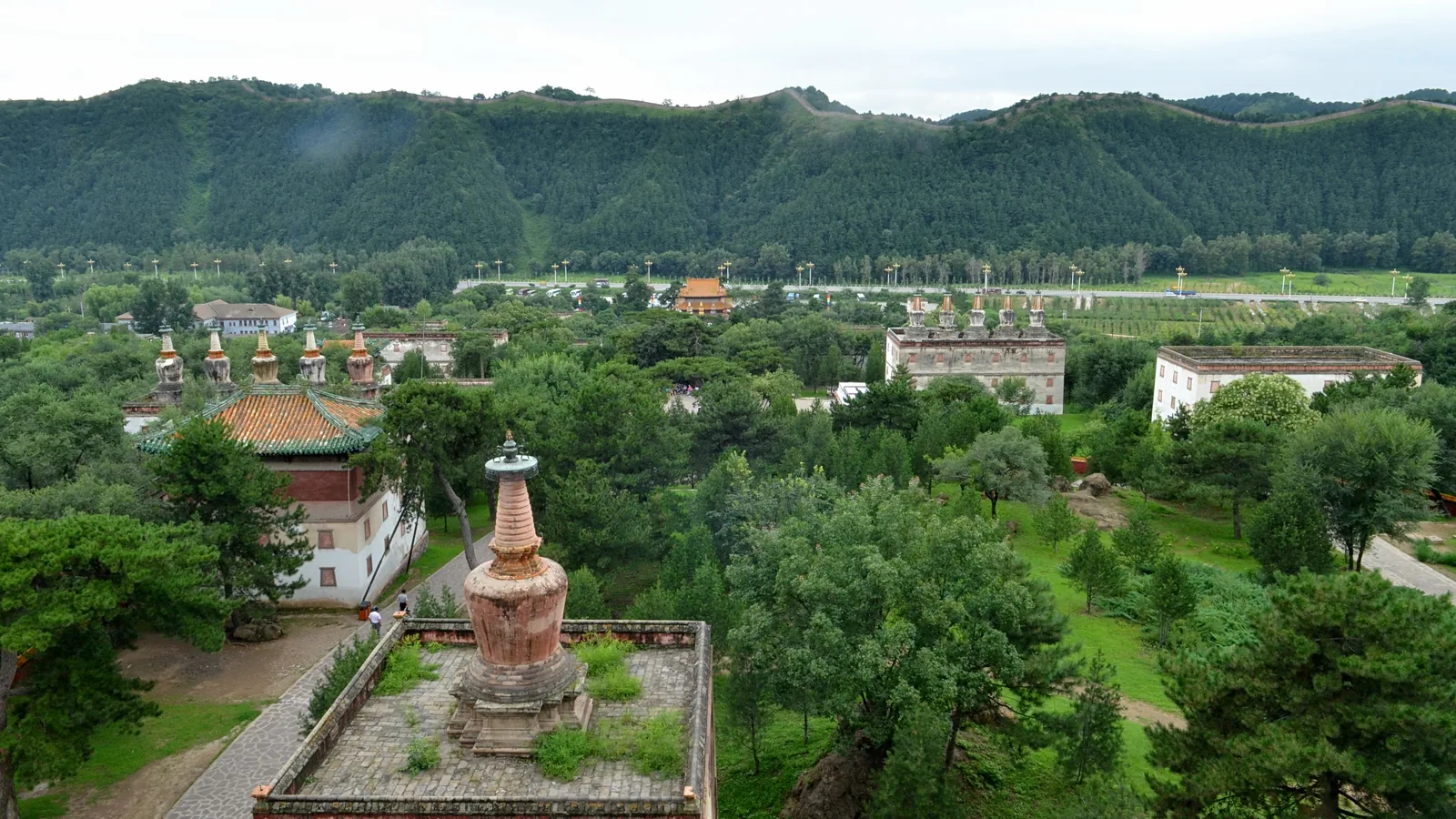

TL;DR — Qianlong’s monument, translated by Amiot in 1776, dates the Torghuts’ arrival on the Ili to 1771 after eight months; Chinese, Russian and French counts of the dead disagree.
“La trente-sixieme année de Kien-long, c’est-à-dire l’an de Jesus-Christ 1771, tous les Tartares qui composent la Nation des Tourgouths sont venus à travers mille périls jusques dans les campagnes qu’arrose la rivière d’Ily.” In the thirty-sixth year of Qianlong, 1771, all the Tartars who make up the Torghut nation came through a thousand perils to the plains watered by the river Ili. So begins the inscription the Qianlong emperor composed when the Torghuts, a Mongol people whom the Russians called Kalmyks, left the lower Volga for the Ili valley, in what is now Xinjiang. The Jesuit Jean-Joseph-Marie Amiot translated it from a Manchu copy and printed it in 1776 in the first volume of the Mémoires concernant l’histoire … des Chinois. The emperor, Amiot wrote, had the text cut in stone in Manchu, Mongolian, Tibetan and Chinese, and the stone “doit être elevé à Ily,” was to be raised at the Ili, under the eyes of the Torghuts themselves. How many finished the march depends on who counted.
Quick facts
- When
- Eleventh moon of Qianlong 35 (December 1770, per Hummel; January 5, 1771, per Howorth's sources) · eight days to the Yaik · two months to the Irgitch · end of the sixth moon (Howorth's "middle of 1771") at Charapen near the Ili · August 1771 audience at Rehe · 1772 arrival of 30,000 more families · October 15, 1773 (Amiot's letter on the printed inscription)
- Where
- The steppe on the left bank of the lower Volga; the Yaik, Irgitch, Torgai and Ishim rivers; the yellow-water steppe of Kangarbein sharra ussun; Lake Balkhash; Charapen on the Ili in what is now Xinjiang; Rehe (Jehol); Peking
- Who
- Ubashi, khan of the Torghuts; the Russian grand pristav Kishinskoi; the starshin Mitrassof and General Traubenberg; Nurali of the Little Horde and Ablai of the Middle Horde; the Russian officer Dudin; the Qianlong emperor; the general Ileton and the councillor Shuhede; the prince Chereng; the Jesuit Jean-Joseph-Marie Amiot; the French minister Bertin; Catherine II
- Outcome
- The Torghuts reached the Ili after eight months and were received at Rehe in August 1771; Ubashi was made Jarktu Khan; the emperor had the story cut in Manchu, Mongolian, Tibetan and Chinese for a stone at the Ili; Catherine II's edict took all power from the khan of the Kalmyks who remained on the Volga
"A bear fastened to a chain": levies, a hostage and the lamas
The stone gives the Torghuts’ reasons in the emperor’s words. The Russians never stopped demanding soldiers from Ubashi, the khan, “en dernier lieu lui ayant enlevé son propre fils pour leur servir d’otage,” having lastly taken his own son as a hostage, and they made no account of the faith of the lamas. Arthur Hummel’s Eminent Chinese of the Ch’ing Period (1943) dates the Torghuts’ move west from Dzungaria to about 1616; a Qing envoy, Tulisen, met Ubashi’s great-grandfather Ayuki at Manytch on July 12, 1714.
Henry Howorth’s History of the Mongols (1876), following Bergmann and Pallas, adds more. The Russians had also decided to remove “300 young men of their best families” for schooling under Russian eyes. When Ubashi came home from the Ochakov campaign, the Russian grand pristav Kishinskoi told him he was “merely a bear fastened to a chain, who cannot go where he will but where he is driven.”
January 5, 1771, or the eleventh moon: three dates for the departure
Howorth quoted his sources: “It was on the 5th of January, 1771 . . . that Ubasha began his march with 70,000 families. Most of the hordes were then assembled in the steppes on the left bank of the Volga . . . Only 15,000 families remained in Russia.” The stone says “Au commencement de la onzième lune de l’année dernière,” at the start of the eleventh moon of the previous year, which Amiot’s footnote renders as “l’an 1770, & environ les deux premiers mois de 1771.” A calendar note printed after the inscription sets December 16, 1770, as the first day of that moon, and Hummel says “In December 1770.” Russian dates then ran eleven days behind western Europe’s; which calendar Howorth’s January 5 follows, he did not say.
One explanation for those who stayed was that the Volga had not frozen. Howorth’s source rejected it for the Derbets, who stayed behind “not because the river was not frozen, as some suggest, but because they disapproved of the flight.” The Russians “were fully warned, but were either indifferent or incredulous.”
Eight days to the Yaik, then Kazakh attacks and a yellow desert
Ubashi, Howorth wrote, went up the Yaik with 15,000 men to cover the column. They crossed the steppe between the Volga and the Yaik in eight days and the Yaik on the ice. Some 2,000 Cossacks under the starshin Mitrassof overtook the Erkets, 1,000 yurts, who turned back. After two months the column reached the river Howorth calls the Irgitch. General Traubenberg, marching from the fort of Orsk with Nurali, khan of the Little Horde, stopped at the further Torgai and turned back.
Beyond the Ishim lay the steppe of Kangarbein sharra ussun, 150 versts across, named for its yellow water. When the Torghuts came out of it, Nurali and Ablai of the Middle Horde attacked, and “a bloody two days’ battle was fought against these old enemies.” A second battle followed at Lake Balkhash. On the road a captured Russian officer, Dudin, died in Torghut hands, a death Bergmann described and the stone confirms: asked about the officer and his soldiers, a Torghut chief told the emperor “il y a grande apparence qu’ils ont tous péri le long de la route.”
Charapen, the sixth moon and a banquet in the garden of a thousand trees
They “at length arrived within the borders of the Chinese empire, namely, at Charapen,” near the Ili, Howorth wrote, “in the middle of 1771, and after a march of eight months.” The stone agrees: “vers la fin de la sixieme lune de cette année,” after “plus de dix mille lys pendant l’espace de huit mois entiers.” The calendar note puts the last day of that moon at August 9, 1771.
The emperor sent Shuhede, a councillor then at Ush, to settle the newcomers. Hummel says he was “ordered by Emperor Kao-tsung to receive them and to distribute to them clothing, cattle, grain, and other necessities.” Courtiers objected with one voice: “Parmi ceux qui viennent se soumettre . . . il y a le perfide Chereng.” The emperor answered, “Chereng auroit-il pu, lui seul, persuader toute une nation?”
In August the princes were called to Gi’ho, Rehe, where the emperor was at the hunt. Howorth quoted him: “after the days allotted to that recreation were ended they repaired in suite to Ge Ho. There I gave them the banquet of ceremony,” held in the garden of a thousand trees. Ubashi, Hummel records, “was created Jarktu Khan.” Hummel gives pasture “at Urumtsi and Tarbagatai”; Howorth gives the Altai for some and “the western part of the Gobi desert” for others.
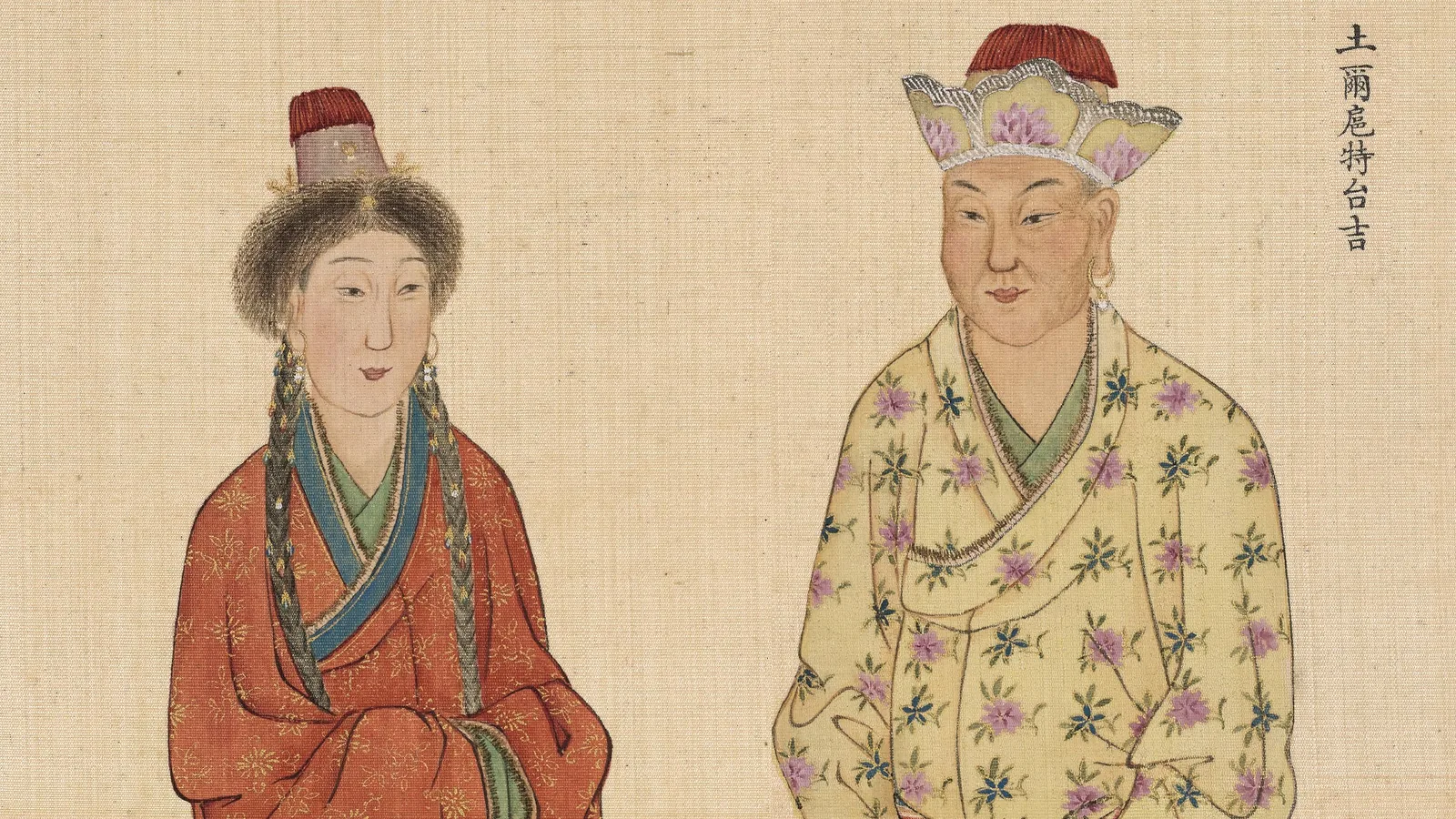
_of_the_Torghuts_and_his_wife_(土爾扈特台吉(婦).jpg)
Families counted four ways, and an edict on the Volga
The stone counts “cinquante mille familles” on arrival, “trois cens mille bouches,” and in 1772 “trente mille familles” more, “un total de quatre cens quatre-vingts mille bouches.” Howorth set the Russian figure against it: “only 40,000 families left Russia,” a gap that showed the loss of life “could not have been so great as Bergmann supposes.” Hummel wrote that “some 169,000 of them, comprising more than 33,000 families” set out and “lost more than half of their number.” Jiří Šima, in Études mongoles in 1973, wrote “sur quelque 30 000 familles qui avaient suivi le mouvement, 20 000 disparurent pendant le trajet, et 10 000 seulement atteignirent leur but,” with “plus de 11 000 familles” left in Russia, where “Catherine II (1762-1796) retirait, par édit, tout pouvoir au khan des Kalmouks et plaçait le peuple sous contrôle russe.”
Amiot vouched for the text: the Chinese accounts, he wrote, “ne diront cependant que le vrai.” On October 15, 1773, he wrote to the French minister Bertin that the emperor had had the history cut in stone “en quatre langues différentes,” and that a grandee named Yu-min-tchoung had printed it in white characters on a black ground.
Key facts
- The inscription opens with the thirty-sixth year of Qianlong, “l’an de Jesus-Christ 1771,” and was cut in Manchu, Mongolian, Tibetan and Chinese for a stone to be raised “à Ily” (Amiot 1776).
- The stone gives the causes as Russian levies, the taking of Ubashi’s son as a hostage and contempt for the faith of the lamas; Howorth adds 300 young men marked for Russian schooling and Kishinskoi’s “bear fastened to a chain.”
- Departure: “the 5th of January, 1771” (Howorth’s sources); “la onzième lune de l’année dernière,” December 16, 1770, by the calendar note (Amiot); “December 1770” (Hummel).
- Howorth’s source says most hordes were already on the left bank of the Volga and 15,000 families stayed because “they disapproved of the flight,” not because the river was unfrozen.
- The route: eight days to the Yaik, two months to the Irgitch, the Torgai, the Ishim, three days across the 150-verst yellow-water steppe, then Lake Balkhash (Howorth).
- Mitrassof’s 2,000 Cossacks turned back 1,000 yurts of Erkets; Traubenberg halted at the further Torgai; Nurali and Ablai fought “a bloody two days’ battle” (Howorth).
- Arrival at Charapen near the Ili “in the middle of 1771, and after a march of eight months” (Howorth); end of the sixth moon, August 9, 1771 (Amiot); audience at Rehe in August; Ubashi made Jarktu Khan (Hummel).
- Counts: 50,000 families and 300,000 mouths in 1771 plus 30,000 families in 1772 (the stone); 40,000 families departing (Howorth’s Russian figure); 169,000 people, more than half lost (Hummel); 30,000 families, 20,000 lost, 10,000 arrived, 11,000 stayed (Šima 1973).
FAQ
Why did the Torghuts leave the Volga in 1771?
The Qianlong emperor's inscription gives three reasons: Russian demands for soldiers, the taking of Ubashi's son as a hostage, and Russian disregard for the lamas' faith. Howorth adds the planned removal of 300 young men of leading families and the pristav Kishinskoi's insult that Ubashi was "merely a bear fastened to a chain."
How many Torghuts reached the Ili?
The inscription counts 50,000 families and 300,000 people in 1771, with 30,000 families more in 1772. Howorth gives a Russian figure of 40,000 families leaving; Hummel says 169,000 people left and more than half were lost; Šima, in 1973, says 10,000 of 30,000 families arrived.
Where was the Torghut monument set up?
Amiot's 1776 translation says the four-language stone "doit être elevé à Ily," was to be raised at the Ili, under the eyes of the Torghuts. His letter of October 15, 1773, adds that a grandee named Yu-min-tchoung had the text printed in white characters on black.
Sources
- Henry H. Howorth, History of the Mongols from the 9th to the 19th Century, Part I: The Mongols Proper and the Kalmuks (London: Longmans, Green, and Co., 1876), chapter "The Keraits and Torguts," pp. 572–580, citing Bergmann, Pallas and de Hell. Internet Archive full text.
- Arthur W. Hummel (ed.), Eminent Chinese of the Ch'ing Period (1644–1912), vol. II (Washington: United States Government Printing Office, for the Library of Congress, 1943–44), entry "Shu-ho-te," pp. 668–669: the migration of 1770–1771, Shuhede's orders, the audience at Jehol and the titles granted. Internet Archive full text.
- Arthur W. Hummel (ed.), Eminent Chinese of the Ch'ing Period (1644–1912), vol. II, entry "Tulisen," pp. 784–787: the Torghuts' move west about 1616, Ayuki, and Tulisen's meeting with him on July 12, 1714. Internet Archive full text.
- Jean-Joseph-Marie Amiot (trans.), "Monument de la transmigration des Tourgouths des bords de la mer Caspienne dans l'empire de la Chine," in Mémoires concernant l'histoire, les sciences, les arts, les mœurs, les usages, &c. des Chinois, par les missionnaires de Pékin, vol. I (Paris, 1776), pp. 400–427: the Qianlong emperor's inscription in French, with Amiot's preface and footnotes. Internet Archive full text.
- Mémoires concernant l'histoire ... des Chinois, vol. I (Paris, 1776): the calendar note printed after the inscription (December 16, 1770, and August 9, 1771) and the extract of Amiot's letter to Bertin, Peking, October 15, 1773, on the four-language stone and the printed text. Internet Archive full text.
- Jiří Šima, adapted by Françoise Aubin, "À propos de la colonie kalmouke de Tchécoslovaquie," Études mongoles, cahier 4 (1973), pp. 181–189, at p. 181. Persée.
Cite this article
- APA
- Our Earth's History. (2026, September 22). Four scripts on one stone: the Torghuts' march to the Ili, 1771. Our Earth's History. https://ourearthshistory.com/central-asia/early-modern/torghut-return-1771-volga-to-ili-qianlong-monument-amiot/
- Chicago
- Our Earth's History. “Four scripts on one stone: the Torghuts' march to the Ili, 1771.” Our Earth's History, September 22, 2026. https://ourearthshistory.com/central-asia/early-modern/torghut-return-1771-volga-to-ili-qianlong-monument-amiot/.
- MLA
- “Four scripts on one stone: the Torghuts' march to the Ili, 1771.” Our Earth's History, 22 Sep. 2026, https://ourearthshistory.com/central-asia/early-modern/torghut-return-1771-volga-to-ili-qianlong-monument-amiot/.
Text licensed CC BY-NC-ND 4.0. Found an error? Tell us.