A lame dervish from Tehran to Samarkand: Vámbéry's ten months, 1863–64

TL;DR — Vámbéry left Tehran in March 1863 as the dervish “Reshid Efendi,” reached Khiva, Bukhara and Samarkand, and was back at the Turkish embassy in Tehran on January 20, 1864.
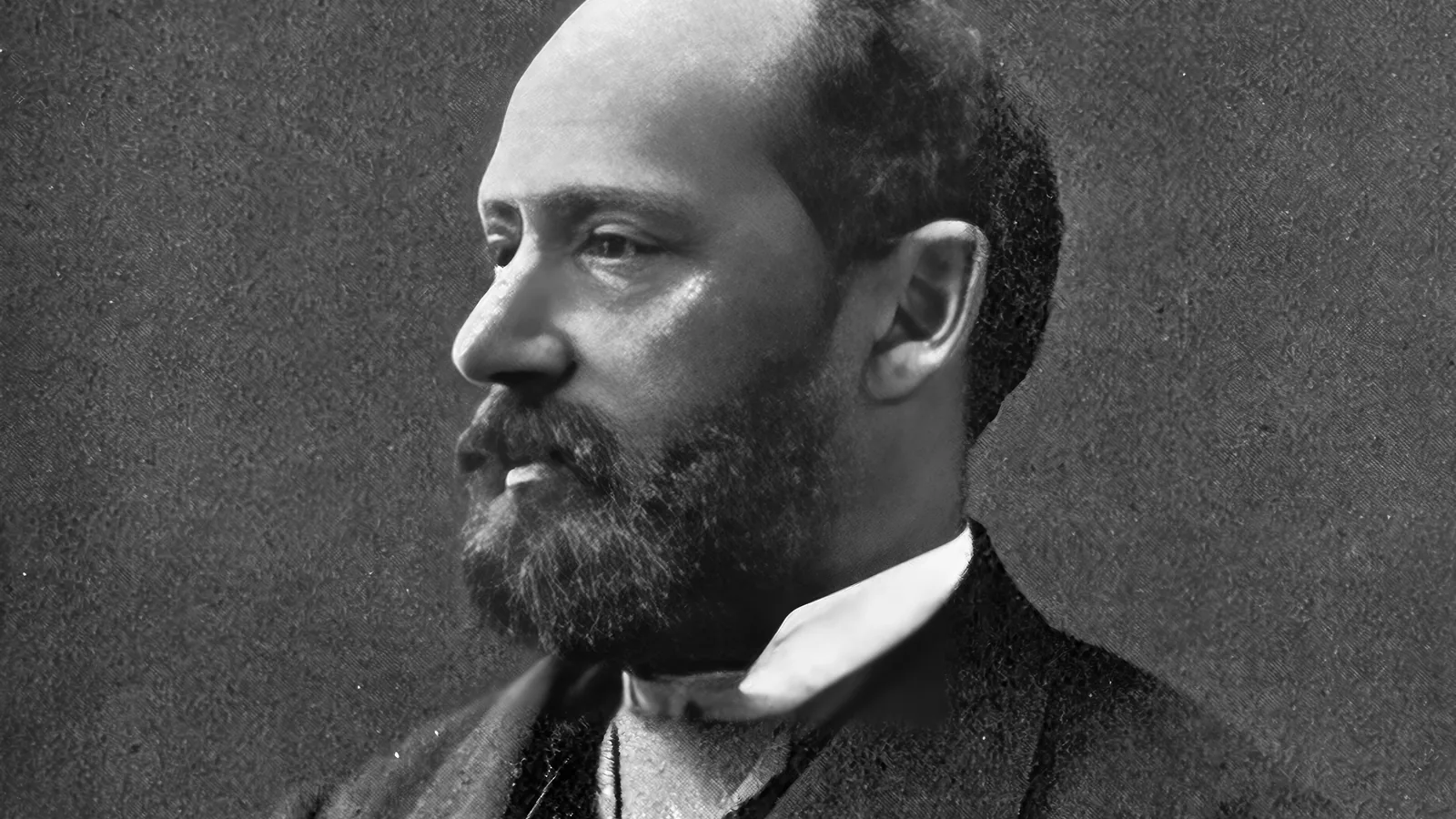
“On the morning of the 28th March, 1863, at an early hour, I proceeded to our appointed rendezvous, the karavanserai.” So begins the journey in Travels in Central Asia, the book Ármin Vámbéry published in London in 1864. The biography on the Hungarian Academy of Sciences Library’s Vámbéry site gives March 22, 1863, for the same departure, six days earlier. Vámbéry was a Hungarian orientalist, lame in the right leg since the age of three, and he traveled as the dervish Reshid Efendi with a party of hajjis going home from Mecca. Ten months later the book gives its matching sentence: “Towards evening on the 19th of January, 1864, I was at a distance of two leagues” from Tehran. He found the city gate shut, slept in a caravanserai beside it and walked next morning to the Turkish embassy.
Quick facts
- When
- March 1863 (departure from Tehran; March 28 in Vámbéry's book, March 22 in the Hungarian Academy's biography) · April 10, 1863 (Caspian crossing) · June 3 (Khiva) · June 27 (leaves Khiva) · November 1863 (leaves Herat) · January 19–20, 1864 (Tehran) · June 9, 1864 (London) · September 28, 1864 (preface of Travels in Central Asia)
- Where
- Tehran; the Turkmen coast at Gömüshtepe; Khiva; Bukhara; Samarkand; Karshi and Kerki on the Oxus; Maimana; Herat; Meshed; London
- Who
- Ármin (Arminius) Vámbéry, traveling as Reshid Efendi; Hadji Bilal of Aksu; Seid Mehemmed Khan of Khiva; the emir Mozaffar-ed-din of Bukhara; Serdar Mehemmed Yakoub Khan at Herat; Nasr-ed-din Shah; Sir Roderick Murchison; General Kmetty; Sir Philip Currie, Sir Thomas Sanderson, Arthur James Balfour and Sir Charles Hardinge of the Foreign Office
- Outcome
- Vámbéry returned to Tehran in January 1864, lectured to the Royal Geographical Society in London that summer and published Travels in Central Asia with John Murray; from 1865 he taught at Pest University, and the National Archives at Kew catalogs his letters to the Foreign Office from 1889 into the 1900s
Hadji Bilal's caravan and the Caspian, April 10, 1863
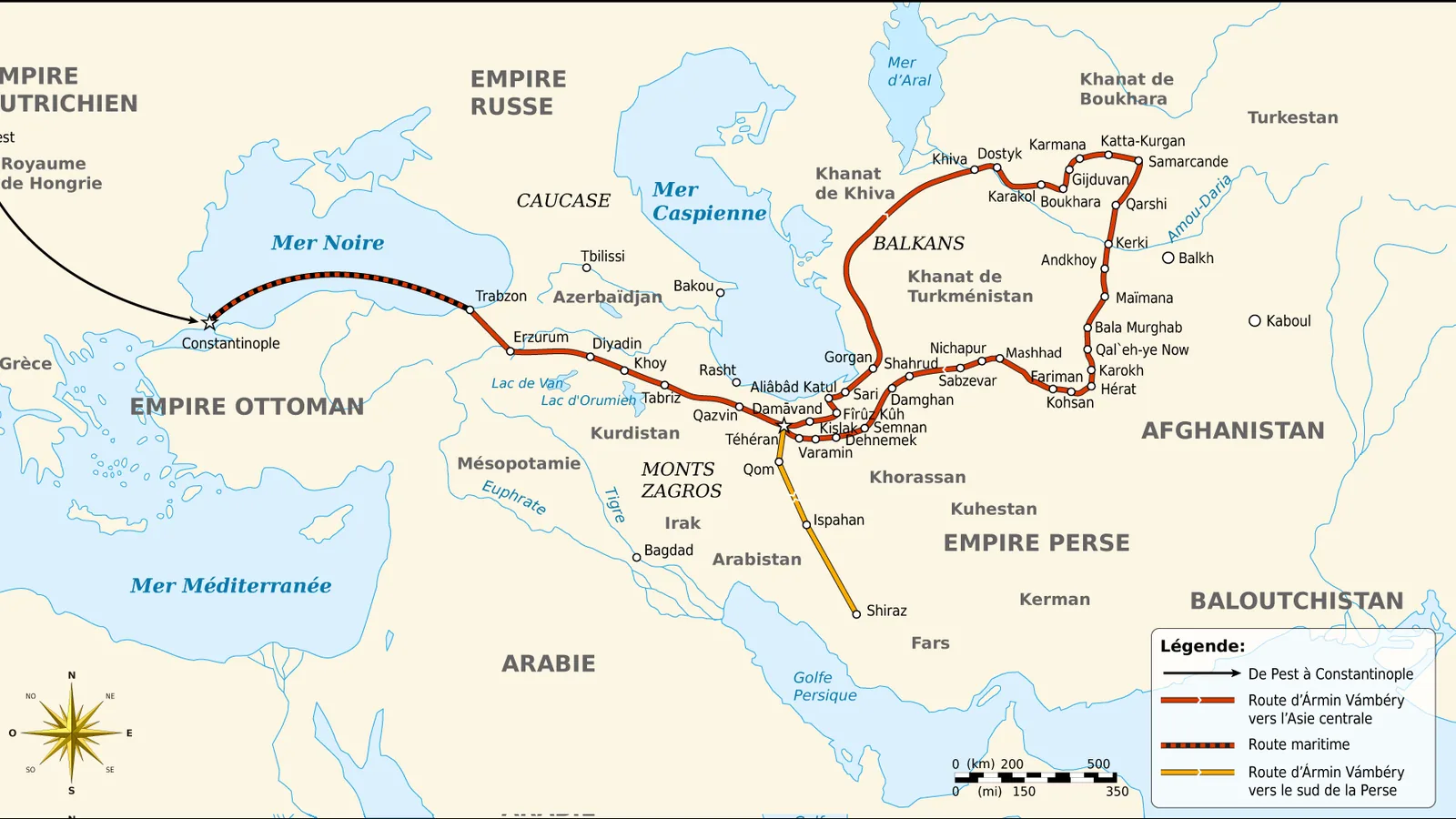
The party’s leader was Hadji Bilal, whom Vámbéry lists first among his companions as “from Aksu (Chinese Tartary), and Court Iman of the Chinese Musselman Governor of the same province.” The pilgrims marched north-east from Tehran toward Sari and the sea, and on April 10, 1863, at midday, a favorable wind took their small vessel across the corner of the Caspian, “driving the little vessel before it like an arrow.”
The boat landed at Gömüshtepe, a Yomut settlement at the mouth of the Görghen. “After having only been five days in Gömüshtepe, I had a numerous acquaintance,” he wrote. The wait there was for the khan of Khiva’s caravan leader to assemble a party for the desert, and it lasted weeks.
June 3, 1863: the gates of Khiva
After three weeks in the desert, by the Academy’s count, the party entered Khiva on June 3, 1863. “The curtain was rolled up, and I saw before me Seid Mehemmed Khan, Padishahi Kharezm, or, as he would be styled in ordinary prose, the Khan of Khiva, on a sort of elevation, or dais, with his left arm supported upon a round silk velvet pillow, and his right holding a short golden sceptre.” Before that audience the khan’s minister, the Mehter, had asked whether the visitor brought “a few lines from the Sultan or his ambassador in Teheran”; he had only a passport under the sultan’s seal.
Before leaving, Vámbéry went with the minister Shukrullah on an 18-day excursion to Kungrat, by boat along the Oxus and back by land. The pilgrims left Khiva on June 27, 1863, for Bukhara, where Rahmet Beg, the emir’s leading dignitary, tested the traveler’s credibility, and he passed. Vámbéry described the emir, Mozaffar-ed-din Khan, as “a well-disposed man” who “enforces with severity the laws respecting religion and morals,” and added that he saw him afterwards in Samarkand.

A lame foot before the emir at Samarkand
At Samarkand the emir questioned him. Vámbéry had called himself a Djihangeshte, a world pilgrim. The emir answered: “What, thou, with thy lame foot, a Djihangeshte! That is really astonishing.” The reply: “Sire, thy glorious ancestor (peace be with him!) had certainly the same infirmity, and he was even Djihanghir” (conqueror of the world). Vámbéry’s footnote names the ancestor as Timur, whom his enemies called Timur Lenk, the lame.
From Samarkand the party went back through Karshi to the Oxus and crossed it at Kerki, then through the khanate of Maimana toward Herat, according to the Academy’s biography.
"Inghiliz hestid": Herat, Meshed and a shut gate at Tehran
At Herat Vámbéry called on the ruler of the newly conquered province, Serdar Mehemmed Yakoub Khan, son of the king of Afghanistan and “a lad in his sixteenth year.” When Vámbéry raised his hands for the customary prayer, the prince “half rose from his chair, and, pointing with his finger to me, he called out, half laughing and half bewildered, ‘Vallahi, Billahi Schuma, Inghiliz hestid’”, which Vámbéry translated as an oath that he was an Englishman.
He left Herat with a caravan of 2,000 people bound for Meshed on a date the two accounts again give differently: November 15, 1863, in the book, November 10 in the biography. On the evening of January 19, 1864, he found the gate of Tehran shut and slept a few paces from it. Next morning he hurried through the streets “in my droll costume” to the Turkish embassy. He stayed two months. Nasr-ed-din Shah gave him an audience of half an hour, said of Herat that he had no taste for such ruined cities, and left him the ribbon of the fourth class of the Order of the Lion and the Sun. On March 28, 1864, by the Academy’s account, he left for Tabriz, Trebizond and Istanbul.
Forty years of letters: Burlington House to FO 800/33
Vámbéry reached London on June 9, 1864, to report to the Royal Geographical Society. In his memoirs of 1904 he recorded that a sunburnt face and unaccented Persian and Turkish made some orientalists take him “for a disguised Asiatic,” until General Kmetty, a Hungarian who had known him in Constantinople, allayed their doubts. His first lecture, at Burlington House, was in English “with a strong foreign accent, as the Times remarked next day.” The preface of Travels in Central Asia thanks Sir Justin and Lady Sheil, Sir Roderick Murchison, president of the Society, Viscount Strangford and Layard, the under-secretary of state, and is signed “London: September 28, 1864.” The memoirs also answer a charge. “Many well-disposed critics even have doubted the verity of some of my experiences, which to the European pur sang are simply incredible,” he wrote, and set against it the judgment of the French orientalist Jules Mohl that he was a singularly modest traveler who “ne raconte pas tout ce qui lui arrive.”
From 1865 he taught at the Faculty of Eastern Languages of Pest University, an ordinary professor from 1870 until his retirement in 1905. The National Archives at Kew catalogs his correspondence with the Foreign Office in the series FO 800/32 and FO 800/33: letters to Sir Philip Currie from June 1889, letters to Sir Thomas Sanderson through the 1890s, and on May 20, 1904, a letter to Arthur James Balfour described as an “Application for an annual payment for the remainder of his life; with history of his services in supporting England in Asia over the previous 40 years.” Of Sultan Abdülhamid II his memoirs say that “He treated me, so to speak, as a confidential friend, talked with me about State concerns, and the interests of his dynasty.” The same catalog holds a letter dated January 11, 1909, from Sir Charles Hardinge to Professor Vámbéry “concerning: Professor Vambéry’s misstatements in the press regarding British foreign policy.”
Key facts
- Vámbéry’s book dates his departure from Tehran to March 28, 1863; the Hungarian Academy’s biography gives March 22 (Travels in Central Asia; MTA KIK page 3).
- He traveled as Reshid Efendi with hajjis returning from Mecca, led by Hadji Bilal of Aksu (Travels in Central Asia).
- The Caspian crossing to the Turkmen coast began at midday on April 10, 1863, and the party landed at Gömüshtepe (Travels in Central Asia).
- The Academy’s biography gives June 3, 1863, for the entry into Khiva and June 27 for the departure; Vámbéry describes the audience with Seid Mehemmed Khan (MTA KIK page 3; Travels in Central Asia).
- At Samarkand the emir said “What, thou, with thy lame foot, a Djihangeshte!” and Vámbéry answered that Timur had the same infirmity (Travels in Central Asia).
- At Herat the sixteen-year-old Serdar Mehemmed Yakoub Khan called out “Vallahi, Billahi Schuma, Inghiliz hestid” during the prayer (Travels in Central Asia).
- He reached the gate of Tehran on the evening of January 19, 1864, and the Turkish embassy on January 20; he arrived in London on June 9, 1864, and the preface of his book is dated September 28, 1864 (Travels in Central Asia).
- The National Archives catalogs his letters to the Foreign Office in FO 800/32 and FO 800/33, including a pension application to Balfour of May 20, 1904, and a letter from Hardinge of January 11, 1909 (TNA Discovery).
FAQ
When did Vámbéry leave Tehran for Central Asia?
His own book says the morning of March 28, 1863. The biography on the Hungarian Academy of Sciences Library's Vámbéry site says March 22, 1863. Both accounts agree that he traveled with hajjis returning from Mecca under the name Reshid Efendi.
Did Vámbéry meet the emir of Bukhara?
Not in Bukhara. He wrote that he saw the emir, Mozaffar-ed-din Khan, afterwards in Samarkand, where the emir questioned him about traveling as a pilgrim with a lame foot.
When did Vámbéry get back to Tehran?
On the evening of January 19, 1864, he reached the gate, found it shut and slept in a caravanserai; on January 20 he walked to the Turkish embassy, which he had left ten months earlier. He stayed two months and left on March 28, 1864.
Sources
- Arminius Vámbéry, Travels in Central Asia (London: John Murray, 1864), Project Gutenberg e-text #41751: preface dated September 28, 1864; departure from Tehran; the Caspian crossing; Gömüshtepe; the audience at Khiva; the emir of Bukhara; the exchange at Samarkand; Herat; the return to Tehran and the audience with the shah.
- Arminius Vámbéry, The Story of My Struggles: The Memoirs of Arminius Vambéry, vol. 1 (London, 1904), Project Gutenberg e-text #50812: the reception in London, General Kmetty, the Burlington House lecture, Jules Mohl and the "well-disposed critics."
- Arminius Vámbéry, The Story of My Struggles, vol. 2 (London, 1904), Project Gutenberg e-text #50837: his account of Sultan Abdülhamid II.
- The National Archives (Kew), Discovery catalog API, search "Vambery": 201 records, including the FO 800/32 and FO 800/33 series (letters to Sir Philip Currie, Sir Thomas Sanderson and Sir Charles Hardinge, 1889 onward) and RGS/CB6/2242.
- The National Archives (Kew), Discovery catalog record FO 800/33/63: letter from Professor Vambéry to Arthur James Balfour, May 20, 1904 (application for an annual payment).
- The National Archives (Kew), Discovery catalog record FO 800/33/98: letter from Sir Charles Hardinge to Professor Vambéry, January 11, 1909.
- Hungarian Academy of Sciences Library and Information Centre (MTA KIK), Vámbéry Ármin online exhibition (vambery.mtak.hu), English page 1: childhood lameness, the Pest University appointments of 1865, 1868, 1870 and the retirement of 1905.
- MTA KIK, Vámbéry Ármin online exhibition, English page 3: the 1863 itinerary, with March 22 for the departure from Tehran, June 3 for Khiva, June 27 for leaving Khiva, Rahmet Beg at Bukhara, the crossing at Kerki, November 10 for leaving Herat and March 28, 1864, for leaving Tehran.
- MTA KIK, Vámbéry Ármin online exhibition, English page 4: Mullah Ishak (Izsák Csagatáj), who joined the pilgrims in July 1863.
Cite this article
- APA
- Our Earth's History. (2026, September 22). A lame dervish from Tehran to Samarkand: Vámbéry's ten months, 1863–64. Our Earth's History. https://ourearthshistory.com/central-asia/modern/vambery-1863-dervish-tehran-khiva-bukhara-samarkand-gutenberg-1864/
- Chicago
- Our Earth's History. “A lame dervish from Tehran to Samarkand: Vámbéry's ten months, 1863–64.” Our Earth's History, September 22, 2026. https://ourearthshistory.com/central-asia/modern/vambery-1863-dervish-tehran-khiva-bukhara-samarkand-gutenberg-1864/.
- MLA
- “A lame dervish from Tehran to Samarkand: Vámbéry's ten months, 1863–64.” Our Earth's History, 22 Sep. 2026, https://ourearthshistory.com/central-asia/modern/vambery-1863-dervish-tehran-khiva-bukhara-samarkand-gutenberg-1864/.
Text licensed CC BY-NC-ND 4.0. Found an error? Tell us.