Cliff Palace, 150 rooms and 23 kivas: Mesa Verde, 1888 to 1906
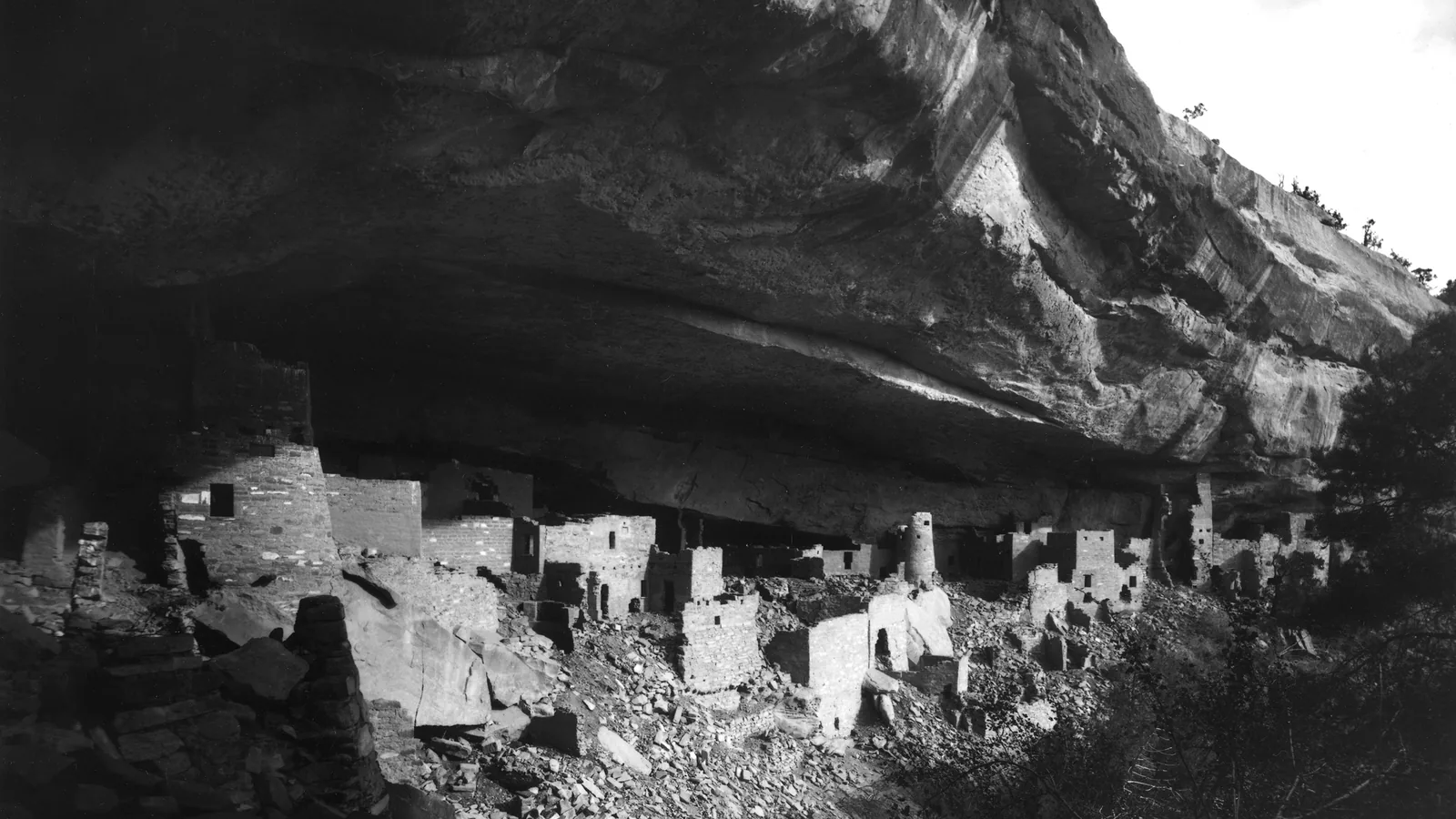

TL;DR — Two ranchers saw Cliff Palace on December 18, 1888; its Ancestral Pueblo builders had left by about 1285, and Congress protected the site in June 1906.
“On December 18, Richard Wetherill and his brother-in-law, Charles Mason, rode out in search of lost cattle with their Ute guide Acowitz. They first saw Cliff Palace near modern-day Sun Point and went to investigate.” That is how the National Park Service’s timeline for Mesa Verde, in what is now Colorado, records the year 1888. The park’s page on Cliff Palace states that “Recent studies reveal that Cliff Palace contained 150 rooms and 23 kivas and housed a population of approximately 100 people.” The timeline puts the word “discovery” in quotation marks and adds that Richard’s brother Al had seen Cliff Palace the year before without entering it. Four years of collecting followed, then a Swedish excavation in 1891, and in June 1906 an Act of Congress and a national park.
Quick facts
- When
- About AD 1180–1300 (cliff dwellings built, per the National Park Service) · about 1285 (region emptied, per Crow Canyon) · December 18, 1888 (Wetherill and Mason at Cliff Palace) · 1891 (Nordenskiöld's excavation) · June 8, 1906 (Antiquities Act) · June 29, 1906 (Mesa Verde National Park) · 1958–1965 (Wetherill Mesa Archeological Project) · spring 2006 (reburial)
- Where
- Mesa Verde, in what is now Colorado; Cliff Palace, Spruce Tree House, Balcony House, Long House and Step House; the Four Corners region
- Who
- Ancestral Pueblo builders; Richard Wetherill, Charles Mason and their Ute guide Acowitz; Benjamin Wetherill; Gustaf Nordenskiöld; Virginia McClurg and Lucy Peabody; Theodore Roosevelt; Jesse Walter Fewkes; the 27 associated Pueblos, Tribes and Nations
- Outcome
- The Antiquities Act of June 8, 1906 made it a federal crime to collect or destroy antiquities on federal land; on June 29, 1906 Theodore Roosevelt established Mesa Verde National Park; Nordenskiöld's 600 items remain in Helsinki; in spring 2006 all human remains held by the park were reburied
The people who built them, AD 500 to 1300
The park’s people page states that between 500 and 1300 the Four Corners region “was home to tens of thousands of Ancestral Pueblo people.” One park page dates most cliff dwellings to 1180 to 1300, another to 1180 to 1280. The people page reads that “life in the Mesa Verde area continued until the mid 1200s, when people started to move south,” and that “Over the course of several decades, the Ancestral Pueblo people left Mesa Verde entirely.” It names drought, limits on resources and social change as reasons.
The Crow Canyon Archaeological Center gives two sharper dates. “In about A.D. 1250, the number of Pueblo people living in the Mesa Verde region peaked at more than 20,000. Only 35 years later, by about A.D. 1285, they were gone.” A 2016 study in Science Advances by R. Kyle Bocinsky and three colleagues, built on 29,311 tree-ring dates, set the Pueblo III period at 1200 to 1285 and the start of Pueblo IV at 1285. The period names date from 1927, when, in the paper’s words, “some 40 researchers converged on Pecos, New Mexico,” two years before the master tree-ring chronology. Its reference for that chronology is a 1929 article by Andrew Ellicott Douglass, founder in 1937 of the University of Arizona’s Laboratory of Tree-Ring Research.
Balcony House, Long House, Spruce Tree House and Step House
Cliff Palace was the exception. The park counts 600 alcove dwellings, 75 percent of them with one to five rooms. An ordinary site had about one kiva for every six rooms; Cliff Palace had one for every three, which the park reads as the mark of a public, ceremonial place. For the whole park the pages differ: the Places page counts more than 5,000 archeological sites on over 52,000 acres, the preservation page over 4,700.
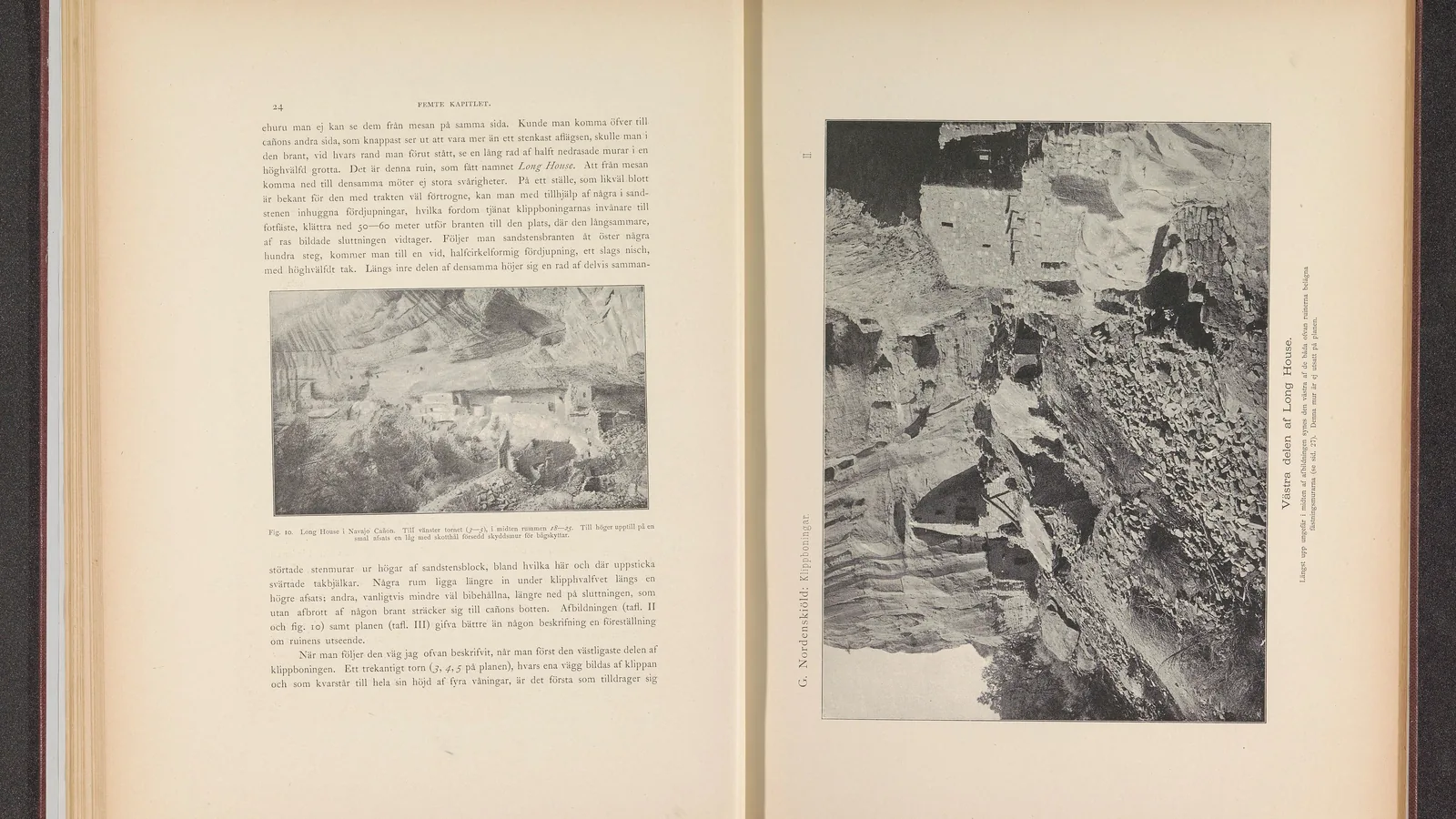
Balcony House had “38 rooms and two kivas that would have been home to over 30 people.” Long House had “150 rooms, 21 kivas, and a large kiva-plaza at its center,” and a population of “well over 100.” Spruce Tree House had “about 130 rooms and eight kivas, home to approximately 60 to 80 people”; it has been closed since a rockfall in 2015 left the arch of the alcove unstable. Step House holds pithouses from about 700 and a stone village from about 1200 with “27 rooms and 3 kivas, likely home to a dozen to two dozen people.”
_(titel_op_object),_RP-F-2001-7-1466-7.jpg)
Eight collections and a letter to the Smithsonian
Between 1888 and 1892, the timeline states, “At least eight individual collections were assembled by the Wetherills during this period, several of which were later combined and sold in four collections. The first collection was sold to the Colorado Historical Society.”
On December 20, 1889, their father, Benjamin Wetherill, proposed to the Smithsonian Institution that the Mancos and its side canyons, with Mesa Verde, be made a national park; in a second letter of February 11, 1890, he warned that otherwise “the tourists, will destroy them.” In 1891, the timeline records, “Baron Gustaf E. A. Nordenskiöld, of the Academy of Sciences in Sweden, using painstaking field methods for his time, excavated, sketched, and photographed numerous sites. He is credited by many as being the first scientist to visit Mesa Verde. He collected about 600 items which were sent to Sweden, and now reside in the National Museum in Helsinki, Finland.”
"An Act for the Preservation of American Antiquities," June 8, 1906
In 1900 Virginia McClurg and Lucy Peabody founded the Colorado Cliff Dwellings Association, which pressed for a park with letters, money and press tours. The first bill for a “Colorado Cliff Dwellings National Park” failed in Congress in February 1901, as did at least four more. A bill introduced in the 59th Congress in 1905 passed, and the timeline records the result: “On June 29, 1906, President Theodore Roosevelt established Mesa Verde National Park to preserve cultural heritage, the first national park of its kind.”
Three weeks earlier a law had reached every federal acre. The timeline reads: “Earlier that same year, on June 8, 1906, a bill called ‘an Act for the Preservation of American Antiquities,’ or more commonly, the ‘1906 Antiquities Act,’ was passed. This act made it a federal crime to collect or destroy any historic or prehistoric object or building on federally owned land.” The Park Service’s archeology program cites it as 34 Stat. 225 and adds that it let a president proclaim national monuments, a power used almost 300 times since. In 1908 excavation and repair began, and, the timeline states, “Most of the early work was done by Jesse Walter Fewkes, an archeologist from the Smithsonian Institution.”
1958 to 1965 on Wetherill Mesa, and a reburial in spring 2006
The Wetherill Mesa Archeological Project of 1958 to 1965 “ranks among the biggest archeological studies ever performed in the United States,” the timeline states, and “excavated eleven sites on Wetherill Mesa, including Long House.” In 1978, in the park’s words, Mesa Verde “joined a select group of areas designated by UNESCO (United Nations Educational, Scientific and Cultural Organization) as a World Heritage Cultural Site.” Five large wildfires between 1996 and 2003 burned more than half of the park, and the Burned Area Emergency Response surveys that followed found unrecorded farming terraces, petroglyphs and hand-and-toe-hold trails.
The park lists 27 associated Pueblos, Tribes and Nations, and describes the Pueblo and Hopi people as “the direct descendants of those who built and lived in the communities at Mesa Verde.” After 12 years of consultation with those tribes, and under the Native American Graves Protection and Repatriation Act, “a private repatriation ceremony took place in the spring of 2006. All Native American human remains and associated grave goods found within park boundaries were reburied in an undisclosed park location,” carried out by park staff and the Hopi tribe.
Key facts
- The National Park Service timeline states that on December 18, 1888, Richard Wetherill and Charles Mason, with their Ute guide Acowitz, first saw Cliff Palace while searching for lost cattle; Al Wetherill had seen it the year before without entering.
- The park’s Cliff Palace page reads that “Recent studies reveal that Cliff Palace contained 150 rooms and 23 kivas and housed a population of approximately 100 people.”
- The park gives the building of most cliff dwellings as 1180 to 1300 on one page and 1180 to 1280 on another; Crow Canyon puts the regional population above 20,000 in about AD 1250 and gone by about 1285.
- Bocinsky, Rush, Kintigh and Kohler (Science Advances, 2016) used 29,311 tree-ring dates to set Pueblo III at 1200–1285 and the start of Pueblo IV at 1285.
- Balcony House had 38 rooms and two kivas; Long House 150 rooms and 21 kivas; Spruce Tree House about 130 rooms and eight kivas, closed since a rockfall in 2015; Step House 27 rooms and three kivas (NPS, Cliff Dwellings page).
- Between 1888 and 1892 the Wetherills assembled at least eight collections; in 1891 Gustaf Nordenskiöld excavated and shipped about 600 items to Sweden, now in the National Museum in Helsinki.
- The Antiquities Act passed on June 8, 1906 (34 Stat. 225), and on June 29, 1906 Theodore Roosevelt established Mesa Verde National Park, “the first national park of its kind.”
- The Wetherill Mesa Archeological Project (1958–1965) excavated eleven sites including Long House; in spring 2006 all human remains held by the park were reburied in consultation with 27 associated tribes.
FAQ
Who first saw Cliff Palace at Mesa Verde?
The National Park Service timeline credits Richard Wetherill and Charles Mason, riding with their Ute guide Acowitz after lost cattle on December 18, 1888. The same timeline states that Richard's brother Al saw Cliff Palace the year before but did not enter it, and it places the word "discovery" in quotation marks.
How many rooms and kivas does Cliff Palace have?
The park's Cliff Palace page states that recent studies found 150 rooms and 23 kivas, with a population of about 100 people. Long House, the second largest dwelling in the park, had 150 rooms and 21 kivas.
What did the Antiquities Act of 1906 do for Mesa Verde?
Passed on June 8, 1906, it made it a federal crime to collect or destroy any historic or prehistoric object or building on federal land and let the president proclaim national monuments. Three weeks later, on June 29, 1906, Theodore Roosevelt established Mesa Verde National Park by a separate act of Congress.
Sources
- National Park Service, Mesa Verde National Park, "Histories of Mesa Verde" (timeline from 1765 to 2013: the ride of December 18, 1888; the Wetherill collections; Benjamin Wetherill's letters; Nordenskiöld, 1891; the Colorado Cliff Dwellings Association; the bills of 1901–1905; the Act of June 8 and the park of June 29, 1906; Fewkes, 1908; the Wetherill Mesa Archeological Project; 1978; the fires of 1996–2003; the reburial of spring 2006).
- National Park Service, Mesa Verde National Park, "Cliff Palace" (150 rooms, 23 kivas, about 100 people; 75 percent of the park's alcove sites with one to five rooms).
- National Park Service, Mesa Verde National Park, "Cliff Dwellings" (Balcony House, Long House, Spruce Tree House and Step House; building dates 1180 to 1300; the 2015 rockfall and closure).
- National Park Service, Mesa Verde National Park, "Places" (over 52,000 acres, more than 5,000 sites, 600 alcove dwellings, building dates 1180 to 1280) and "Preservation of Archeological Sites" (over 4,700 sites).
- National Park Service, Mesa Verde National Park, "People" (tens of thousands of Ancestral Pueblo people between 500 and 1300; the move south from the mid-1200s; 27 associated Pueblos, Tribes and Nations; 21 communities and six languages).
- National Park Service, Archeology Program, "Antiquities Act of 1906" (text and citation, 34 Stat. 225; almost 300 presidential proclamations).
- Crow Canyon Archaeological Center, "Explore Pueblo History" (population of the Mesa Verde region above 20,000 in about AD 1250 and gone by about 1285; William Lipe's lecture).
- R. Kyle Bocinsky, Johnathan Rush, Keith W. Kintigh and Timothy A. Kohler, "Exploration and exploitation in the macrohistory of the pre-Hispanic Pueblo Southwest," Science Advances 2, no. 4 (2016), e1501532, open access at PubMed Central (29,311 tree-ring dates; Pueblo III 1200–1285 and Pueblo IV from 1285; the Pecos conference of 1927 and the master chronology of 1929).
- University of Arizona, Laboratory of Tree-Ring Research, "Lab History" (the laboratory founded in 1937 by Andrew Ellicott Douglass).
Cite this article
- APA
- Our Earth's History. (2026, September 22). Cliff Palace, 150 rooms and 23 kivas: Mesa Verde, 1888 to 1906. Our Earth's History. https://ourearthshistory.com/americas/medieval/mesa-verde-december-18-1888-cliff-palace-antiquities-act-june-8-1906/
- Chicago
- Our Earth's History. “Cliff Palace, 150 rooms and 23 kivas: Mesa Verde, 1888 to 1906.” Our Earth's History, September 22, 2026. https://ourearthshistory.com/americas/medieval/mesa-verde-december-18-1888-cliff-palace-antiquities-act-june-8-1906/.
- MLA
- “Cliff Palace, 150 rooms and 23 kivas: Mesa Verde, 1888 to 1906.” Our Earth's History, 22 Sep. 2026, https://ourearthshistory.com/americas/medieval/mesa-verde-december-18-1888-cliff-palace-antiquities-act-june-8-1906/.
Text licensed CC BY-NC-ND 4.0. Found an error? Tell us.