Gold seized by police in February 1987 led archaeologists to Sipán

TL;DR — Walter Alva’s team recorded the Lord of Sipán’s tomb on July 20, 1987; its gold fills a 2002 museum, and one looted piece came back in 2011.
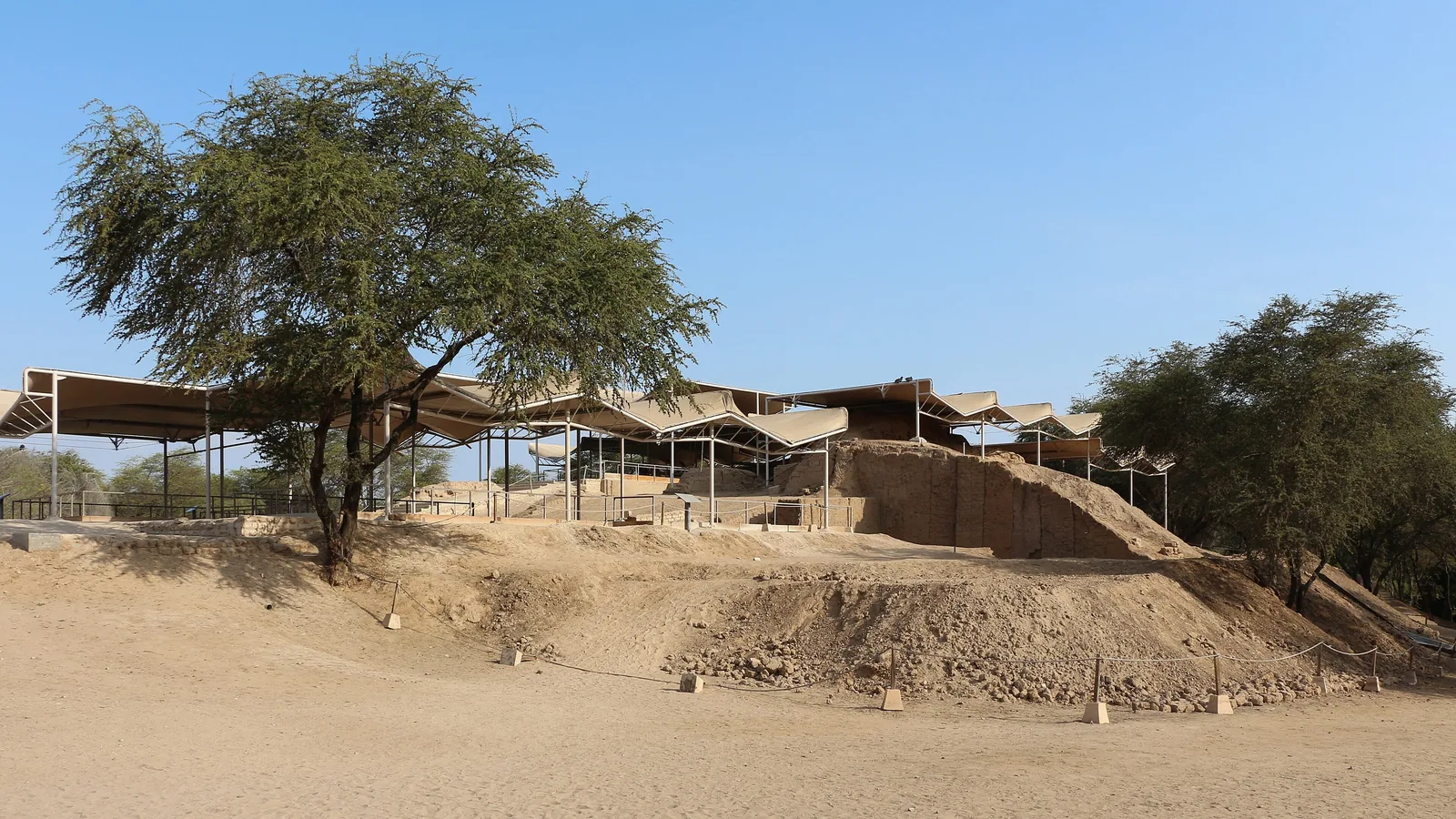
In February 1987 the Peruvian National Police recovered pieces of gold and gilded copper from a looted tomb at Sipán, a village on the Lambayeque River in northern Peru. Peru’s tourism ministry, in its inventory entry for the Museo Tumbas Reales de Sipán, writes that those pieces “marcaron el inicio de la investigación arqueológica,” marked the start of the archaeological investigation. A team led by Walter Alva, Susana Meneses and Luis Chero Zurita went to work at Huaca Rajada, a group of three adobe pyramids near the village. On July 20, 1987, according to Peru’s Ministry of Culture, they registered the discovery of the tomb of the Lord of Sipán, a Moche ruler buried with ornaments of gold, silver and gilded copper. No looter had reached it. Its contents went to a museum in Lambayeque that opened in 2002; a gold monkey head taken by raiders came back to Peru on December 8, 2011.
Quick facts
- When
- February 1987 (police recover looted gold and gilded copper) · July 20, 1987 (discovery of the Lord of Sipán's tomb registered) · 2002 (Museo Tumbas Reales de Sipán opens) · 2007 and 2009 (new tombs found at Huaca Rajada) · 2023 (materials study of a thigh protector published) · December 8, 2011 (gold monkey head returned to Peru)
- Where
- Huaca Rajada, near the village of Sipán on the Lambayeque River, Lambayeque region, northern Peru; the city of Lambayeque; the Peruvian Embassy in Washington, D.C.
- Who
- archaeologists Walter Alva, Susana Meneses and Luis Chero Zurita; the Museo Brüning de Lambayeque; the Peruvian National Police; Marta Porcaro, Roberto Cesareo, Angel Bustamante and Antonio Brunetti; U.S. Attorney Charles M. Oberly III; the Museum of New Mexico
- Outcome
- The Lord of Sipán's tomb was excavated intact and its contents went to the Museo Tumbas Reales de Sipán, which Peru's tourism ministry says holds more than 2,000 gold pieces; a gold monkey head taken by raiders came back to Peru from New Mexico in 2011
February 1987: gold in police hands
The tourism ministry, known by its Spanish initials Mincetur, describes the ground around Huaca Rajada as a zone “constantemente saqueada por los huaqueros,” constantly plundered by grave robbers. The pyramids stand in the Saña district of Chiclayo province; the Ministry of Culture spells the district Zaña. Moche people built there first, and the later Lambayeque culture took the site over.
The museum in Lambayeque keeps a set of cases for “la tumba saqueada,” the looted tomb. They hold the pieces of gold and gilded copper that the police recovered in February 1987. Mincetur’s entry says those pieces decided the intervention of the archaeologists, to save the monument from plunder and destruction. The U.S. Justice Department, writing in 2011, gave a different order of events. The royal tombs were discovered in 1987, its release said, and “Shortly thereafter, tomb raiders descended on the sites, looking for gold.”
Walter Alva and the tomb registered on July 20
Alva’s team came from the Museo Brüning de Lambayeque. A Ministry of Culture press release of July 18, 2025, credits the team led by Alva, Meneses and Chero Zurita with rescuing “de la destrucción un mausoleo real mochica,” a royal Mochica mausoleum, from destruction. Mincetur’s entries use Mochica and Moche for the same culture. The release described the find as one of the most important archaeological discoveries of the 20th century.
Mincetur’s Huaca Rajada entry states that the tomb of the Lord of Sipán “no fue devastada nunca” and stayed intact until the 1987 excavation. It adds: “Es, hasta la fecha, el único hallazgo hecho en esta condición,” the only find made in that condition to date. The same entry lists ornaments, headdresses and emblems of gold and silver, gilded copper, and semiprecious stones such as turquoise and lapis lazuli.
Dates vary by source. Mincetur calls him a Mochica ruler of the third century and places him around AD 250. The Justice Department dated the Moche culture from the first through the eighth centuries AD. Porcaro and her co-authors, writing in 2023, have it emerge around the first century AD and flourish until the seventh. Museo Larco in Lima labels its Mochica gold “Florescent Epoch (1 AD – 800 AD).”
Fourteen tombs, by one count
The 1987 burial was the first of several. Excavations resumed on the funerary platform in 2007, funded through an Italian-Peruvian fund, and uncovered a burial now called the priest-warrior, with a solid copper figure of a man in an owl mask. In 2009 excavators found the oldest tomb yet at Sipán, from the Early Mochica phase, and named its occupant the young warrior.
Counts of the whole differ. Porcaro and her co-authors describe the Royal Tomb of Sipán as multiple levels “totaling fourteen tombs” of different generations of lords. Mincetur’s entry counts sixteen funerary contexts of the Mochica elite at Huaca Rajada, and calls it the only place in the Lambayeque region where so many have been identified.

Tumbaga, copper under a gold surface
Porcaro, Roberto Cesareo, Angel Bustamante and Antonio Brunetti examined one object from those tombs, a thigh protector split vertically into a silver half and a gold half. They read the halves as the Moon and the Sun, both deities in Moche belief. The piece came from the burial of a man the authors call a warrior priest. It was the first object of its kind found, the paper says, after the design had been known only from Moche images. Because of its rarity it cannot be sampled or taken out of the museum, so the team measured it with a portable X-ray fluorescence instrument and computer simulations.
The silver half proved to be a silver-based alloy under a layer of corrosion. The gold half was Tumbaga, an alloy of 60 to 80 percent copper with smaller amounts of gold and silver. Moche smiths oxidized the copper and removed it from the surface. In the team’s model the surface layer held 55.8 percent gold and the innermost layer 30 percent. The authors compared the profile with other Tumbaga objects from the same burial and sorted them into two groups; the larger group shared the same alloy and gold profile, “thus proving a certain degree of standardization in the manufacturing technique.”
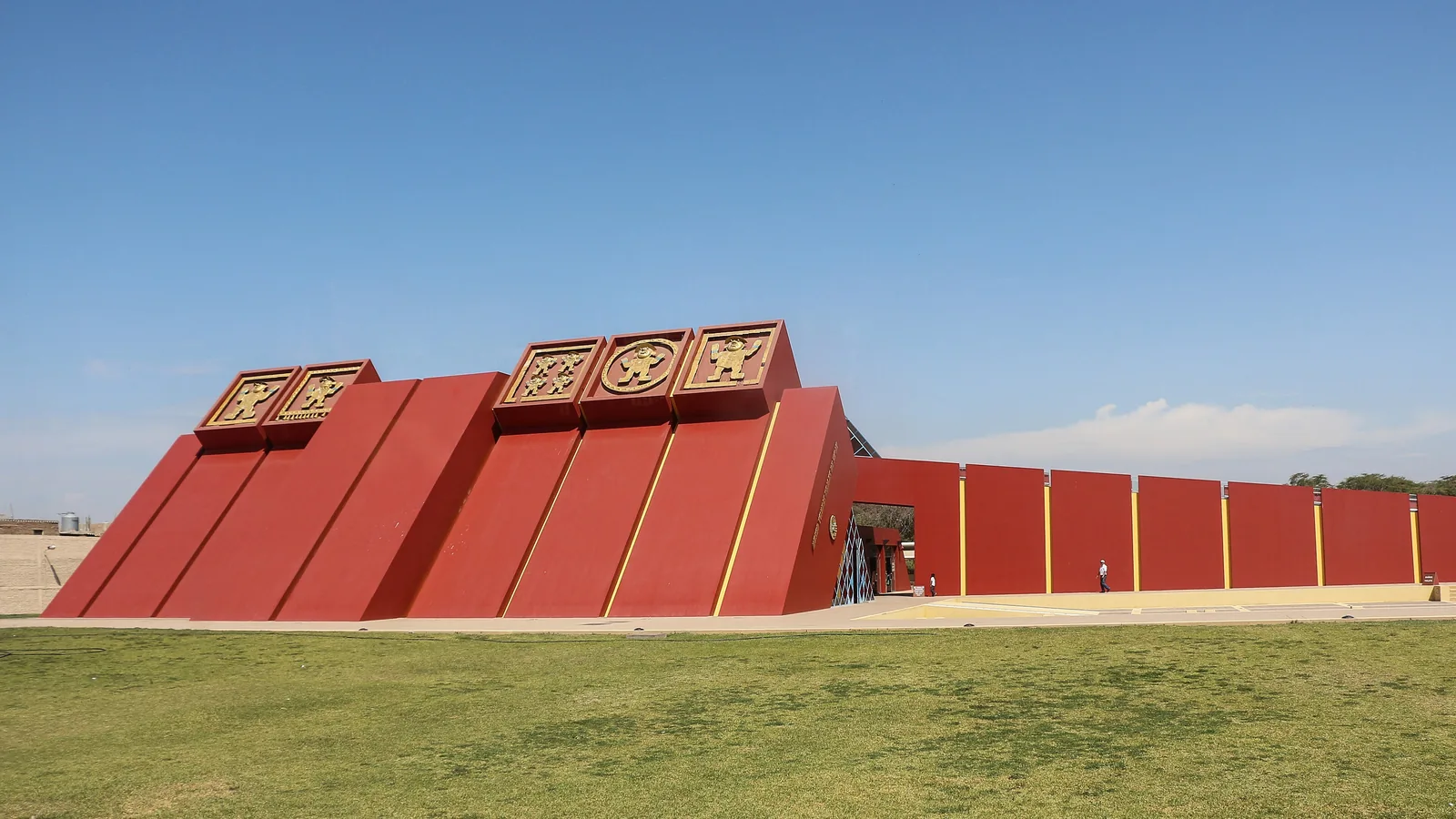
The museum that holds the thigh protector is a three-story building entered by a ramp 74.21 meters long, modeled on the approach to Moche temples. Mincetur counts more than 2,000 gold pieces in the collection and more than 400 jewels in armored cases, among them ear ornaments of gold and turquoise. Peru’s Ministry of Culture runs it.
At the Peruvian Embassy in Washington
The Justice Department release of December 8, 2011, stated that raiders at the Moche sites after 1987 found a gold monkey head dated to about AD 300. It passed into a private collection in the United States, and the collector gave it to the Museum of New Mexico, Palace of the Governors, in Santa Fe. The museum then signed a memorandum of understanding with the government of Peru to send it back.
Charles M. Oberly III, the U.S. attorney for the District of Delaware, credited the FBI Art Crime Team, the New Mexico Attorney General’s Office and the Museum of New Mexico, among others. Oberly said he hoped the return would “help repair at least some of the damage caused by the looting of Moche sites.” The monkey head went back to the government of Peru at a ceremony in the Peruvian Embassy in Washington on December 8, 2011.
Key facts
- The Peruvian National Police recovered looted gold and gilded copper at Sipán in February 1987; Mincetur says the pieces marked the start of the archaeological investigation.
- Peru’s Ministry of Culture gives July 20, 1987, as the date the discovery of the Lord of Sipán’s tomb was registered, by a team led by Walter Alva, Susana Meneses and Luis Chero Zurita.
- Huaca Rajada is a group of three adobe pyramids near Sipán, in the Saña (or Zaña) district of Lambayeque region.
- Mincetur dates the Lord of Sipán to the third century and places him around AD 250.
- Porcaro and co-authors describe the Royal Tomb of Sipán as totaling fourteen tombs; Mincetur counts sixteen elite Mochica funerary contexts at Huaca Rajada.
- A gold-and-silver thigh protector from the tombs has a gold half made of Tumbaga, an alloy of 60 to 80 percent copper (Porcaro et al., 2023).
- The Museo Tumbas Reales de Sipán in Lambayeque opened in 2002; Mincetur counts more than 2,000 gold pieces in its collection.
- A gold Moche monkey head, dated to about AD 300, was returned to Peru at its embassy in Washington, D.C., on December 8, 2011.
FAQ
Who discovered the tomb of the Lord of Sipán?
A team of Peruvian archaeologists led by Walter Alva, Susana Meneses and Luis Chero Zurita, working for the Museo Brüning de Lambayeque. Peru's Ministry of Culture gives July 20, 1987, as the date the discovery was registered.
Where are the Sipán gold objects kept?
Most are in the Museo Tumbas Reales de Sipán in the city of Lambayeque, which opened in 2002 and is run by Peru's Ministry of Culture. Mincetur counts more than 2,000 gold pieces there.
What is Tumbaga?
An alloy made mostly of copper, 60 to 80 percent, with smaller amounts of gold and silver. Moche smiths removed copper from the surface so the object looked like pure gold; a 2023 study found Tumbaga in the gold half of a thigh protector from Sipán.
Sources
- Ministerio de Cultura del Perú, press release "Museo de Sitio Huaca Rajada Sipán conmemora 38 años del hallazgo del Señor de Sipán, ícono de la arqueología peruana" (July 18, 2025).
- Ministerio de Comercio Exterior y Turismo (Mincetur), tourism resource inventory, "Complejo Arqueológico Huaca Rajada - Sipán" (code 155).
- Mincetur, tourism resource inventory, "Museo Tumbas Reales De Sipán" (code 2352).
- Ministerio de Cultura del Perú, Museos del Perú, "Museo Tumbas Reales de Sipán" (address and administration).
- Marta Porcaro, Roberto Cesareo, Angel Bustamante and Antonio Brunetti, "Characterization of an Ancient Bimetallic Alloy from Moche Civilization (Peru)," Materials 16, no. 22 (2023): 7211, PubMed Central PMC10673082.
- Museo Larco, Lima, permanent exhibition, "Mochica Gold Ear Ornaments" (Room 11, Vitrine 137).
- U.S. Department of Justice, "Peruvian Artifact Repatriated" (press release, December 8, 2011, FBI archived copy).
Cite this article
- APA
- Song Letter. (2026, September 30). Gold seized by police in February 1987 led archaeologists to Sipán. Our Earth's History. https://ourearthshistory.com/americas/classical/sipan-1987-walter-alva-moche-royal-tombs/
- Chicago
- Song Letter. “Gold seized by police in February 1987 led archaeologists to Sipán.” Our Earth's History, September 30, 2026. https://ourearthshistory.com/americas/classical/sipan-1987-walter-alva-moche-royal-tombs/.
- MLA
- Song Letter. “Gold seized by police in February 1987 led archaeologists to Sipán.” Our Earth's History, 30 Sep. 2026, https://ourearthshistory.com/americas/classical/sipan-1987-walter-alva-moche-royal-tombs/.
Get the week in history
One email a week: the new articles, and what was happening elsewhere at the same moment. Free, no ads, unsubscribe any time. How we handle your email.
Text licensed CC BY-NC-ND 4.0. Found an error? Tell us.