Why did an emperor carve his regret for a war into rock across India?

TL;DR — Ashoka conquered Kalinga, then had an edict cut into rock saying the killing and deportation pained him and that his heirs should conquer by dhamma instead.
Ashoka, the third Maurya king, carved his regret into rock because he wanted his sons and grandsons to read it and give up conquest by arms. He ruled from about 268 to 232 BC over most of the Indian subcontinent. Eight years after his coronation his armies took Kalinga, on the east coast of India, and the text he had cut afterward, Rock Edict 13, gives its own count of the cost. Copies of his edicts stood at more than 30 places, and their script went unread for centuries until James Prinsep read it in 1837.
Quick facts
- When
- Ashoka ruled about 268–232 BC · Kalinga conquered eight years after his coronation, about 262–260 BC · script read 1837 · name Ashoka found 1915
- Where
- More than 30 sites from Kandahar in what is now Afghanistan to Karnataka in south India; Sarnath and Sanchi in the north
- Who
- Ashoka, third Maurya king; James Prinsep, who read Brahmi in 1837; G. Yazdani, who published the Maski edict in 1915
- Outcome
- Rock Edict 13 gives its own count of 150,000 deported and 100,000 killed; the emperor's name Ashoka appears on one edict only
What Rock Edict 13 says about Kalinga
The only contemporary account of the war is the edict itself. In the translation of the Australian monk S. Dhammika, published in Kandy in 1993, it opens: “Beloved-of-the-Gods, King Piyadasi, conquered the Kalingas eight years after his coronation. One hundred and fifty thousand were deported, one hundred thousand were killed and many more died (from other causes).” Those figures are the edict’s own. No census or enemy account survives to check them.
The absolute date depends on when the coronation is placed: Dhammika put the war in 262 BC, Joshua J. Mark of World History Encyclopedia about 260 BC, so about 261 BC. The edict says the king “feels deep remorse,” that the deaths of the pious householders and ascetics of Kalinga pained him most, and that “conquest by dhamma” was now the only conquest worth having. It also warns the forest peoples that he still had the power to punish them. It does not say that Kalinga was returned or that the deported came home, a silence Mark wrote about in his 2020 article on the king.
What dhamma meant in practice
Dhamma is the Prakrit form of the Sanskrit dharma, and the edicts define it as conduct: “little evil, much good, kindness, generosity, truthfulness and purity.” The Major Rock Edicts, issued about 257 and 256 BC by Dhammika’s dating, spell out the program. Rock Edict 1 says that “hundreds of thousands of animals” had once been killed each day for the royal kitchen and that the number was now “two peacocks and a deer, and the deer not always.”
Rock Edict 2 records medical treatment for people and for animals, herbs imported where they did not grow, and wells dug and trees planted along the roads, a service extended beyond the border to the Seleucid king Antiochus II. Rock Edict 5 says the king appointed officers called dhamma mahamatras 13 years after his coronation to work “among all religions.” Rock Edict 12 tells subjects to stop “praising one’s own religion, or condemning the religion of others without good cause.” The edicts describe the king as a lay Buddhist who went on pilgrimage to Bodh Gaya and Lumbini; they say nothing about Buddhist philosophy, which Dhammika read as a sign that their purpose was administrative.
Where the edicts stand and in what scripts
Dhammika counted the edicts at more than 30 places in India, Nepal, Pakistan and Afghanistan. They fall into 14 Major Rock Edicts, a set of Minor Rock Edicts, seven Major Pillar Edicts and a few Minor Pillar Edicts. The pillar edicts are best preserved on the Delhi-Topra pillar, dated by Dhammika to 243 and 242 BC. Ten inscribed pillars survive, up to 50 feet tall, all quarried at Chunar near Varanasi.
The language was Prakrit, in four regional dialects according to J. G. de Casparis in Encyclopaedia Iranica, and most copies were cut in Brahmi, the ancestor of later Indian scripts. At Shahbazgarhi, in what is now Pakistan, the same texts were cut in Kharosthi, a script derived from Aramaic, as Jona Lendering of Livius described. At Kandahar, in what is now Afghanistan, a Greek and Aramaic summary of the early edicts was cut for the Greek colony settled there since Alexander; Gérard Fussman’s Iranica entry cites its publication by Daniel Schlumberger and Louis Robert in 1958. The scribe of the Brahmagiri copy in Karnataka signed in Brahmi and then wrote the word for “scribe” in Kharosthi, a northerner’s habit that Vincent Smith and Fussman both recorded.
How the edicts were read again: 1837 and 1915
By the 19th century no one could read Brahmi. James Prinsep, a British scholar working in India, worked out the script in 1837 from the Delhi pillar and an inscription at Sanchi, and found that the texts were issued by a king who called himself Devanampiya Piyadasi, “Beloved of the Gods, He Who Looks On With Affection.” Buddhist texts, among them the chronicles of Sri Lanka, told of a king Asoka, and scholars argued for decades over whether the two were the same man.
The name itself surfaced in 1915. A Minor Rock Edict found at Maski, then in the Nizam’s Dominions and now in Karnataka, opened with the words Devanampiyasa Asokasa, “of Beloved-of-the-Gods Asoka.” G. Yazdani published it that year in the Hyderabad Archaeological Series. Smith, revising his biography of the king in 1920, wrote that the Maski text “supersedes much argument” and that no other inscription gave the emperor’s personal name.
What became of the empire
The Maurya line did not hold. Smith cited the Puranas, which give the dynasty 133 or 137 years in all, and dated its end to about 188 BC; Mark gave 185 BC. The last king, Brihadratha, was killed by his own commander, Pushyamitra Shunga, who took the throne. Within 50 years of Ashoka’s death the empire was gone, and Mark wrote that the edicts were forgotten with it as Brahmi fell out of use. According to the Sri Lankan chronicles, Ashoka’s son Mahinda had carried Buddhism to the island; the edicts themselves speak of envoys to the Hellenistic kings and to the south as far as Tamraparni, an old name for Sri Lanka.
What survives: the lion capital and Sanchi
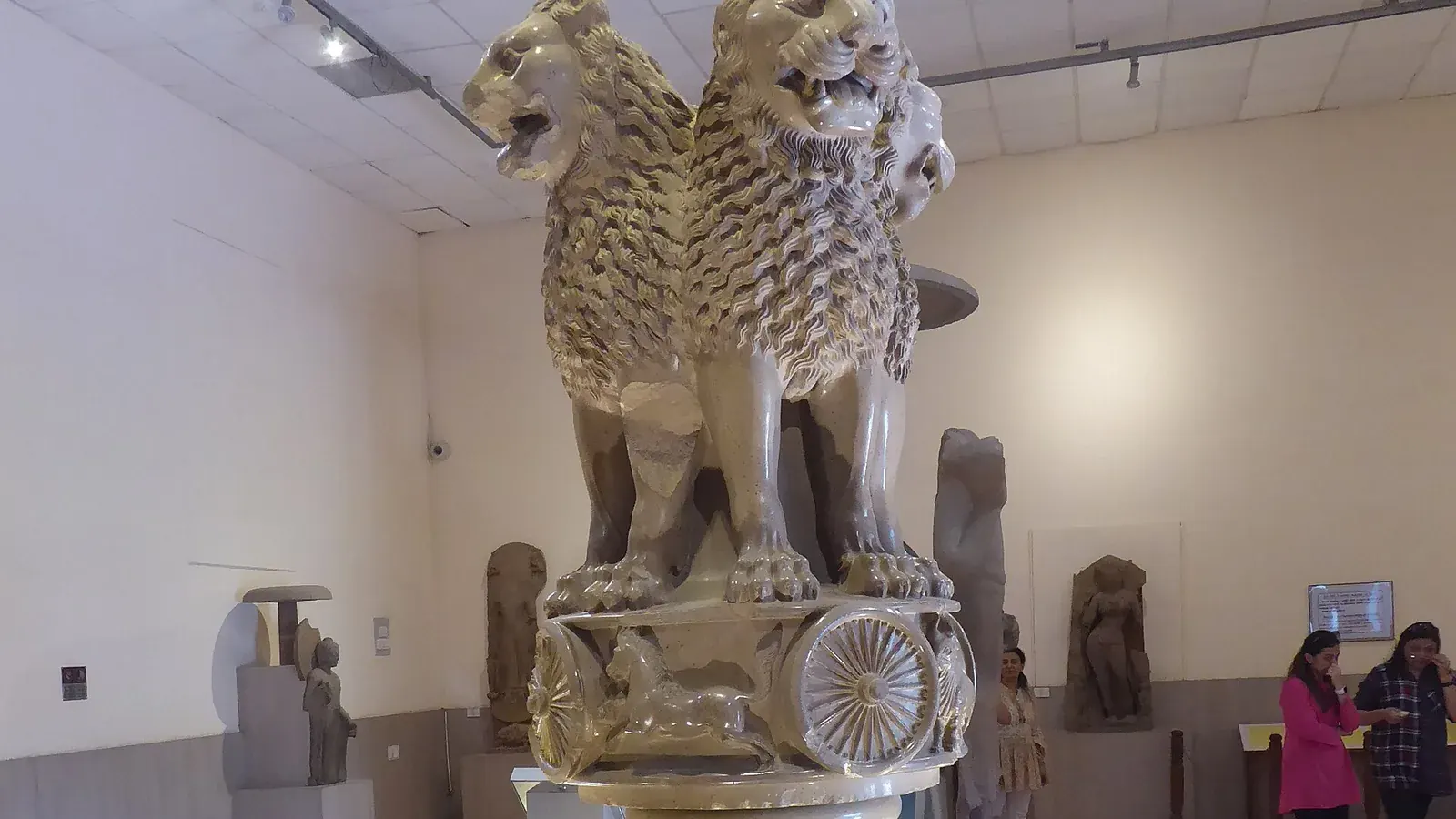
The pillar Ashoka set up at Sarnath, near Varanasi, carried a capital of four lions facing in four directions. After India’s independence in 1947 that capital was adopted as the national emblem. At Sanchi in Madhya Pradesh the brick stupa Ashoka raised was enlarged and cased in stone under the Shunga dynasty and given four carved gateways; Smith recorded fragments of Ashoka’s pillar near the southern one. UNESCO listed the Buddhist monuments at Sanchi as a World Heritage site in 1989.
The edicts are the earliest body of writing from India that can still be read, and Dhammika judged their repetitive style to be the king’s own. They record a war by its cost, a policy by its rules, and a name that took 78 years of reading to recover.
Key facts
- Ashoka ruled the Maurya empire from about 268 to 232 BC; the Kalinga campaign fell eight years after his coronation, dated 262 BC by Dhammika and about 260 BC by Mark.
- Rock Edict 13 gives its own figures: 150,000 deported, 100,000 killed, “many more” dead from other causes.
- The edicts survive at more than 30 sites in what is now India, Nepal, Pakistan, Bangladesh and Afghanistan; 14 Major Rock Edicts, seven Major Pillar Edicts and the minor edicts.
- The language was Prakrit; the scripts were Brahmi, Kharosthi in the northwest, and Greek and Aramaic at Kandahar.
- James Prinsep read Brahmi in 1837 and found the royal title Devanampiya Piyadasi; the Maski edict published in 1915 was the first to carry the name Asoka.
- The Sarnath lion capital became the national emblem of India after independence in 1947; Sanchi was inscribed by UNESCO in 1989.
FAQ
What does Rock Edict 13 say about the Kalinga war?
That the king conquered Kalinga eight years after his coronation, that 150,000 were deported and 100,000 killed by the edict's own count, and that the king felt remorse and wanted his successors to conquer by dhamma instead.
Who first read Ashoka's edicts?
James Prinsep deciphered the Brahmi script in 1837 and read the title Devanampiya Piyadasi. The personal name Asoka appeared only on the Maski edict, found in 1915 and published by G. Yazdani.
Where can Ashoka's edicts be seen?
On rocks at Girnar, Kalsi, Shahbazgarhi, Dhauli and other sites, on pillars such as Delhi-Topra and Lumbini, and in the Kandahar Greek and Aramaic text, which was kept in the Kabul Museum and has since disappeared.
Sources
- Livius.org — "Ashoka's Rock Edicts," the 14 Major Rock Edicts in the translation of Ven. S. Dhammika.
- Ven. S. Dhammika — The Edicts of King Asoka (Buddhist Publication Society, Kandy, 1993), DharmaNet edition mirrored at Colorado State University.
- World History Encyclopedia — Joshua J. Mark, "The Edicts of Ashoka the Great" (June 29, 2020).
- World History Encyclopedia — Joshua J. Mark, "Ashoka the Great" (June 24, 2020).
- Livius.org — Jona Lendering, "Shahbazgarhi."
- Livius.org — Jona Lendering, "Alexandria in Arachosia (Kandahar)."
- Encyclopaedia Iranica — J. G. de Casparis, "Aśoka i. The life and teaching of Aśoka" (1987).
- Encyclopaedia Iranica — Gérard Fussman, "Aśoka ii. Aśoka and Iran" (1987).
- Vincent A. Smith — Asoka, the Buddhist Emperor of India, 3rd ed. (Oxford: Clarendon Press, 1920), full text at the Internet Archive.
- UNESCO World Heritage Centre — "Buddhist Monuments at Sanchi" (inscribed 1989).
- World History Encyclopedia — "Greek and Aramaic inscriptions by king Ashoka," image record with the Greek text and G. P. Carratelli's translation.
Cite this article
- APA
- Our Earth's History. (2026, September 20). Why did an emperor carve his regret for a war into rock across India? Our Earth's History. https://ourearthshistory.com/south-asia/classical/ashoka-edicts-regret-carved-in-rock/
- Chicago
- Our Earth's History. “Why did an emperor carve his regret for a war into rock across India?” Our Earth's History, September 20, 2026. https://ourearthshistory.com/south-asia/classical/ashoka-edicts-regret-carved-in-rock/.
- MLA
- “Why did an emperor carve his regret for a war into rock across India?” Our Earth's History, 20 Sep. 2026, https://ourearthshistory.com/south-asia/classical/ashoka-edicts-regret-carved-in-rock/.
Text licensed CC BY-NC-ND 4.0. Found an error? Tell us.