The Pharos of Alexandria, a marble tower with a fire for ships
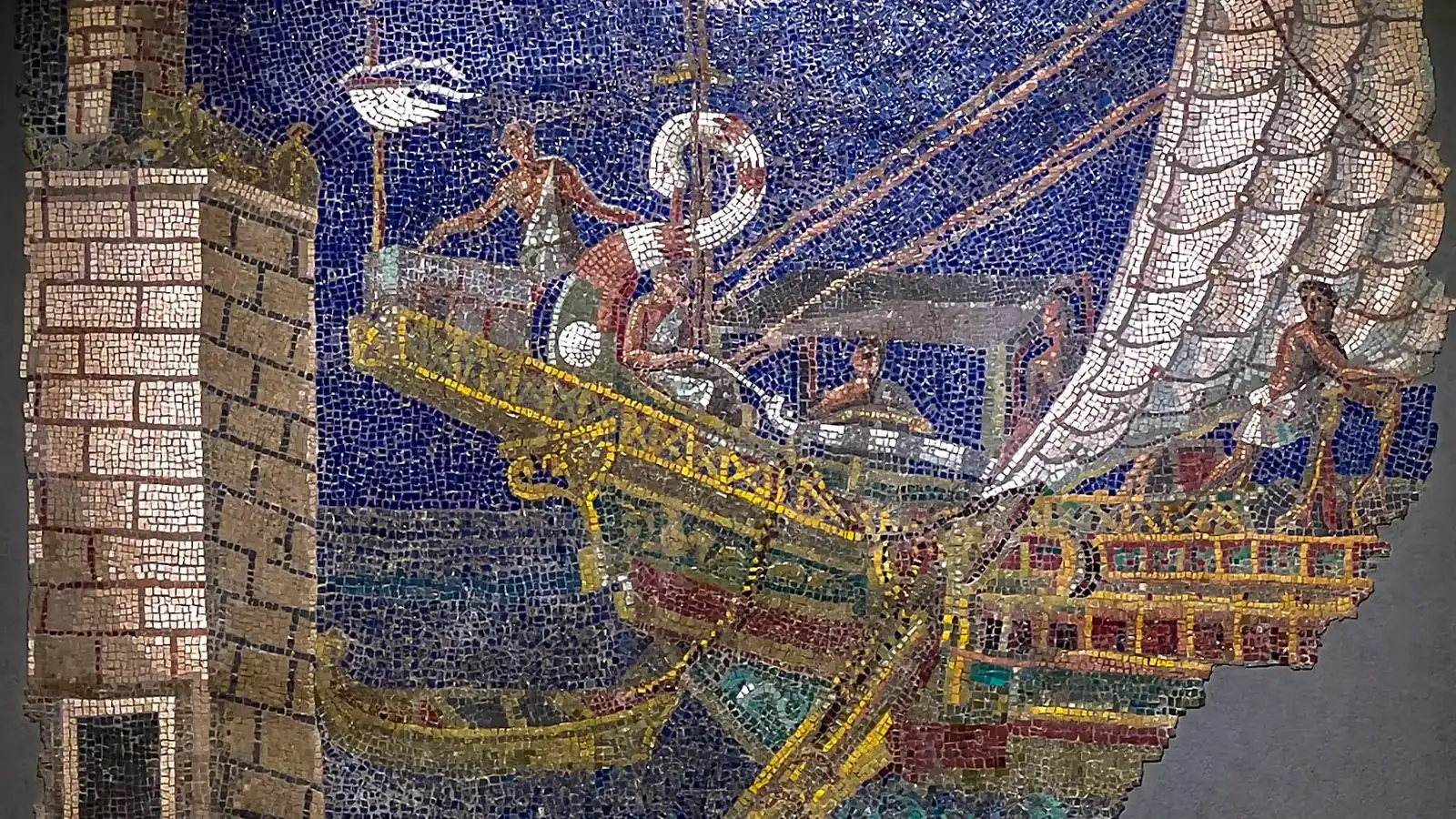

TL;DR — The Pharos of Alexandria, commissioned by Ptolemy I in 299 BC and finished in 279, rose over 100 meters to guide ships into port.
The Lighthouse of Alexandria stood on the island of Pharos at the entrance to the harbor of the Ptolemies’ capital. The historian Jona Lendering records that it was “commissioned in 299 BCE by king Ptolemy I Soter of Egypt,” built by an architect named Sostratus, and “finished in 279, when Ptolemy II Philadelphus was on the throne.” Two Roman-era writers describe it: the geographer Strabo and Pliny the Elder, who gives its cost.
Quick facts
- When
- Commissioned in 299 BC; finished in 279 BC; destroyed by an earthquake in 1326
- Where
- The eastern tip of the island of Pharos, at the harbor of Alexandria, Egypt
- Who
- Ptolemy I Soter and Ptolemy II Philadelphus; the architect Sostratus of Cnidus
- Outcome
- A tower of more than 100 meters in three stages, later used as a lighthouse, and counted among the Seven Wonders
A harbor that needed a mark
Alexandria was rich because of its position. Strabo wrote that its greatest advantage was “being the only place in all Egypt well situated by nature for communication with the sea by its excellent harbour, and with the land by the river,” which made it “the greatest mart in the habitable world.” The city, Lendering notes, was founded by Alexander the Great and became the capital of the Ptolemaic Empire under Ptolemy I.
Its approach was dangerous. “As the coast on each side is low and without harbours, with reefs and shallows,” Strabo explained, “an elevated and conspicuous mark was required to enable navigators coming in from the open sea to direct their course exactly to the entrance of the harbour.”
Marble and an architect's name
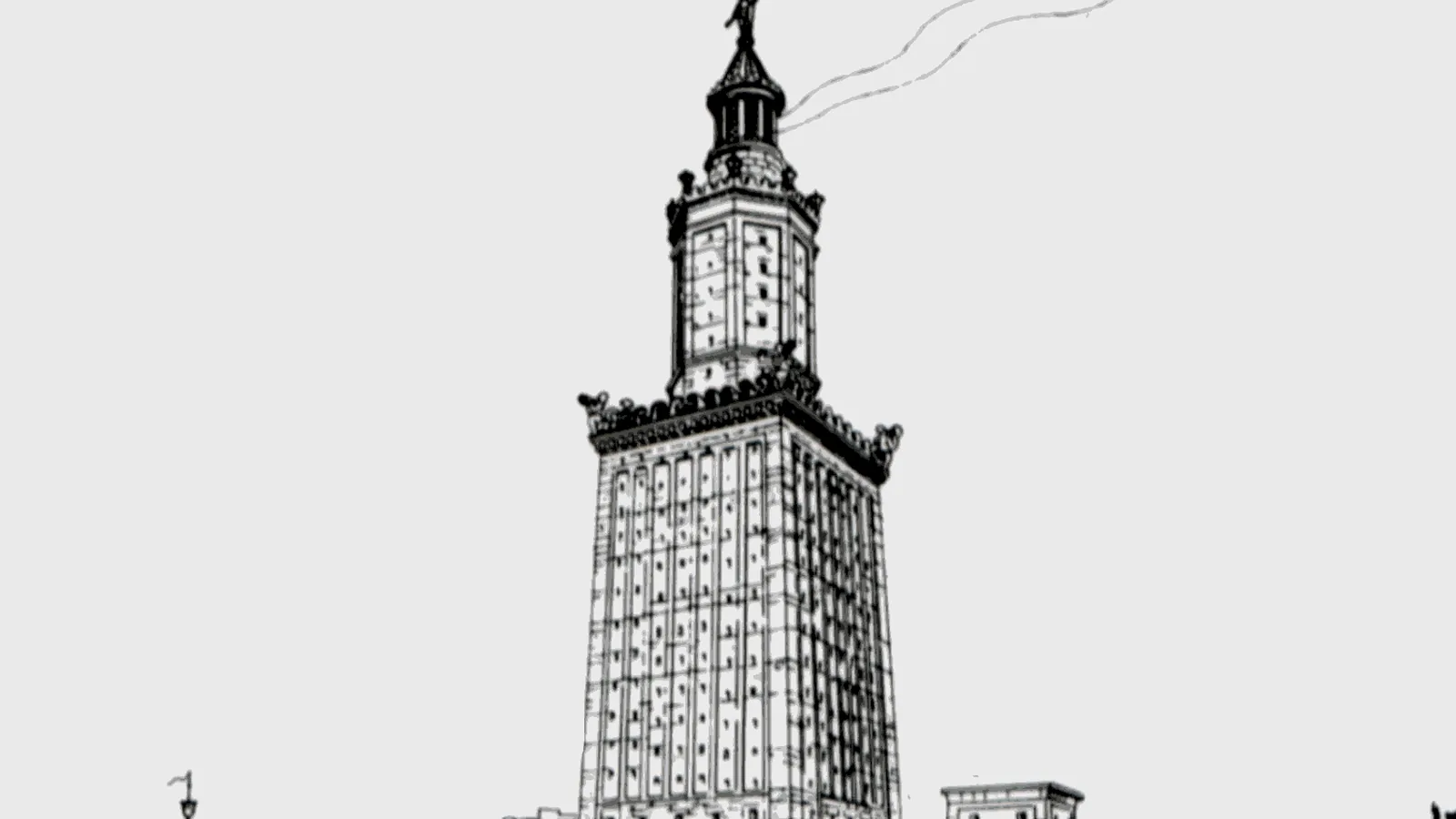
Strabo describes the tip of Pharos as “a rock, washed by the sea on all sides, with a tower upon it of the same name as the island, admirably constructed of white marble, with several stories.” He adds that “Sostratus of Cnidus, a friend of the kings, erected it for the safety of mariners, as the inscription imports.” A note in the Perseus edition records that the scholar Kramer rejected the exact words of that dedication as a later insertion from the margin.
Pliny gives the price. “The cost of its erection was eight hundred talents, they say,” he wrote, and he praised the magnanimity of King Ptolemy, who “gave permission to the architect, Sostratus of Cnidos, to inscribe his name upon the edifice itself.”
Three stages and a fire
Lendering gives the tower’s form as “a square base 56 meters high; an octagonal middle 28 meters high; a circular top of perhaps another 28 meters; the total was more than 100 meters.” He adds that it was at first “just a high tower that made the port of Alexandria visible from far away,” and that at some time in the first century BC “it was converted into a real lighthouse, so that sailors could benefit from it by night as well.”
Pliny knew it as a light. Its object, he wrote, was “by the light of its fires at night, to give warning to ships, of the neighbouring shoals, and to point out to them the entrance of the harbour.” Similar fires burned “in numerous places, Ostia and Ravenna, for example,” and “the only danger is, that when these fires are thus kept burning without intermission, they may be mistaken for stars.”

A Macedonian king crowned as pharaoh
The tower’s patron ruled Egypt in two styles. Ptolemy I, one of Alexander’s successors, “assumed the royal diadem in the late summer of 306, and was crowned in the native fashion, as a pharaoh, in January 304,” Lendering writes, taking a throne name in Egyptian form. Presenting himself as pharaoh, Lendering adds, was the best way to win over the Egyptian population.
The Museum, the scholars’ institution of his capital, stood in the same palace quarter. Strabo describes it as “a part of the palaces,” with “a public walk and a place furnished with seats, and a large hall, in which the men of learning, who belong to the Museum, take their common meal,” and “property in common.”
A wonder that fell
The lighthouse took its place among the Seven Wonders later. One of the first known lists, by Antipater of Sidon in the first half of the second century BC, began with the walls of Babylon; “later, the first item was replaced by the Lighthouse of Alexandria, and this has become the canonical list,” Lendering writes. The tower “was destroyed by an earthquake in 1326,” and a fort stands on its site.
Key facts
- The lighthouse was commissioned by Ptolemy I in 299 BC and finished in 279 BC under Ptolemy II (Lendering).
- Strabo describes a tower “of white marble, with several stories” built by “Sostratus of Cnidus, a friend of the kings.”
- Pliny gives its cost as 800 talents and says its fires at night marked the harbor entrance.
- It rose in three stages of 56, 28 and about 28 meters, more than 100 meters in all (Lendering).
- It became a true lighthouse in the first century BC and was destroyed by an earthquake in 1326 (Lendering).
- It replaced the walls of Babylon on Antipater of Sidon’s list of wonders (Lendering).
FAQ
Who built the Lighthouse of Alexandria?
The architect Sostratus of Cnidus, for the Ptolemies. Ptolemy I commissioned it in 299 BC and it was finished in 279 BC under Ptolemy II.
How tall was the Lighthouse of Alexandria?
More than 100 meters, in Jona Lendering's figures: a square base of 56 meters, an octagonal middle of 28 and a round top of perhaps 28 more.
How much did the Pharos cost?
Eight hundred talents, according to Pliny the Elder.
Was the Pharos always a lighthouse?
Lendering writes that it began as a high landmark visible by day and was converted to a true lighthouse in the first century BC. Pliny describes its fires at night.
What happened to the Lighthouse of Alexandria?
It was destroyed by an earthquake in 1326. A fort now stands on the site.
Sources
- Strabo, Geography 17.1.6, 17.1.8 and 17.1.13, translated by H. C. Hamilton and W. Falconer (1903), Perseus Digital Library, Tufts University
- Pliny the Elder, Natural History 36.18, translated by J. Bostock and H. T. Riley (1855), Perseus Digital Library, Tufts University
- Jona Lendering, "Alexandria, Lighthouse," Livius.org
- Jona Lendering, "Alexandria," Livius.org
- Jona Lendering, "Ptolemy I Soter (3)," Livius.org
- Jona Lendering, "Seven Wonders of the Ancient World," Livius.org
Cite this article
- APA
- Song Letter. (2026, October 11). The Pharos of Alexandria, a marble tower with a fire for ships. Our Earth's History. https://ourearthshistory.com/africa/classical/pharos-lighthouse-alexandria-ptolemaic-harbor/
- Chicago
- Song Letter. “The Pharos of Alexandria, a marble tower with a fire for ships.” Our Earth's History, October 11, 2026. https://ourearthshistory.com/africa/classical/pharos-lighthouse-alexandria-ptolemaic-harbor/.
- MLA
- Song Letter. “The Pharos of Alexandria, a marble tower with a fire for ships.” Our Earth's History, 11 Oct. 2026, https://ourearthshistory.com/africa/classical/pharos-lighthouse-alexandria-ptolemaic-harbor/.
Get the week in history
One email a week: the new articles, and what was happening elsewhere at the same moment. Free, no ads, unsubscribe any time. How we handle your email.
Text licensed CC BY-NC-ND 4.0. Found an error? Tell us.