Meroë's royal pyramids and the gold Ferlini took in 1834

TL;DR — In 1834 Giuseppe Ferlini opened a Meroë pyramid and took gold jewelry made for Queen Amanishakheto, at first dismissed as fake, later split between Berlin and Munich.
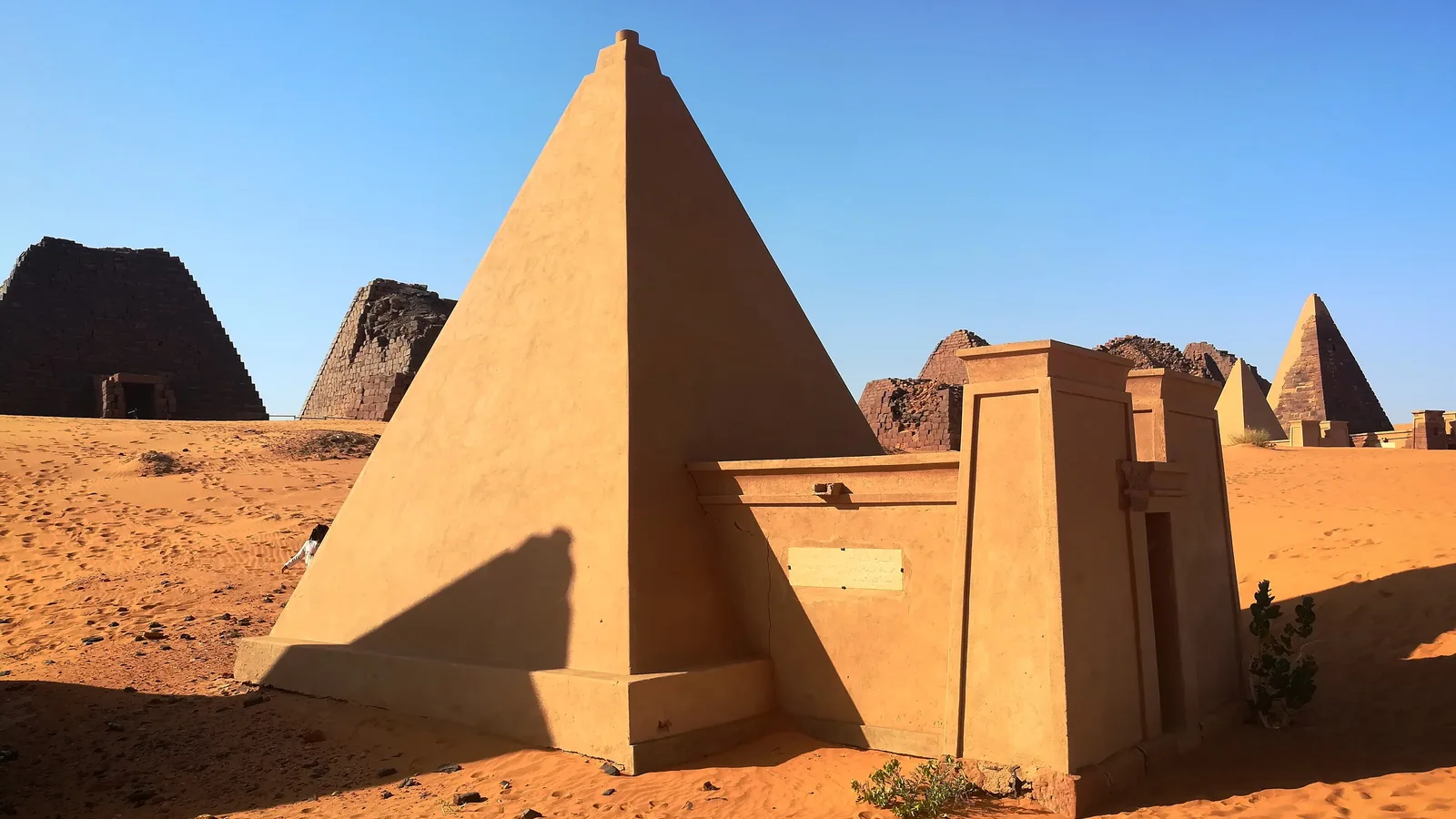
A Berlin museum catalogue entry says Giuseppe Ferlini, an Italian physician, found gold jewelry in a Meroë pyramid in 1834 that had belonged to Queen Amanishakheto. The Staatliche Museen zu Berlin describes the find as coming from “Ausgrabungen,” excavations, and puts that word in quotation marks. In the upper part of one of the largest pyramids at Meroë he found a small chamber holding a bier and a mass of grave goods, most of them identified as jewelry belonging to the Kushite queen buried below. The pyramid, later numbered Beg. N. 6, stood at Begarawiyah, the royal cemetery of the Kingdom of Kush near the ancient city of Meroë. Ferlini’s search left the structure in ruins, and the jewelry he brought out was at first taken for a fake.
Quick facts
- When
- 1834 (Ferlini's find) · 1840 (King Ludwig I buys 90 pieces for Munich) · 1844 (Karl Richard Lepsius confirms the find; the main lot is bought for Berlin) · July 15, 2002 (Munich reopens its Nubian gallery)
- Where
- A royal pyramid at Begarawiyah North, the cemetery of the Kingdom of Kush near Meroë, on the Nile about 200 kilometers northeast of modern Khartoum, Sudan; the objects now in Berlin and Munich
- Who
- Giuseppe Ferlini, an Italian physician; Queen Amanishakheto, a kandake of Kush; Karl Richard Lepsius; King Ludwig I of Bavaria; King Frederick William IV of Prussia
- Outcome
- Ferlini's find, first suspected a forgery, was confirmed in 1844 and divided between the Egyptian Museum in Berlin and the State Museum of Egyptian Art in Munich, where both collections still hold it
Giuseppe Ferlini opens a pyramid
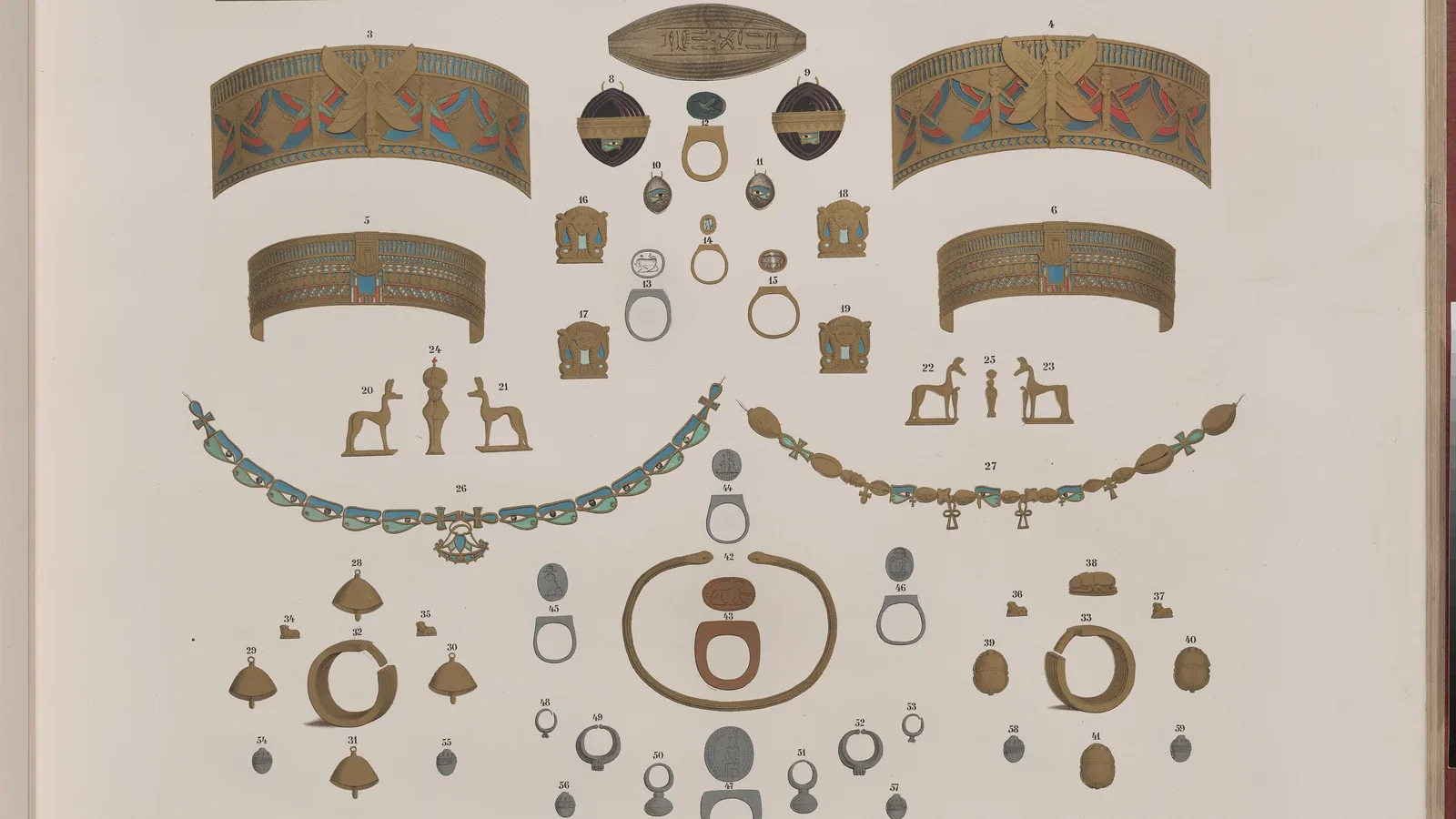
Berlin’s catalogue lists what came out of the chamber: ten bracelets, nine “Schildringe,” or shield rings, sixty-seven seal rings, two arm chains, and a number of amulets and pieces of four-strand necklaces or collars. A separate Berlin catalogue entry, describing a reassembled collar from the same find, counts “over sixty” seal rings, ten shield rings and ten bracelets. That second entry also states that the pyramid, Beg. N. 6, was built for the ruling queen Amanishakheto, whose burial is dated to the second half of the first century BC, and that the structure “was already nearly completely destroyed in 1834 by the Italian Giuseppe Ferlini’s search for treasure.”
1844: Lepsius confirms the gold is genuine
Buyers first suspected the jewelry was forged. Berlin’s catalogue states that only in 1844, when Karl Richard Lepsius obtained confirmation in Meroë from local residents who had taken part in the find, was the largest portion bought for Berlin. A smaller group had already left Sudan by then: in 1840, King Ludwig I of Bavaria bought ninety objects for his own collection, now in Munich. Munich’s State Museum of Egyptian Art names the buyer on the Prussian side as King Frederick William IV, who acquired the Berlin lot after Lepsius’s 1844 visit as part of the Royal Prussian Expedition. Berlin’s own catalogue adds a qualification about its source: Ferlini’s account of exactly where inside the pyramid’s superstructure the objects lay is “disputed today,” though the museum states that the objects’ uniqueness is not in question.
Shield rings, bracelets and a queen's name in a cartouche
The workmanship, per Berlin’s catalogue, points away from Egypt. One bracelet, ÄM 1644, is made of two hinged halves, with the hinges hidden under a small cast head of the ram-headed god Amun set on a large aegis, worked with raised uraeus and rosette motifs. A shield ring, ÄM 22870, carries a solid cast ram head of Amun wearing a double-feather crown, a god Berlin’s catalogue calls one of the most powerful in the south, worshipped for centuries in the kingdoms of Napata and Meroë. Another shield ring, ÄM 22872, has a modeled lion head wearing a hemhem crown, an image of the Meroitic god Apedemak; Berlin’s catalogue for that ring calls it one of a group of nine shield rings found in Amanishakheto’s tomb, the number that conflicts with the ten given on the collar’s catalogue page. Two collars now on display, ÄM 1755 and ÄM 1757, are modern assemblies built from countless loose beads and amulets, arranged the way such collars appear on royal, non-royal and divine figures in relief carving; Berlin’s catalogue states that those reliefs give no detailed basis for reconstructing the originals piece by piece. Berlin’s catalogue calls the pieces among the most valuable evidence of Meroitic craft, certainly not Egyptian work, with some pieces of Hellenistic manufacture.
._Pyramidengruppe_A._Pyr._15._Gold-_und_Silber-_Schmuck_aufgefunden_von_Ferlini_1830._(_jetzt_im_K._Museum_zu_Berlin.)_(NYPL_b14291191-44190)_(cropped).jpg)
"Probably" the queen who fought Augustus
Berlin’s catalogue describes Amanishakheto as one of the kandakes, the “king’s mothers” of the Kingdom of Kush, who also carried the titles of ruler and king, and states that she was “probably” the opponent of the emperor Augustus in a war of 24 to 21 BC. Jehan Desanges, writing in the Revue française d’histoire d’outre-mer in 1975, states that under Augustus the Romans led an expedition as far as Napata, and perhaps beyond the fourth cataract, but did not hold ground past the Dodekaschoinos, a stretch of the Nile that Desanges describes as a Roman-Meroitic co-principality on the land of Isis, where the king of Meroë exercised certain powers. Desanges dates Rome’s later withdrawal from territory beyond Syene, today’s Aswan, to a decision by the emperor Diocletian, probably in AD 298.
Ninety pieces for Munich, the rest for Berlin
Berlin’s catalogue for the North Cemetery at Begarawiyah, next to the city of Meroë, states that the ground was used for about 250 BC to the middle of the fourth century AD, roughly six hundred years, and that its pyramid tombs hold thirty kings, eight ruling queens and three princes. The same catalogue gives the Kingdom of Meroë’s span as 300 BC to the middle of the fourth century AD. The Metropolitan Museum of Art’s own collection record, for an unrelated Meroitic-period archer’s ring excavated at Faras in Lower Nubia during the University of Oxford’s 1910-12 excavations in Nubia, independently gives the same period as “300 B.C.-A.D. 350.” Munich’s State Museum of Egyptian Art reopened its Nubian gallery, with the Amanishakheto jewelry on display, on July 15, 2002.
Key facts
- Berlin’s catalogue records Giuseppe Ferlini’s 1834 find inside a Meroë pyramid: ten bracelets, nine shield rings, sixty-seven seal rings and two arm chains.
- A separate Berlin catalogue page for the same find gives the shield rings as ten and the seal rings as “over sixty,” a count that does not match the first page.
- The pyramid is identified as Beg. N. 6, built for the ruling queen Amanishakheto, whose burial Berlin dates to the second half of the first century BC.
- Berlin’s catalogue states the pyramid “was already nearly completely destroyed in 1834” by Ferlini’s search.
- The jewelry was first suspected a forgery; Berlin’s catalogue says confirmation came only in 1844, from Karl Richard Lepsius’s inquiries among Meroë residents who had taken part in the find.
- King Ludwig I of Bavaria bought ninety objects for Munich in 1840, before the main Berlin purchase; Munich’s own museum names King Frederick William IV of Prussia as the buyer on the Berlin side.
- Berlin’s catalogue calls Amanishakheto “probably” the opponent of Augustus in a war of 24 to 21 BC, without stating it as certain.
- Berlin’s North Cemetery catalogue counts thirty kings, eight ruling queens and three princes buried there over about six hundred years, from around 250 BC to the mid-fourth century AD.
FAQ
Who was Giuseppe Ferlini?
An Italian physician who, in 1834, opened a pyramid at Meroë's Begarawiyah North Cemetery while searching for treasure, according to the Staatliche Museen zu Berlin's own catalogue of the find.
Why was the Amanishakheto jewelry first thought to be fake?
Berlin's catalogue does not give a reason beyond the suspicion itself, stating only that the find "was at first suspected to be forged" and that confirmation did not come until Karl Richard Lepsius's 1844 inquiries in Meroë.
Where is the Amanishakheto gold now?
Divided between two museums: the main portion in the Egyptian Museum in Berlin, bought after Lepsius's 1844 visit, and ninety pieces bought earlier, in 1840, by King Ludwig I of Bavaria for what is now the State Museum of Egyptian Art in Munich, which reopened its Nubian gallery on July 15, 2002.
Sources
- Staatliche Museen zu Berlin, collection object "Armschmuck mit dem widderköpfigen Gott Amun in einem Schrein" (ÄM 1644), text after K.-H. Priese, "Ägyptisches Museum Berlin," Mainz 1991, cat. 161
- Staatliche Museen zu Berlin, collection object "Halskragen" (ÄM 1755)
- Staatliche Museen zu Berlin, collection object "Schildring mit dem widderköpfigen Gott Amun" (ÄM 22870)
- Staatliche Museen zu Berlin, collection object "Schildring mit dem löwenköpfigen Gott Apedemak" (ÄM 22872)
- Staatliches Museum Ägyptischer Kunst München, "Meroe-Goldschmuck wieder ausgestellt," July 15, 2002
- Jehan Desanges, "L'Afrique noire et le monde méditerranéen dans l'Antiquité (Éthiopiens et Gréco-romains)," Revue française d'histoire d'outre-mer, 62/228 (1975), pp. 391-414
- Metropolitan Museum of Art, collection record for an "Archer's ring" (accession 26.4.127, Faras Cemetery 1, Grave 54)
Cite this article
- APA
- LETTER. (2026, September 28). Meroë's royal pyramids and the gold Ferlini took in 1834. Our Earth's History. https://ourearthshistory.com/africa/classical/meroe-pyramids-begarawiyah-ferlini-1834-amanishakheto-treasure/
- Chicago
- LETTER. “Meroë's royal pyramids and the gold Ferlini took in 1834.” Our Earth's History, September 28, 2026. https://ourearthshistory.com/africa/classical/meroe-pyramids-begarawiyah-ferlini-1834-amanishakheto-treasure/.
- MLA
- LETTER. “Meroë's royal pyramids and the gold Ferlini took in 1834.” Our Earth's History, 28 Sep. 2026, https://ourearthshistory.com/africa/classical/meroe-pyramids-begarawiyah-ferlini-1834-amanishakheto-treasure/.
Text licensed CC BY-NC-ND 4.0. Found an error? Tell us.