Hannibal's oath at the altar, as he told it to a king

TL;DR — Polybius says Hannibal himself told King Antiochus III that at nine his father made him swear at an altar never to be a friend of the Romans.
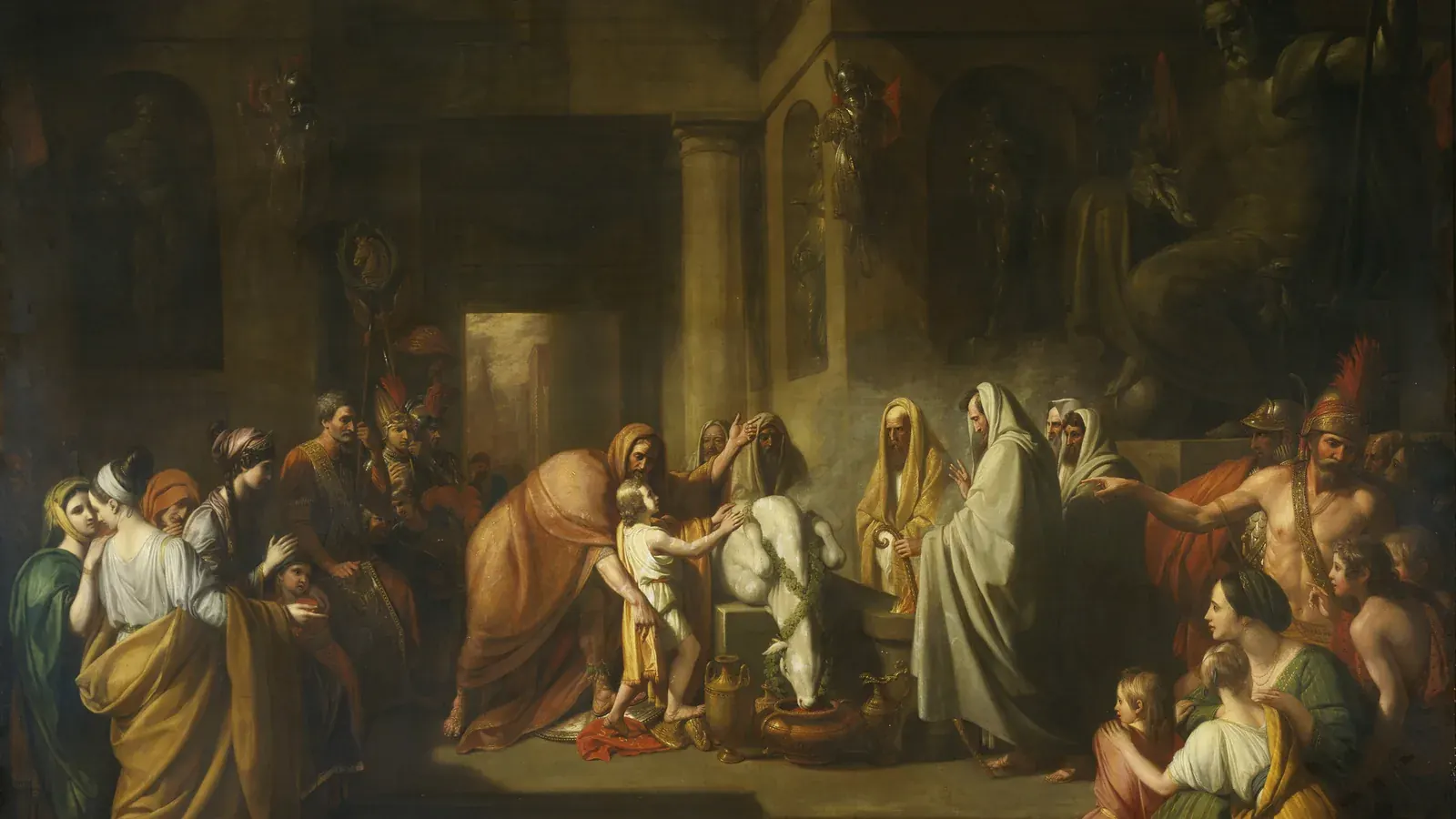
The story of Hannibal’s oath comes from Hannibal. The Greek historian Polybius reports that Hannibal, at the court of King Antiochus III, told the king how his father, Hamilcar Barca, about to leave with an army for Spain, had him swear at an altar “never to be the friend of the Romans.” Hannibal was nine. The Roman historian Livy tells the same scene independently, but introduces it as “a story.”
Quick facts
- When
- Hamilcar left for Spain when Hannibal was nine, by Polybius's account; Hannibal was born in 247 BC
- Where
- Carthage, before Hamilcar's expedition to Spain
- Who
- Hannibal; his father Hamilcar Barca; King Antiochus III, to whom Hannibal later told the story
- Outcome
- Hannibal led Carthage against Rome in the Second Punic War (218–202 BC)
The story Hannibal told Antiochus
Polybius places it in a conversation with Antiochus in which Hannibal was defending himself and, “being at a loss for further arguments,” used this one. “He said that at the time when his father was about to start with his army on his expedition to Spain, he himself, then nine years of age, was standing by the altar, while Hamilcar was sacrificing to Zeus.”
When the omens were good, Hamilcar sent the others away and asked the boy “if he wished to accompany him on the expedition.” Hannibal accepted “with delight,” Polybius continues, and “his father took him by the hand, led him up to the altar, and bade him lay his hand on the victim and swear never to be the friend of the Romans.”
Livy's version
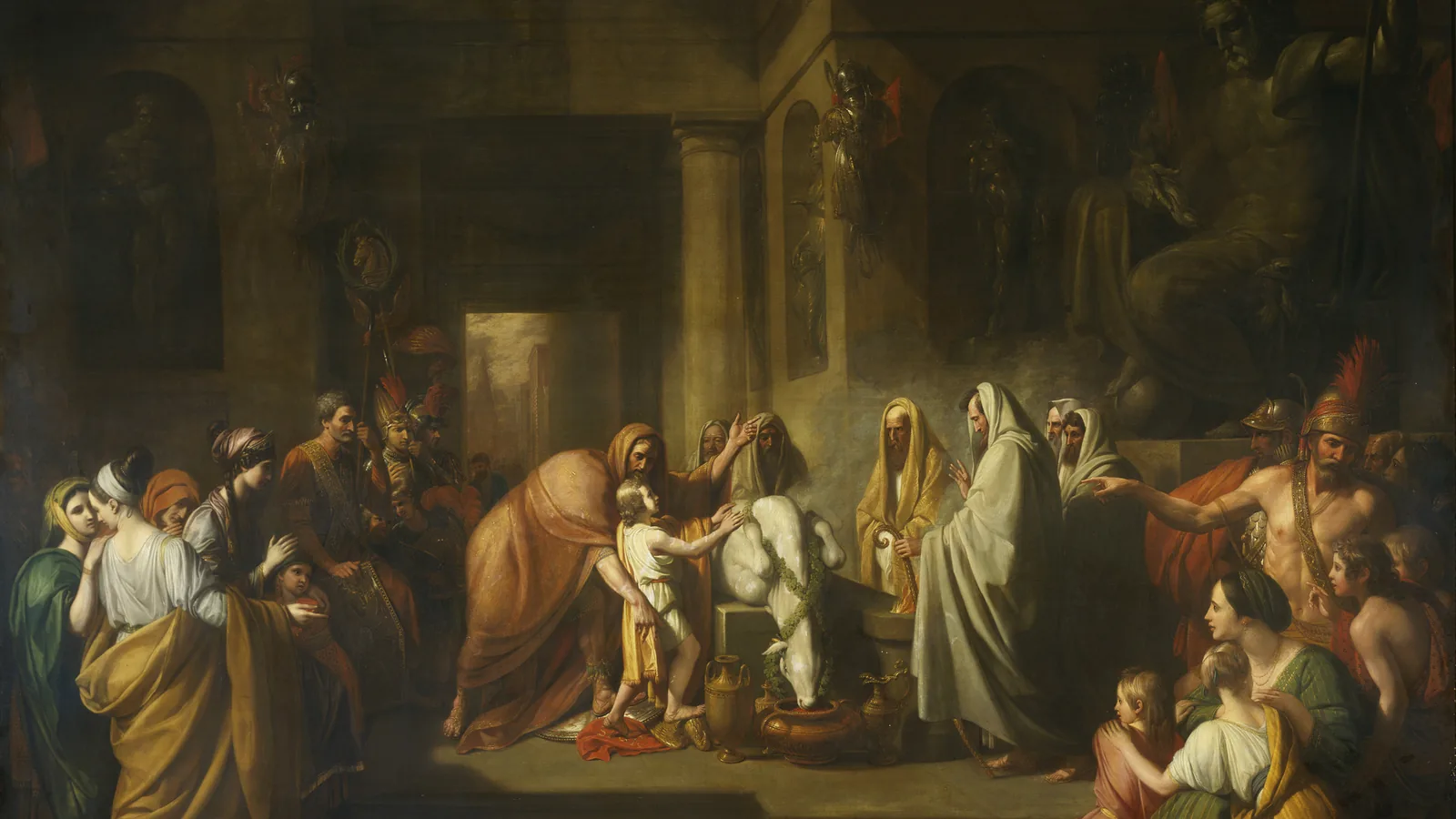
Livy, the Roman historian, gives the scene with a hedge. “There is besides a story,” he writes, “that Hannibal, when about nine years old, while he boyishly coaxed his father Hamilcar that he might be taken to Spain,” was “conducted to the altar; and, having laid his hand on the offerings, was bound by an oath to prove himself, as soon as he could, an enemy to the Roman people.”
Both accounts agree on the age, the altar and the journey to Spain. Polybius’s comes from Hannibal’s own telling, years after the event, to a king whose trust he needed.
The war his father had lost
Hamilcar’s grievance was the First Punic War. When it ended in 241 BC, the first terms agreed, as Polybius records them, required Carthage to evacuate Sicily and “to pay to the Romans by instalments in twenty years two thousand two hundred Euboean talents.” Rome’s people rejected that draft and sent ten commissioners, who made the terms harsher: “they reduced the term of payment by one half, added a thousand talents to the indemnity.”
Livy describes Hamilcar’s mood. “The loss of Sicily and Sardinia grieved the high spirit of Hamilcar,” he writes, “for he deemed that Sicily had been given up through a premature despair of their affairs.”
Nine or ten?
The age is the sources’ own. Jona Lendering, the historian behind Livius.org, dates Hannibal’s birth to 247 BC and writes that Hamilcar “took the ten-year old boy to Iberia in 237,” a year older than Polybius and Livy make him. Whatever his age, the boy grew into the general of the Second Punic War of 218–202 BC who, in Lendering’s words, “caught the Romans off guard by crossing the Alps.”
Key facts
- Polybius says Hannibal told King Antiochus III of the oath sworn at nine at his father’s altar (Polybius 3.11).
- The oath, in Polybius’s words, was “never to be the friend of the Romans” (Polybius 3.11).
- Livy tells the same scene as “a story,” with Hannibal “about nine years old” (Livy 21.1).
- The first peace terms of 241 BC set 2,200 talents over twenty years; Rome halved the term and added 1,000 talents (Polybius 1.62–63).
- Livius.org dates Hannibal’s birth to 247 BC and the journey to Iberia to 237 BC, at ten (Lendering).
FAQ
Did Hannibal really swear an oath against Rome?
The only source for it is Hannibal himself, as reported by Polybius: he told King Antiochus III that he swore it at nine. Livy repeats it as "a story."
How old was Hannibal when he swore the oath?
Nine, according to Polybius and Livy. Livius.org, counting from his birth in 247 BC, makes him ten when Hamilcar took him to Iberia in 237.
What exactly did Hannibal swear?
In Polybius's account, he swore "never to be the friend of the Romans." In Livy's, "to prove himself, as soon as he could, an enemy to the Roman people."
What did Carthage pay Rome after the First Punic War?
The first draft of the peace set 2,200 Euboean talents over twenty years. Rome's commissioners halved the term and added 1,000 talents.
Why did Hamilcar go to Spain?
Polybius says only that he was setting out with his army "on his expedition to Spain." Livy adds that the loss of Sicily and Sardinia grieved him.
Sources
- Polybius, The Histories 3.11, translated by W. R. Paton (1922), LacusCurtius, University of Chicago
- Polybius, The Histories 1.62–63, translated by W. R. Paton (1922), LacusCurtius, University of Chicago
- Livy, The History of Rome 21.1, translated by D. Spillan and Cyrus Edmonds (1849), Project Gutenberg
- Jona Lendering, "Hannibal Barca," Livius.org
Cite this article
- APA
- Song Letter. (2026, October 11). Hannibal's oath at the altar, as he told it to a king. Our Earth's History. https://ourearthshistory.com/africa/classical/hannibal-nine-year-old-oath-altar-rome/
- Chicago
- Song Letter. “Hannibal's oath at the altar, as he told it to a king.” Our Earth's History, October 11, 2026. https://ourearthshistory.com/africa/classical/hannibal-nine-year-old-oath-altar-rome/.
- MLA
- Song Letter. “Hannibal's oath at the altar, as he told it to a king.” Our Earth's History, 11 Oct. 2026, https://ourearthshistory.com/africa/classical/hannibal-nine-year-old-oath-altar-rome/.
Get the week in history
One email a week: the new articles, and what was happening elsewhere at the same moment. Free, no ads, unsubscribe any time. How we handle your email.
Text licensed CC BY-NC-ND 4.0. Found an error? Tell us.