What did the frozen tombs of the Altai preserve for 2,400 years?
.jpg)
TL;DR — Ice under the Pazyryk mounds kept wood, felt, horses, tattooed skin, a wagon and a knotted carpet from about 2,400 years ago — much of it matching Herodotus.
Permafrost under the Pazyryk mounds in the Altai Mountains kept log chambers, felt, horses, a wagon, tattooed skin and the oldest known pile carpet from the fifth and fourth centuries BC. The mounds belong to the Pazyryk culture, an eastern branch of the horse-riding Scythian world that Herodotus described from the Black Sea coast in about 430 BC. Sergei Rudenko’s teams opened the mounds in 1929 and 1947 to 1949; in 1993 Natalia Polosmak found a frozen woman’s grave on the nearby Ukok Plateau. The finds matched several of Herodotus’s stranger reports and started a dispute that has not ended: whether the Ukok woman should go back into the ground.
Quick facts
- When
- Pazyryk culture about 6th–2nd century BC · Herodotus wrote about 430 BC · Darius's campaign 513 BC · excavations 1929 and 1947–49 · Ukok burial found 1993 · returned to Gorno-Altaysk 2012
- Where
- Pazyryk valley and the Ukok Plateau in the Altai Mountains, in what is now the Altai Republic of Russia; Scythian steppe from the Black Sea to the Altai
- Who
- Sergei Rudenko and Mikhail Gryaznov (Pazyryk excavations); Natalia Polosmak (Ukok, 1993); Borys Mozolevskyi (Tovsta Mohyla pectoral, 1971); Herodotus
- Outcome
- Permafrost lenses kept wood, felt, leather, horses and tattooed bodies intact; the finds matched several of Herodotus's descriptions; the Ukok woman's remains are still contested
Who the Scythians were, and where the Altai fits
The Greeks used the name Scythians for nomadic, Iranian-speaking tribes of the Eurasian steppe. According to Anatoly Grablevsky’s 2024 essay for the Metropolitan Museum of Art, these tribes moved west from Central Asia in the late eighth century BC into what is now Ukraine and southern Russia and gave way to the Sarmatians by the late second century BC. They left no writing, so what is known of them comes from Assyrian, Persian and Greek texts and from their graves.
The Altai Mountains lie at the far eastern end of that world, some 4,000 kilometers from Thrace. Pavel Azbelev of the State Hermitage Museum placed the Pazyryk culture there between the sixth and second centuries BC and grouped it with the other “Scythian-Siberian” cultures by a shared triad of weapons, horse harness and animal-style art.
What Herodotus wrote, and how he knew it
Herodotus, a Greek from Halicarnassus, devoted the fourth book of his Histories to the Scythians. He was writing about people he mostly heard about: Karen S. Rubinson wrote in Expedition in 1975 that he traveled as far as Olbia on the Dnieper, and that much of the rest came secondhand from Black Sea Greeks who traded with the nomads. In George Rawlinson’s translation, he wrote that the Scythians had “neither cities nor forts,” shot from horseback and kept “their waggons the only houses that they possess.”
He recorded how a dead king was gutted, packed with chopped cypress and frankincense, sealed in wax and carted through the tribes before burial under a vast mound with strangled attendants and horses. After a burial, mourners built a booth of three sticks wrapped in felt, set red-hot stones inside and threw hemp seed on them; the vapor made the Scythians “shout for joy.” He also told how Darius I of Persia crossed the Danube into Scythia, chased an enemy who refused battle, received a bird, a mouse, a frog and five arrows as gifts, and slipped back by night. Jona Lendering of Livius.org dated the campaign to 513 BC, with 514 as the alternative.
What the ice kept at Pazyryk
Excavation began in 1929, when Mikhail Gryaznov of Rudenko’s Altai expedition opened the first Pazyryk mound; Rudenko dug mounds 2 through 5 between 1947 and 1949, and the finds went to the Hermitage. The preservation came from robbery: Rubinson described how thieves broke into the chambers soon after burial, water followed them in, and the water froze under the insulating cairn and stayed frozen.
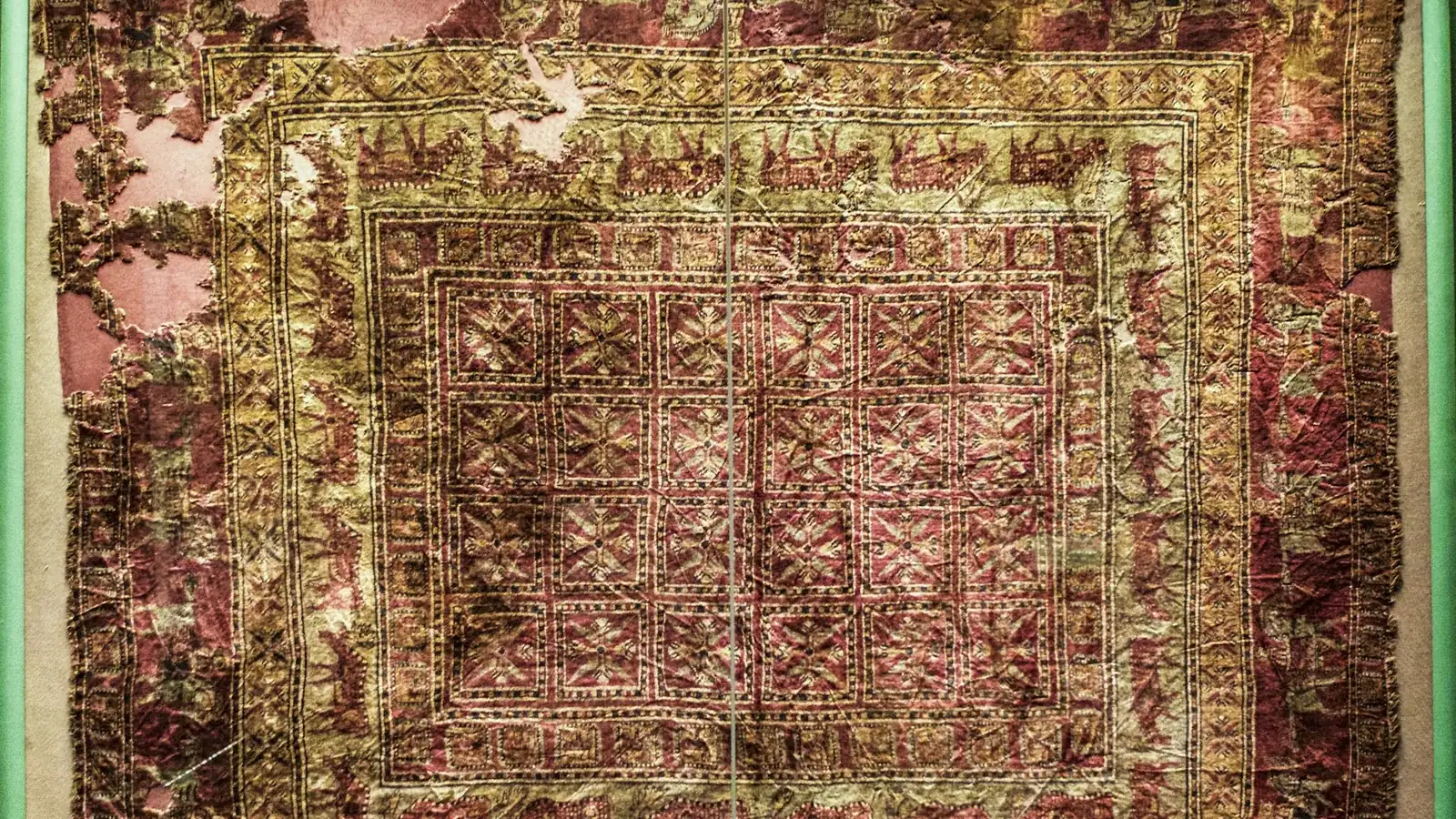
Mound 2 held an embalmed man whose skin still carried animal tattoos, and a censer on legs holding stones and hemp seeds, with the poles of a small tent frame beside it, Herodotus’s felt booth. Mound 5, opened in 1949, held what the Hermitage calls the world’s oldest pile carpet, about 2 meters square, with 24 cross-shaped lotus figures in the center, a border of 24 fallow deer and an outer band of 28 men on horseback and on foot. The same mound held a four-wheeled birch carriage about 3 meters high and more than 6 meters long, buried in pieces with four horses.
The woman of Ukok and the argument over her
In 1993 a team from the Institute of Archaeology and Ethnography in Novosibirsk, led by Polosmak, opened a lone mound at Ak-Alakha on the Ukok Plateau, where ice filled the larch chamber. The woman inside, aged about 25 and dated to the fifth century BC, wore a shirt of imported wild silk, a wool skirt and high felt boots; her tall headdress carried 14 birds carved from cedar, and six saddled horses lay with her. A stag with griffin heads on its antlers was tattooed on her shoulder. The press called her the “Altai Princess” or the “Siberian Ice Maiden”; the archaeologist Maria Ochir-Goryaeva told The Moscow Times in 2026 that the grave held no sign of royal power.
The body was flown to Novosibirsk, and in 2012 it came back to the Anokhin National Museum in Gorno-Altaysk. Elders said the woman had guarded the entrance to the underworld and blamed floods and earthquakes on her removal, and in 2014 the republic’s Council of Elders voted for reburial; a republic official answered that a museum exhibit could not simply be buried. In August 2026 The Moscow Times reported fresh calls for reburial, which Ochir-Goryaeva called impractical, since nothing can be put back into melting permafrost.
Gold, the animal style and the graves of armed women
The western Scythians left the gold. On June 21, 1971, the Ukrainian archaeologist Borys Mozolevskyi found a pectoral in an unrobbed side vault of the Tovsta Mohyla mound in the Dnipro region. Fourth century BC, 30.6 centimeters across and more than a kilogram of gold, it carries three tiers of scenes: two men sewing a shirt, a ewe being milked, and below them griffins biting at horses. It is in the Museum of Historical Treasures of Ukraine in Kyiv. Grablevsky described the animal style behind such work as naturalism pushed into stylization, a stag whose antlers sprout bird heads.
Some of the armed dead were women. In 2019 Valerii Guliaev’s team reported a fourth-century BC mound at Devitsa in western Russia with four women, one buried with two spears in a rider’s pose and the oldest in a gold headdress. Barry Cunliffe’s study The Scythians, quoted by Patrick Scott Smith in 2021, counted more than 40 female warrior burials in Scythian territory.
What the tombs still do not say
The carpet’s makers are unknown. The Hermitage entry lists Iran, Central Asia or a local copy of a Persian original; Azbelev read it as a foreign gift. No one knows who the carriage was for. Grablevsky wrote that scholars had argued for more than a century about what the animals meant, and Rubinson judged Herodotus right about the hemp but wrong about why it was burned, an intoxication rite, not a bath.
The ice answered questions that no text could. It showed the wax and the stitches on embalmed bodies, the felt tents and the wagons that Herodotus had only described. What it could not settle is who speaks for the woman of Ukok.
Key facts
- The Pazyryk culture occupied the Altai Mountains from about the sixth to the second century BC (Azbelev, Hermitage, 2022).
- Herodotus wrote about the Scythians in Book 4 of his Histories, about 430 BC; he visited Olbia and relied on Black Sea Greeks for much of the rest (Rubinson, 1975).
- Gryaznov opened Pazyryk mound 1 in 1929; Rudenko dug mounds 2 to 5 in 1947 to 1949.
- The Pazyryk pile carpet from mound 5 measures 183 by 200 centimeters with about 3,600 knots per square decimeter (Hermitage).
- Mound 2 held a tattooed man and a censer with hemp seeds beside a tent frame (Rubinson, after Rudenko).
- Polosmak’s team found the Ukok woman in 1993; her remains returned to Gorno-Altaysk in 2012, and reburial was still demanded in 2026.
- The Tovsta Mohyla pectoral, found June 21, 1971, is 30.6 centimeters across and weighs more than a kilogram.
FAQ
Who were the Scythians?
Nomadic, Iranian-speaking tribes of the Eurasian steppe between roughly the eighth and second centuries BC. They left no writing; Greek, Persian and Assyrian texts and their own graves are the evidence.
Why are the Pazyryk tombs so well preserved?
Robbers broke in soon after burial, water entered, and it froze under the insulating stone cairn. The ice lens kept wood, felt, leather, horses and embalmed bodies intact until excavation in 1929 and 1947 to 1949.
Was the Siberian Ice Maiden reburied?
No. Her remains were moved from Novosibirsk to the Anokhin National Museum in Gorno-Altaysk in 2012. The Council of Elders voted for reburial in 2014, and calls continued in 2026, but she remained in the museum.
Sources
- State Hermitage Museum — "Pile Carpet," Pazyryk Barrow No. 5, excavations by S. I. Rudenko, 1949 (digital collection entry).
- Voices on Central Asia — Pavel Azbelev (State Hermitage Museum), "The Treasures of Pazyryk Kurgans in the Hermitage Museum" (February 11, 2022).
- Wikisource — The History of Herodotus, Book 4 (Melpomene), translated by George Rawlinson.
- Livius.org — Jona Lendering, "Herodotus, bk 4, logos 11" (Darius's campaign against the Scythians, 4.83–144).
- Penn Museum, Expedition Magazine 17(4) — Karen S. Rubinson, "Herodotus and the Scythians" (1975).
- The Metropolitan Museum of Art, Heilbrunn Timeline of Art History — Anatoly Grablevsky, "Gold, Griffins, and Greeks: Scythian Art and Cultural Interactions in the Black Sea" (May 2024).
- Science First Hand (Siberian Branch of the Russian Academy of Sciences) — "The Altai Princess Revealed Her Face" (2022).
- The Moscow Times — Leyla Latypova, "Calls to Rebury a Siberian Mummy Unearth Decades of Distorted History" (August 28, 2026).
- IBTimes UK — Mary-Ann Russon, "Siberian Mummy Burial Row: Villagers Want Princess Ukok Reburied To Stop Natural Disasters" (August 26, 2014).
- Bukvy — "53 years ago archeologists found the Gold Pectoral from Tovsta Mohyla" (2024).
- World History Encyclopedia — Patrick Scott Smith, "Scythians" (March 18, 2021).
- Smithsonian Magazine — Theresa Machemer, "Tomb Containing Three Generations of Warrior Women Unearthed in Russia" (December 30, 2019).
Cite this article
- APA
- Our Earth's History. (2026, September 20). What did the frozen tombs of the Altai preserve for 2,400 years? Our Earth's History. https://ourearthshistory.com/central-asia/classical/scythians-frozen-tombs-altai/
- Chicago
- Our Earth's History. “What did the frozen tombs of the Altai preserve for 2,400 years?” Our Earth's History, September 20, 2026. https://ourearthshistory.com/central-asia/classical/scythians-frozen-tombs-altai/.
- MLA
- “What did the frozen tombs of the Altai preserve for 2,400 years?” Our Earth's History, 20 Sep. 2026, https://ourearthshistory.com/central-asia/classical/scythians-frozen-tombs-altai/.
Text licensed CC BY-NC-ND 4.0. Found an error? Tell us.