How did Persia run the largest empire the world had seen?

TL;DR — Darius I cut the empire into tax districts under appointed governors, tied them together with a royal road and relay riders, and paid and recorded everything in standard coin.
Persia ran its empire through tax districts under appointed governors, a royal road with relay riders, standard gold and silver coin, and records kept on clay. Cyrus the Great and his son Cambyses took the territory between 550 and 525 BC. Darius I, who seized the throne in 522 BC, turned it into an administration. Herodotus of Halicarnassus, writing in the fifth century BC, counted 20 tax districts and put Darius’s yearly revenue at 14,560 Euboean talents. Darius’s own Behistun inscription counted 23 lands.
Quick facts
- When
- 550 BC (Cyrus takes Media) to 330 BC (Alexander burns Persepolis); Darius I reigned 522–486 BC
- Where
- From Sardis in what is now western Turkey to Susa and Persepolis in what is now Iran, with Egypt, Babylonia and the Indus lands
- Who
- Cyrus the Great, Cambyses and Darius I; Herodotus of Halicarnassus; Henry Rawlinson, who copied the Behistun inscription from 1835
- Outcome
- Tax districts under satraps, a road of 111 stations, gold darics and silver sigloi, and tens of thousands of administrative tablets from Persepolis
How Cyrus and Cambyses assembled the empire
Cyrus, king of Anshan, revolted against his overlord, the Median king Astyages, in 550 BC. The Median general Harpagus went over to him, Astyages was captured, and Cyrus took charge of the Median federation and its tributaries. Around 547 BC he turned on Lydia, and the Metropolitan Museum of Art’s Department of Ancient Near Eastern Art records that Sardis fell after a two-week siege. In October 539 BC he took Babylon and captured its king, Nabonidus.
His son Cambyses routed the Egyptian army in the eastern Nile Delta in 525 BC, and Memphis fell after a ten-day siege. He died in 522 BC on the way home. Darius took the throne, fought a civil war against rebels in most provinces, and later pushed the frontier into the Indus valley.
Twenty tax districts, or twenty-three lands
Herodotus recorded that Darius set up 20 provincial governorships, joined neighboring peoples into single units, and assessed each for a fixed sum. Under Cyrus and Cambyses, he wrote, there had been no fixed tribute, only gifts, which was why the Persians called Darius a tradesman.
The sums in the Histories, at 3.89 to 3.97, are specific. Babylon and Assyria paid 1,000 talents of silver and 500 eunuch boys. Egypt paid 700 talents plus the fish revenue of Lake Moeris and 120,000 bushels of grain for the garrison at Memphis. India paid the largest single sum, 360 talents of gold dust. Persia paid nothing.
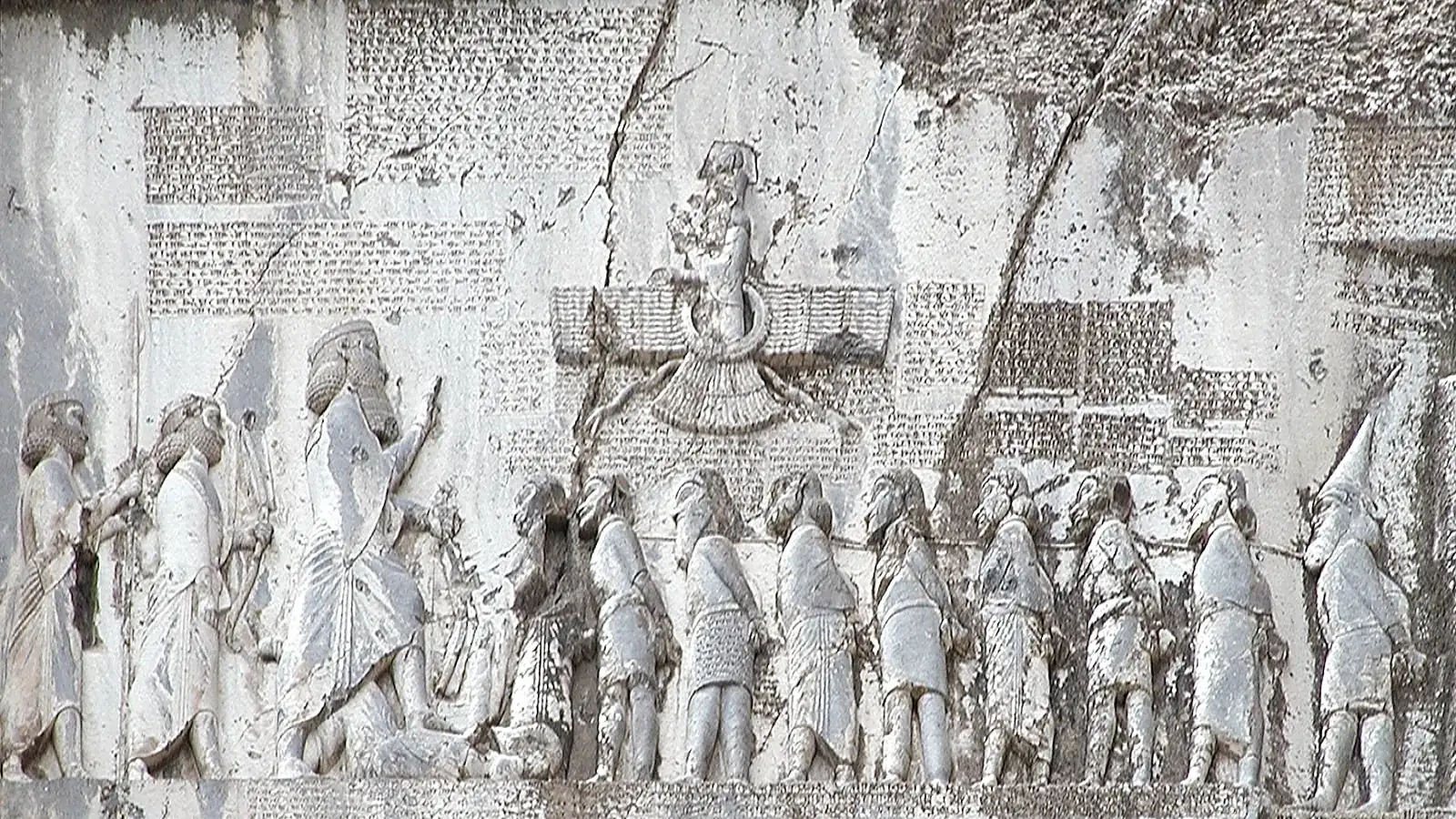
Darius’s own count came out differently. The Behistun inscription, cut about 521 BC, names the countries subject to him and ends the list with the phrase “twenty-three lands in all.” Jona Lendering’s table for Livius sets that list beside Herodotus’s districts and the inscription on Darius’s tomb at Naqsh-e Rustam, and the names do not always agree, each a snapshot of a map that kept moving. The governor’s title was older than the empire, a Median word meaning protector of the realm, and the kings sent out inspectors titled “eye of the king” to watch the men they appointed.
The road from Sardis to Susa
Herodotus described the road from Sardis to Susa as a chain of royal stations with rest houses in settled country. He counted the stages by region, 20 through Lydia and Phrygia, 28 across Cappadocia, and reached a total of 111 stations. The distance he gives comes to 2,500 kilometers, and at 30 kilometers a day he reckoned some 90 days on foot. Guard posts and fortified gates stood at the Halys and on the Cilician border.
Dispatches moved faster because horses and riders waited in relay. Herodotus wrote of the system: “Neither snow nor rain nor heat nor darkness of night prevents them from accomplishing the task proposed to them with the very utmost speed.” He compared the handover from rider to rider with the Greek torch race, and gave the Persian name, angareion. He gave no figure for how long a dispatch took. The Persepolis tablets record the same horse-changing arrangement under the name pirradazish.
Coin, clay and three languages
Darius issued a gold coin of about 8.4 grams, the daric, late in the sixth century BC, with a silver coin, the siglos. Michael Alram’s article for Encyclopaedia Iranica traces the pair to the Lydian standard; Greeks called the coins “archers” after the bowman stamped on them. The dating evidence came out of Persepolis: M. C. Root published a fortification tablet from Darius’s twenty-second regnal year, 500 or 499 BC, stamped with two archers.
That tablet belongs to the Persepolis Fortification Archive, tens of thousands of tablets and fragments excavated in 1933 and loaned to the Chicago institute in 1935. The texts are administrative, written in Elamite and Aramaic and sometimes in other languages, and they carry thousands of seal impressions. The project team, led in part by Matthew W. Stolper, has published editions of more than 7,500. The tablets record 1,348 people employed in the Persepolis treasury in 467 BC.
UNESCO’s World Heritage entry for Bisotun describes about 1,200 lines on the cliff, Elamite first, then Babylonian, then the Old Persian version Darius introduced there for the first time. Elamite was the language of the imperial administration. Henry Rawlinson climbed the cliff from 1835 to copy the texts and worked out the 42 signs of the Old Persian alphabet.
What the Cyrus Cylinder says, and what it does not
The Cyrus Cylinder is a clay barrel found in 1879 and held by the British Museum, on which Cyrus describes his capture of Babylon in 539 BC. Its claims follow Babylonian and Assyrian royal convention: restored temples, care for the gods, exiles and divine statues sent home, and a long titulary. The god named in the text is Marduk, Babylon’s city god.
In 1971 Mohammad Reza Pahlavi used the cylinder in his celebration of 2,500 years of Persian monarchy and called it the world’s human rights charter. Lendering’s Livius entry rejects that reading, stating that it ignores the stereotypical nature of the document and that no evidence shows Cyrus starting a new policy of tolerance.
The end at Persepolis, 330 BC
Darius founded Persepolis in 518 BC on a terrace half natural and half built, by UNESCO’s description. Alexander of Macedon took it early in 330 BC and burned several palace buildings that April, the palace of Xerxes worse than the rest. The reliefs on the east stairs of the Apadana survived, and their southern wall still shows 23 national delegations filing toward the king with gifts. The Met’s curators read such carvings as an image of a harmonious empire supported by its peoples rather than a record of one occasion. What Darius built was a fiscal and clerical frame laid over conquered ground, and that frame is what the evidence preserves: the assessments in Herodotus, the road stations, the coins, and the treasury accounts on clay.
Key facts
- Cyrus revolted against the Median king Astyages in 550 BC, beat Lydia around 547 BC and captured Babylon in October 539 BC; Cambyses took Egypt in 525 BC.
- Herodotus recorded 20 tax districts and a yearly revenue of 14,560 Euboean talents; the Behistun inscription of about 521 BC lists 23 lands.
- Persia itself paid no tribute; India paid the largest single sum, 360 talents of gold dust.
- The road from Sardis to Susa had 111 stations over about 2,500 kilometers, some 90 days on foot at 30 kilometers a day.
- Herodotus called the relay courier service the angareion; the Persepolis tablets call the horse-changing system pirradazish.
- The gold daric weighed about 8.4 grams; a fortification tablet dated 500 or 499 BC carries impressions of the archer coin type.
- The Persepolis Fortification Archive, excavated in 1933, holds tens of thousands of tablets in Elamite and Aramaic; they record 1,348 workers in the Persepolis treasury in 467 BC.
FAQ
How many satrapies did the Persian Empire have?
The number depends on the source and the date. Herodotus listed 20 tax districts under Darius I, the Behistun inscription of about 521 BC names 23 lands, and the tomb inscription at Naqsh-e Rustam, the Daiva inscription of Xerxes and Arrian's account each give a different arrangement.
How fast was the Persian Royal Road?
Herodotus put the journey from Sardis to Susa at 111 stations and some 90 days on foot, reckoning 30 kilometers a day. He described the mounted relay couriers as faster than any traveler, but he gave no figure for how long a dispatch took.
Was the Cyrus Cylinder the first declaration of human rights?
No. That reading dates from Mohammad Reza Pahlavi's celebration of 1971 and is rejected by scholars of the text, who point out that the cylinder repeats the standard claims of Babylonian and Assyrian royal inscriptions and shows no new policy of tolerance.
Sources
- Livius (Jona Lendering) — "Royal Road," with Herodotus, Histories 5.52-53 and 8.98.
- Livius — "The Satrapies," Herodotus, Histories 3.89-97, translated by Aubrey de Selincourt.
- Livius (Jona Lendering) — "Satraps and satrapies."
- Livius — "Behistun, Persian Text," section 6, the list of twenty-three lands.
- Livius (Jona Lendering) — "Behistun (2)," on Henry Rawlinson and the decipherment.
- Livius (Jona Lendering) — "Cyrus Cylinder."
- Livius (Jona Lendering) — "Persepolis."
- Livius (Jona Lendering) — "Persepolis, Apadana, East Stairs."
- Livius (Jona Lendering) — "Cyrus the Great."
- Livius (Jona Lendering) — "Cambyses."
- Encyclopaedia Iranica — Michael Alram, "DARIC," Vol. VII, Fasc. 1, published December 15, 1994.
- OCHRE, University of Chicago — "The Persepolis Fortification Archive Project."
- World History Encyclopedia — Peter Davidson, "Achaemenid Empire," extract from Atlas of Empires.
- The Metropolitan Museum of Art, Department of Ancient Near Eastern Art — "The Achaemenid Persian Empire (550-330 B.C.)," Heilbrunn Timeline of Art History (October 2004).
- UNESCO World Heritage Centre — "Bisotun," World Heritage List no. 1222.
- UNESCO World Heritage Centre — "Persepolis," World Heritage List no. 114.
Cite this article
- APA
- Our Earth's History. (2026, September 19). How did Persia run the largest empire the world had seen? Our Earth's History. https://ourearthshistory.com/west-asia/classical/how-persia-ran-the-largest-empire/
- Chicago
- Our Earth's History. “How did Persia run the largest empire the world had seen?” Our Earth's History, September 19, 2026. https://ourearthshistory.com/west-asia/classical/how-persia-ran-the-largest-empire/.
- MLA
- “How did Persia run the largest empire the world had seen?” Our Earth's History, 19 Sep. 2026, https://ourearthshistory.com/west-asia/classical/how-persia-ran-the-largest-empire/.
Text licensed CC BY-NC-ND 4.0. Found an error? Tell us.