A cylinder from Babylon, 1879: a building text called a rights charter

TL;DR — A clay cylinder buried in Babylon after 539 BC is a Babylonian building text; Iran’s 1971 celebrations made it a human rights symbol, a reading the British Museum rejects.
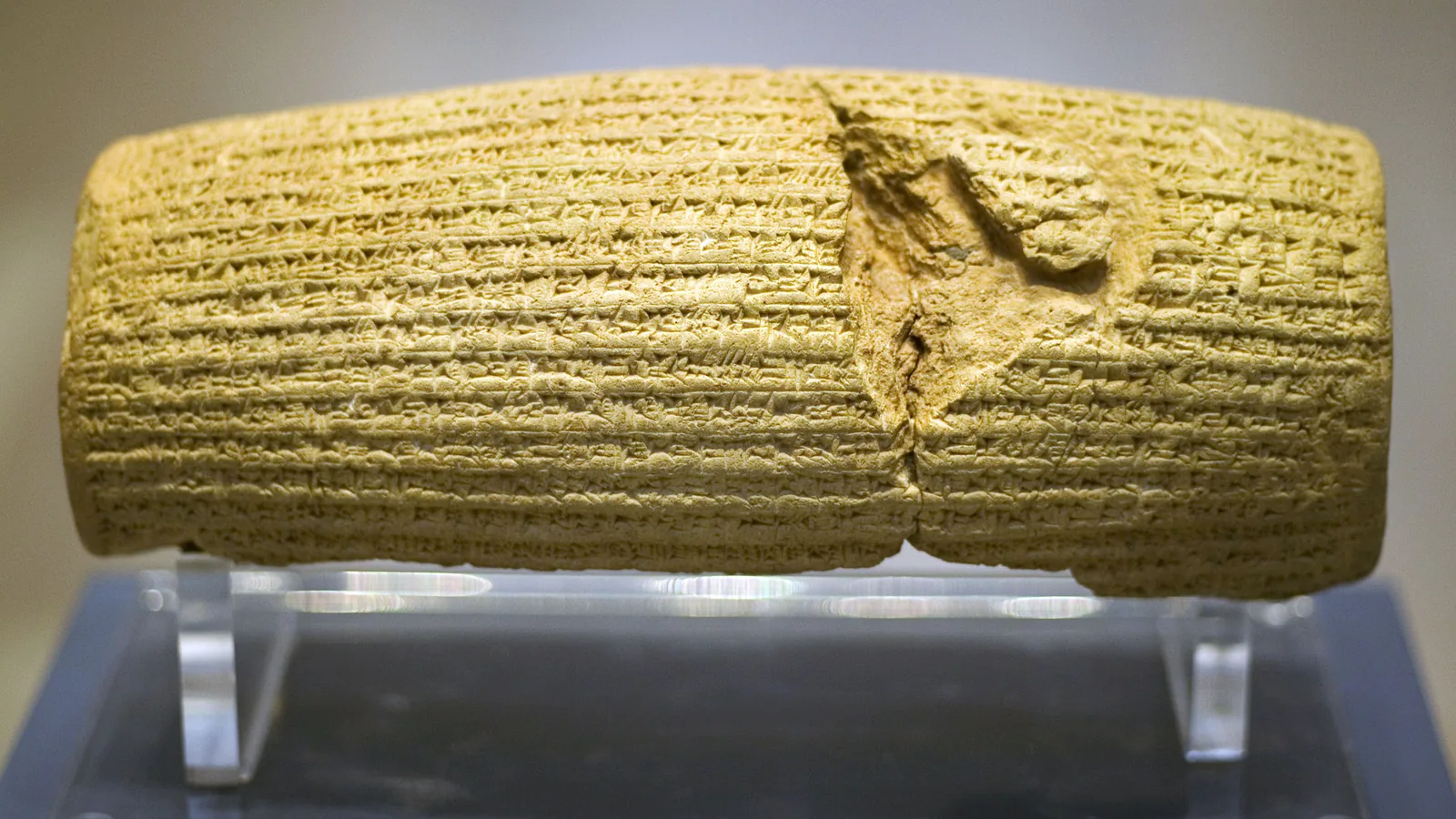
In 1879 Hormuzd Rassam dug a broken clay cylinder, now British Museum number 90920, out of a foundation deposit in Babylon. Its 45 lines of Babylonian cuneiform tell how Cyrus took the city in 539 BC. Encyclopaedia Iranica calls the text “a typical Mesopotamian building inscription.” In October 1971 the government of Mohammad Reza Pahlavi, the shah of Iran, made the cylinder the emblem of its celebrations of 2,500 years of monarchy, and a cast went to the United Nations; in that setting it came to be called a charter of human rights. The museum’s own record states that “the cylinder says nothing of human rights,” and Irving Finkel, the curator who helped identify a copy of the text on tablets in 2010, repeated the point at Yale in 2024.
Quick facts
- When
- 539 BC (Cyrus takes Babylon; the cylinder was buried after this) · 1879 (Rassam's excavation) · January 1972 (Yale fragment reported and lent) · October 1971 (first loan to Iran; United Nations cast) · January 2010 (tablet fragments identified) · May 1, 2024 (Finkel's lecture at Yale)
- Where
- Babylon, in what is now Iraq; the British Museum, London; Tehran; United Nations headquarters, New York; the Yale Peabody Museum, New Haven
- Who
- Cyrus the Great; Nabonidus; Hormuzd Rassam; R. D. Barnett; Princess Ashraf Pahlavi; U Thant; Wilfred Lambert; Irving Finkel; John Curtis; Jona Lendering
- Outcome
- A Babylonian foundation text in 45 lines, held by the British Museum as number 90920, was adopted as the symbol of Iran's 1971 celebrations and called a human rights charter, a reading the museum's own record and Finkel reject
Hormuzd Rassam's find at Babylon, 1879
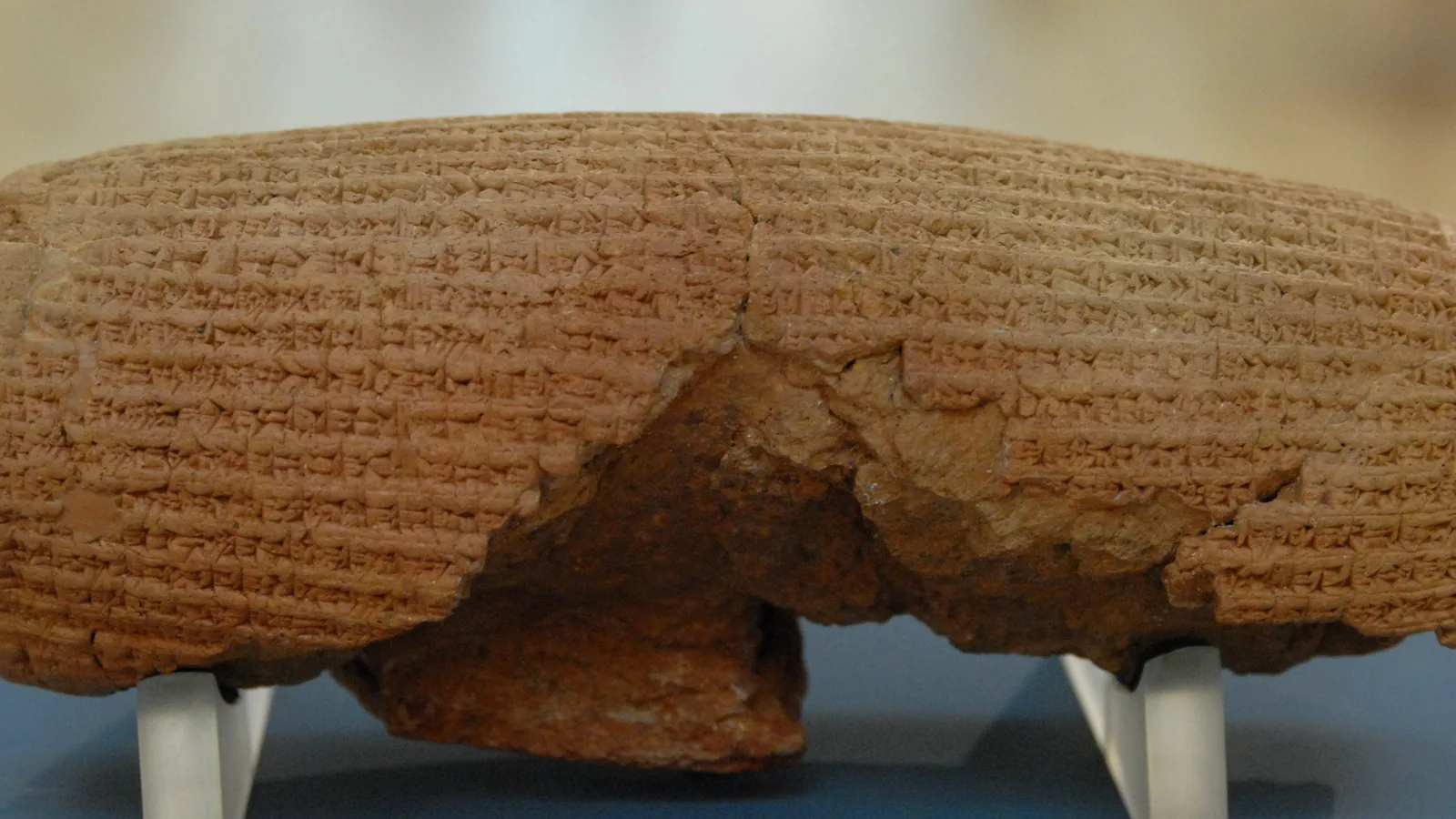
Rassam found the cylinder in a foundation deposit at the site of the Marduk temple, according to Muhammad A. Dandamayev’s article for Iranica, which cites a letter from Rassam to the British Museum dated November 20, 1879. The object is fired clay, made on a wheel, between 21.9 and 22.8 centimeters long and 10 centimeters across at its widest.
It broke into several pieces in antiquity, and the museum’s record traces the breakage to a coarse clay core full of large gray stone inclusions. A small fragment in the Yale Babylonian Collection, NBC 2504, turned out to carry lines 36 to 45; Iranica credits the identification to P.-R. Berger. R. D. Barnett, then keeper of the museum’s Department of Western Asiatic Antiquities, reported the find to the Trustees on January 7, 1972, the Trustees agreed to the loan on January 22, and the piece is now joined to the back of the cylinder.
Forty-five lines in Babylonian terms
The first three lines are almost entirely lost. In lines 4 to 8, by Iranica’s outline, the text sets out the crimes of Nabonidus, the last Chaldean king of Babylon, against the cult of Marduk, the city god. Lines 9 to 19 say that Marduk searched for a righteous king, chose Cyrus to rule the world and let Babylon fall without a battle. Then Cyrus speaks in the first person: “I am Cyrus, king of the world, great king, mighty king, king of Babylon, king of Sumer and Akkad, king of the four quarters.”
The king says that he freed the people of Babylon from forced labor and sent gods and people home. In the Livius translation he says, “I returned the images of the gods, who had resided there, to their places,” naming sanctuaries from Assur and Susa to the region of Gutium, across the Tigris. The last lines describe work on the city wall and an older inscription of Ashurbanipal, king of Assyria, found during the rebuilding.
Dandamayev wrote that priests of Marduk composed the text in an archaizing form modeled on Ashurbanipal’s inscriptions. The British Museum’s record states that the cylinder was written to be buried in the foundations of Babylon’s city wall after Cyrus captured it. The record adds that the document is written from a purely Babylonian point of view, with no acknowledgement that Cyrus worshipped the Iranian god Ahuramazda. Jona Lendering of Livius writes that the cylinder was once read as confirming the biblical return of the Jews, though the text does not mention them.
1971: the Shahyad Monument and a cast for the United Nations
After an official request from the Iranian government, Barnett carried the cylinder to Tehran from October 7 to 22, 1971, at Iran’s expense. His report to the Trustees, preserved in the museum’s record, states that the object had been “selected . . . in spite of its damaged state and somewhat slight aesthetic appeal, as the national symbol of the entire celebrations.” It was pictured on a postage stamp. It went on display in the new Shahyad Monument near Mehrabad airport. At the ceremony held at Persepolis on October 15, the cylinder shown was a plaster cast brought by the Reverend Norman Sharp, according to the museum’s record.
On October 14, 1971, Princess Ashraf Pahlavi, the shah’s sister, presented a cast to U Thant, secretary-general of the United Nations. The text was translated into the six official languages of the United Nations. Lendering writes that the religious references were left out of the copy given to the United Nations. The shah, in his account, sought to show that the secular Iran with religious freedom he wanted to promote had existed before, and in that context the cylinder was called the “world’s human rights charter.”
"The cylinder says nothing of human rights"
Because the text speaks of just rule and the return of deported peoples and their gods, the record says, the cylinder has been called “a kind of ‘charter of human rights,’” a concept “quite alien to Cyrus’s contemporaries.” It adds that the return of the Jews and other deported peoples was “a significant reversal of the policies of earlier Assyrian and Babylonian kings.” The record dates the reading of the cylinder as propaganda of the Persian Achaemenid dynasty to the 1970s, citing the historian Josef Wiesehöfer’s book of 1996.
Lendering’s entry puts it in one sentence: “There is no evidence that Cyrus inaugurated a new policy of tolerance.” Restored temples, care for the gods and the return of exiles and divine statues, he writes, were common elements of Babylonian and Assyrian royal propaganda, and Cyrus used them too.
Because the clay text does not support the rights reading, Lendering writes, a fake translation was produced, and it still circulates online. Shirin Ebadi quoted it when she accepted the Nobel Peace Prize in 2003. His test for spotting it is the name of the supreme god: the fake puts Ahuramazda where the clay text has Marduk. He does not know who wrote it and suspects it was made before fragment B, the Yale piece, was identified. The museum’s press file records a column in The Independent of March 30, 2007, that opened with what the museum calls a “mis-quotation” of the object.
Tablet fragments in London, 2010, and a lecture at Yale
In January 2010 Wilfred Lambert, a retired Birmingham University professor going through some of the museum’s 130,000 cuneiform tablets, found part of the cylinder’s text on a tablet fragment. Finkel, a curator in the Middle East department, found a second piece of the same tablet. The Art Newspaper reported on February 1, 2010, that one fragment clarified a passage unreadable on the cylinder and the other supplied part of its missing text. John Curtis, keeper of the department, called the find “very significant”: the text had also gone out as a proclamation on tablets across Cyrus’s empire, besides the copy buried in a foundation.
The discovery delayed a loan to Iran due on January 16, 2010; the cylinder went on show at the National Museum of Iran on September 12, 2010.
On May 1, 2024, Finkel gave the first talk in the new Central Gallery of the Yale Peabody Museum, where the cylinder was on loan. “There are no human rights in antiquity. There were never human rights in antiquity,” he said, and the cylinder’s “only concern is with restoring peaceful circumstances.” It had been found in a wall where no one would see it, he said, and dozens more were probably still buried around its original location. He also said its meaning had changed since its own time: “Now it is a symbol of human rights.” The Peabody listed the cylinder as on display through June 2024.

Key facts
- Hormuzd Rassam found the cylinder in a foundation deposit in Babylon in 1879; the British Museum registered it in 1880 as number 90920 (registration 1880,0617.1941).
- The fired clay cylinder is 21.9 to 22.8 centimeters long; its text runs to 45 lines, the first three almost lost (British Museum; Iranica).
- A Yale fragment, NBC 2504, carries lines 36 to 45; its identification was reported to the Trustees on January 7, 1972.
- The text says Marduk chose Cyrus, who entered Babylon without a battle in 539 BC, and records the return of gods and people to sanctuaries east of the Tigris.
- The cylinder was lent to Iran from October 7 to 22, 1971; on October 14 Princess Ashraf Pahlavi gave a cast to U Thant at the United Nations.
- The British Museum’s record states that “the cylinder says nothing of human rights”; Livius identifies the fake translation by the name Ahuramazda in place of Marduk.
- Wilfred Lambert identified a tablet fragment with the cylinder’s text in January 2010, and Irving Finkel found a second piece of the same tablet; Finkel spoke on the cylinder at Yale on May 1, 2024.
FAQ
Who found the Cyrus Cylinder, and where is it now?
Hormuzd Rassam found it in 1879 at Babylon, in what is now Iraq, in a foundation deposit at the site of the Marduk temple. It is in the British Museum in London, museum number 90920, with the Yale fragment joined to it.
Is the Cyrus Cylinder the first charter of human rights?
The British Museum's record states that the cylinder "says nothing of human rights" and that the idea would have been alien to Cyrus's contemporaries. Irving Finkel said at Yale in 2024 that there were no human rights in antiquity. Jona Lendering of Livius connects the label to the shah's celebrations of 1971.
How can the fake Cyrus Cylinder translation be recognized?
Jona Lendering of Livius writes that the fake names Ahuramazda as the supreme god where the clay text names Marduk. He also writes that Shirin Ebadi quoted it in her Nobel Peace Prize speech in 2003.
What did the 2010 tablet fragments show?
Two fragments of one clay tablet, found in the British Museum's collection by Wilfred Lambert and Irving Finkel, carry part of the cylinder's text. John Curtis said they showed the text was distributed as a proclamation on tablets as well as buried in a foundation.
Sources
- British Museum, Collection Online, "The Cyrus Cylinder," museum number 90920, registration number 1880,0617.1941 (object record as captured December 16, 2023).
- Muhammad A. Dandamayev, "CYRUS iv. The Cyrus cylinder," Encyclopaedia Iranica, Vol. VI, Fasc. 5, pp. 521-522 (published December 15, 1993; updated July 26, 2013).
- Jona Lendering, "Cyrus Cylinder," Livius.org (last modified October 12, 2020).
- Livius.org, "Cyrus Cylinder Translation," after Mordechai Cogan's translation, adapted to Hanspeter Schaudig's edition (last modified July 13, 2020).
- Martin Bailey, "Discovery of fragment belonging to British Museum's Cyrus cylinder further defers loan to Iran," The Art Newspaper, February 1, 2010.
- Steven Scarpa, "Superstar Assyriologist Dispels Myths About Cyrus Cylinder," Yale Peabody Museum (updated May 6, 2024).
Cite this article
- APA
- LETTER. (2026, September 28). A cylinder from Babylon, 1879: a building text called a rights charter. Our Earth's History. https://ourearthshistory.com/west-asia/classical/cyrus-cylinder-1879-babylon-human-rights-label/
- Chicago
- LETTER. “A cylinder from Babylon, 1879: a building text called a rights charter.” Our Earth's History, September 28, 2026. https://ourearthshistory.com/west-asia/classical/cyrus-cylinder-1879-babylon-human-rights-label/.
- MLA
- LETTER. “A cylinder from Babylon, 1879: a building text called a rights charter.” Our Earth's History, 28 Sep. 2026, https://ourearthshistory.com/west-asia/classical/cyrus-cylinder-1879-babylon-human-rights-label/.
Text licensed CC BY-NC-ND 4.0. Found an error? Tell us.