'Small scattered fragments do not a dwarf make': Palau, 2008

TL;DR — PLOS ONE published a Palau dwarfism claim on March 12, 2008; on August 27 a reply titled “Small scattered fragments do not a dwarf make” answered it.
Lee R. Berger and colleagues titled their paper “Small-Bodied Humans from Palau, Micronesia” and published it in PLOS ONE on March 12, 2008. Their central claim read: “individuals from the older time horizons are small in body size even relative to ‘pygmoid’ populations from Southeast Asia and Indonesia, and thus may represent a marked case of human insular dwarfism.” Five and a half months later, on August 27, 2008, the same journal carried a reply from Scott M. Fitzpatrick of North Carolina State University, Greg C. Nelson of the University of Oregon and Geoffrey Clark of the Australian National University. Its title stated their argument outright: “Small Scattered Fragments Do Not a Dwarf Make: Biological and Archaeological Data Indicate that Prehistoric Inhabitants of Palau Were Normal Sized.”
Quick facts
- When
- March 12, 2008 (Berger and colleagues published) · August 27, 2008 (Fitzpatrick, Nelson and Clark published) · 2018 (Fitzpatrick and Jew refined the cemetery dates)
- Where
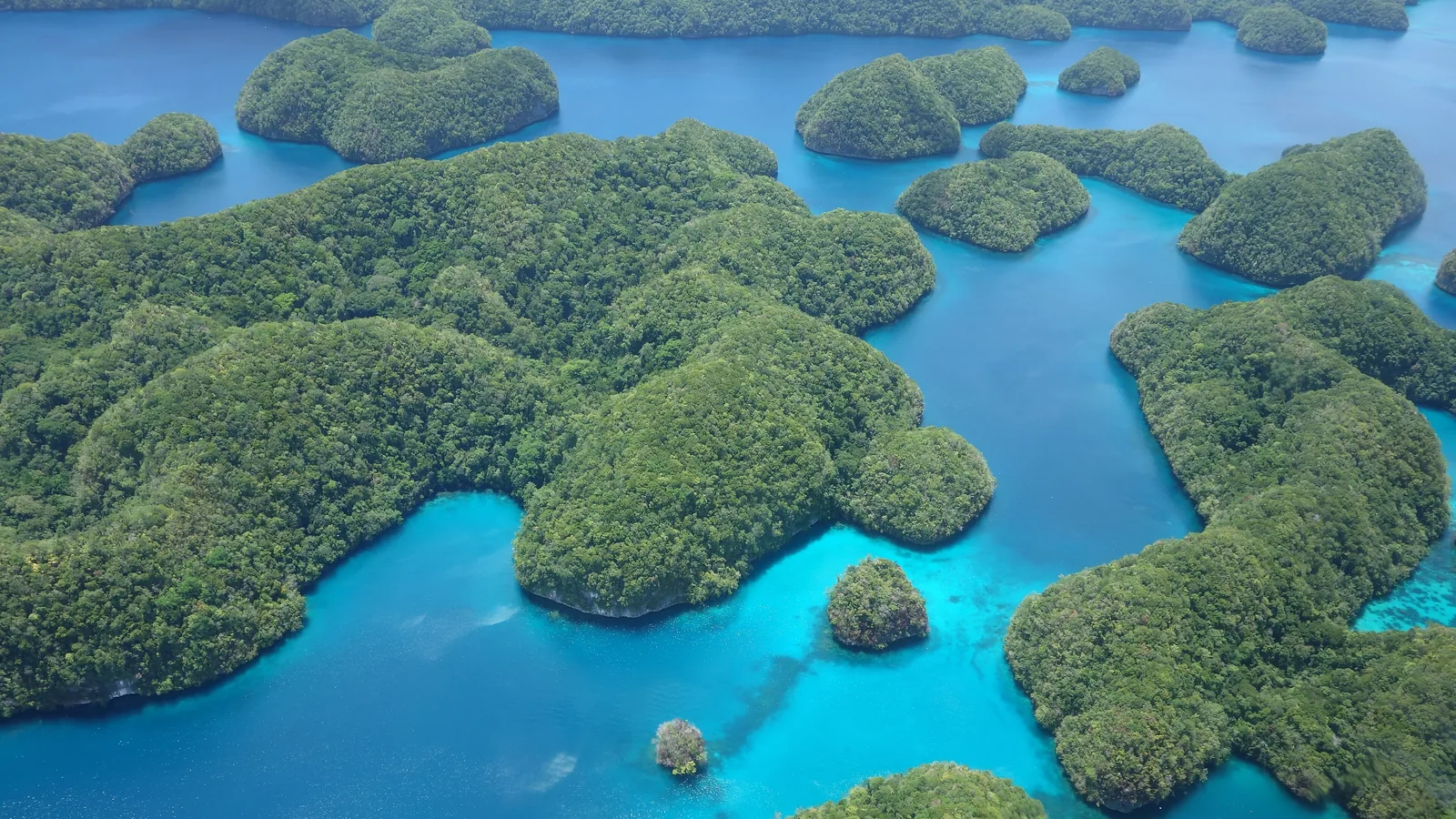
- Ucheliungs and Omedokel caves and Chelechol ra Orrak, all in the limestone Rock Islands of Palau, Micronesia
- Who
- Lee R. Berger, Steven E. Churchill, Bonita De Klerk and Rhonda L. Quinn; Scott M. Fitzpatrick, Greg C. Nelson and Geoffrey Clark; Nicholas P. Jew
- Outcome
- Fitzpatrick, Nelson and Clark reclassified one skull as a child's, showed Chelechol ra Orrak femora fell within the normal modern range, and concluded that prehistoric Palauans were normal sized
Two caves, not the cemetery
Berger’s paper named the site precisely. “At least ten burial caves have been discovered in the rock islands,” it noted, “and excavations at one of them (Chelechol ra Orrak) has produced the skeletal remains of at least 25 individuals,” but, the paper went on, “the remains discussed here were recovered from two such sites (Ucheliungs and Omedokel caves).” The bone count at Ucheliungs cave, from excavation and surface collection combined, was described as an NISP of more than 1,000; at Omedokel cave, a surface NISP of 87. Radiocarbon dates placed the Ucheliungs material between “1420 and 2890 cal ybp.” Within Omedokel, the small individuals dated between 1410 and 2300 cal ybp, while larger individuals near the cave entrance dated between 940 and 1080 cal ybp.
From these bones the authors estimated body mass at 28.7 kilograms for females and 43.2 kilograms for males, figures they set against the Onge people of the Andaman Islands, whom they gave as averaging 40.1 kilograms for females and 47.4 kilograms for males. The work was funded, the paper stated, by “the National Geographic Society Missions Programme and University of the Witwatersrand and BHP Billiton.” One week after publication, on March 19, 2008, PLOS ONE issued a correction. It changed only Berger’s listed institutional affiliation, to the Institute for Human Evolution and the Bernard Price Institute for Palaeontology at the University of the Witwatersrand; it did not alter any finding.
A skull reassigned to a child
Fitzpatrick, Nelson and Clark opened their reply by challenging the sample itself, writing that it was “too small and fragmentary to adequately address the variation inherent in modern humans.” One specific case anchored the point: a skull that Berger’s team had classified among the small adults was, on dental development evidence, “a child of approximately 4-5 years of age.”
The reply turned next to the site Berger’s paper had set aside, Chelechol ra Orrak. There, two female femora averaged “405±11.3 mm which equates to an adult height of between 152 and 157 cm depending on formulae used,” a range the authors called “well within the expected range for modern human adult females.” They set this beside other prehistoric populations: “average female maximum femoral lengths from the Ancestral Puebloan sites of Arroyo Hondo… and Mesa Verde… are 400.9 mm (n = 9) and 398.1 mm (n = 10), respectively.” Measured against those North American cemeteries, the Palau femora fell in the same range.
Teeth, diet and a diagnosis
Berger’s paper had also pointed to large teeth relative to body size as a sign of dwarfism. Fitzpatrick, Nelson and Clark answered that logic directly: “Teeth are only megadont if the people are small—if the people are normal sized, then the teeth are just big.” They challenged the radiocarbon dating too, writing that Berger’s dates “presume a wholly terrestrial diet,” while stable isotope analysis of early Chelechol ra Orrak and Ngermereues Ridge bones showed “a high percentage of marine foods in the diet,” an unaccounted marine reservoir effect that, they argued, could make the dated bone as much as 250 years younger than the published figures. Their reply described Chelechol ra Orrak as dated to “ca. 3000 BP” and as “the most extensively excavated early cemetery in Palau.” Their conclusion was direct: “Prehistoric Palauan populations were normal sized and exhibit traits that fall within the normal variation for Homo sapiens—they do not support the claims by Berger et al. (2008).”
Nelson's statement, August 26
The day before the reply appeared, the University of Oregon issued a news release on EurekAlert!, dated August 26, 2008, under the headline “Bone parts don’t add up to conclusion of Palauan dwarfs.” In it, Nelson said: “Our evidence indicates the earliest inhabitants of Palau were of normal stature, and it counters the evidence that Berger, et al, presented in their paper.” He added a direct assessment of the earlier study’s method: “I think Berger’s primary mistakes were his not understanding the variation in the skeletal population in which he was working, using fragmentary remains again in a situation where he didn’t understand variation, and stepping outside his own area of expertise.”
Chelechol ra Orrak's own record
Nelson and Fitzpatrick had reported on Chelechol ra Orrak two years earlier, in Anthropological Science, published by the Anthropological Society of Nippon. Their 2006 paper described “the discovery of a cemetery dating to near 3000 BP” that presented “an opportunity to examine what portends to be a large sample of the earliest peoples to inhabit the western Pacific,” with skeletal remains spanning “neonates through aged adults” and a pathology profile including degenerative joint disease, porotic hyperostosis and spondylolysis. At that point the cemetery had yielded at least 25 individuals. A decade later, Fitzpatrick and Nicholas P. Jew, writing in Antiquity in 2018, applied radiocarbon dating and Bayesian modeling to the site and reported that results “provide more secure evidence for burial activity dating back to c. 3000 cal BP, thus confirming Chelechol ra Orrak as one of the only cemeteries in Remote Oceania that dates to the earliest, known stages of island colonisation.” By then the count of interred individuals had risen to at least 50.

.jpg)
Key facts
- Berger and colleagues published “Small-Bodied Humans from Palau, Micronesia” in PLOS ONE 3(3): e1780 on March 12, 2008, based on bones from Ucheliungs and Omedokel caves.
- Ucheliungs cave produced an NISP of more than 1,000 bones; Omedokel cave, a surface NISP of 87.
- The paper estimated body mass at 28.7 kilograms for females and 43.2 kilograms for males, against Onge comparison figures of 40.1 and 47.4 kilograms.
- Funding came from the National Geographic Society Missions Programme, the University of the Witwatersrand and BHP Billiton.
- A PLOS ONE correction on March 19, 2008, fixed Berger’s institutional affiliation only, not any finding.
- Fitzpatrick, Nelson and Clark published their reply, “Small Scattered Fragments Do Not a Dwarf Make,” in PLOS ONE 3(8): e3015 on August 27, 2008.
- The reply reclassified one skull as belonging to “a child of approximately 4-5 years of age” and measured Chelechol ra Orrak female femora at 405±11.3 mm, equal to a stature of 152 to 157 cm.
- Fitzpatrick and Jew’s 2018 Antiquity study confirmed Chelechol ra Orrak’s burial activity to c. 3000 cal BP and counted at least 50 interred individuals.
FAQ
What did Berger's 2008 paper actually study?
Bones from two caves, Ucheliungs and Omedokel, in the Rock Islands of Palau, not the Chelechol ra Orrak cemetery, which the paper mentioned only as a separate site with at least 25 individuals from its own excavation.
Who wrote the reply, and when did it appear?
Scott M. Fitzpatrick, Greg C. Nelson and Geoffrey Clark, of North Carolina State University, the University of Oregon and the Australian National University, published "Small Scattered Fragments Do Not a Dwarf Make" in PLOS ONE on August 27, 2008, five and a half months after Berger's paper.
Did the PLOS ONE correction change the dwarfism claim?
No. The correction, published March 19, 2008, fixed an error in Berger's institutional affiliation and made no change to the paper's data or conclusions.
Sources
- Lee R. Berger, Steven E. Churchill, Bonita De Klerk and Rhonda L. Quinn, "Small-Bodied Humans from Palau, Micronesia," PLOS ONE 3(3): e1780, March 12, 2008.
- Scott M. Fitzpatrick, Greg C. Nelson and Geoffrey Clark, "Small Scattered Fragments Do Not a Dwarf Make: Biological and Archaeological Data Indicate that Prehistoric Inhabitants of Palau Were Normal Sized," PLOS ONE 3(8): e3015, August 27, 2008.
- PLOS ONE, "Correction: Small-Bodied Humans from Palau, Micronesia," March 19, 2008, PMC copy.
- University of Oregon news release, "Bone parts don't add up to conclusion of Palauan dwarfs," EurekAlert!, August 26, 2008.
- Greg C. Nelson and Scott M. Fitzpatrick, "Preliminary investigations of the Chelechol ra Orrak Cemetery, Republic of Palau: I, skeletal biology and paleopathology," Anthropological Science 114(1): 1-12, 2006, J-STAGE.
- Scott M. Fitzpatrick and Nicholas P. Jew, "Radiocarbon dating and Bayesian modelling of one of Remote Oceania's oldest cemeteries at Chelechol ra Orrak, Palau," Antiquity 92(361), published online February 9, 2018, Cambridge Core abstract.
Cite this article
- APA
- Our Earth's History. (2026, September 25). 'Small scattered fragments do not a dwarf make': Palau, 2008. Our Earth's History. https://ourearthshistory.com/oceania/classical/palau-2008-small-bodied-humans-berger-ucheliungs-omedokel-plos-one-reply/
- Chicago
- Our Earth's History. “'Small scattered fragments do not a dwarf make': Palau, 2008.” Our Earth's History, September 25, 2026. https://ourearthshistory.com/oceania/classical/palau-2008-small-bodied-humans-berger-ucheliungs-omedokel-plos-one-reply/.
- MLA
- “'Small scattered fragments do not a dwarf make': Palau, 2008.” Our Earth's History, 25 Sep. 2026, https://ourearthshistory.com/oceania/classical/palau-2008-small-bodied-humans-berger-ucheliungs-omedokel-plos-one-reply/.
Text licensed CC BY-NC-ND 4.0. Found an error? Tell us.