Must Farm: Bronze Age stilt houses that burned into a river

TL;DR — A fire destroyed the Must Farm stilt houses in Cambridgeshire less than a year after they were built, the 2024 excavation report states.
Antiquity’s 2019 report on the excavation states that “a major conflagration event appeared to have destroyed the settlement,” a group of stilt houses built over a river channel at Whittlesey, in Cambridgeshire. The timber piles first surfaced in 1999, when local archaeologist Martin Redding found them exposed at the edge of the disused Must Farm quarry pit. Evaluations in 2004 and 2006 dated the piles to the Late Bronze Age and confirmed the fire. The Cambridge Archaeological Unit excavated the site fully in 2015 and 2016 for Historic England and the landowner, Forterra Building Products Ltd, because it was uncertain whether the waterlogged conditions that preserved it could be maintained. What came up from the river channel, from a bowl still holding its last meal to bronze tools set aside for recycling, was published in a two-volume report in 2024.
Quick facts
- When
- 1999 (piles first noticed) · 2004 and 2006 (preliminary evaluations) · 2015 to 2016 (full excavation) · March and April 2024 (excavation report and exhibition)
- Where
- the Must Farm quarry, Whittlesey, Cambridgeshire, England
- Who
- Martin Redding; the Cambridge Archaeological Unit, led by Mark Knight, with Rachel Ballantyne, David Gibson and Iona Robinson Zeki; Historic England; Forterra Building Products Ltd; Peterborough Museum and Art Gallery
- Outcome
- A Late Bronze Age settlement of five stilt houses, built in a single phase and destroyed by fire within about a year, had its contents preserved in a river channel and published in a two-volume excavation report in 2024
Martin Redding's find, 1999 to 2006
Martin Redding, a local archaeologist, first noticed timber piles exposed at the edge of the disused Must Farm quarry pit in 1999. Antiquity’s 2019 report records that on later visits he collected potsherds, worked flint and metalwork from the sediment around them. A small exploration in 2004 found a 2.2-meter alignment of 12 piles driven into the silt of an old river channel, and radiocarbon dates from three of the piles placed the timber in the Late Bronze Age. A more intensive evaluation by the Cambridge Archaeological Unit in 2006 opened two trenches and showed that the piles formed part of an enclosing palisade around a pile-dwelling settlement. Most of what the trenches uncovered was fire-damaged and confined to a thin, 300-millimeter horizon, and a radiocarbon sample of charred food crust from a pot in that layer dated to the end of the Late Bronze Age.
In 2015 and 2016, a single excavation
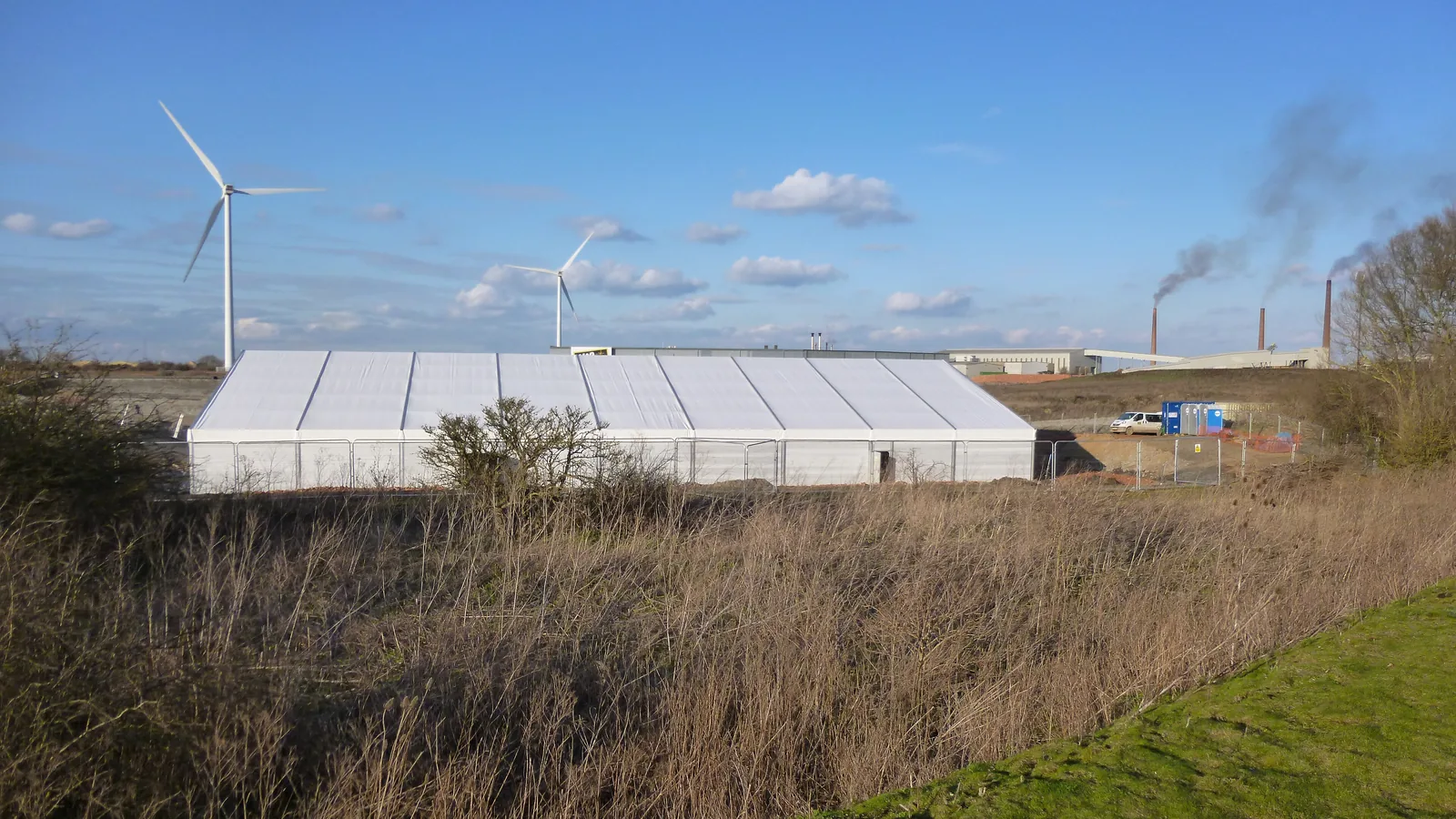
In 2015 and 2016 the Cambridge Archaeological Unit carried out a single phase of full excavation, commissioned by Historic England and the landowner, Forterra Building Products Ltd. Antiquity’s 2019 report explains the timing: after ten years of preservation in place with groundwater monitoring, it was uncertain whether the waterlogged, oxygen-free conditions needed to keep the site intact could be maintained indefinitely. Excavators worked under a temporary shelter, hand-excavating the channel silts in a one-meter grid and recording finds by photogrammetry. Hundreds of uprights defined at least five stilt-raised structures, numbered one to five, set inside a curving, 49.3-meter palisade with an internal walkway. The four largest stood in a row; the smallest, structure four, was the only one built across the palisade and walkway, and the report’s authors read it as an ancillary building. The report found no sign of repair or rebuilding, and concluded the settlement was built in a single phase, using timber felled in the same year, and destroyed without being remodeled. Because the wood was still unseasoned and free of insect damage when it burned, and because juvenile sheep or goat bones had an estimated age of three to six months at death, the report puts the fire in summer, after about a year of occupation.
Nine logboats, counted two ways
Before the pile dwellings were dug, the Cambridge Archaeological Unit spent 2009 to 2012 investigating a separate stretch of the same river channel. Antiquity’s 2019 report counts nine logboats there, eight of the Late Bronze Age and one of the Iron Age, found across a 325-meter stretch alongside Middle Bronze Age fish weirs, fish traps and weapons, in a channel active from 1700 to 100 BC. The Must Farm project’s own page on the find, titled “2011: Bronze Age River,” describes the same boats as nine Bronze Age logboats recovered from 150 meters of channel. The two accounts agree on the number of boats and differ on their dates and on the length of channel searched.
Objects counted five years apart
The published object counts differ by year. Antiquity’s 2019 report, written soon after the dig, tallied over 180 fiber and textile items, 160 wooden artifacts, 120 pottery vessels, 90 pieces of metalwork and at least 80 glass beads. The Must Farm project’s website, updated after the 2024 report, gives almost 200 wooden artifacts, over 150 fiber and textile items, 128 pottery vessels, more than 90 pieces of metalwork and 49 glass beads, of which all but one may have been made in Iran, 4,500 kilometers away. The same website records 18,021 pieces of structural wood. Among the finds was a coarseware bowl still holding its last meal, a wheat-meal porridge mixed with animal fat, with the wooden spatula used to stir it still inside; in the smallest structure, a wooden bucket held broken bronze tools and weapons gathered for recycling. A separate study of coprolites, published in Parasitology in 2019, examined 15 coprolites, four identified as human and seven as canine using fecal lipid biomarkers. Its authors, led by C. M. Ledger, recovered eggs of fish tapeworm, Echinostoma worms, probable pig whipworm and the giant kidney worm, and described the fish tapeworm, Echinostoma, Capillaria and giant kidney worm finds as the earliest evidence for those parasites so far identified in Britain.

No human remains have been found at Must Farm
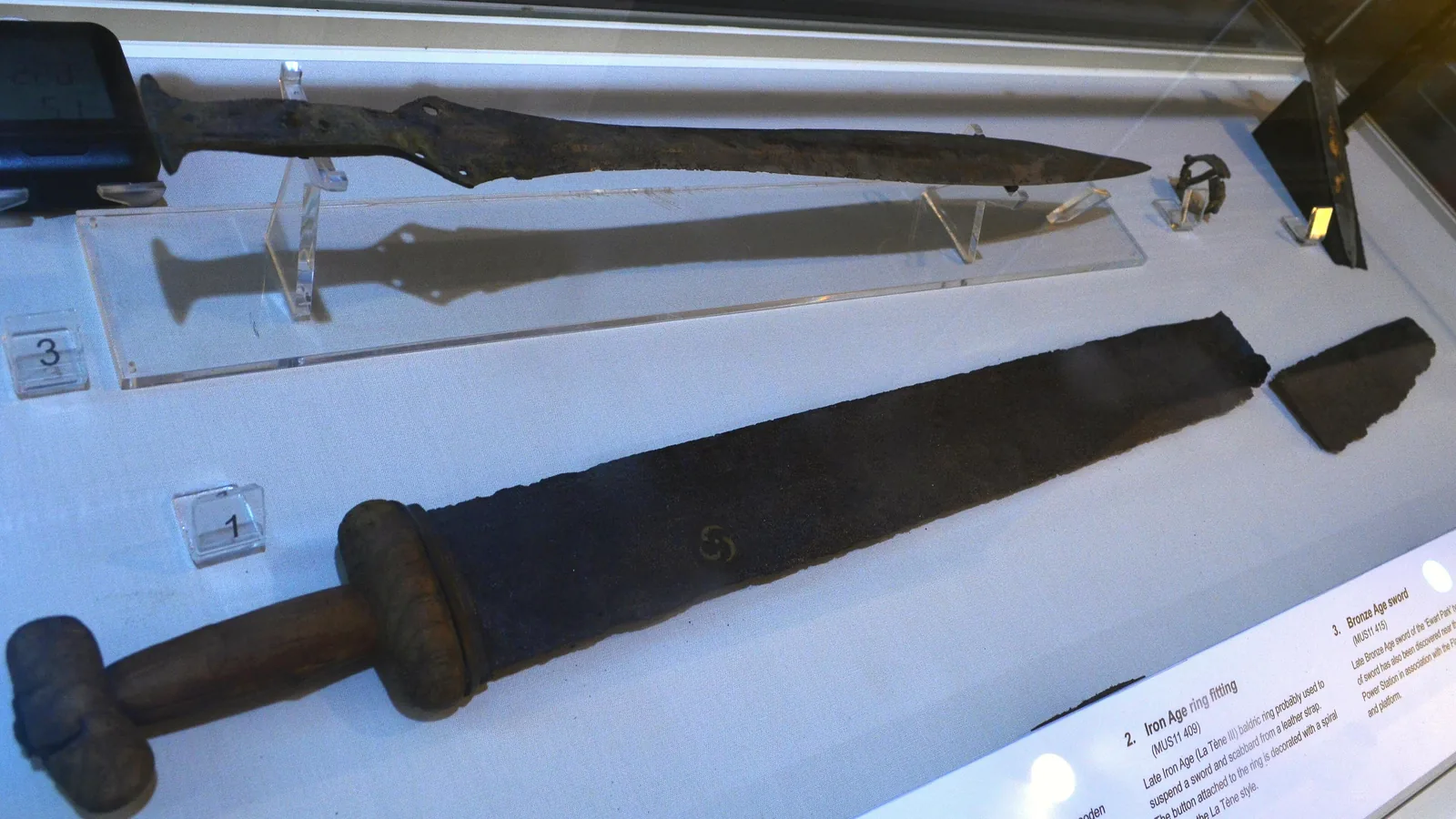
The Must Farm project’s website states that no human remains have turned up at the site, which it takes to mean none of the occupants died in the fire. The website mentions weapons among the finds and the settlement’s position over water inside a palisade as points bearing on a deliberate attack, and concludes that the cause of the destruction “is likely to remain elusive.” The excavation results appeared in full in March 2024, when the McDonald Institute for Archaeological Research published two open-access volumes edited by Mark Knight, Rachel Ballantyne, Matthew Brudenell, Anwen Cooper, David Gibson and Iona Robinson Zeki: Landscape, architecture and occupation, and Specialist reports. The University of Cambridge’s repository records the first volume’s online publication date as March 5, 2024, and its introduction states that the pile dwelling was “built in the mid-9th century BC” and “engulfed by a catastrophic fire less than a year after construction.” Peterborough Museum and Art Gallery opened an exhibition of the finds, Introducing Must Farm, a Bronze Age Settlement, on April 27, 2024, funded by Historic England and the museum, giving visitors their first chance in eight years to see objects recovered from the riverbed.
Key facts
- Local archaeologist Martin Redding first noticed timber piles at the edge of the Must Farm quarry pit in 1999 (Antiquity, 2019).
- A 2004 exploration found a 2.2-meter alignment of 12 piles radiocarbon-dated to the Late Bronze Age (Antiquity, 2019).
- The Cambridge Archaeological Unit excavated the settlement fully in 2015 and 2016 for Historic England and landowner Forterra Building Products Ltd (Antiquity, 2019).
- At least five stilt-raised structures stood inside a 49.3-meter palisade, with structure four built across the walkway as an ancillary building (Antiquity, 2019).
- Antiquity’s 2019 report tallied over 180 textile items, 160 wooden artifacts, 120 pottery vessels and at least 80 glass beads; the Must Farm project’s website, updated after 2024, counts almost 200 wooden artifacts, over 150 textile items and 49 glass beads.
- Between 2009 and 2012 the same channel yielded nine logboats: Antiquity’s 2019 report counts eight Bronze Age and one Iron Age, and the Must Farm project’s website counts nine Bronze Age (Antiquity, 2019; mustfarm.com).
- The McDonald Institute for Archaeological Research published a two-volume excavation report online on March 5, 2024 (University of Cambridge repository).
- Peterborough Museum and Art Gallery opened an exhibition of the finds on April 27, 2024, funded by Historic England and the museum (Peterborough Museum press release).
FAQ
What caused the fire at Must Farm?
The Must Farm project's website states that it has not been possible to establish the circumstances of the fire. Broken weapons found among the debris and the settlement's defensive position have been raised as reasons it might not have been an accident, but no human remains were found, and the website concludes the cause is likely to remain unknown.
How many logboats were found near Must Farm?
Nine, recovered from the same river channel between 2009 and 2012. Antiquity's 2019 report counts them as eight Bronze Age and one Iron Age; the Must Farm project's website counts all nine as Bronze Age.
When was the Must Farm excavation report published?
The McDonald Institute for Archaeological Research published the two-volume report online on March 5, 2024, and Peterborough Museum and Art Gallery opened an exhibition of the finds on April 27, 2024.
Sources
- Mark Knight, Rachel Ballantyne, Iona Robinson Zeki and David Gibson, "The Must Farm pile-dwelling settlement," Antiquity, vol. 93, issue 369 (Cambridge University Press, published online June 12, 2019), pp. 645-663.
- Must Farm project (Cambridge Archaeological Unit, University of Cambridge), "About."
- Must Farm project, "2011: Bronze Age River."
- Mark Knight, Rachel Ballantyne, Matthew Brudenell, Anwen Cooper, David Gibson and Iona Robinson Zeki (eds.), Must Farm pile-dwelling settlement: Volume 1. Landscape, architecture and occupation (Cambridge: McDonald Institute for Archaeological Research, 2024).
- Peterborough Museum and Art Gallery, "Introducing Must Farm, a Bronze Age Settlement" (press release, March 20, 2024).
- C. M. Ledger, E. Grimshaw, M. Fairey, H. L. Whelton, I. D. Bull, R. Ballantyne, M. Knight and P. D. Mitchell, "Intestinal parasites at the Late Bronze Age settlement of Must Farm, in the fens of East Anglia, UK (9th century B.C.E.)," Parasitology, vol. 146, issue 12 (Cambridge University Press, 2019), pp. 1583-1594.
Cite this article
- APA
- LETTER. (2026, September 28). Must Farm: Bronze Age stilt houses that burned into a river. Our Earth's History. https://ourearthshistory.com/europe/ancient/must-farm-pile-dwellings-fire-850-bc-whittlesey-2015-2016-dig/
- Chicago
- LETTER. “Must Farm: Bronze Age stilt houses that burned into a river.” Our Earth's History, September 28, 2026. https://ourearthshistory.com/europe/ancient/must-farm-pile-dwellings-fire-850-bc-whittlesey-2015-2016-dig/.
- MLA
- LETTER. “Must Farm: Bronze Age stilt houses that burned into a river.” Our Earth's History, 28 Sep. 2026, https://ourearthshistory.com/europe/ancient/must-farm-pile-dwellings-fire-850-bc-whittlesey-2015-2016-dig/.
Text licensed CC BY-NC-ND 4.0. Found an error? Tell us.