Dug up July 4, 1999, seized in Basel in 2002: the Nebra Sky Disc

TL;DR — Two looters dug the Nebra Sky Disc out of the Mittelberg on July 4, 1999; the Basel police seized it in February 2002; it was buried about 1600 BC.
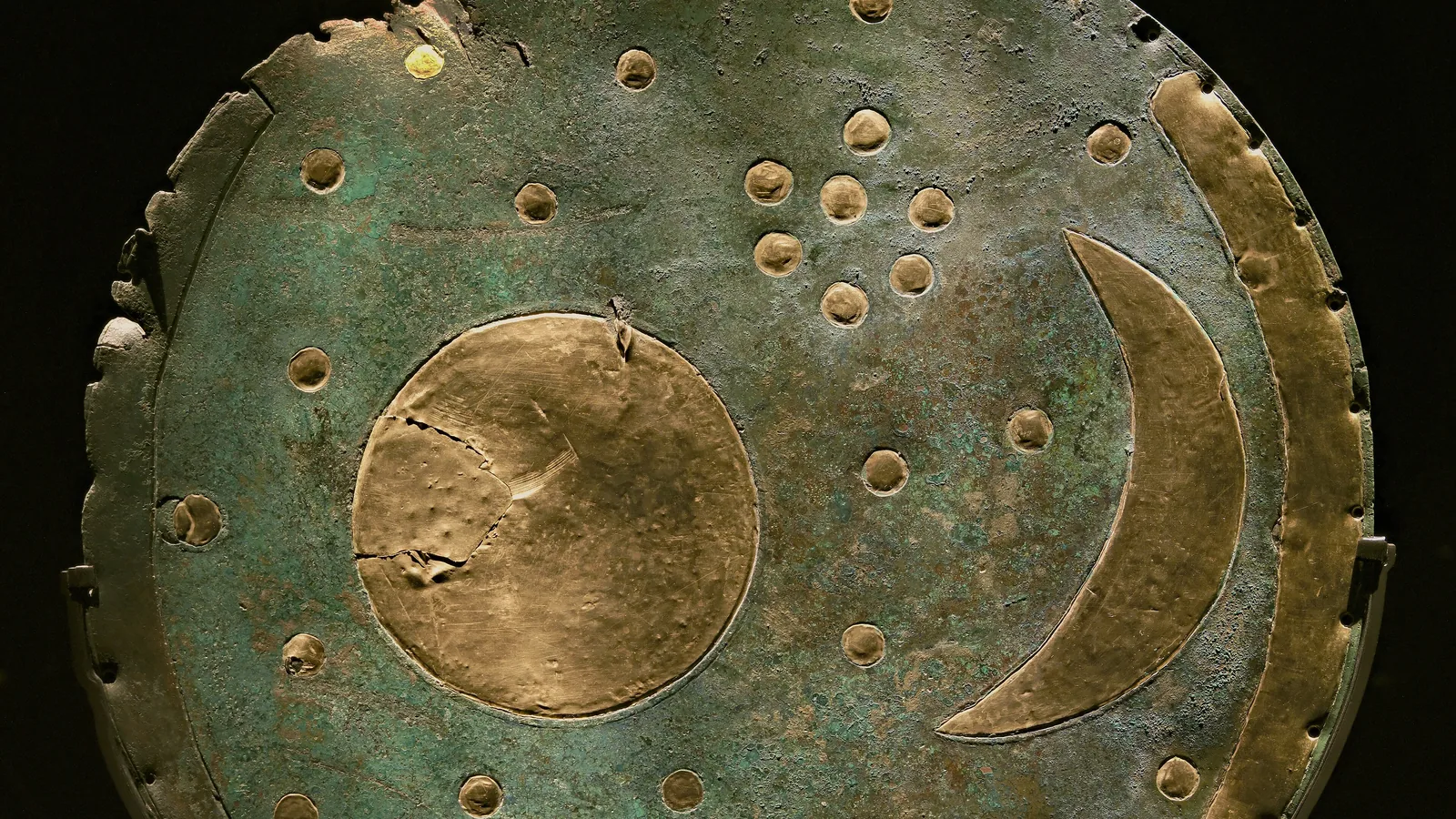
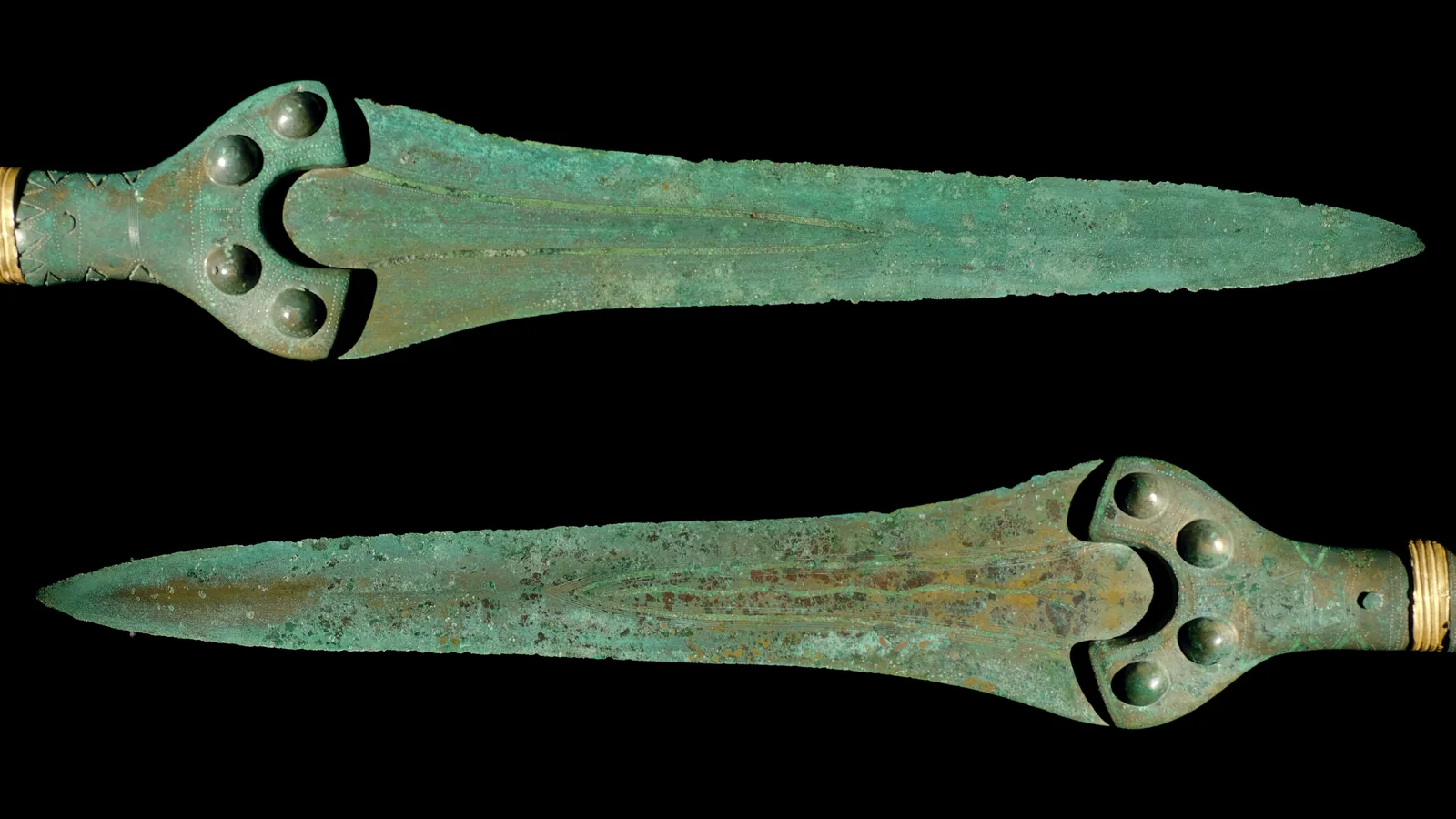
A bronze disc 32 centimeters across, inlaid with gold: 32 stars at first, a cluster of seven, a crescent, a full circle, two arcs on the rim and a curved band that the State Museum of Prehistory in Halle reads as a boat. The museum calls it “the world’s oldest concrete depiction of astronomical phenomena that we know.” On July 4, 1999, two looters with a metal detector dug it out of the summit of the Mittelberg, a hill near Nebra in Saxony-Anhalt, with two swords, two ax heads, a chisel and two arm spirals. The day is given in a 2020 paper led by Ernst Pernicka; the museum’s page says the summer of 1999. The looters sold the lot to a dealer within days. In February 2002 the Basel police secured the find, on February 23 by Pernicka’s account. The swords and ax heads place the burial about 1600 BC.
Quick facts
- When
- Dug up July 4, 1999; sold to a dealer days later; seized in Basel February 23, 2002; findspot excavated August 19 to November 25, 2002; on permanent display since May 23, 2008; Memory of the World June 2013; Iron Age proposal and reply 2020
- Where
- Summit of the Mittelberg near Nebra, Burgenlandkreis, Saxony-Anhalt, Germany; seized in a hotel in Basel, Switzerland; kept at the State Museum of Prehistory in Halle
- Who
- Two looters (convicted in Halle); the Basel police; Thomas Koiki (2002 excavation); Ernst Pernicka and Harald Meller (2020 reply); Rupert Gebhard and Rüdiger Krause (2020 Iron Age proposal)
- Outcome
- A bronze disc 32 centimeters across with gold inlays, buried with two swords, two ax heads, a chisel and two arm spirals about 1600 BC; its date and findspot were defended in a 2020 paper by 13 authors after two archaeologists proposed an Iron Age origin
Two looters, a fire ax and a shallow hole on the Mittelberg
The disc came out of the ground almost hidden by soil, and the looters saw the gold only after cleaning it badly, Pernicka and his 12 co-authors record. Their tool was a converted fire ax, the museum’s conservation page says: a blow bent the upper rim so that one star fell out, and the blade tore a wedge from the gold sheet of the large circle. Both pieces were recovered; the star went back on. The whole hoard comes to about four kilograms of bronze and 50 grams of gold, the museum’s science page states, as totals for the group rather than for the disc alone. The blow to the rim tells the museum that the disc stood upright in the ground, boat at the bottom, arcs at the sides.
Basel, February 2002, then a vault in Halle
The find passed through several fences and dealers over almost three years, the museum writes, and was recovered in a Swiss hotel. Since then the originals have belonged to the museum’s treasury in Halle. The looters were convicted, then testified in 2005 before the Regional Court in Halle against the two dealers who last held the hoard. Police work located the findspot, which Thomas Koiki excavated from August 19 to November 25, 2002. The disc has stood in the permanent exhibition since May 23, 2008; the museum’s page records its entry on the UNESCO Memory of the World register in June 2013.
Copper from the Mitterberg, gold from the Carnon River
None of the metal came from near Nebra. The copper in every object came from one ore deposit, probably in the eastern Alps, the museum writes; around 1600 BC the largest mine there was the Mitterberg, in what is now the Austrian state of Salzburg. The museum’s science page says the trail of the gold leads to Austria and England; the 2020 paper names the Carnon River in Cornwall, where an antler pick from a placer mine has been radiocarbon dated to between 1620 and 1497 BC. A smith hammered a cast blank of soft bronze out to 32 centimeters, the museum writes; Sebastian Dieck and colleagues measured it in 2024 at 4.6 millimeters thick in the center and 1.5 to 1.8 at the edge, heated and forged about ten times. The same kind of provenance work traced Stonehenge’s Altar Stone to northeast Scotland in 2024.
Five phases: 32 stars first, then arcs, a boat and holes
The museum reads the surface as a history in five steps. First the bronze carried a night sky of 32 stars with a full moon and a crescent. Then a smith added the two horizon arcs, covering two stars; a third was moved so that it stayed visible. Third came the boat, a gold band with feathered edges that differs in color from the rest and is squeezed between stars. Fourth, holes were punched around the rim, perhaps to mount the disc on a pole. Fifth, one arc was removed in antiquity, before burial. Only one group of stars stands out, the museum says: the Pleiades, the cluster of seven.
When the disc was made is not known, the museum states. Its bronze shows no measurable radioactivity from lead-210, a sign of old metal; birch bark in the sword hilts was radiocarbon dated to the 16th to 15th century BC; and the ax heads, flanged with a weak central step, are a form of about 1600 BC on the lower Elbe and Oder. Pernicka’s paper assigns every object to phase Bz A2c of the Early Bronze Age, the Únětice culture, and Dieck’s paper adds that the disc itself was probably made 100 to 200 years before it went into the ground.
Iron Age or Bronze Age: the 2020 exchange
On September 4, 2020, Deutsche Welle reported that Rupert Gebhard of the Munich State Archaeological Collection and Rüdiger Krause of the University of Frankfurt had argued in Archäologische Informationen that the disc was made in the Iron Age, between 800 and 50 BC. “The disc must be assessed as an individual find,” Krause told DW. They cited a pit that was “too small,” lead isotopes that did not match the other pieces and a likeness to the Celtic sword of Allach of the fifth century BC. “In our opinion, it is only a symbolic representation of individual stars,” Krause said.
The reply came the same year in Archaeologia Austriaca from Pernicka, Harald Meller and 11 others. Gebhard and Krause’s argument, they wrote, “is based on early published and unpublished material, which is used and cited selectively and ignores a substantial number of subsequent publications,” and rests “on a distortion of the evidence derived both in the court trial and by scientific analyses.” They turned to the Halle verdict. The presiding judge, Judge Gester, had concluded: “After a comprehensive review of all the evidence, there was no doubt about the find location of the Nebra Sky Disc.” One looter, Mario Renner, had described a different find situation in a ghostwritten book, which the court judged untrustworthy and Renner himself called fictitious; his accomplice, Henry Westphal, the court found, “faithfully reported the location of the hoard.” That verdict, Pernicka’s group wrote, “cannot be denied validity, even in a scientific discourse.”
The exchange left the two sides where they started: Halle keeps the disc at about 1600 BC on the strength of the swords, the ax heads, the birch bark and the ore, while Gebhard and Krause read the images as Iron Age and the hoard as no hoard at all. The disc itself, hammered from Alpine copper and dressed in Cornish gold, has been on show in Halle since 2008.

Key facts
- Two looters dug the hoard out of the summit of the Mittelberg near Nebra, Saxony-Anhalt, on July 4, 1999, and sold it to a dealer a few days later (Pernicka et al. 2020).
- The hoard held the disc, two swords, two ax heads, a chisel and two arm spirals; the museum gives its totals as about four kilograms of bronze and 50 grams of gold.
- The Basel police secured the find in February 2002, on February 23 by Pernicka’s paper, in a Swiss hotel; the findspot was excavated August 19 to November 25, 2002.
- The disc is 32 centimeters across, 4.6 millimeters thick at the center and 1.5 to 1.8 millimeters at the edge, forged from a cast blank in about ten cycles of heating and hammering (Dieck et al. 2024).
- The copper came from the eastern Alps, where the Mitterberg was the largest mine around 1600 BC; the gold came from the Carnon River in Cornwall (Pernicka et al. 2020).
- The museum describes five phases: 32 stars with full moon and crescent; two horizon arcs; the feathered boat; holes around the rim; removal of one arc before burial.
- Burial about 1600 BC, phase Bz A2c of the Únětice culture, dated by the ax heads, the swords and birch bark from the hilts; the disc itself was probably made 100 to 200 years earlier.
- Gebhard and Krause proposed an Iron Age date (800 to 50 BC) in 2020; Pernicka, Meller and 11 co-authors replied in Archaeologia Austriaca 104 that the argument rested on selective citation and cited the Halle court’s finding on the findspot.
FAQ
Where is the Nebra Sky Disc now?
In the State Museum of Prehistory in Halle, Saxony-Anhalt, where it has been part of the permanent exhibition since May 23, 2008. The originals of the whole hoard belong to the museum's treasury. DW reported in 2019 that Halle and the British Museum had agreed a loan for a London showing planned for 2021.
What do the images on the disc mean?
The museum reads the 32 stars as an abstract night sky with one cluster picked out, the Pleiades; the crescent and the full circle as moon and sun or full moon; the two rim arcs as the sun's rising and setting points between the solstices; and the feathered band as a boat crossing the sky. DW reported in 2019 that research published in 2006 proposed the disc as a rule for adding a 13th month to a lunar calendar.
Is the Nebra Sky Disc genuine?
The Halle Regional Court, trying the dealers in 2005, answered the question of authenticity, in Pernicka's quotation of the verdict, "affirmatively with a probability close to certainty." The 2020 Iron Age proposal by Gebhard and Krause did not call it a forgery; it disputed the date and the link to the other finds, and 13 authors replied that the soil on the objects, the metals and the excavation of the findspot tie the disc to the hoard.
Sources
- State Museum of Prehistory, Halle — "Nebra Sky Disc" (English) and "Himmelsscheibe von Nebra" (German).
- Landesmuseum für Vorgeschichte Halle — "Der Fundort," "Der Hort von Nebra" and "Datierung."
- Landesmuseum für Vorgeschichte Halle — "Vom Kupfererz zum Himmelsbild," "Die Phasen der Himmelsscheibe" and "Das Universum der Himmelsscheibe."
- Landesmuseum für Vorgeschichte Halle — "Naturwissenschaftliche Untersuchungen" and "Restaurierung."
- Ernst Pernicka, Jörg Adam, Gregor Borg, Gerhard Brügmann, Jan-Heinrich Bunnefeld, Wolfgang Kainz, Mechthild Klamm, Thomas Koiki, Harald Meller, Ralf Schwarz, Thomas Stöllner, Christian-Heinrich Wunderlich and Alfred Reichenberger — "Why the Nebra Sky Disc Dates to the Early Bronze Age. An Overview of the Interdisciplinary Results," Archaeologia Austriaca 104 (2020), 89–122, open access.
- Sebastian Dieck et al. — "Archaeometallurgical investigation of the Nebra Sky Disc," Scientific Reports 14, 28868 (November 21, 2024), via PubMed Central.
- Deutsche Welle — Verena Greb, "Nebra sky disk could be much younger than previously thought" (September 4, 2020).
- Deutsche Welle — Kristie Pladson, "Germany loans Nebra Sky Disc to UK" (October 21, 2019).
Cite this article
- APA
- Our Earth's History. (2026, September 22). Dug up July 4, 1999, seized in Basel in 2002: the Nebra Sky Disc. Our Earth's History. https://ourearthshistory.com/europe/ancient/nebra-sky-disc-1600-bc-found-1999/
- Chicago
- Our Earth's History. “Dug up July 4, 1999, seized in Basel in 2002: the Nebra Sky Disc.” Our Earth's History, September 22, 2026. https://ourearthshistory.com/europe/ancient/nebra-sky-disc-1600-bc-found-1999/.
- MLA
- “Dug up July 4, 1999, seized in Basel in 2002: the Nebra Sky Disc.” Our Earth's History, 22 Sep. 2026, https://ourearthshistory.com/europe/ancient/nebra-sky-disc-1600-bc-found-1999/.
Text licensed CC BY-NC-ND 4.0. Found an error? Tell us.