More than 2,000 km of open sea: the Mariana Islands, about 1500 BC

TL;DR — About 1500 BC people crossed more than 2,000 km of open sea to the Mariana Islands; pottery, rice husks and 2021 ancient DNA point to the Philippines.
“They crossed more than 2,000 km of open ocean to get there.” The sentence comes from the abstract of a 2021 paper in the Proceedings of the National Academy of Sciences on ancient DNA from Guam, and the crossing it describes happened about 3,500 years ago, around 1500 BC, the date Mike T. Carson of the University of Guam set for the first settlement horizon in the Mariana Islands in 2020. The 15 islands run about 750 km from north to south, Guam the largest. The 2021 paper puts them about 2,500 km east of the Philippines; Hsiao-chun Hung’s team in 2011 and Carson’s in 2025 gave the gap as 2,300 km. By the same abstract’s count, no other voyage of that length happened anywhere else for more than 2,000 years afterward. Pottery and sailing simulations gave opposite answers on where the settlers came from, until two skeletons from a cave at the north tip of Guam, sequenced in 2021, sided with the pottery.
Quick facts
- When
- About 1500 BC (first settlement layers at Ritidian on Guam and Bapot-1 on Saipan) · 3500 to 3100 years ago (rice phytoliths on Marianas Red pottery) · 2,180 ± 30 cal BP (skeleton RBC2 at Ritidian Beach Cave) · after AD 1000 (latte villages) · 1742 (Anson's drawing of the House of Taga) · April 1, 2020 (US Census of Guam)
- Where
- The Mariana Islands in the western Pacific, 15 islands over about 750 km, with Guam the largest and southernmost; Ritidian at the north tip of Guam; Unai Bapot on Saipan; the House of Taga on Tinian
- Who
- The first settlers of Remote Oceania, ancestors of the CHamoru people (Chamorro in the US Census); archaeologists Mike T. Carson and Hsiao-chun Hung; Fiona Petchey and Geoffrey Clark; Scott M. Fitzpatrick, Richard T. Callaghan and Álvaro Montenegro; geneticists Pugach and Stoneking of the Max Planck Institute for Evolutionary Anthropology
- Outcome
- Pottery, rice and, in 2021, ancient DNA from two skeletons on Guam trace the settlers to the Philippines, against sailing simulations that favored New Guinea or the Maluku Islands. In 2020 the Census Bureau counted 63,035 people on Guam as Chamorro alone or in combination
Ritidian Beach Cave, around 1500 BC
Carson published the Ritidian evidence in Antiquity in 2017. “Around 1500 BC, people lived in one small area outside of Ritidian Beach Cave,” he wrote, where they left a layer of broken pottery, stone tools, shell beads and food refuse in a bed of algal bioclasts. A shallow lagoon then reached the foot of the limestone cliff, about 200 m inland of the shoreline of 2017. The layer held red-slipped pottery, mostly plain but with one circle-stamped rim, a chert adze blank, beads of Conus shell, shellfish mostly of the genus Anadara and a few fish bones.
On Saipan the site is Bapot-1 at Unai Bapot, where Geoffrey Clark, Fiona Petchey and colleagues dated human arrival to about 3,400 to 3,200 years before present. Carson wrote in Radiocarbon in 2020 that the marine reservoir corrections used by Petchey’s team showed wide variance, and Petchey and Clark answered in the same journal in 2021 that his statement “is misleading on all three points,” since hard water from the limestone had complicated the shell dates. Both sides keep the first arrival between roughly 3,500 and 3,200 years ago.
Rice husks on Marianas Red pottery
The earliest bowls, 5 to 20 cm across and mostly coated with red slip, are known as Marianas Red. In 2025 Carson and five co-authors reported in Science Advances “abundant rice husk and leaf phytoliths adhering to red-slipped pottery (‘Marianas Red’) at the Ritidian Site Complex in Guam, dated by radiocarbon to 3500 to 3100 years ago.” Phytoliths are silica bodies formed inside plant cells. “During this early period, rice was restricted to special ritual events in the Marianas,” the paper states; the everyday diet rested on taro, yams, bananas and breadfruit, and a Spanish record of 1602 has rice served at deathbeds and funerals. The authors’ reading of the husks is that “The early voyage apparently was planned with provisions of rice at 3500 years ago.” The early layers hold no pig, dog or chicken bones.
"Not from Taiwan or the Philippines": the sailing simulations
Hung, Carson, Peter Bellwood and six co-authors compared the Marianas pottery with assemblages in the Philippines in Antiquity in 2011. The published summary of their paper describes “an epic pioneering voyage of men and women, with presumably some cultivated plants but apparently no animals.” Scott M. Fitzpatrick and Richard T. Callaghan replied in the same journal in 2013 with computer voyages: the Marianas, they wrote, were settled “not from Taiwan or the Philippines . . . but from New Guinea or Island Southeast Asia to the south.” In 2016 Álvaro Montenegro, Callaghan and Fitzpatrick reported that simulated downwind voyages from Taiwan and the Philippines failed to reach the islands, while departures between August and October from Palau, the Maluku Islands, New Guinea and the Bismarck Archipelago succeeded. Central New Guinea voyages that set out in September had the highest probability of success, 25%; Bismarck crossings in September succeeded 13% of the time and lasted 93 days on average. The 2016 paper concluded that western Micronesia “was likely settled from somewhere around the Maluku (Molucca) Islands.” The 2021 DNA paper answered that the simulations left out “the ability of ancient voyagers to travel against strong ocean currents and prevailing winds.”
Two skeletons, about 2,200 years old
The DNA came from two people buried side by side outside Ritidian Beach Cave. A direct radiocarbon date on the second, RBC2, gave 2,180 ± 30 calibrated years before present, “some 1,000 y after the initial settlement of Guam, but also some 1,000 y before the latte period.” Pugach, Stoneking and colleagues at the Max Planck Institute for Evolutionary Anthropology sequenced complete mitochondrial genomes and genome-wide markers from both. The results, in the abstract’s words, “strongly support ancestry from the Philippines.” “The most likely source is the Philippines, although western Indonesia is also possible,” the text states, and none of the genome-wide analyses found any trace of Papuan-related ancestry.
The same two genomes sat close to early Lapita individuals from Vanuatu and Tonga, and the authors raised the possibility that the Marianas and Polynesia were settled from one source population. They set their own limit on the finding. The two individuals “may be related,” and they died some 1,400 years after the first settlement, so “Some caution is warranted.”
After AD 1000: latte pillars on Tinian and a count in 2020
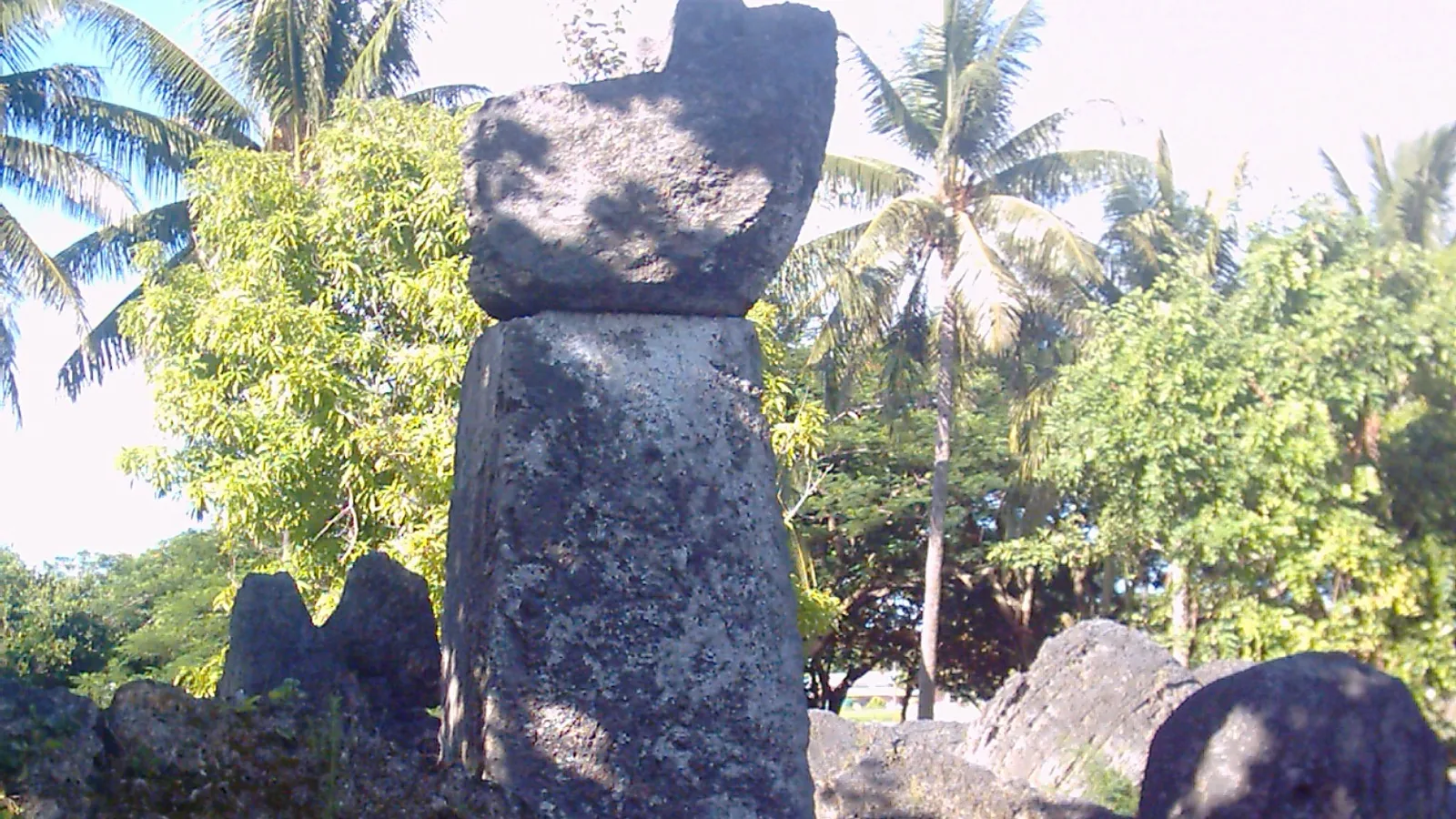
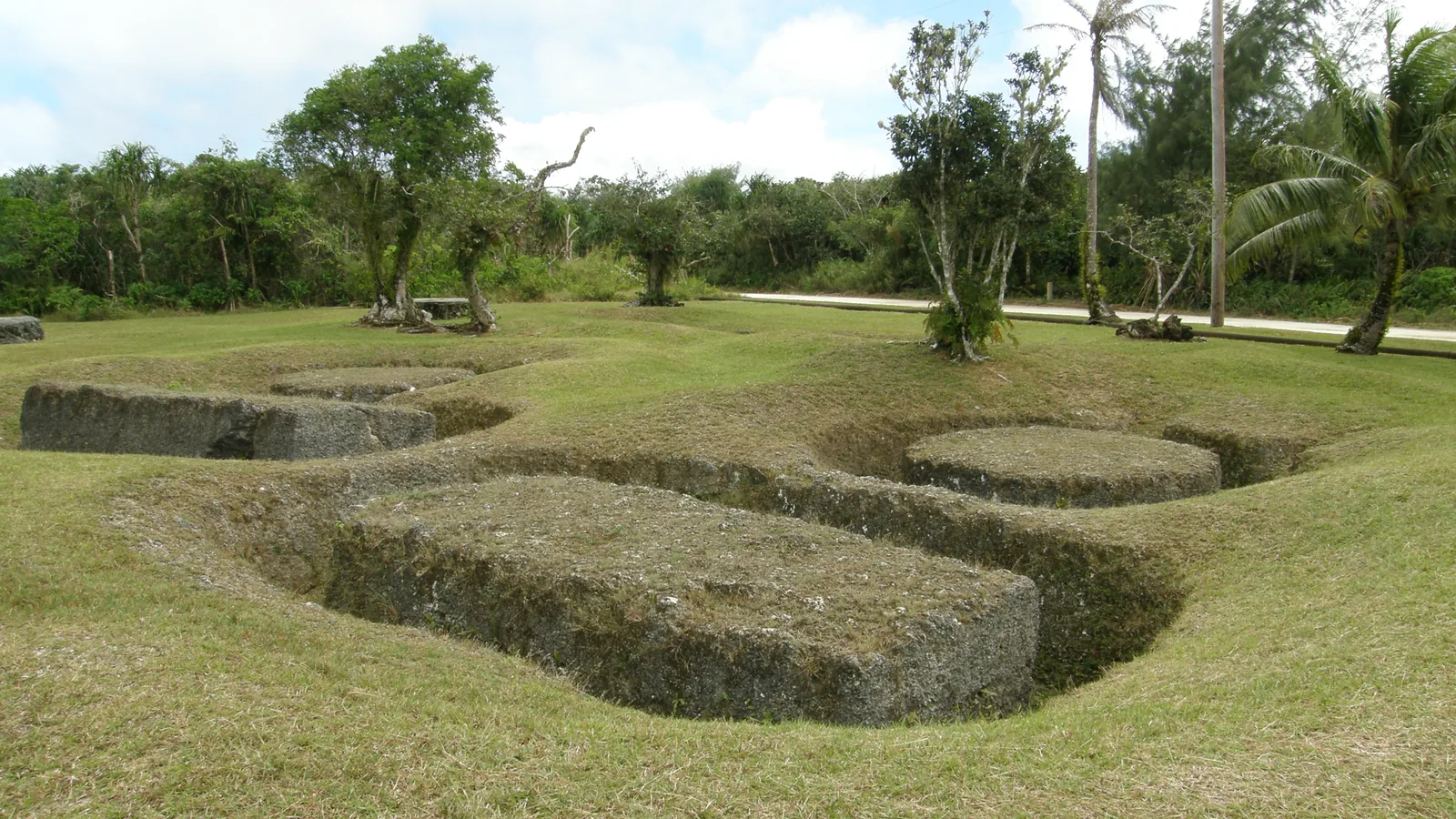
Carson’s 2017 paper places the widest settlement of Ritidian after AD 1000, in villages of houses built on “quarried stone pillars with elevated capitals supporting a wooden superstructure. They were locally known as latte.” In Guampedia’s entry by Lawrence J. Cunningham the pillar is the haligi and the cap the tåsa. The largest set standing is the House of Taga on Tinian, 12 latte whose capstones measure 2.48 to 2.7 m across and whose shafts run 3.87 to 4.23 m. In 1742 the British commodore George Anson recorded all 12 stones upright, each pillar “about five feet square at the base, and about thirteen feet high,” topped by “a semi-globe, with the flat part upwards.” Seven stood when Freycinet visited in 1819, five in Georg Fritz’s report of 1900, two in 1924, and shelling before the American landing of 1944 knocked one of those down. One stone stands.
The descendants of the first settlers are the CHamoru people (Chamorro in the US Census). On April 1, 2020, the Census Bureau counted 153,836 people on Guam, 50,420 of whom identified as Chamorro alone and 63,035 as Chamorro alone or in combination with another group.

Key facts
- The first settlers reached the Mariana Islands about 1500 BC, crossing “more than 2,000 km of open ocean,” and no voyage of that length is recorded elsewhere for more than 2,000 years afterward (Pugach et al. 2021).
- Hung et al. 2011 and Carson et al. 2025 give the Philippines-to-Marianas gap as 2,300 km; Pugach et al. 2021 give about 2,500 km.
- At Ritidian on Guam a layer dated to about 1500 BC held red-slipped pottery, a chert adze blank, Conus shell beads and Anadara shellfish, laid down in a lagoon bed that then reached the cliff (Carson 2017).
- Bapot-1 on Saipan was dated by Clark, Petchey and colleagues to about 3,400 to 3,200 years before present; Carson (2020) and Petchey and Clark (2021) dispute the marine corrections but share the broad window.
- Rice husk and leaf phytoliths on Marianas Red pottery at Ritidian date to 3500 to 3100 years ago, and rice was restricted to ritual use (Carson et al. 2025).
- Sailing simulations by Montenegro, Callaghan and Fitzpatrick (2016) failed from Taiwan and the Philippines; September departures from central New Guinea succeeded 25% of the time and from the Bismarcks 13%, with an average duration of 93 days.
- Two skeletons from Ritidian Beach Cave, RBC2 dated 2,180 ± 30 cal BP, carry ancestry from the Philippines and no Papuan-related ancestry; the authors add that the two “may be related” (Pugach et al. 2021).
- The House of Taga on Tinian has capstones 2.48 to 2.7 m across and shafts 3.87 to 4.23 m long; all 12 stood in 1742 and one stands (Guampedia). The 2020 Census counted 153,836 people on Guam, 63,035 of them Chamorro alone or in combination.
FAQ
When were the Mariana Islands first settled?
About 1500 BC, or roughly 3,500 years ago. Carson (2020) set the initial settlement horizon at 1500 BC from layered sites on Guam and Saipan; Clark, Petchey and colleagues dated arrival at Bapot-1 on Saipan to about 3,400 to 3,200 years before present.
Where did the first settlers of the Marianas come from?
Pottery comparisons (Hung et al. 2011) and ancient DNA from two skeletons on Guam (Pugach et al. 2021) point to the Philippines. Sailing simulations (Fitzpatrick and Callaghan 2013; Montenegro et al. 2016) favored New Guinea or the Maluku Islands, and the DNA paper answers that those models did not allow for sailing against wind and current.
What is a latte stone?
A quarried stone pillar (haligi) with a hemispherical capstone (tåsa) that supported a wooden house in the Marianas after AD 1000. The largest standing set is the House of Taga on Tinian, with shafts 3.87 to 4.23 m long.
Sources
- Pugach, Hübner, Hung, Meyer, Carson and Stoneking, "Ancient DNA from Guam and the peopling of the Pacific," PNAS 118(1): e2022112118 (2021), full text at PubMed Central.
- Carson, Wang, Huan, Dong, Hung and Deng, "Earliest evidence of rice cultivation in Remote Oceania: Ritual use by the first islanders in the Marianas 3500 years ago," Science Advances 11(26): eadw3591 (2025), full text at PubMed Central.
- Hung, Carson, Bellwood, Campos, Piper, Dizon, Bolunia, Oxenham and Zhang, "The first settlement of Remote Oceania: the Philippines to the Marianas," Antiquity 85(329): 909–926 (2011), published summary at Cambridge Core.
- Mike T. Carson, "Peopling of Oceania: Clarifying an initial settlement horizon in the Mariana Islands at 1500 BC," Radiocarbon 62(6): 1733–1754 (2020), abstract at Cambridge Core.
- Clark, Petchey, Winter, Carson and O'Day, "New Radiocarbon Dates from the Bapot-1 Site in Saipan and Neolithic Dispersal by Stratified Diffusion," Journal of Pacific Archaeology 1(1): 21–35, abstract.
- Fiona Petchey and Geoffrey Clark, "Clarifying the age of initial settlement horizon in the Mariana Islands and the impact of hard water: a response to Carson (2020)," Radiocarbon 63(3): 905–913 (2021), abstract at Cambridge Core.
- Mike T. Carson, "Cultural spaces inside and outside caves: a study in Guam, western Micronesia," Antiquity 91(356): 421–441 (2017), open-access full text at Cambridge Core.
- Scott M. Fitzpatrick and Richard T. Callaghan, "Estimating trajectories of colonisation to the Mariana Islands, western Pacific," Antiquity 87(337): 840–853 (2013), abstract at Cambridge Core.
- Montenegro, Callaghan and Fitzpatrick, "Using seafaring simulations and shortest-hop trajectories to model the prehistoric colonization of Remote Oceania," PNAS 113(45): 12685–12690 (2016), full text at PubMed Central.
- Guampedia (Guampedia Foundation, Inc.), "Latte Structures," by Lawrence J. Cunningham.
- Guampedia (Guampedia Foundation, Inc.), "Taga," by Don Farrell.
- U.S. Census Bureau, "Census Bureau Releases 2020 Census Population and Housing Unit Counts for Guam," CB21-TPS.73, October 28, 2021.
- U.S. Census Bureau, "2020 Island Areas Censuses: Guam," CB22-CN.21 (revised), October 20, 2022.
Cite this article
- APA
- Our Earth's History. (2026, September 22). More than 2,000 km of open sea: the Mariana Islands, about 1500 BC. Our Earth's History. https://ourearthshistory.com/oceania/ancient/marianas-1500-bc-first-settlement-longest-ocean-crossing/
- Chicago
- Our Earth's History. “More than 2,000 km of open sea: the Mariana Islands, about 1500 BC.” Our Earth's History, September 22, 2026. https://ourearthshistory.com/oceania/ancient/marianas-1500-bc-first-settlement-longest-ocean-crossing/.
- MLA
- “More than 2,000 km of open sea: the Mariana Islands, about 1500 BC.” Our Earth's History, 22 Sep. 2026, https://ourearthshistory.com/oceania/ancient/marianas-1500-bc-first-settlement-longest-ocean-crossing/.
Text licensed CC BY-NC-ND 4.0. Found an error? Tell us.