Who reached the remote Pacific first, and how did they get there?
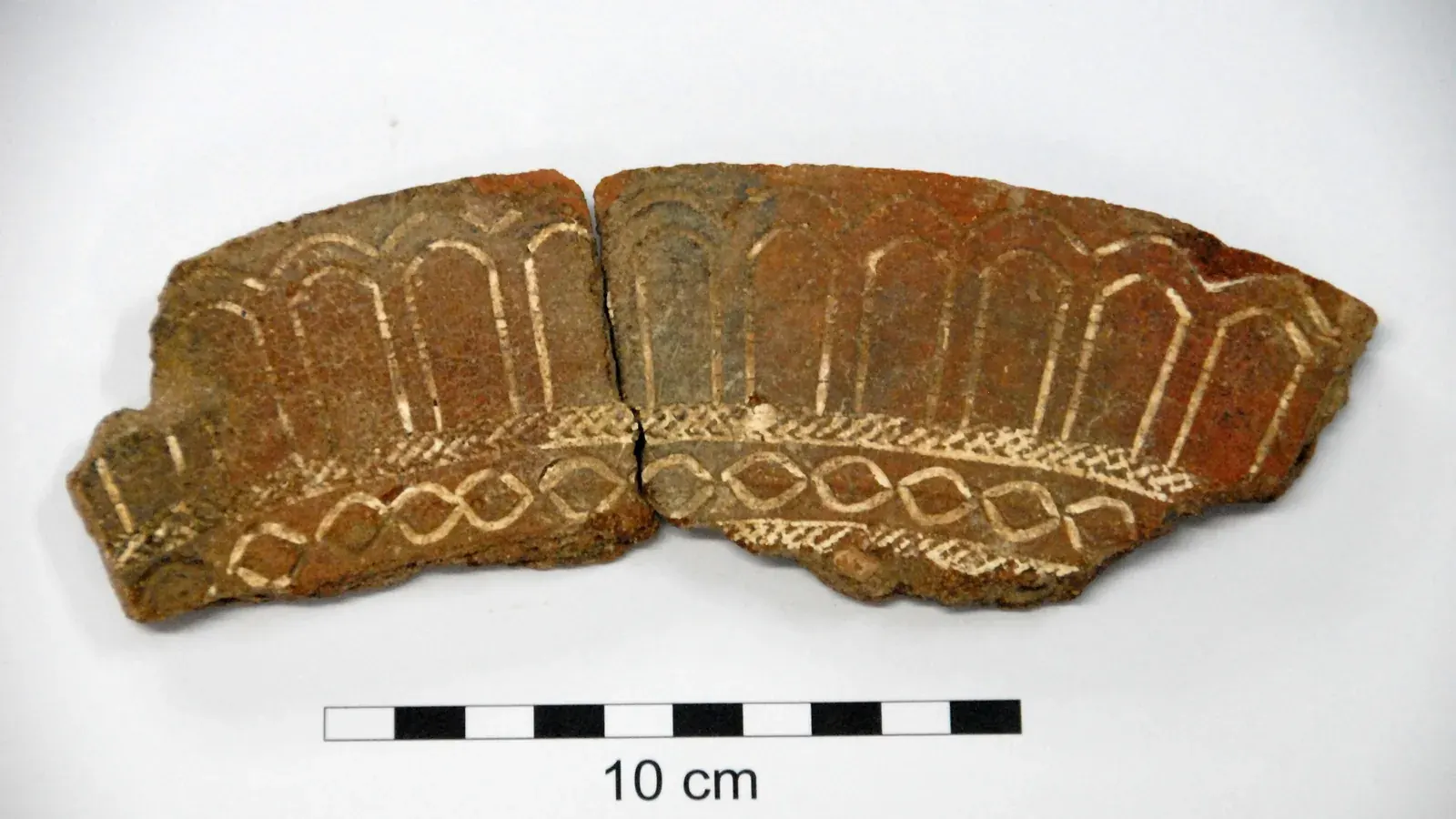

TL;DR — Lapita voyagers from the Bismarck Archipelago settled Vanuatu, Fiji, Tonga and Samoa between about 1400 and 1000 BC; ancient DNA published in 2016 traced them to East Asia.
The first people to reach Vanuatu, Fiji, Tonga and Samoa were pottery-making voyagers of the Lapita culture, who sailed east from the Bismarck Archipelago after about 1400 BC. New Guinea and the main Solomon Islands had been inhabited for tens of thousands of years; the islands beyond them, which archaeologists call Remote Oceania, had never held a human being. The Lapita people crossed that line and reached Samoa in four to five centuries, carrying pigs, chickens and garden plants with them. DNA from their cemetery at Teouma in Vanuatu, published in 2016, showed that they came from the direction of Taiwan and the Philippines.
Quick facts
- When
- About 1400 to 1000 BC (first voyages east of the Solomon Islands to Tonga and Samoa)
- Where
- Bismarck Archipelago, Vanuatu, New Caledonia, Fiji, Tonga, Samoa
- Who
- People of the Lapita culture, Austronesian speakers of East Asian descent
- Outcome
- The first human settlement of the remote Pacific; a pause of more than 1,000 years before Polynesia was settled further east
A misheard word in New Caledonia, 1952
The culture got its name by accident. In 1952 two American archaeologists, Edward W. Gifford and Richard Shutler Jr., excavated a beach at Foué, near Koné in New Caledonia. On August 2 of that year Gifford wrote in his notebook that the name of the site was Lapita. The word he heard was xapeta’a, which in the local Haveke language means the place where one digs, according to the New Caledonian news site DNC.NC. Gifford and Shutler published their excavations in 1956, and the name stuck to the pottery style and then to the people who made it. Stuart Bedford and Christophe Sand, reviewing the field in 2007 for the Australian National University, counted more than 200 recorded Lapita sites, from Manus off New Guinea to New Caledonia and Samoa.
Pots stamped with a comb
The pots were decorated before firing with a comblike tool pressed into the wet clay, a technique archaeologists call dentate stamping. Each stamp carried a single design element, and potters combined elements into bands of repeating geometric patterns; a few pots carry stylized human faces. Jennifer Wagelie, writing for the Metropolitan Museum of Art in 2002, described the larger vessels as cooking, serving or storage pots.
In Tonga, David Burley and Sean Connaughton reported from radiocarbon-dated sites in the Vava’u group that decorated Lapita ceramics disappeared rapidly after the first landfalls.
Island by island, from the Bismarcks to Samoa
The oldest Lapita pottery comes from the Bismarck Archipelago, in what is now Papua New Guinea. Robin Torrence of the Australian Museum, who excavated on New Britain, wrote that the style appeared there immediately after a large eruption about 1300 BC, and that shortly afterward people using Lapita pots sailed to the islands east of the Solomons for the first time.
From there the settlement ran south and east: Vanuatu and New Caledonia, then Fiji, then Tonga. Burley and Connaughton put the start of the migration at about 1400 BC and the first entry into Polynesia at Tongatapu, from which settlers spread north to Samoa along what they called a natural sailing corridor. The Metropolitan Museum essay gives the end point: Tonga and Samoa by about 1000 BC.
What the canoes carried
No Lapita canoe has been excavated, so the boats are known only by what they delivered. The Skoglund team described them as the first boats capable of long-distance sea travel, and archaeologists call their cargo a transported landscape: a set of domesticated plants and animals carried from island to island so that settlers could farm land that had never been farmed. At Teouma the village midden held bones of domestic pigs and chickens, and Rebecca Kinaston and colleagues, who studied the diet there in 2014, named yam, taro and breadfruit as the starchy staples of Pacific meals. They also carried stone: obsidian, the volcanic glass that takes a razor edge, reached Teouma from New Britain, far to the northwest.
In the 1970s Peter Bellwood argued that the pottery rode east with the expansion of Austronesian-speaking farmers out of Southeast Asia. Roger Green proposed in 1991 a compromise of intrusion from Southeast Asia, innovation in the islands and integration with people already there, which Bedford and Sand described as the point at which the debate stalled. Torrence argued instead that the pottery was invented on New Britain after the eruption, a theory she wrote was a challenge to the migrant view.
The dead at Teouma and what their bones said in 2016
Teouma lies on the south coast of Efate, the island of Vanuatu’s capital, Port Vila. In December 2003 a bulldozer driver quarrying soil for a prawn farm turned up a decorated sherd, which Salkon Jonah, a fieldworker of the Vanuatu National Museum, recognized as Lapita; the museum called in archaeologists. Matthew Spriggs of the Australian National University and Bedford led excavations from 2004 to 2010 that uncovered 68 graves holding about 100 people, the oldest cemetery yet found in the Pacific Islands, with pottery in the range of 3,200 to 3,000 years old. Every adult was missing a head. The skulls had been taken after the flesh decayed, and in one grave a shell ring lay where the head had been; an old man was buried with three skulls on his chest.
In 2016 a team led by David Reich at Harvard Medical School, with Pontus Skoglund as lead author, published genome-wide DNA from three Teouma skeletons dated between about 3,100 and 2,700 years old and from one skeleton from Talasiu on Tongatapu, Tonga, dated between about 2,700 and 2,300 years old. The four carried little or no Papuan ancestry and were closest to the Ami and Atayal of Taiwan and the Kankanaey of the northern Philippines.
Every living Pacific islander has at least 25 percent Papuan ancestry, which most researchers had read as proof that the first settlers were already a mixed population from near New Guinea. The ancient genomes said otherwise: the pioneers went past New Guinea and the Solomons without much mating, and Papuan ancestry arrived later, in Vanuatu around 800 to 700 BC according to Spriggs, mostly through men marrying women of Lapita descent.
The long pause before Polynesia
At Samoa the expansion stopped, and Fiji, Tonga and Samoa stayed the eastern limit of human settlement for well over a thousand years. Spriggs, speaking in 2016, put the move from Tonga and Samoa toward Hawaii and Tahiti at about AD 1000, and the Skoglund paper gave AD 1000 to 1300 for the arrival of Lapita descendants on the most isolated islands of the eastern and southern Pacific. None of the sources read for this article gives a cause for the pause.
The shape of the story is not in doubt. A pottery-making people left the Bismarcks after about 1400 BC, reached Samoa by about 1000 BC, and were the first humans on every island in between, carrying their pots and livestock and an East Asian ancestry that no living population holds unmixed.
Key facts
- The Lapita culture is named after a beach at Foué, near Koné in New Caledonia, dug by Edward W. Gifford and Richard Shutler Jr. in 1952; the name is a mishearing of the Haveke word xapeta’a.
- Lapita pottery is dentate-stamped earthenware; more than 200 sites were on record by 2007, from Manus in the Bismarck Archipelago to New Caledonia and Samoa.
- The migration east of the Solomons began about 1400 BC and reached Tonga and Samoa by about 1000 BC (Burley and Connaughton; Metropolitan Museum of Art).
- Settlers carried a transported landscape of domesticated plants and animals; Teouma yielded pig and chicken bones and obsidian from New Britain.
- Teouma on Efate, Vanuatu, found in December 2003 and excavated 2004 to 2010, is the oldest known cemetery in the Pacific Islands: 68 graves, about 100 people, about 3,200 to 3,000 years old.
- Skoglund et al. (Nature, 2016) sequenced three Teouma skeletons and one from Tonga; all had little or no Papuan ancestry and were closest to indigenous Taiwanese and northern Philippine groups.
- After reaching Samoa, settlement paused for well over 1,000 years before Polynesia further east was reached.
FAQ
Who were the Lapita people?
Austronesian-speaking farmers and sailors who made dentate-stamped pottery and, from about 1400 BC, settled the islands east of the Solomons for the first time. Ancient DNA shows their ancestry was East Asian, closest to indigenous groups of Taiwan and the northern Philippines.
Why is the culture called Lapita?
Because of a 1952 excavation at Foué, near Koné in New Caledonia, where American archaeologist Edward W. Gifford recorded the site's name as Lapita, a mishearing of the Haveke word xapeta'a, the place where one digs.
What did the 2016 DNA study find?
Skoglund and colleagues read the genomes of three people buried at Teouma in Vanuatu and one buried in Tonga. None carried more than a trace of Papuan ancestry, so the Papuan share found in all living Pacific islanders arrived with later migrations.
Sources
- DNC.NC (Nouméa) — "De Xapeta'a à l'IANCP, l'archéologie en quête d'une histoire commune" (in French).
- ANU Press — Bedford and Sand, "Lapita and Western Pacific Settlement: Progress, prospects and persistent problems," Terra Australis 26 (2007).
- The Metropolitan Museum of Art — Jennifer Wagelie, "Lapita Pottery (ca. 1500–500 B.C.)," Heilbrunn Timeline of Art History, 2002.
- Australian Museum — Robin Torrence, "Volcanic disasters and the beginning of Lapita style pottery in Papua New Guinea."
- Radiocarbon (Cambridge Core) — Burley and Connaughton, "First Lapita Settlement and its Chronology in Vava'u, Kingdom of Tonga" (abstract).
- Australia and Pacific Science Foundation — "Archaeological investigation of the Lapita site of Teouma" (project PBF 04-1, M. Spriggs).
- Australian Academy of the Humanities — "On a Melanesian island, the Pacific's oldest cemetery helps solve a mystery."
- PLoS ONE (PubMed Central) — Kinaston et al., "Lapita Diet in Remote Oceania: New Stable Isotope Evidence from the 3000-Year-Old Teouma Site, Efate Island, Vanuatu," 2014.
- Nature — Skoglund et al., "Genomic insights into the peopling of the Southwest Pacific," 2016 (abstract and editorial summary).
- Reich Lab, Harvard Medical School — author copy of Skoglund et al. 2016 with supplementary information (PDF).
- ABC News (Australia) — "DNA reveals Lapita ancestors of Pacific Islanders came from Asia," October 4, 2016.
- ScienceDaily — "Study reveals Asian ancestry of Pacific islanders," October 3, 2016.
Cite this article
- APA
- Our Earth's History. (2026, September 19). Who reached the remote Pacific first, and how did they get there? Our Earth's History. https://ourearthshistory.com/oceania/ancient/lapita-first-people-remote-pacific/
- Chicago
- Our Earth's History. “Who reached the remote Pacific first, and how did they get there?” Our Earth's History, September 19, 2026. https://ourearthshistory.com/oceania/ancient/lapita-first-people-remote-pacific/.
- MLA
- “Who reached the remote Pacific first, and how did they get there?” Our Earth's History, 19 Sep. 2026, https://ourearthshistory.com/oceania/ancient/lapita-first-people-remote-pacific/.
Text licensed CC BY-NC-ND 4.0. Found an error? Tell us.