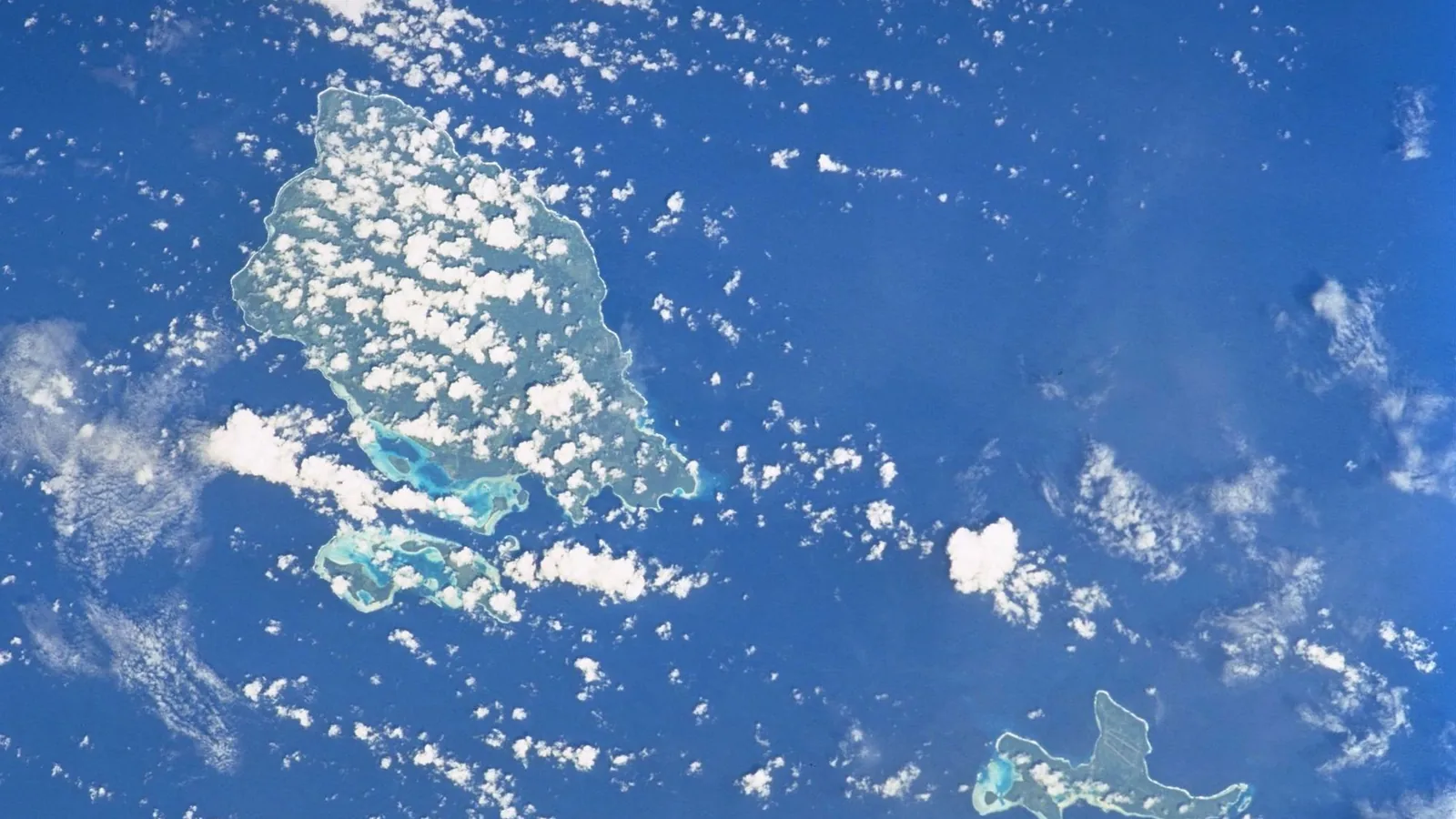
Stilt posts in a lagoon: the Lapita village at Talepakemalai, Mussau
.JPG)
TL;DR — In August 1985 Patrick Kirch’s team found a waterlogged Lapita layer at Talepakemalai, Eloaua Island, with a stilt-house post base, dentate-stamped pottery, obsidian and shell.
“Arriving on Eloaua in early August 1985, and after reconnoitering the ECA site with Ave Male as my guide, I decided that the highest priority was to define the site’s boundaries and to construct an accurate site map,” Patrick Vinton Kirch wrote of the start of his excavation at Talepakemalai, on Eloaua Island in the Mussau group of Papua New Guinea’s Bismarck Archipelago. Kirch returned for further seasons in 1986 and 1988. Digging reached a waterlogged, subtidal layer that preserved the base of a stilt-house post next to dentate-stamped pottery, obsidian and shell ornaments, and radiocarbon dates published in 2022 place the main occupation of that stilt house at about 3200 to 2950 cal BP.
Quick facts
- When
- August 1985 (excavation begins); 1986 and 1988 (further seasons); August 28, 1985 (a post base exposed)
- Where
- Eloaua Island, Mussau Islands, Bismarck Archipelago, Papua New Guinea
- Who
- Patrick Vinton Kirch; Ave Male, his local guide
- Outcome
- A waterlogged layer preserved the base of a stilt-house post, dentate-stamped pottery, obsidian from Lou and Talasea, and shell ornaments; radiocarbon dates published in 2022 place the main occupation at about 3200 to 2950 cal BP
Kirch defines the site, August 1985
Kirch laid out a grid along an east-west baseline, “beginning at E100N0 and extending to W500N0,” and the test pits dug that year became known on site as TP-1 through TP-15. One of them, at W200N100 and about seven meters east of a 1978 trench dug by Bafmatuk and colleagues, was expected to be shallow and single-layered. Instead, Kirch wrote, “we were surprised to discover pottery, obsidian, bone, and shell midden extending well into the white, calcareous beach sands down to 100 cm.” A 2022 chapter in the Australian National University’s Terra Australis series, by Scarlett Chiu, Yuyin Su, David Killick, Kirch, Glenn R. Summerhayes, Jim Specht and Wallace Ambrose, puts the site, known by the code ECA, at up to 82,000 square meters, “thus representing the largest Lapita village site on record.” The same team’s survey covered two smaller sites nearby, Etakosarai and Etapakengaroasa, estimated at about 3,000 and 1,000 square meters.
August 28, 1985: a post set upright in the reef
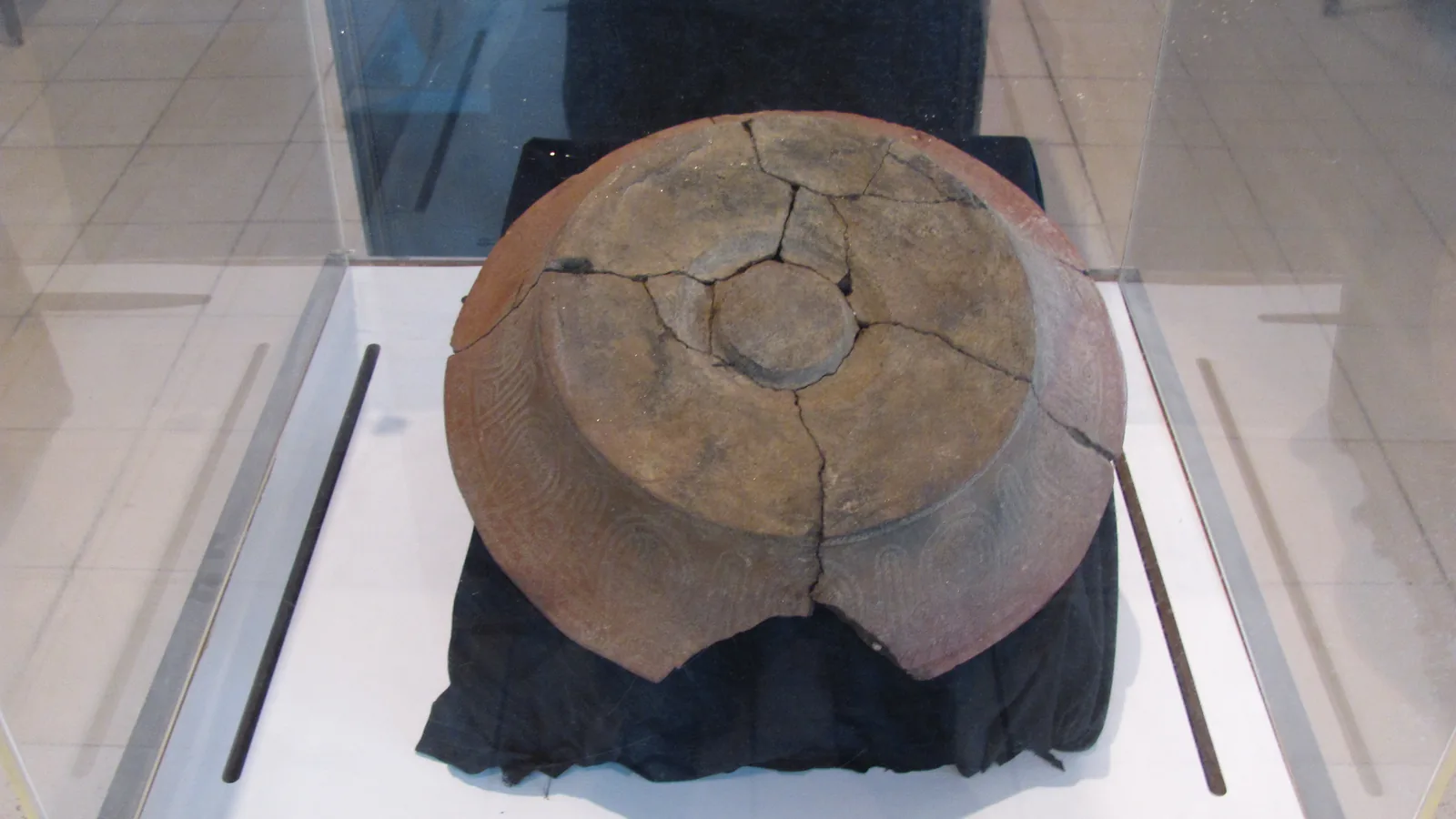
At about 70 centimeters down, Kirch’s team reached “a concentrated deposit of large, unweathered sherds, nearly half of them carrying classic dentate-stamped Lapita decoration.” There the sand began to meet the tidally fluctuating contact with the brackish Ghyben-Herzberg aquifer. Beside the sherds lay “abundant large obsidian flakes, two whole Conus-shell rings, a small Conus-shell bead, and a perforated pig-tusk pendant.” What the excavators first took for a rotten tree root turned out, as digging went on, to be increasingly well-preserved wood. On August 28, 1985, timed to a low tide, the team exposed “the worked base of a wooden post that had been set upright into the coral reef rubble,” 65 centimeters long with adze marks at its end. Kirch recorded that residents of Eloaua “saw the discovery of the preserved post as confirmation of an oral tradition that a special ‘haus matmat’ [burial house] had formerly stood in the area known to them as Talepakemalai.”
Pottery, obsidian and shell from one layer
The 2022 Terra Australis chapter reports that obsidian recovered across the Mussau sites came from two sources, Lou and Talasea, both in the Bismarck Archipelago. Petrographic analysis of pottery temper found grains of clinopyroxene with “a relatively strong colouration,” which the authors trace to the Tabar-Lihir-Tanga-Feni island chain. A separate chemical analysis of 172 sherds by Hunt in 1989, cited in the same chapter, sorted the material into 16 compositional groups; some matched Hus and M’Buke clays from the Admiralty Islands, while others came from sources the authors call exotic to Mussau and still unidentified. The chapter’s petrographic survey traces incoming pottery to the Admiralty Islands, northern and central New Britain, and northern and southwestern New Ireland, with no evidence of imports from southern New Britain or the New Guinea coast. Kirch’s 1988 paper in Radiocarbon, written with Terry Hunt, describes long-distance transport of obsidian and other exotic materials across the wider Lapita cultural complex “over distances of up to 3700km,” a figure drawn from the whole network of Lapita sites rather than from Mussau alone.

"A complex of pole-supported structures"
The excavated stilt house in Area B, Kirch wrote, “was just one of a complex of pole-supported structures that extended over a zone some 100 m from the original shoreline.” The 2022 chapter’s radiocarbon summary, drawing on AMS dates calibrated by Kirch in 2021, gives Emananus Island’s Etapakengaroasa as the earliest Lapita site in the Mussau group, established no later than 3350 to 3325 cal BP. The main stilt-house occupation at Area B and its extension dates to about 3200 to 2950 cal BP, and a later Lapita phase further along the excavated transect began between 3154 and 2970 cal BP and ended between 2778 and 2492 cal BP. The chapter reports that unweathered sherds from these layers allowed the reconstruction of around 260 vessels.
Descendants and a 1997 book
A 2018 genetic study in Molecular Biology and Evolution, by Irina Pugach and colleagues, found that residents of some small islands in the region, including Manus and Mussau, “do not follow” the ancestry pattern typical of nearby New Britain coastal populations; about a third of their ancestry traces to a Polynesian-related component. The study concerns people living in the region today and is separate from the archaeological record at Talepakemalai. Kirch later summarized the culture his excavation had helped define in The Lapita Peoples: Ancestors of the Oceanic World, published by Wiley-Blackwell in 1997 and described in its Ulukau library listing as an account of “the common ancestor of the Polynesians, Micronesians, and Austronesian-speaking Melanesians.”
Key facts
- In August 1985 Patrick Kirch began excavating at Talepakemalai on Eloaua Island, in the Mussau Islands of Papua New Guinea, and returned for further seasons in 1986 and 1988 (Chiu et al., ANU Press, 2022).
- At about 70 centimeters down, excavators found dense dentate-stamped pottery beside large obsidian flakes, two Conus-shell rings, a shell bead and a perforated pig-tusk pendant (Kirch, UCLA Cotsen Institute).
- On August 28, 1985, the team exposed the worked base of a wooden post, 65 centimeters long with adze marks, set upright into coral reef rubble (Kirch, UCLA Cotsen Institute).
- Eloaua Island residents linked the find to an oral tradition that a “haus matmat,” or burial house, had once stood at Talepakemalai (Kirch, UCLA Cotsen Institute).
- The 2022 Terra Australis chapter puts the ECA site at up to 82,000 square meters, calling it the largest Lapita village site on record (Chiu et al., 2022).
- Obsidian at the site came from the Lou and Talasea sources, and a 1989 chemical analysis traced some pottery clays to the Admiralty Islands (Chiu et al., 2022).
- Radiocarbon dates published in 2022 place the main stilt-house occupation at Area B at about 3200 to 2950 cal BP (Kirch 2021, cited in Chiu et al., 2022).
- A 2018 study in Molecular Biology and Evolution found that some Mussau and Manus islanders carry about a third Polynesian-related ancestry, unlike most of their region (Pugach et al., 2018).
FAQ
What did excavators find in the waterlogged layer at Talepakemalai?
Dentate-stamped pottery, large obsidian flakes, Conus-shell rings and beads, a perforated pig-tusk pendant, and the worked base of a wooden stilt-house post, all preserved by contact with the site's brackish-water aquifer, according to Patrick Kirch's excavation account published by the UCLA Cotsen Institute of Archaeology.
How old is the stilt-house occupation at Talepakemalai?
The 2022 Terra Australis chapter by Chiu and colleagues, using AMS radiocarbon dates calibrated by Kirch in 2021, places the main occupation of the Area B stilt house at about 3200 to 2950 cal BP.
Where did the obsidian found at Talepakemalai come from?
The 2022 Terra Australis chapter reports two sources, Lou and Talasea, both within the Bismarck Archipelago.
Sources
- Patrick V. Kirch, Talepakemalai: Lapita and Its Transformations in the Mussau Islands of Near Oceania (UCLA Cotsen Institute of Archaeology Press, Monumenta Archaeologica 47, 2021), "Excavation Objectives and Strategy" chapter, Digital Information Gateway.
- Scarlett Chiu, Yuyin Su, David Killick, Patrick Kirch, Glenn R. Summerhayes, Jim Specht and Wallace Ambrose, "Understanding social connections within the Bismarck Archipelago through petrographic and motif analyses of Mussau Lapita pottery assemblages," ch. 6 in Forty Years in the South Seas: Papers in Honour of Val Attenbrow, Terra Australis 57 (ANU Press, 2022).
- Patrick V. Kirch and Terry L. Hunt, "Radiocarbon Dates from the Mussau Islands and the Lapita Colonization of the Southwestern Pacific," Radiocarbon 30(2) (Cambridge University Press, 1988), pp. 161-169.
- I. Pugach, A. T. Duggan, D. A. Merriwether, F. R. Friedlaender, J. S. Friedlaender and M. Stoneking, "The Gateway from Near into Remote Oceania: New Insights from Genome-Wide Data," Molecular Biology and Evolution 35(4) (2018), pp. 871-886, PubMed Central.
- Patrick V. Kirch, The Lapita Peoples: Ancestors of the Oceanic World (Wiley/Blackwell, 1997), publisher description, Ulukau digital library of Hawaiian and Pacific literature.
Cite this article
- APA
- LETTER. (2026, September 28). Stilt posts in a lagoon: the Lapita village at Talepakemalai, Mussau. Our Earth's History. https://ourearthshistory.com/oceania/ancient/talepakemalai-mussau-lapita-stilt-village-kirch-excavation/
- Chicago
- LETTER. “Stilt posts in a lagoon: the Lapita village at Talepakemalai, Mussau.” Our Earth's History, September 28, 2026. https://ourearthshistory.com/oceania/ancient/talepakemalai-mussau-lapita-stilt-village-kirch-excavation/.
- MLA
- LETTER. “Stilt posts in a lagoon: the Lapita village at Talepakemalai, Mussau.” Our Earth's History, 28 Sep. 2026, https://ourearthshistory.com/oceania/ancient/talepakemalai-mussau-lapita-stilt-village-kirch-excavation/.
Text licensed CC BY-NC-ND 4.0. Found an error? Tell us.